
Sales teams do not lose deals due to lack of skill in Salesforce lead generation. More often, they lose opportunities because they are forced to decide which leads to prioritize while the CRM fills with prospects that appear active but show little real intent.
AI lead generation shifts this from guesswork to data-backed decisions. Modern lead generation software uses ai tools for lead generation to study conversion behavior, identify patterns, and trigger automated actions. Salesforce AI lead generation combines predictive analytics with real-time engagement signals, helping teams prioritize the right leads and move faster through the sales process.
In this blog, we explain how AI-driven lead scoring improves pipeline performance and helps teams focus on opportunities that are more likely to convert..
The problem with traditional lead scoring in sales pipelines
Traditional lead scoring often creates more inefficiencies than value. Many sales teams still depend on manual processes that reduce productivity and lead to inconsistent outcomes.
Manual prioritization wastes sales rep time
Sales teams spend a significant amount of time manually sorting and prioritizing leads. This effort directly takes away from time that should be spent on selling. Instead of engaging with high-potential prospects, reps rely on spreadsheets and subjective judgment to decide who to contact first. The issue becomes more serious when you consider how these decisions are made. A large portion of sales reps rely on instinct rather than actual data. Factors like geography, company size, or even list order influence outreach, even though they do not reflect real buying intent. Manual follow-up also slows everything down. Delayed response times reduce the chances of conversion, especially when faster competitors engage first. When qualification depends on manual effort, speed becomes a major limitation.
Over time, decision fatigue adds to the problem. As reps handle more leads, their ability to evaluate them consistently declines. This leads to unpredictable outcomes where similar leads are treated differently, making it difficult to refine or improve the scoring process.
Inconsistent scoring across team members
When different sales reps evaluate the same lead, results often vary. One rep may see early research as a strong signal, while another may treat it as low intent. This inconsistency comes from relying on personal judgment instead of standardized criteria. As a result, teams spend time on leads that may never convert while missing better opportunities. Manual scoring models are prone to bias and errors because they depend on human interpretation and fixed scoring rules.
Alignment between sales and marketing further complicates the process. Many organizations do not have a shared definition of a qualified lead, leading to misalignment and inefficient handoffs. Marketing may pass leads that sales teams are not ready to pursue, creating friction and slowing down pipeline progress. Low conversion rates reflect this gap. A small percentage of leads move forward in the funnel, largely because teams spend time on prospects that do not match real buying intent.
Outdated lead data reduces accuracy
Poor data quality weakens even well-designed scoring systems. Many teams work with incomplete, outdated, or incorrect lead data, which disrupts workflows and reduces effectiveness. The impact is significant. Sales teams often pursue contacts who are no longer relevant, lack decision authority, or are not actively interested. This results in wasted effort and missed opportunities. Data becomes outdated quickly. Job roles change, business priorities shift, and engagement signals lose relevance over time. Relying on static information, such as a past download or job title, does not reflect current intent.
Contact accuracy is another challenge. Incorrect details lead to poor outreach experiences, making communication feel generic or misaligned. Many reps also begin conversations without enough context, which affects engagement quality.
Without reliable and up-to-date data, Salesforce lead generation efforts become inefficient, leaving teams with low confidence in their pipeline and limited ability to prioritize effectively.
What is Agentforce and how does it use AI for lead scoring
Agentforce is an enterprise AI platform designed to connect people, applications, data, and AI agents to automate Salesforce lead generation. It works within your existing systems, allowing organizations to deploy AI-driven workflows across CRM data and integrations without rebuilding their current setup.
AI-powered predictive analytics for lead qualification
Agentforce uses the Atlas Reasoning Engine to drive autonomous decision-making. It interprets intent, identifies what data is needed, and determines the next actions required to complete a task. These actions are then executed automatically, reducing the need for manual intervention. Predictive analytics models calculate the likelihood of conversion using historical data and machine learning. Instead of relying on fixed scoring rules, the system evaluates multiple factors such as engagement behavior, demographic and firmographic data, and past conversion trends.
Lead scoring updates dynamically as new signals appear. For example, repeated visits to high-intent pages or deeper engagement with content can increase a lead’s priority. Over time, the models improve as they learn from new data, adjusting weightings based on patterns that consistently lead to conversions.
Integration with Salesforce and existing CRM systems
Agentforce integrates directly with Salesforce Customer 360, allowing agents to access and act on complete customer data across sales, service, marketing, and commerce workflows. This enables actions like identifying upsell opportunities or generating targeted outreach based on real-time engagement. Through Data 360, the platform accesses real-time information without duplicating data. Agents can work with both structured and unstructured data sources, including CRM records, knowledge bases, and external systems, ensuring decisions are based on the latest available context.
Real-time lead enrichment and data validation
Agentforce continuously improves data quality by validating and enriching records in the background. It removes duplicates, corrects inconsistencies, and fills missing details to maintain reliable lead profiles. As new data points are added through interactions or external sources, lead scores update instantly. This ensures that prioritization reflects current behavior and not outdated information.
Automated workflows that trigger next actions
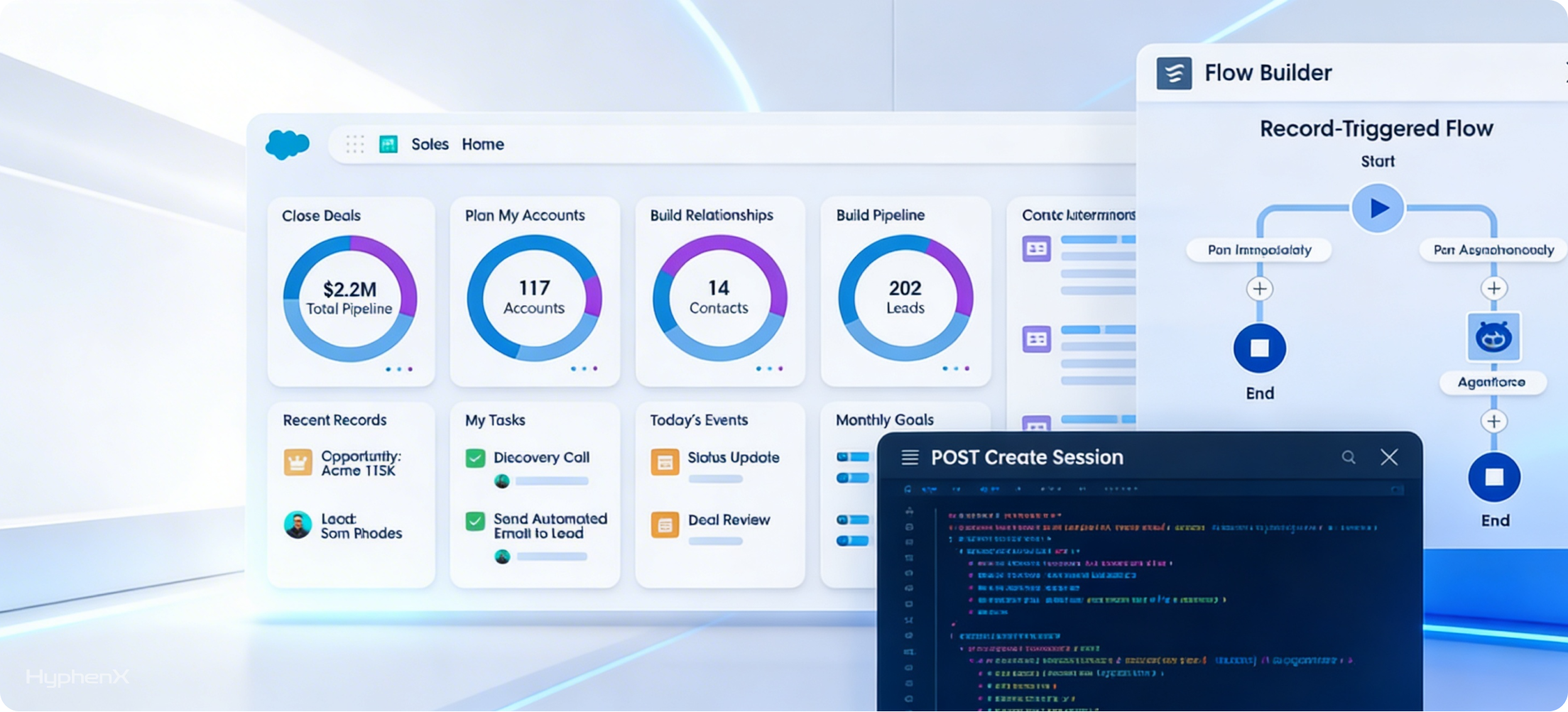
Using Agent Builder and Flow, teams can automate actions across different systems. Agents can trigger processes such as assigning leads, updating records, or escalating tasks based on defined conditions. Security and governance are maintained through the Einstein Trust Layer, which enforces safeguards like data protection, controlled responses, and policy-based behavior. These controls ensure that automation remains reliable and aligned with organizational standards.
How AI lead generation software increases pipeline performance by 40%

Machine learning does more than improve how leads are scored. It directly improves pipeline 7performance by increasing efficiency, accuracy, and speed across the sales process.
Better lead qualification saves rep hours
prospects early in the process. This allows teams to focus on leads with a higher chance of conversion.
Core improvements:
- Reduces time spent per lead through automated data processing
- Filters out poor-fit leads before they reach sales teams
- Frees up rep capacity to focus on high-value opportunities
- Identifies hidden buying signals across behavior and engagement data
- Processes multiple factors simultaneously, including intent, timing, and engagement patterns
Higher conversion rates from improved targeting
AI scoring improves targeting accuracy, which leads to stronger conversion performance across the funnel. Leads are prioritized based on actual conversion likelihood rather than static rules.
Core improvements:
- Increases lead-to-deal conversion rates through better prioritization
- Uses historical data to identify high-value prospects more accurately
- Improves targeting precision compared to manual scoring methods
- Aligns sales efforts with leads showing real buying intent
- Continuously improves scoring accuracy as more data is processed
Reduced sales cycle length with faster routing
AI enables instant lead scoring and routing, helping teams respond faster and move opportunities through the pipeline more efficiently.
Core improvements:
- Shortens sales cycles by accelerating lead response times
- Routes leads to the right reps immediately based on priority
- Reduces delays caused by manual qualification processes
- Improves first-response speed, increasing chances of conversion
- Ensures high-intent leads are acted on without delay
More accurate forecasting with AI predictions
AI scoring provides a clearer view of pipeline quality, helping teams forecast outcomes with greater confidence.
Core improvements:
- Links lead scores directly to probability of closing
- Improves forecast accuracy using data-backed predictions
- Helps managers assess pipeline health more reliably
- Enables better planning based on realistic conversion expectations
Consistent scoring eliminates bias and guesswork
AI applies the same criteria to every lead, removing inconsistencies caused by human judgment and creating a more reliable qualification process.
Core improvements:
- Standardizes lead evaluation across the entire team
- Removes bias from manual decision-making
- Ensures consistent prioritization regardless of volume
- Improves trust in scoring by using objective data signals
- Strengthens overall lead prioritization and pipeline quality
Key features that make Agentforce effective for sales teams
Several core capabilities distinguish Agentforce from basic lead scoring tools. These features directly address key challenges such as lack of trust in AI decisions, slow response times, limited signal visibility, and weak targeting accuracy that sales teams often face.
Explainable AI scoring that reps can understand
Traditional AI systems often operate without transparency, making it difficult for teams to trust their outputs. Agentforce uses Explainable AI (XAI) to clearly show how each score is calculated, breaking down the contribution of different factors in a structured way. Instead of only displaying a probability score, the system highlights the impact of elements such as company size, industry alignment, engagement level, budget signals, and timing. This allows sales teams to understand not just the outcome but the reasoning behind it.
In addition, counterfactual insights explain how outcomes can change. For example, the system may indicate that improving a specific factor, such as engagement or budget alignment, could increase the likelihood of conversion. This level of visibility builds confidence and encourages adoption, as teams are more likely to act on insights they can clearly interpret.
Speed-to-lead enforcement with SLA tracking
Agentforce integrates SLA tracking directly into sales workflows, ensuring that leads are followed up within defined timeframes. The system monitors response times continuously and triggers alerts or reassignment actions when thresholds are exceeded.
This creates accountability by assigning clear ownership to each lead and providing real-time visibility into response performance. SLA timers within Salesforce help teams track deadlines, while automated rules ensure no lead is left unattended. By reducing response times from hours to minutes, organizations can engage prospects when interest is highest. Faster response improves conversion rates and helps teams maintain a consistent follow-up process without relying on manual tracking.
Multi-channel engagement signals and intent data
Agentforce captures intent signals from multiple channels to understand how actively a lead is researching solutions. It analyzes behavior across websites, content platforms, review portals, and other digital touchpoints to build a more complete picture of buyer intent.
AI processes this data by grouping interactions into meaningful patterns, identifying which topics a prospect is exploring and how frequently they engage. This helps sales teams identify leads that are actively evaluating solutions rather than those showing passive interest. As a result, prioritization becomes more accurate, and outreach can be aligned with the prospect’s current stage in the buying journey.
Dynamic lead grading based on ICP fit
Agentforce uses machine learning to evaluate how closely each lead matches your Ideal Customer Profile (ICP). It analyzes firmographic, technographic, and geographic attributes to identify patterns associated with successful deals. Leads are then graded based on their fit, typically using a structured scale. Higher-fit leads receive greater priority, allowing teams to focus on accounts that are more likely to convert and deliver long-term value.
This dynamic grading adapts over time as the system learns from new data, ensuring that targeting remains aligned with evolving business goals and market conditions.
Getting started with AI-driven lead scoring

Implementation begins with a clear understanding of your current process before introducing AI tools for lead generation. A structured approach ensures better accuracy, smoother adoption, and more reliable outcomes.
Audit your current lead scoring process
Start by mapping how leads move through your organization from entry to conversion. Identify weekly and monthly lead volumes to understand scale requirements and capacity planning.
Measure conversion rates at each stage of the funnel to establish baseline performance metrics. Evaluate response times to understand how quickly your team engages with new leads, as speed directly affects outcomes.
Also review CRM data quality, including completeness and accuracy, since reliable data is essential for effective AI predictions. For initial model training, ensure you have a balanced dataset with both converted and non-converted leads so the system can learn meaningful patterns.
Clean and standardize your CRM data
Data quality directly impacts the effectiveness of Salesforce AI lead generation. Since CRM data naturally degrades over time, regular cleanup is necessary before implementing AI-driven scoring. Remove duplicate records that distort lead counts and create confusion. Fill missing fields using enrichment tools to ensure each lead profile contains key information such as company details and contact attributes.
Standardize formats for fields like company name, job title, and industry classification. Consistency helps AI models recognize patterns more accurately and improves overall scoring reliability.
Set up scoring thresholds for different sales motions
Define clear scoring ranges to guide how leads are handled at different stages of the funnel. These thresholds help align sales and marketing efforts and ensure consistent follow-up actions.
Typical scoring ranges include:
- Hot Leads (70–100 points): High-intent prospects ready for immediate sales engagement
- Warm Leads (40–69 points): Moderately engaged leads that require nurturing and follow-up
- Cold Leads (0–39 points): Early-stage prospects that need awareness and educational content
These categories help teams prioritize effectively and allocate effort based on conversion potential.
Monitor and optimize based on conversion outcomes
After implementation, continuously track performance to refine your scoring model. Monitor lead-to-MQL conversion rates and compare them against baseline metrics to measure improvement. Conduct regular reviews to evaluate lead-to-opportunity conversion, source performance, and overall pipeline quality. Use these insights to adjust scoring logic, improve targeting, and ensure the system stays aligned with actual business outcomes.
Your hottest leads deserve certified Agentforce hands
Scoring leads is easy. Scoring them right is where pipelines grow. We hold 250+ Salesforce certifications across our delivery and consulting roles, and the ones that matter here are Agentforce Specialist and Sales Cloud Consultant. Need this expertise inside your own team? Through our Salesforce staff augmentation services, you can bring these same certified professionals on board quickly. Your best deals rise to the top, automatically. Curious about the people behind the badges? Meet the HyphenX team.
Conclusion
AI-driven lead scoring replaces the guesswork that often slows down sales teams and reduces productivity. As shown, Agentforce removes manual prioritization, brings consistency to lead qualification, and uses predictive analytics to improve pipeline performance by up to 40%.
The impact is clear. Teams respond faster, convert more leads, and move deals through the pipeline in less time. These improvements come from shifting away from instinct-based decisions toward data-driven prioritization. Start by reviewing your current process and improving CRM data quality. Once you have a reliable foundation, define scoring thresholds that align with your sales approach. This allows your team to focus less on sorting leads and more on engaging prospects that are more likely to convert.