
Choosing a Salesforce consulting partner affects far more than the initial CRM rollout. The partner you bring in will influence how Salesforce fits into your daily operations, how reliable your reporting becomes, how well your teams actually use the platform, and how prepared your business is for automation, Data Cloud, AI workflows, and long-term scaling in 2026 and beyond.
A lot of businesses move too quickly during Salesforce partner selection. They compare certifications, timelines, or pricing before evaluating how the partner thinks about workflows, integrations, user adoption, governance, and data quality. That usually creates problems later: disconnected automation, messy customer records, weak reporting visibility, low platform adoption, or expensive rework after go-live.
This guide breaks down how to choose the right Salesforce consulting partner using a more practical evaluation approach. You’ll learn what to assess, which Salesforce partner red flags to watch for, what questions to ask during discovery calls, and how to identify a Salesforce implementation partner that can support both immediate project goals and long-term business growth. HyphenX, for example, often works with businesses that need deeper Salesforce consulting services around integrations, customization, reporting structure, AI readiness, and ongoing CRM improvement after the initial implementation phase.
Why Choosing the Right Salesforce Consulting Partner Matters
Salesforce can improve how a business sells, serves customers, manages data, and tracks performance. But the result depends heavily on the Salesforce consulting partner behind the work. A strong partner studies how your teams operate, where data breaks, which systems need to connect, and what business outcomes Salesforce should support before making recommendations. That is where HyphenX brings a stronger consulting lens, because the focus stays on practical CRM planning, cleaner execution, and long-term platform value.
Salesforce projects fail when strategy is weak
Salesforce projects usually struggle when planning is rushed. Discovery may be too shallow. Workflows may be copied from old systems without review. Data migration may be handled late. Configuration may be pushed forward just to meet a go-live date. When that happens, the platform starts working against the team. Fields don’t match real sales or service processes. Automation breaks in everyday scenarios. Reports fail to reflect the actual pipeline. Then users lose trust, and adoption drops.
A serious Salesforce consulting partner prevents this by treating discovery as the base of the project. HyphenX looks at business process, user roles, reporting needs, data quality, and integration points before recommending how Salesforce should be built.
The right partner connects Salesforce with business outcomes
A good Salesforce partner links every decision to a business result. Faster lead follow-up, shorter case resolution time, better pipeline visibility, cleaner forecasting, and stronger customer segmentation should all connect back to how Salesforce is configured. That approach makes the CRM easier to trust and easier to use. As a result, teams don’t feel like Salesforce is extra admin work. They see it as part of how daily work gets done.
Salesforce is now connected to data, AI, and automation
Salesforce consulting in 2026 goes far beyond basic CRM setup. Businesses now need partners who understand Data Cloud, Agentforce, Flow automation, AI readiness, MuleSoft integrations, governance, and connected customer journeys.
The wrong Salesforce consulting partner can cause:
- Misaligned configurations that don’t match real business processes
- Poor data quality that weakens reporting and AI readiness
- Low user adoption because workflows feel confusing or forced
- Integration gaps that leave customer data scattered across systems
- Extra costs from rework, fixes, and delayed improvements after launch
- A Salesforce setup that becomes harder to scale as the business grows
Start With Your Business Needs Before Shortlisting Salesforce Partners

Most guides on choosing a Salesforce consulting partner begin with partner selection criteria. That is the wrong place to start. Before reaching out to any Salesforce consulting company, a business must first define its own situation clearly.
Identify the Salesforce Problem You Need to Solve
Are you starting a fresh Salesforce implementation? Migrating from another CRM? Fixing a poorly configured existing instance? Adding a new cloud to your current setup? Improving integrations with your ERP or marketing platform? Each of these scenarios requires a different type of partner expertise. Knowing what problem you are actually solving helps you ask better questions and evaluate partners against the right criteria.
Map the Salesforce Clouds and Systems Involved
Different partners carry different product specializations. If your project involves Sales Cloud and a CPQ implementation, you need a partner with CPQ-specific experience, not just a general Salesforce partner. If the project touches Marketing Cloud, Service Cloud, or Experience Cloud, those products have their own configuration complexity. Similarly, understanding which third-party systems need to connect to Salesforce, whether that is an ERP, a finance platform, a customer support tool, or a marketing automation system, directly shapes who is the right consulting fit.
Define What Success Should Look Like
Vague goals produce vague outcomes. Before any partner conversation, define what success looks like in measurable terms. Is it a target adoption rate among sales reps? Faster average case resolution time in support? Cleaner lead attribution data? Improved revenue reporting? Reduced time-to-quote? These metrics give a partner something to design toward, and they give you something to measure the engagement against.
Start with your business needs before shortlisting Salesforce partners
The best Salesforce partner selection process begins inside the business. Before comparing agencies, certifications, or proposals, you need a clear view of what Salesforce is expected to fix, connect, or improve. This makes every partner conversation sharper because you’re no longer asking, “Can you do Salesforce?” You’re asking, “Can you solve this business problem with Salesforce?”
At HyphenX, our team usually starts here. We look at workflows, data issues, user roles, reporting gaps, integrations, and long-term CRM goals before recommending the right Salesforce consulting approach.
Identify the Salesforce problem you need to solve
Start by naming the actual problem. Are you planning a fresh Salesforce implementation? Moving from another CRM? Cleaning up a messy setup? Adding Service Cloud, Marketing Cloud, CPQ, or Data Cloud? Or fixing weak reporting and automation that teams no longer trust? Each situation needs a different Salesforce consultant selection criteria. A migration project needs strong data handling. A CPQ rollout needs pricing and quoting experience. An optimization project needs someone who can spot process gaps without rebuilding everything from scratch.
Map the Salesforce clouds and systems involved
Next, list the Salesforce products and external systems involved. Sales Cloud, Service Cloud, Marketing Cloud, Experience Cloud, CPQ, Data Cloud, ERP, finance tools, support platforms, and marketing automation systems all affect the scope. A good Salesforce consulting partner should understand how these systems connect, where data should move, and where governance is needed. That clarity helps avoid weak integrations and disconnected customer records later.
Define what success should look like
Clear goals make the project easier to measure. Success may mean faster lead follow-ups, cleaner pipeline reporting, shorter case resolution time, better adoption, improved segmentation, or reduced time-to-quote.
Before You Speak to a Salesforce Consulting Partner, Clarify These Points:
- What are the current pain points with your CRM or sales and service workflows?
- What business goals are you trying to achieve with Salesforce?
- Which Salesforce clouds or products are involved in this project?
- What data sources need to be connected or migrated?
- What third-party systems need to integrate with Salesforce?
- Which teams and user groups will be affected?
- What is your budget range and flexibility?
- What is the realistic project timeline?
- How will you measure the success of this project?
- What level of post-launch support do you need?
Core criteria for evaluating a Salesforce consulting partner
This is where Salesforce partner evaluation gets serious. Once your business needs are clear, the next step is to judge whether a Salesforce consulting partner can actually handle the work in front of them. A good proposal may sound polished, but the real proof sits in their certifications, discovery process, data handling, integration depth, adoption planning, and support model.
At HyphenX, we treat this stage as a fit check, not a sales formality. Our team looks at the business problem first, then maps the right Salesforce consulting services around the systems, users, data, and outcomes involved.
Relevant Salesforce certifications and product expertise
Salesforce certifications matter, but they need to match your project. A certified Salesforce partner with Sales Cloud strength may still be the wrong fit for a Service Cloud, CPQ, Data Cloud, or Field Service project. Ask which Salesforce consultant, architect, developer, or administrator will actually work on your implementation. Team-level clarity matters more than a large certification count on a company profile.
Industry experience and similar use cases
A Salesforce partner with industry experience can move faster because they already understand common workflows, reporting needs, compliance concerns, and integration patterns. For example, a SaaS sales process, healthcare service model, manufacturing workflow, and financial services operation all need different Salesforce decisions. Ask for similar use cases, project examples, and references from businesses with comparable operating models.
Discovery and solution architecture process
Strong partners don’t finalize scope after one basic call. They ask about workflows, user roles, permissions, data structure, reporting needs, integrations, automation, and change management before recommending a solution. That early work protects the project from weak estimates, missed requirements, and avoidable rework after go-live.
Data migration, integration, and governance capability
Data quality can make or break Salesforce performance. A serious Salesforce implementation partner should explain how they handle data assessment, field mapping, deduplication, validation, migration, access control, and governance. Integration experience matters just as much. Salesforce often needs to connect with ERP, finance, marketing, support, or analytics tools. Weak planning here can leave teams dealing with duplicate work and disconnected records.
Training, adoption, and change management support
A Salesforce setup only works when people use it correctly. So, evaluate how the partner handles role-based training, user documentation, adoption tracking, feedback, and post-launch improvement. Our consultants build adoption planning into the project early so teams understand the system, trust the data, and know how Salesforce supports their daily work.
Salesforce consulting partner evaluation scorecard
| Evaluation Area | What to Check | Strong Partner Signal | Red Flag |
|---|---|---|---|
| Certifications | Project-team certifications | Skills match your cloud and scope | Only company-level cert claims |
| Industry experience | Similar clients and workflows | Relevant use cases and references | Generic CRM examples only |
| Discovery process | Depth before proposal | Workshops, workflow review, clear scope | Proposal after 1 shallow call |
| Data migration | Audit, mapping, cleanup | Clear migration and validation plan | Migration treated as simple export |
| Integrations | Third-party system experience | ERP, finance, support, or API clarity | Vague answers about connections |
| AI readiness | Data Cloud and Agentforce fit | Data readiness and governance thinking | No AI or data platform discussion |
| Training | User enablement plan | Role-based training and documentation | One session at go-live |
| Support | Hypercare and improvement plan | Defined SLAs and support path | No clear post-launch model |
| Communication | Updates and ownership | Clear cadence and project contacts | No governance structure |
| Pricing | Scope and change requests | Itemized estimate and assumptions | Vague pricing with no breakdown |
Salesforce consulting partner checklist: questions to ask before you hire
A Salesforce consulting partner checklist helps you move beyond polished sales calls and understand how a partner actually works. The right questions reveal their thinking, delivery discipline, data maturity, and support model before you commit budget. Our team at HyphenX encourages businesses to ask these questions early because they expose gaps that a proposal may hide.
Strategy and discovery questions
How do you understand our business workflows before recommending a solution? A strong answer should include stakeholder discussions, process mapping, current CRM review, and workflow documentation.
What information do you need before finalizing the project scope? Look for specifics such as user count, data volume, integration needs, reporting gaps, automation requirements, and business priorities.
How do you define success for a Salesforce project? A reliable Salesforce consulting partner should connect success to adoption, cleaner reporting, faster follow-ups, shorter case resolution, or other measurable outcomes.
How do you prevent unnecessary customization? Good partners explain when standard Salesforce configuration is enough and when custom development is genuinely needed.
Technical and delivery questions
Which Salesforce clouds does your delivery team specialize in? The answer should match your project, whether it involves Sales Cloud, Service Cloud, CPQ, Experience Cloud, Data Cloud, or integrations.
How do you handle data migration and cleanup? Listen for a clear process covering data audit, field mapping, deduplication, testing, validation, and cutover planning.
How do you manage third-party integrations? Ask about ERP, finance, marketing, support, MuleSoft, middleware, APIs, monitoring, and failure handling after go-live.
How do you manage testing, documentation, and user acceptance? A mature Salesforce implementation partner should explain unit testing, system testing, UAT, signoff, and documentation clearly.
Support and long-term partnership questions
What happens after go-live? The answer should include hypercare, issue handling, training support, and a transition plan.
How do you track user adoption after launch? A serious partner should review usage patterns, process gaps, and feedback after teams start using Salesforce daily.
How do you handle change requests? Clear change control helps avoid surprise costs and scope confusion.
How do you support long-term Salesforce improvement? Salesforce should keep improving as the business grows. Ask how the partner supports releases, new features, AI readiness, and future CRM planning.
How AI, Data Cloud, and Agentforce change Salesforce partner selection in 2026

Salesforce partner selection in 2026 needs a sharper lens. Businesses are no longer choosing a Salesforce consulting partner only for CRM setup, reports, or workflow changes. AI, Data Cloud, Agentforce, automation, and connected customer data now affect how Salesforce should be planned from the start. So the right partner needs to understand data quality, governance, integrations, user workflows, and operational risk before recommending AI-driven features.
AI readiness starts with clean, connected data
Salesforce AI works only when the data behind it is usable. If customer records are duplicated, fields are incomplete, consent data is missing, or systems don’t share information properly, AI outputs become weak. A strong Salesforce AI consulting partner should assess data quality, ownership, access rules, and system connections before building AI workflows. At HyphenX, our consultants look at the data foundation first because poor data can damage reporting, automation, segmentation, and Agentforce performance later.
Data Cloud experience is becoming more important
Salesforce Data Cloud helps businesses connect customer data from multiple systems and create unified customer profiles. For companies managing sales, service, marketing, commerce, or support data across separate platforms, this has become a serious part of Salesforce planning. A capable Salesforce Data Cloud partner should understand data model design, identity resolution, consent rules, real-time activation, segmentation, and customer journey planning. That skill set is very different from basic Salesforce configuration.
Agentforce requires governance and workflow understanding
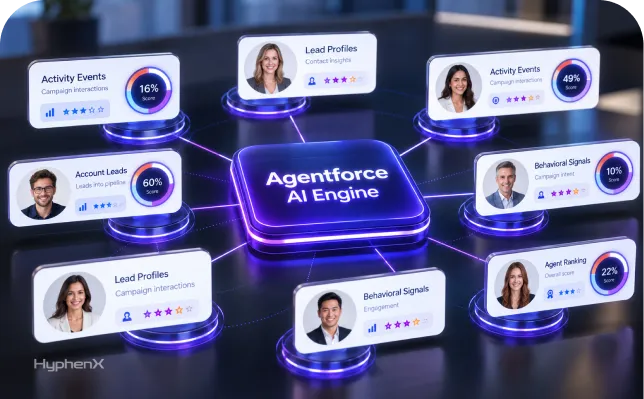
Agentforce can support AI agents that take actions inside Salesforce. But those actions need clear rules. The partner should define what agents can access, when they can act, when they should escalate, and how their activity will be monitored. Without governance, automation can create compliance issues, customer experience gaps, or internal confusion.
Choose a partner who can support the next 3 to 5 years
Salesforce keeps changing, and your business will change with it. A partner should be able to support current implementation needs as well as future phases involving Data Cloud, AI readiness, analytics, integrations, and new Salesforce products. Our team helps businesses plan Salesforce roadmaps that can grow beyond the first go-live.
Ask these AI-readiness questions before choosing a Salesforce consulting partner
- Can you assess our data quality for Salesforce AI?
- Have you worked with Salesforce Data Cloud?
- How do you plan governance for AI workflows?
- How do you reduce automation risk?
- Can you build a Salesforce roadmap for the next few years?
| Option | Best for | Limitations |
|---|---|---|
| Salesforce consulting partner | Multi-cloud projects, integrations, data migration, AI readiness, long-term planning | Higher cost for very small tasks |
| Freelance Salesforce consultant | Specific fixes, reports, automations, limited configuration | Harder to scale for complex projects |
| In-house Salesforce admin | Daily support, minor changes, user help, routine updates | May lack deep architecture, integration, or AI product expertise |
Conclusion
Choosing the right Salesforce consulting partner shapes how well your teams use Salesforce, how clean your data stays, how smoothly integrations run, and how ready your business is for AI, Data Cloud, and Agentforce. Strong partners bring business understanding, technical depth, clear discovery, honest pricing, adoption support, and post-launch guidance. As you compare options, focus on fit, relevant expertise, data quality, integration skill, AI readiness, and long-term support. For businesses that need practical help with planning, implementation, customization, integrations, or ongoing Salesforce improvement, our hire Salesforce consultant service at HyphenX can support each stage with the right consulting depth.