Many businesses buy Salesforce expecting growth to happen on its own. Real growth starts when Salesforce connects your sales pipeline, customer data, marketing journeys, service workflows, Salesforce automation, AI models, and leadership dashboards inside one working system. As a result, teams see the same customer, handoffs become cleaner, and decisions come from reliable data instead of guesswork. Without that connection, Salesforce can turn into a costly contact database. The gap usually comes from implementation quality, adoption, integration, and ongoing improvement. This blog explains how Salesforce drives business growth in practical terms and how HyphenX helps businesses shape Salesforce around measurable outcomes.
Beyond CRM: why Salesforce has become a business growth engine
Salesforce began as a cloud CRM, but its role has grown much bigger for companies that want cleaner revenue control. Today, it connects sales, service, marketing, customer data, automation, AI, and reporting in one working system. So, for leaders looking at Salesforce for business growth, the real value comes from how well the platform is planned, adopted, and tied to daily decisions.
From customer records to revenue visibility
Salesforce connects the full customer path: where a lead came from; how it moved through the pipeline; what the customer bought; which campaigns they engaged with; what support issues they raised; and whether they renewed or expanded. That connection turns scattered records into revenue visibility. Sales leaders can see pipeline health. Marketing teams can track campaigns against actual revenue. Service teams can review customer history before acting. Leadership can spot which segments are growing, slowing down, or at risk. And when this setup is planned well, Salesforce ROI becomes easier to measure because every team works from the same customer truth.
Why connected teams grow faster
Disconnected tools create quite revenue leaks. A sales rep may chase an account without knowing there’s an open support issue. A marketer may send a renewal offer while the customer is already speaking with sales. A service agent may close a case without seeing a possible upsell sitting in the pipeline. Salesforce reduces that gap by giving teams shared data, cleaner workflows, and better reporting. Through our Salesforce consulting services at HyphenX, we focus on building that connection early, so the platform supports growth instead of becoming another system teams have to manage.
Growth area | How Salesforce supports it | Business impact |
Sales growth | Lead tracking, pipeline views, forecasting | Faster deal movement |
Productivity | Automation, task routing, approvals | Less manual work |
Retention | Service Cloud, customer history, SLA tracking | Better customer experience |
Marketing ROI | Segments, journeys, campaign reports | Better conversion |
Decision-making | Dashboards, reports, AI insights | Faster leadership action |
AI readiness | Data Cloud, Agentforce, governed data | Smarter workflows |
How Salesforce improves sales, marketing, and customer experience together
Salesforce for business growth works best when the full customer lifecycle sits inside one connected system. A lead enters through marketing, moves into sales, becomes a customer, raises service requests, renews, and may later expand. When those moments are tracked in Salesforce, teams stop working from half-finished stories.
Sales Cloud helps revenue teams build cleaner pipelines
Sales Cloud gives revenue teams a clearer way to manage leads, accounts, opportunities, activities, and forecasts. Lead assignment rules help prospects reach the right rep faster. Opportunity stages give every salesperson the same pipeline language. Activity tracking shows what happened, what’s pending, and which deals need attention. So the sales process becomes easier to manage. Reps spend less time digging through email threads or spreadsheets. Managers get cleaner pipeline reviews. Leadership gets a sharper view of expected revenue, hiring needs, and sales capacity.
This is where Salesforce Sales Cloud supports real growth. It gives teams the structure to move deals forward with fewer blind spots and stronger follow-up discipline.
Marketing Cloud turns customer data into better campaigns
Marketing Cloud adds another layer to Salesforce business growth by connecting campaign activity with CRM data. Marketers can build segments using customer behavior, purchase history, engagement patterns, service issues, and lifecycle stage.
As a result, campaigns become more relevant. Journey Builder helps teams plan communication based on what a customer actually does, rather than sending the same message to every contact on a fixed schedule. The connection between Marketing Cloud and Sales Cloud matters even more. Marketing can see which campaigns create quality leads. Sales can see which touchpoints shaped the buying journey. Then, every campaign becomes easier to judge, refine, and connect with revenue.
Service Cloud protects retention and post-sale revenue
Growth does not end when a deal closes. Customer retention, renewals, referrals, and account expansion often decide whether Salesforce ROI becomes visible over time. Service Cloud helps support teams manage cases, track SLAs, review case history, use knowledge resources, and respond with better customer context. When a support agent can see the full account history, the response feels more informed. When escalations are tracked properly, problems can be handled before they damage the relationship. And when service data flows back into Salesforce, sales and account teams can spot at-risk customers earlier. They can also identify accounts that may be ready for renewal, expansion, or a deeper conversation.
At HyphenX, our Salesforce consulting approach focuses on connecting these teams properly, so Salesforce supports the full revenue cycle instead of one isolated department.
How data, automation, and AI make Salesforce a stronger growth system

This is where Salesforce CRM for business growth moves past the basics. Dashboards and pipeline views help, of course. But the deeper value comes when customer data is connected, workflows are automated, and AI has the right foundation to work from.
Salesforce now positions its platform around AI, data, CRM apps, and agents working together on one system. That matters because Salesforce AI CRM depends on clean data, clear workflows, and proper governance before it can support real business growth.
Salesforce Customer 360 gives teams a single view of the customer
Salesforce Customer 360 gives sales, marketing, service, and leadership teams a shared customer picture. Purchase history, support cases, campaign engagement, sales activity, account health, and open opportunities can sit together instead of being scattered across several tools. So every conversation becomes more informed. A sales rep can see a recent service issue before starting a renewal discussion. A service agent can understand account value, open opportunities, and previous communication before replying. As a result, the customer does not have to repeat the same story to every team.
That single view is one reason Salesforce business growth becomes easier to manage. Better context leads to better timing, cleaner follow-ups, and more useful decisions.
Salesforce automation reduces manual work and revenue leakage
Manual processes slow teams down and create inconsistency. A lead can sit untouched because nobody saw it. An approval can wait for days because it reached the wrong person. A renewal can slip because no reminder was set. Salesforce automation reduces these gaps through Flow, assignment logic, reminders, approval steps, alerts, and escalation paths. When these workflows are mapped around real business processes, response times improve and revenue-related tasks are less likely to fall through.
This is where Salesforce for business growth becomes practical. The system supports the work instead of relying on someone to remember every handoff, follow-up, and deadline.
Salesforce AI CRM, Data 360, and Agentforce create the next layer of growth
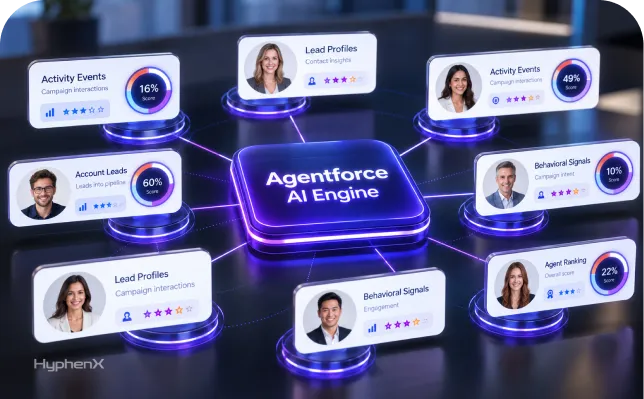
In 2026, Salesforce growth strategy is closely tied to Data 360, AI, and Agentforce. Salesforce describes Agentforce as its agentic CRM approach, where humans and AI agents work together across sales, service, and marketing. Data 360, previously known as Data Cloud, helps bring customer data into trusted profiles that AI tools can use more reliably. Agentforce then adds AI agents that can support customer queries, help employees find information, assist service workflows, and reduce repetitive work. But AI cannot fix messy CRM foundations. It reflects what the system already knows. If records are duplicated, fields are incomplete, ownership is unclear, or integrations are weak, AI output becomes weak too.
At HyphenX, we treat AI readiness as part of Salesforce implementation services from the start. Clean data, governed workflows, useful automation, and proper integration planning make Salesforce Agentforce and Data 360 far more useful for business growth.
Before Salesforce optimization | After Salesforce is strategically implemented |
Customer data is scattered across tools | Teams work from one customer view |
Leads are followed up inconsistently | Routing and reminders improve response speed |
Reports are prepared manually | Dashboards show live business performance |
Service issues are hard to track | Cases, SLAs, and escalations become visible |
AI use is limited by poor data | Data 360 and governance improve AI readiness |
Why Salesforce needs the right strategy to create growth
This part needs more attention because Salesforce can become powerful or painful depending on how it’s planned. The platform can support Salesforce business growth, but weak setup, poor adoption, messy data, and rushed integrations can limit that value very quickly.
Poor data quality weakens every Salesforce outcome
Bad data damages every decision built on Salesforce. Duplicate records, missing fields, inconsistent formats, and unclear ownership make reports unreliable. As a result, sales forecasts become shaky, marketing segments lose accuracy, and Salesforce AI CRM tools work with weak inputs. Clean data is a growth requirement. Without it, teams question dashboards instead of using them.
Weak adoption turns Salesforce into an expensive database
Salesforce ROI depends on daily usage. If sales reps track deals outside the platform, pipeline reports break. If service teams avoid case workflows, SLA tracking becomes unreliable. If marketing campaigns aren’t connected to CRM data, attribution turns into guesswork. So adoption has to be built into the system design. Salesforce should make the right action easier for users, not harder.
Over-customization and poor integration planning create long-term problems
Many Salesforce issues start with rushed choices. Too many custom fields, unclear workflows, weak architecture, and disconnected tools create technical debt that slows future growth.
Salesforce growth usually suffers when businesses ignore the following:
- Process mapping before configuration
- Clean data and ownership rules
- User adoption and training
- Reporting needs before go-live
- Integration planning across business tools
- Governance after launch
- Ongoing improvement cycles
Through our Salesforce consulting services, HyphenX helps businesses build stronger foundations early so Salesforce implementation, integration, and adoption support measurable growth without creating avoidable complexity later.
How to measure Salesforce ROI and business growth impact
Salesforce ROI becomes clearer when growth is tied to numbers, not opinions. The platform can track the metrics that matter across sales, marketing, service, and adoption. However, those numbers only become useful when fields, stages, workflows, and reporting logic are planned properly from the start.
Growth metrics Salesforce can help improve
KPI | What it shows | Why it matters for growth |
Lead conversion rate | How many leads become opportunities or customers | Shows lead quality and sales efficiency |
Sales cycle length | How quickly deals move | Helps find pipeline delays |
Win rate | Percentage of opportunities won | Measures sales performance |
Customer retention | How many customers stay | Shows relationship strength |
Case resolution time | How quickly issues are solved | Affects satisfaction and renewals |
Campaign ROI | Revenue connected to marketing activity | Shows which campaigns support growth |
Forecast accuracy | How reliable revenue predictions are | Helps leaders plan with confidence |
User adoption | How actively teams use Salesforce | Shows whether Salesforce is part of daily work |
Why reporting must be planned before implementation
Salesforce dashboards depend on the data behind them. If a company wants to track forecast accuracy by region, the right territory fields, deal stages, ownership rules, and forecast categories need to be ready early. So reporting cannot be treated as an afterthought. When KPIs are agreed before build, every configuration choice supports better measurement later. Six months after go-live, leadership can open a dashboard and trust what they see.
At HyphenX, our team connects Salesforce implementation services, customisation, dashboards, and ongoing improvement with measurable business outcomes, so the reporting layer grows with the operating layer from day one.
Building a Salesforce growth strategy that keeps scaling

A Salesforce launch is only the starting point. Real Salesforce business growth comes from how the platform is managed after teams begin using it every day. Processes change, customer data grows, reporting needs become sharper, and AI use cases become more practical. So the strategy has to keep moving with the business.
Match Salesforce Clouds to the business goal
Sales Cloud, Service Cloud, Marketing Cloud, Experience Cloud, Commerce Cloud, Data Cloud, and Agentforce all support different growth needs. A company struggling with slow lead follow-up may need a stronger Sales Cloud setup first. A business losing customers after purchase may need better service cloud workflows. Another team may need Data Cloud and Agentforce because scattered data is blocking AI readiness. The right Salesforce Cloud selection should come from the business problem. When the goal is clear, configuration, integrations, automation, and reporting become easier to plan. When the choice is made without that clarity, Salesforce can become too heavy, too expensive, and harder for teams to use.
Treat Salesforce as a long-term growth system
After go-live, Salesforce should keep improving. Teams will find manual tasks that can be automated. Leaders may need new dashboards. Integrations may need stronger controls. Data rules may need cleanup as records grow. And as Salesforce AI CRM becomes more useful, clean data becomes even more important.
A strong Salesforce growth strategy should include:
- Clear business goals before configuration begins
- Clean customer data with ownership rules
- Salesforce Cloud selection based on real objectives
- Salesforce automation mapped to actual workflows
- Integration planning across business tools
- Dashboards tied to leadership decisions
- User adoption planning and ongoing training
- Governance and improvement cycles after go-live
- AI readiness built through trusted data
At HyphenX, our Salesforce implementation and consulting approach keeps the platform practical for daily users while making room for future growth. That balance helps Salesforce support measurable outcomes instead of becoming another system teams work around.
Conclusion: Salesforce creates growth when strategy, data, AI, and adoption work together
How Salesforce drives business growth comes down to connection. When sales, marketing, service, customer data, Salesforce automation, AI, and reporting work inside one governed system, the business gets clearer visibility and better control. Pipeline reviews become more accurate. Campaigns become easier to measure. Service teams respond with better context. Retention improves because teams can see risk earlier. Leadership decisions become faster because the numbers are easier to trust.
But Salesforce needs the right foundation. Strong results come from clear strategy before configuration, clean data, workflows based on real business processes, dashboards tied to actual decisions, and users who rely on the platform every day. And after go-live, Salesforce should keep improving. Reporting needs change. AI readiness grows. Automation gaps appear. Customer expectations shift.
HyphenX helps businesses with Salesforce consulting, implementation, integration, and ongoing improvement, so the platform can support measurable Salesforce business growth instead of becoming another tool teams work around.