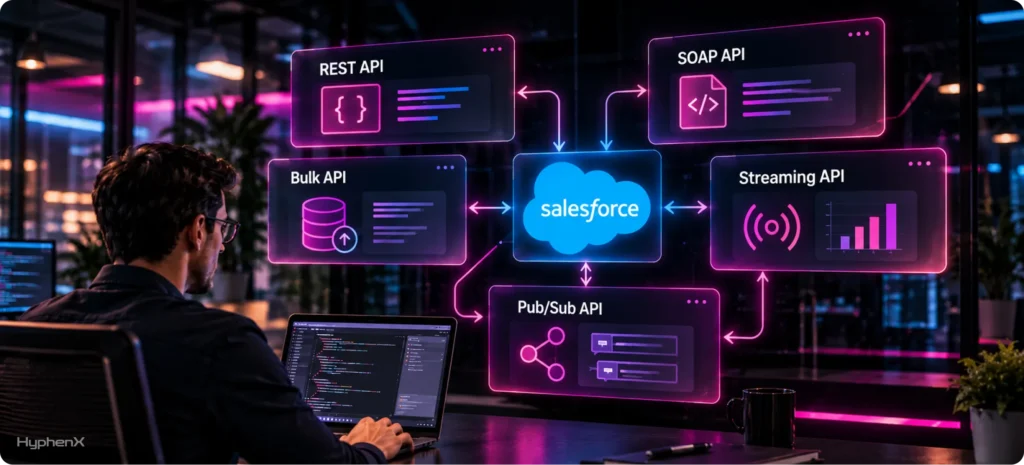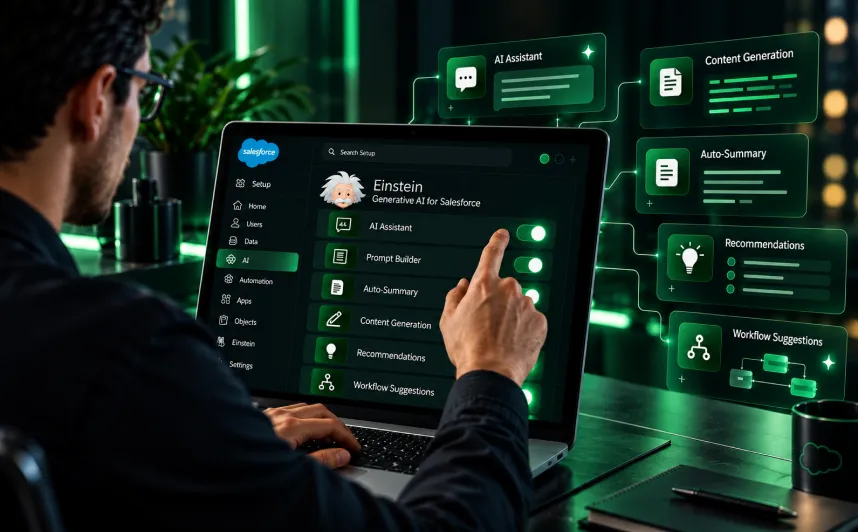



Hiring a Salesforce developer in 2026 is a far more strategic decision than it was 5 years ago. Salesforce now connects AI agents through Agentforce, customer data through Data Cloud, multi-cloud operations, Flow automation, APIs, and business-critical systems across the organization. So, hiring is no longer only about finding someone who can write Apex or configure Sales Cloud. It’s about choosing talent that understands Salesforce architecture, governance, automation, integrations, and long-term CRM growth. The wrong hire can create problems that surface months later: broken automations, weak metadata structure, poor documentation, unstable integrations, and technical debt that slows future scaling. Those fixes often cost more than building the system properly from the start.
This guide is built for CTOs, CRM managers, founders, operations leaders, and decision-makers comparing Salesforce developers in India and the USA. It gives you a practical framework to hire for where your business is heading, not just what Salesforce needs today.
Why Hiring Salesforce Developers Looks Very Different in 2026
Salesforce hiring has changed because the platform now supports deeper business operations, automation, AI, integrations, and customer data workflows. So, businesses need developers who understand technical execution and long-term CRM impact, not just basic configuration or coding.
The Shift From Simple CRM Setup to Enterprise Ecosystems
Salesforce hiring used to focus mainly on developers who could configure objects, write Apex code, create reports, and manage workflow automation. Those skills still matter. But modern Salesforce environments now operate very differently, especially for businesses managing multiple clouds, large automation layers, and enterprise integrations.
Today, Salesforce often sits at the center of business operations. Marketing Cloud supports customer journeys. Revenue Cloud manages CPQ and billing workflows. Service Cloud powers support operations. Data Cloud connects customer data across systems. At the same time, integrations, APIs, automation frameworks, and AI-driven workflows continue expanding across enterprise environments. Because of that, Salesforce developers are increasingly expected to think beyond technical execution and understand architecture, governance, scalability, and operational impact.
Why AI, Automation, and Data Complexity Changed Hiring Needs
Agentforce, Data Cloud, and advanced Flow automation have significantly changed what businesses expect from Salesforce developers in 2026. Developers are now building AI-assisted workflows, managing complex automation structures, and supporting integration-heavy systems that directly affect day-to-day operations. Flow automation has also evolved far beyond simple no-code workflows. Poorly designed automation can now create governor limit issues, deployment conflicts, reporting inconsistencies, and long-term technical debt. Businesses increasingly prioritize Salesforce developers who understand automation governance, DevOps practices, scalability planning, and integration stability instead of focusing only on feature delivery speed.
The Rising Demand for Developers Who Understand Business Processes
Businesses also expect Salesforce developers to understand operational workflows, not just platform syntax. Developers supporting revenue operations, customer service, or enterprise automation need to understand how those processes actually function. That business understanding often determines whether Salesforce solutions continue supporting growth or eventually become operational bottlenecks.
Traditional Salesforce Development vs. Modern Salesforce Ecosystem Development
Dimension | Traditional Development | Modern Salesforce Ecosystem Development |
Primary focus | CRM setup and Apex coding | Enterprise architecture, AI, Data Cloud |
Automation approach | Workflow rules and triggers | Flow governance, Agentforce, event-driven automation |
Integration depth | Basic API integrations | Enterprise integrations and middleware coordination |
Governance maturity | Manual deployments | DevOps pipelines and release planning |
AI readiness | Optional | Increasingly important |
Business alignment | Technical delivery | Process-focused solution design |
Data thinking | Object configuration | Unified customer data architecture |
Understanding What Type of Salesforce Developer Your Business Actually Needs

Choosing the right Salesforce professional has become far more important because Salesforce environments now involve automation, integrations, AI workflows, Data Cloud structures, and multi-cloud operations. Many businesses still group developers, consultants, architects, and admins under the same hiring category, which usually creates delivery gaps later.
Salesforce Developer vs. Consultant vs. Architect
A Salesforce developer mainly focuses on technical execution, including Apex development, Lightning Web Components, APIs, integrations, and automation workflows. A Salesforce consultant works more closely with business teams to translate operational requirements into CRM solutions while improving processes and user adoption. A Salesforce architect operates at a broader level and handles platform structure, integration planning, governance, scalability, security models, and long-term Salesforce strategy.
Many businesses hire developers when the actual challenge involves CRM process alignment or platform planning. Others bring in consultants while dealing with technical environments that genuinely require architectural oversight. Understanding the complexity of your Salesforce environment before hiring directly affects whether the person joining the project can support future business growth.
Skills That Matter Beyond Certifications
Salesforce certifications help validate platform familiarity, but they rarely confirm how developers handle real production environments. Businesses should evaluate how developers approach scalability, technical debt, deployment risk, automation governance, and integration planning.
A developer with multiple certifications but weak understanding of governor limits, Flow recursion, or deployment structure can still create long-term CRM instability. Strong Salesforce developers usually explain technical decisions clearly and think carefully about maintainability before building solutions.
Skills worth probing deeply during the hiring process:
- Apex development and trigger framework practices
- Lightning Web Component architecture and state management
- REST and SOAP API integrations
- Salesforce DevOps and CI/CD workflows
- Flow governance and automation planning
- Data modeling and migration strategy
- Security architecture and sharing models
When Businesses Need Specialized Salesforce Developers
Specialized Salesforce expertise matters much more in 2026 because many industries now operate highly customized Salesforce ecosystems.
Scenarios where specialization materially matters:
- Healthcare and Life Sciences, including Health Cloud and compliance workflows
- Financial Services environments with regulatory reporting requirements
- Manufacturing operations involving ERP and Field Service integrations
- High-growth SaaS businesses managing CPQ and subscription billing complexity
- Enterprise B2B organizations handling territory management and revenue operations
For businesses navigating complex Salesforce hiring decisions, experienced consulting partners like HyphenX can help identify the right Salesforce profile based on operational complexity, industry requirements, and long-term platform goals instead of hiring broadly and adjusting later.
Salesforce Role Comparison
Role | Primary Responsibility | Core Skills | When to Hire |
Salesforce Developer | Build custom functionality | Apex, LWC, APIs, Flow, integrations | Existing architecture and defined requirements |
Salesforce Consultant | Design CRM solutions | Process analysis, CRM strategy, stakeholder management | New implementations and optimization projects |
Salesforce Architect | Design platform structure | Security, integrations, scalability, DevOps | Enterprise and multi-cloud environments |
Salesforce Admin | Manage platform operations | Reporting, configuration, user support | Ongoing operational maintenance |
Skills That Matter Beyond Certifications
Salesforce certifications help validate platform familiarity, but they rarely confirm how developers handle real production environments. Businesses should evaluate how developers approach scalability, technical debt, deployment risk, automation governance, and integration planning.
A developer with multiple certifications but weak understanding of governor limits, Flow recursion, or deployment structure can still create long-term CRM instability. Strong Salesforce developers usually explain technical decisions clearly and think carefully about maintainability before building solutions.
Skills worth probing deeply during the hiring process:
- Apex development and trigger framework practices
- Lightning Web Component architecture and state management
- REST and SOAP API integrations
- Salesforce DevOps and CI/CD workflows
- Flow governance and automation planning
- Data modeling and migration strategy
- Security architecture and sharing models
When Businesses Need Specialized Salesforce Developers
Specialized Salesforce expertise matters much more in 2026 because many industries now operate highly customized Salesforce ecosystems.
Scenarios where specialization materially matters:
- Healthcare and Life Sciences, including Health Cloud and compliance workflows
- Financial Services environments with regulatory reporting requirements
- Manufacturing operations involving ERP and Field Service integrations
- High-growth SaaS businesses managing CPQ and subscription billing complexity
- Enterprise B2B organizations handling territory management and revenue operations
For businesses navigating complex Salesforce hiring decisions, experienced consulting partners like HyphenX can help identify the right Salesforce profile based on operational complexity, industry requirements, and long-term platform goals instead of hiring broadly and adjusting later.
India vs. USA Salesforce Hiring: What Businesses Should Actually Compare
Hiring Salesforce developers in India or the USA is no longer just a pricing decision. Businesses now compare delivery maturity, scalability, communication structure, enterprise experience, and long-term operational value before deciding how their Salesforce team should be built.
Cost vs. Long-Term Value
The pricing difference between Salesforce developers in India and the USA remains substantial in 2026. Senior Salesforce developers in the US commonly charge between $120 and $180 per hour for contract projects, while full-time senior roles often range between $130,000 and $180,000 annually. In India, experienced Salesforce developers with enterprise project exposure and certifications generally range between $25 and $55 per hour depending on specialization and project complexity.
That difference can significantly affect project budgets, especially for long implementation cycles, Salesforce migrations, or automation-heavy projects. Businesses often use those savings to expand development capacity, strengthen QA processes, or add architectural oversight that may otherwise exceed budget limits.
Still, long-term value matters far more than hourly cost alone. A lower-cost Salesforce team that creates delays through weak communication, poor documentation, or unstable delivery processes can eventually cost more than a higher-priced team operating with stronger governance and technical maturity. At the same time, many India-based Salesforce firms now support large enterprise environments with delivery standards comparable to global consulting organizations.
Salesforce Developer Cost Comparison: India vs. USA
Factor | India-Based Developers | USA-Based Developers |
Senior developer hourly rate | $25–$55/hour | $120–$180/hour |
Full-time senior salary | $18,000–$40,000/year | $130,000–$180,000/year |
Talent availability | Large and rapidly growing | Competitive and more limited |
Ramp-up time | Depends on delivery structure | Often faster locally |
Scalability | Faster team expansion | Slower and costlier scaling |
Enterprise delivery maturity | Strong in established firms | Generally high |
Certification density | Very high | High |
Offshore Scalability vs. Local Availability
One major advantage of India-based Salesforce hiring is scalability speed. Businesses expanding Salesforce implementations often need to increase team size quickly during migrations, integration projects, or multi-cloud rollouts. Scaling from two developers to six or eight within a short timeframe is usually easier and more affordable through offshore Salesforce delivery models.
US-based Salesforce hiring still brings advantages in stakeholder collaboration, internal workshops, real-time communication, and business-hour alignment. This becomes important for projects where requirements shift rapidly or where teams rely heavily on ongoing collaboration with internal departments.
Neither model automatically guarantees stronger outcomes. The better fit usually depends on:
- project complexity
- communication intensity
- implementation timelines
- operational structure
- budget flexibility
Communication, Time Zones, and Collaboration
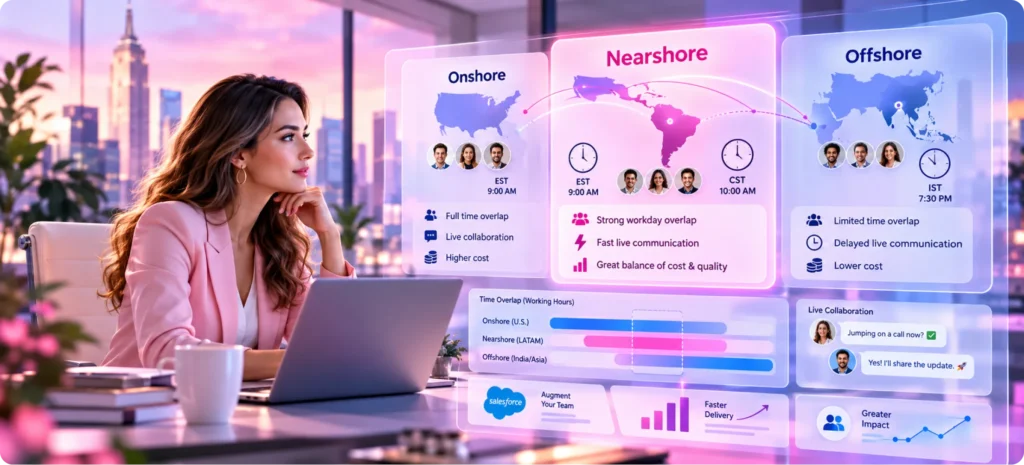
The time-zone gap between the USA and India remains one of the biggest discussion points in offshore Salesforce delivery. Yet many successful Salesforce partnerships already operate effectively through structured collaboration models.
Strong offshore Salesforce engagements typically include:
- overlap working hours
- sprint accountability
- detailed documentation
- structured communication workflows
- clear release ownership
Businesses that build collaboration discipline into the engagement generally experience far smoother delivery cycles than teams expecting offshore developers to operate exactly like local resources without process adjustments.
Enterprise Expectations in USA vs. India Teams
Enterprise Salesforce delivery standards now vary more by organizational maturity than geography. India’s Salesforce ecosystem has matured heavily over the last several years, with many firms supporting Fortune 500 implementations, enterprise DevOps pipelines, Data Cloud projects, and governance-heavy release environments.
Businesses evaluating Salesforce hiring should focus on:
- delivery processes
- governance discipline
- technical maturity
- architectural oversight
- communication standards
Those operational factors usually determine project success far more than geography alone.
How to Evaluate Salesforce Developers Before Hiring

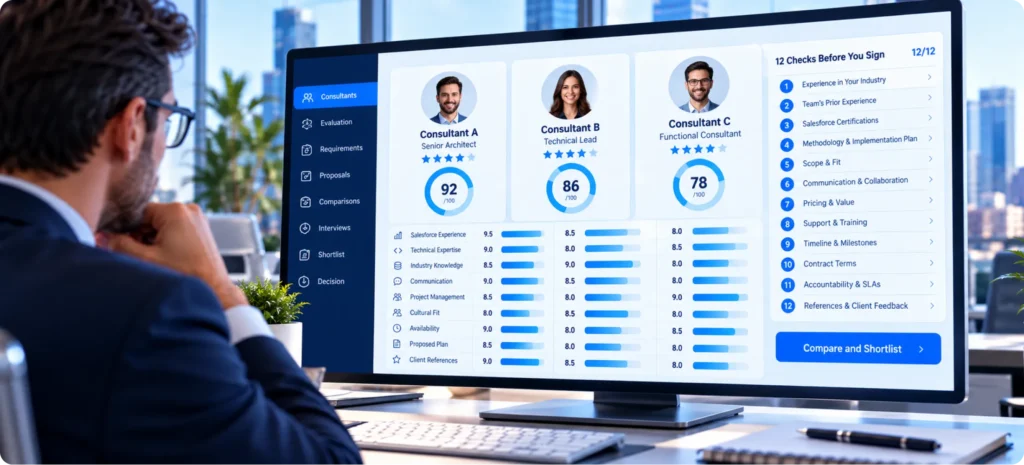
Before hiring, businesses need to look beyond resumes and certifications. A strong Salesforce developer should show practical thinking, technical discipline, and the ability to build solutions that stay stable as automation, integrations, data volume, and business requirements grow.
Technical Skills Businesses Should Validate
Technical evaluation should focus less on memorized platform knowledge and more on how a Salesforce developer approaches real operational problems. Businesses need developers who can think through scalability, deployment impact, automation governance, integrations, and long-term CRM stability under realistic project conditions.
Strong Salesforce developers usually communicate technical tradeoffs clearly, understand platform limitations before problems appear, and build systems that remain manageable as automation, integrations, and data volume grow. That matters much more than simply completing features quickly.
Technical Evaluation Checklist
Area | What to Evaluate | Signal to Look For |
Apex development | Trigger frameworks, code quality, bulkification | Governor limit awareness without prompting |
LWC / Aura | Component architecture and state handling | Strong understanding of event-driven behavior |
Flow automation | Recursion risk, design structure, performance | Governance-focused automation thinking |
Integration design | APIs, retry logic, error handling | Experience with platform events and integration stability |
DevOps maturity | CI/CD pipelines, SFDX, deployments | Source-driven deployment discipline |
Data architecture | Relationships, external IDs, large data handling | Scalability planning from early stages |
Security model | Sharing rules, permission strategy | Proactive security awareness |
AI / Agentforce readiness | Data Cloud familiarity and AI workflows | Understanding of emerging Salesforce capabilities |
Questions to Ask During Salesforce Developer Interviews
Strong Salesforce interview questions should reveal how a developer thinks through complex situations instead of testing isolated technical facts.
Questions worth asking include:
- How would you approach designing a trigger framework for a growing Salesforce environment?
- What factors influence your decision between Flow and Apex for automation?
- Describe a situation where you had to refactor automation that was already creating operational problems.
- How do you manage deployments across multiple developers working simultaneously?
- If you inherited a Salesforce org with weak documentation, how would you assess its overall health?
- What is your process for testing deployments and handling governor limits?
The goal is to evaluate architectural thinking, communication clarity, governance awareness, and operational maturity rather than short-term coding speed alone.
Red Flags That Often Lead to Expensive CRM Problems
Some hiring risks appear subtly during Salesforce interviews and technical discussions.
Watch carefully for:
- broad claims without practical examples
- weak documentation habits
- heavy certification focus without technical depth
- no mention of testing or release governance
- unfamiliarity with Salesforce DevOps practices
- no discussion around scalability or automation management
Developers who only focus on feature delivery often create Salesforce environments that become difficult to maintain later, especially once integrations, workflows, and reporting complexity increase.
Why Scalability Thinking Matters More Than Fast Delivery
Many businesses still overvalue short-term delivery speed during Salesforce hiring. That usually creates long-term operational problems because Salesforce environments grow more complex over time through integrations, automation layers, AI workflows, reporting dependencies, and increasing data volume.
A developer who thinks carefully about the following:
- modular automation design
- integration structure
- deployment discipline
- clean data architecture
- documentation standards
- governance planning
may deliver slightly slower initially. But months later, those decisions usually create a far more stable Salesforce environment. In modern Salesforce ecosystems, scalability thinking is no longer optional. It directly affects how well the platform supports future business growth, automation expansion, AI readiness, and long-term operational reliability.
Certified Salesforce developers, minus the hiring gamble
A bad developer hire costs months of rework. Our delivery and consulting roles together hold 250+ Salesforce certifications, and our development work is backed by the Platform Developer 1, Platform Developer 2 and Javascript Developer 1 credentials. Want them working alongside your people? Hire certified Salesforce experts from that same bench and skip the months-long hiring cycle. You get proven Apex and LWC skills from day one. Curious about the people behind the badges? Meet the HyphenX team.
Conclusion
Hiring the right Salesforce developer in 2026 directly affects how well your CRM supports automation, integrations, AI workflows, Data Cloud readiness, and long-term business growth. A weak hiring decision can leave behind technical debt, unstable workflows, poor documentation, and systems that become harder to scale as the business expands. The strongest hiring decisions start with clarity. Businesses need to understand whether they need a Salesforce developer, consultant, architect, or a more specialized expert based on their platform complexity and future roadmap. India and the USA both offer strong Salesforce talent, but the right choice depends on delivery structure, communication needs, budget, governance expectations, and scalability goals.
More importantly, Salesforce hiring should be treated as a long-term platform decision. Evaluating developers on architecture thinking, automation governance, integration maturity, and release discipline usually creates better outcomes than focusing only on speed or certifications. For businesses that need guidance before hiring or scaling their Salesforce team, HyphenX’s Hire Salesforce Consultant service can help identify the right talent model and support structure for a more stable Salesforce future.