
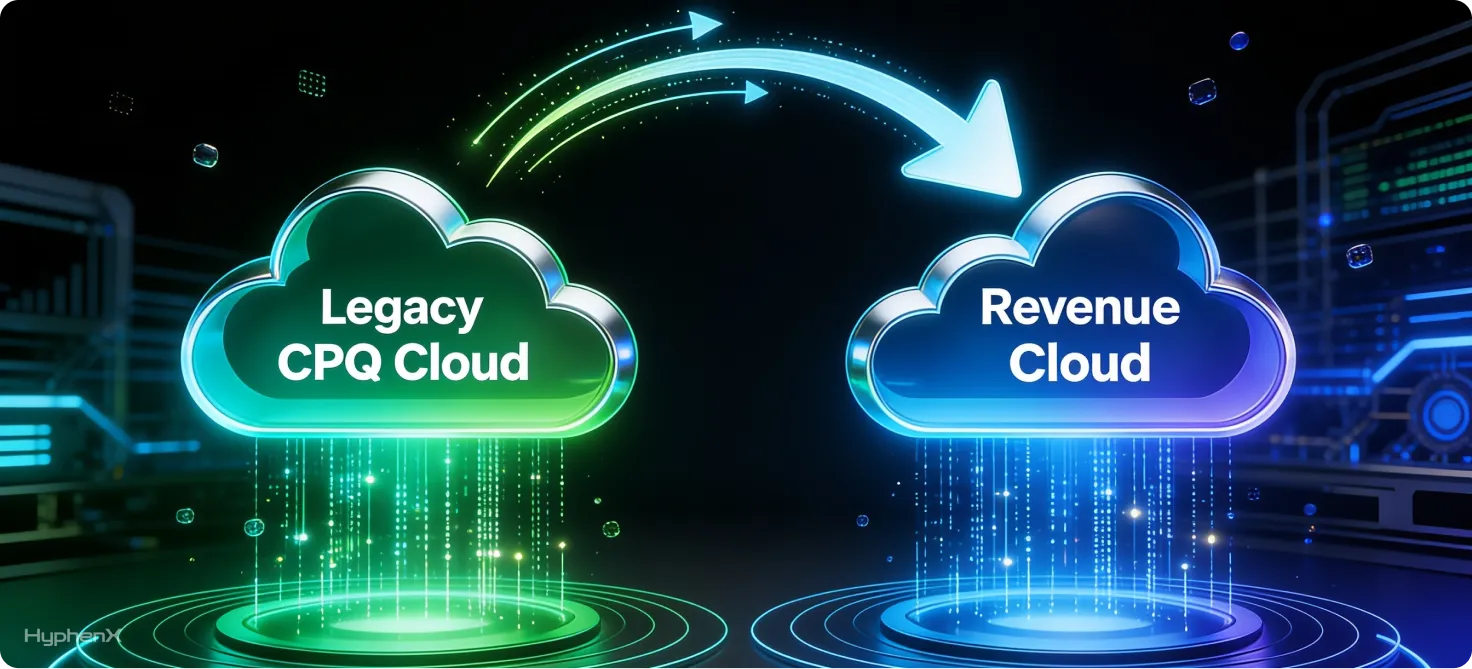
Salesforce CPQ reached End of Sale in 2025. Here’s a clear-eyed look at what that means, what a managed Revenue Cloud Migration actually involves, and why moving on your own timeline this year beats waiting.
If your quoting still runs on Salesforce CPQ, you’re not behind yet. But the ground has shifted. In March 2025, Salesforce moved its long-serving CPQ product — the SteelBrick-based managed package that has powered quote-to-cash for thousands of companies — into End of Sale. New customers can no longer buy it, and every future investment Salesforce makes in configure, price, and quote is going into Salesforce Revenue Cloud instead.
End of Sale is not End of Life. Your existing setup keeps running, and the widely expected end-of-life window sits somewhere around 2029–2030. That gap creates a comfortable illusion: plenty of runway, no need to rush. The reality is different. The cost of staying put compounds quietly — in technical debt, shrinking expertise, rising maintenance, and a feature gap that widens with every Salesforce release. This piece lays out why legacy CPQ is becoming a liability, what a managed CPQ to Revenue Cloud migration actually involves, and why doing it deliberately this year beats doing it under deadline pressure later.
End of Sale started the clock — here's what it really means
It helps to separate two terms that often get blurred:
- End of Sale (EOS): Salesforce no longer sells new CPQ licenses. Existing customers can keep using, renewing, and adding seats, but the product receives no meaningful new features.
- End of Life (EOL): the later date when support, patches, and security updates stop. Salesforce hasn’t committed to a hard date, and most of the ecosystem expects it around 2029–2030.
The trap is reading four or five years of runway as permission to wait. Several gaps open the moment you do:
- Innovation gap: every release from here is built for Revenue Cloud, not CPQ. The functional distance grows each quarter.
- Talent gap: the pool of CPQ-fluent admins and developers is shrinking as the ecosystem retrains on Revenue Cloud.
- Integration drag: your ERP, billing, and e-signature partners are aligning their roadmaps with the new platform, so old integrations get harder to maintain.
- Leverage erosion: the closer you get to EOL, the less room you have on price and timeline. Migrations run under pressure simply cost more.
Why legacy CPQ is quietly becoming a liability
Legacy CPQ was built as a managed package that sits on top of Salesforce CRM. That architecture made sense for its era, but it carries real limits at modern scale:
Large product catalogs slow the quote line editor, and reps feel the lag on every complex deal.
Sophisticated pricing often depends on custom scripts (Quote Calculator Plugins) and stacked price rules that only a specialist can safely maintain.
Years of layered customizations, added by every admin who has touched the org since 2015 turn small changes into risky ones.
Because CPQ runs on its own object model, it can’t take full advantage of newer platform capabilities like Data Cloud and Agentforce.
None of this breaks overnight. But it does mean your revenue engine gets slower to change exactly when the business needs it to move faster. For most teams, the honest question is no longer whether to migrate, but when and on whose terms.
The real risks of delaying your Revenue Cloud Migration
Waiting feels safe because nothing visibly breaks. The costs are simply deferred, and they accumulate:
- Compounding technical debt: every workaround built on an obsolete system is one more thing to unwind later.
- Rising total cost of ownership: maintenance, custom-code upkeep, and workarounds get more expensive as expertise thins out.
- Scarcer, pricier talent: fewer qualified CPQ resources means higher rates and slower fixes.
- Growing integration fragility: each release cycle, connections to ERP, billing, and finance systems get a little harder to hold together.
- Weakening leverage: negotiating a migration against a deadline is always costlier than planning one ahead of it.
- Competitive drag: as peers adopt attribute-based catalogs, dynamic pricing, and AI-assisted selling, a frozen CPQ becomes a ceiling on your revenue operations.
What Salesforce Revenue Cloud actually changes

Revenue Cloud isn’t a re-skinned CPQ. It’s built natively on the Salesforce core platform using standard objects like Quote, Order, and Contract, and it’s API-first, metadata-driven, and attribute-based by design. That foundation changes how the whole quote-to-cash process behaves.
Quoting and quote management
Instead of spinning up a separate SKU for every product variation, Revenue Cloud uses Product Catalog Management with attributes, one product, configurable by size, term, or tier. Catalogs shrink, reps find products faster, and the quote line experience is built to handle large, complex deals without the old performance drag. The result is cleaner quote management and fewer configuration errors.
Pricing automation
Pricing moves from stacked, hard-to-trace price rules to the business rules. Engine is a visual, flow-like way to model volume discounts, currency conversion, and complex logic. That’s real pricing automation: faster to change, easier to audit, and far less dependent on custom code.
Approvals
Approval workflows are rebuilt on native Salesforce automation (Flow) rather than legacy Process Builder or bespoke Apex. Multi-stage discount approvals become easier to design, monitor, and adapt as your deal desk evolves.
Billing and subscription management
This is where the platform’s unified design pays off. Revenue Cloud natively handles subscription management, recurring and usage-based models, and billing automation so quoting, ordering, invoicing, and revenue recognition live on one connected spine instead of being stitched together across tools. For subscription and consumption businesses, that closes some of the biggest gaps in legacy CPQ.
Forecasting and revenue operations
Because sales, pricing, billing, and contracts share one data model, forecasting gets more accurate and revenue operations gain a single source of truth. Native integration with Data Cloud and Agentforce also opens the door to AI-assisted quoting, churn signals, and pricing guidance, capabilities legacy CPQ simply can’t reach.
At a glance, here’s how the two platforms compare:
Capability | Legacy Salesforce CPQ | Salesforce Revenue Cloud |
Architecture | Managed package layered on top of the CRM | Native to the Salesforce core platform |
Product catalog | A separate SKU for each variation | Attribute-based catalog; one product, many configurations |
Pricing | Stacked price rules and custom scripts | Business Rules Engine — visual, auditable pricing automation |
Approvals | Legacy Process Builder / custom Apex | Native Flow-based approval automation |
Billing & subscriptions | Add-on billing, gaps for usage models | Native billing automation, subscription and usage-based support |
Data model | Its own managed-package objects | Standard objects (Quote, Order, Contract) |
Performance at scale | Quote lines slow on large catalogs | Engineered for high-volume, complex quoting |
AI readiness | Limited access to newer platform AI | Built to work with Data Cloud and Agentforce |
Roadmap | End of Sale; no new features | Where all future Salesforce investment is going |
Understand this up front: it's a reimplementation, not an upgrade
Here’s the part teams most often underestimate: there is no one-click migration. CPQ stores its logic in managed-package custom objects; Revenue Cloud uses standard platform objects. Product rules, bundles, pricing logic, and approvals are redesigned for the new model, not copied across. Historical quotes and contracts have to be mapped carefully into new structures like transaction line items.
That sounds daunting, but it’s also the opportunity. A reimplementation is your chance to retire years of accumulated cruft, simplify a bloated catalog, and rebuild pricing the way you’d design it today rather than the way it evolved by accident. Approached well, you don’t just move to a new platform, you come out with a cleaner, faster, more maintainable revenue engine. That’s the difference between a migration that merely beats a deadline and one that genuinely improves the business.
What a managed Revenue Cloud Migration involves
Because there’s no automated path, how you run the project matters enormously. A managed migration brings structure, deep Salesforce expertise, and disciplined change management to a process that punishes improvisation. Our Revenue Cloud services are built around exactly that. At Hyphenx, we run a Revenue Cloud Migration as a staged program rather than a single cutover, roughly along these lines:
- Discovery and assessment. We audit what you actually have: customizations, pricing logic, catalog, dependencies, integrations, and approval flows because the biggest predictor of a clean rebuild is a clear picture of the starting point.
- Data cleanup and catalog rationalization. We deduplicate, document, and simplify before anything moves and right-size seat counts so you don’t pay to migrate users who never build a quote.
- Solution design. We redesign the catalog around attributes, model pricing in the Business Rules Engine, and translate old product rules into constraint rules built for the new platform.
- Build and configuration. We construct the new setup on standard objects, keeping logic native and low-code wherever possible to reduce future maintenance.
- Integration planning and rebuild. We map and rebuild every connection to ERP, billing, e-signature, and finance systems so the quote-to-cash flow stays intact end to end.
- Testing and validation. We validate pricing accuracy, quote-to-order flow, approvals, and reconciliation against real scenarios, not just happy paths.
- Migration and phased cutover. Many teams use a bridge approach: new deals start in Revenue Cloud immediately, while existing contracts stay in CPQ and move over at renewal, which lowers risk and avoids a big-bang switch.
- Enablement and hypercare. We train users, support adoption, and stay close after go-live to resolve issues while the team builds confidence.
Don't skip the data cleanup
The quality of your data going in decides the quality of your rebuild coming out and most teams underestimate this by a wide margin. Before a single object moves, it’s worth working through a short checklist:
- ✔ Product catalog accuracy remove duplicates, retire dead SKUs, and confirm what you actually sell today.
- ✔ Pricing rule documentation captures every discount, bundle, and edge case so nothing important is lost in translation.
- ✔ Quote-to-invoice reconciliation measures how cleanly quotes flow to orders and invoices today and fixes systemic gaps.
- ✔ Dependency mapping: know which customizations and integrations rely on which objects.
- ✔ Seat right-sizing: a meaningful share of named CPQ users never build a quote; don’t carry those seats into a higher-cost platform.
Integration planning: map every connection early
Quote-to-cash rarely lives inside Salesforce alone. Your CPQ almost certainly touches an ERP, a billing engine, e-signature, tax, and finance systems, and each connection has to be reviewed, rebuilt, or retired for the new object model. Plan integrations early rather than treating them as an afterthought:
- Inventory every downstream and upstream system that reads or writes quote, order, or contract data.
- Decide what to rebuild natively versus what to re-integrate via API.
- Sequence the work so billing and revenue recognition are validated before cutover.
- Align with partner roadmaps, since most ERP and billing vendors are prioritizing Revenue Cloud support.
User adoption makes or breaks the migration
The best-configured platform fails if reps quietly go back to spreadsheets. Technology is only half of a Revenue Cloud Migration; the other half is people. A few practices consistently move the needle:
Involve sales, deal desk, and finance early so the new design reflects how they actually work.
Identify internal champions who can support peers and surface issues fast.
Train on real workflows and real deals, not abstract demos.
Roll out in phases so teams build confidence instead of facing one overwhelming switch.
Keep feedback loops open through hypercare and fix friction quickly.
Strong executive sponsorship matters here too, the kind that stays engaged through governance reviews and owns trade-offs when reality diverges from the plan, not the kind that appears only at kickoff. In the migrations we run at Hyphenx, adoption planning that starts on day one rather than bolted on at the end is consistently what separates a smooth rollout from a stalled one.
How long does a Revenue Cloud Migration take?
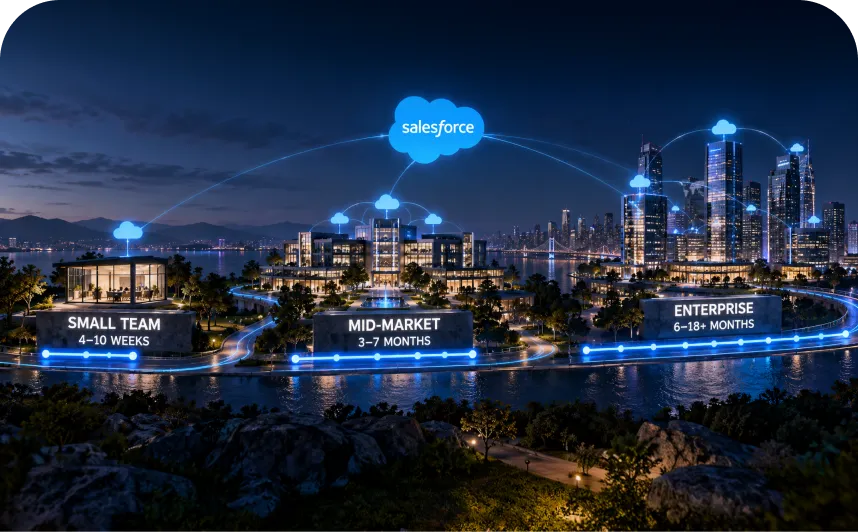
Timelines vary with complexity, but honest expectations help. A simple org with a lean catalog can move in a matter of weeks to a few months. Most enterprise CPQ to Revenue Cloud migrations run roughly nine to eighteen months from kickoff to go-live, with an additional three to six months of discovery and planning that ideally happens before the implementation contract is even signed.
Phase | What happens | Typical timeframe |
Discovery & planning | Audit, data assessment, solution blueprint | 3–6 months (pre-build) |
Design & build | Catalog, pricing (BRE), approvals, configuration | Varies with complexity |
Integrations | Rebuild ERP, billing, e-signature, finance links | Runs alongside build |
Test & validate | Pricing accuracy, quote-to-cash flow, reconciliation | Several weeks+ |
Cutover & adoption | Phased/bridge go-live, training, hypercare | Through go-live |
What moves the timeline most: catalog size and complexity, the depth of custom pricing logic, the number and fragility of integrations, data quality, and how ready your team is to make decisions. This is exactly why starting early, with runway to be deliberate produces a better, and often cheaper, result than a deadline scramble.
Why this year is the right time to move
Put the pieces together, and the case for acting now is straightforward:
You still have runway to do it right. Migrating on your own schedule means a measured project, proper testing, and real change management, not a rushed cutover against an EOL date.
Talent is available now. Experienced Revenue Cloud resources are easier to secure today than they will be as demand concentrates near end-of-life.
The cost of waiting compounds. Technical debt, maintenance, and integration fragility only grow, and negotiating leverage only shrinks.
You unlock upside sooner. Every quarter on Revenue Cloud is a quarter of faster quoting, cleaner pricing automation, better forecasting, and access to AI-assisted selling through Agentforce and Data Cloud.
Waiting doesn’t remove the work, it just makes the same work more expensive and more stressful. Moving this year turns a forced migration into a strategic upgrade.
Leave CPQ behind with certified expertise in your corner
Migrating from managed CPQ touches pricing, quotes and every deal in flight. Our answer is 250+ Salesforce certifications held across our delivery and consulting roles, applied to every quote-to-cash project. Want them working alongside your people? Hire certified Salesforce experts from that same bench and skip the months-long hiring cycle. Your reps keep quoting without interruption, and every pricing rule moves over intact and tested. Learn more about HyphenX and the people behind every certification.
The bottom line
Legacy CPQ isn’t going to stop working tomorrow, but it has stopped moving forward — and in a fast-changing revenue landscape, standing still is its own kind of risk. A well-run CPQ to Revenue Cloud migration does more than tick a compliance box ahead of end-of-life. It resets your quote-to-cash foundation for speed, accuracy, and growth: simpler catalogs, real pricing automation, native billing and subscription management, and forecasting your revenue operations team can actually trust.
The teams that come out of this well treat the timeline as a budget for doing it thoughtfully, not a deadline to procrastinate against. If you’re weighing a Revenue Cloud Migration and want a partner who has done this before, our team at Hyphenx can help you assess your current setup, map a realistic path, and run the migration with minimal disruption. When you’re ready to explore what a move to Salesforce Revenue Cloud could look like for your business, we’d be glad to talk it through.