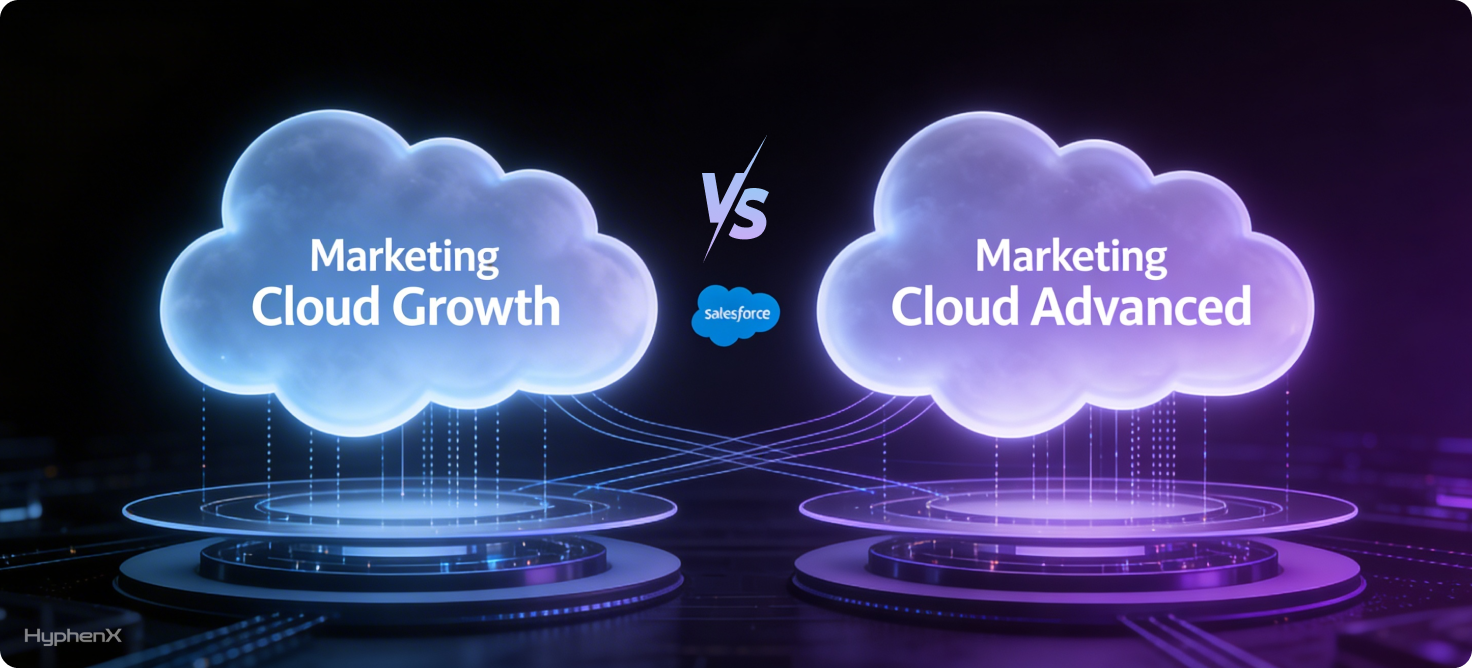
Choosing between Salesforce Marketing Cloud Growth and Advanced is not simply a licensing decision, it is an architectural commitment that influences data strategy, scalability, operational complexity, and long term ROI. Many organizations focus on feature comparisons or pricing tiers, but the real differentiator lies in how each edition aligns with business maturity, integration needs, and customer experience ambitions.
For mid size and enterprise businesses, selecting the wrong edition can create hidden technical debt, force premature migrations, or limit personalization capabilities just as growth accelerates. This guide provides a structured decision framework, architectural clarity, and implementation insights to help organizations confidently evaluate Marketing Cloud Growth vs Advanced in a way that supports sustainable digital transformation.
Core Differences That Actually Impact Architecture
At a surface level, Marketing Cloud Growth and Advanced differ in automation depth, AI capabilities, personalization scale, and data sophistication. However, the most meaningful distinction is architectural flexibility.
Growth is designed for organizations building structured lifecycle marketing with moderate complexity. Advanced supports enterprises orchestrating cross channel, data driven customer journeys with high personalization demands and multiple integration layers.
The following comparison highlights strategic differences beyond marketing features.
Dimension | Marketing Cloud Growth | Marketing Cloud Advanced | Strategic Impact |
Automation Complexity | Standard journey orchestration | Advanced multi path orchestration with deeper logic | Determines scalability of customer experience programs |
Data & Personalization | Moderate segmentation depth | High scale personalization with AI insights | Influences customer engagement maturity |
AI Capabilities | Foundational AI features | Predictive intelligence & advanced optimization | Impacts conversion optimization potential |
Integration Flexibility | Standard connectors | Enterprise grade integration options | Affects system interoperability |
Reporting & Intelligence | Operational analytics | Strategic intelligence & attribution depth | Supports executive decision making |
Industry data consistently shows that organizations investing in advanced personalization and AI driven orchestration outperform peers in customer lifetime value and engagement metrics. The edition choice therefore becomes a business growth lever, not merely a marketing tool decision.
Implementation & Data Architecture Considerations
One of the most overlooked differences between Growth and Advanced editions is how they shape your data architecture.
A simplified architecture model for Marketing Cloud Growth often looks like this:
CRM (Salesforce or external) → Marketing Cloud Growth → Channels (Email, SMS, Ads)
This architecture works well when:
- Customer data is relatively centralized
- Integration points are limited
- Personalization requirements are moderate
Marketing operates with defined lifecycle journeys
Marketing Cloud Advanced introduces a more layered architecture:
CRM + Data Warehouse/CDP → Integration Layer (APIs/Middleware) → Marketing Cloud Advanced → Channels + AI Optimization
This structure supports:
- Complex segmentation from multiple data sources
- Real time personalization triggers
- Predictive analytics workflows
- Cross business unit orchestration
The architectural implication is significant. Advanced requires stronger data governance, integration planning, and technical expertise during implementation. Organizations without this preparation may struggle to realize the full value of the platform.
Key architectural questions businesses should evaluate early:
- Where does customer truth live CRM, CDP, or warehouse?
- How frequently must data sync occur (batch vs near real time)?
- What level of identity resolution is required?
- Are personalization decisions rule based or AI driven?
Answering these questions often determines the correct edition more accurately than feature comparisons.
Marketing Cloud Edition Selection Checklist

Decision makers frequently ask, “Which edition is right for us today?” A more strategic question is: “Which edition aligns with our next three years of growth?”
The following checklist provides practical evaluation criteria.
Choose Marketing Cloud Growth if:
- Marketing automation maturity is still developing
- Customer journeys are relatively linear
- Integration requirements are limited
- AI personalization is not yet a core competitive strategy
- Implementation speed and cost predictability are priorities
- Internal technical resources are constrained
Choose Marketing Cloud Advanced if:
- Personalization at scale is a strategic priority
- Multiple data systems must integrate into marketing workflows
- AI driven optimization is required for competitive advantage
- Customer journeys involve complex decision logic
- The organization operates across multiple regions or business units
- Long term scalability outweighs short term simplicity
A common pattern among enterprises is starting with Growth and later upgrading to Advanced. While this approach appears cost efficient initially, migration complexity, re-architecture effort, and data model adjustments can increase total cost of ownership.
Early architectural clarity reduces this risk significantly.
Implementation Complexity: The Hidden Differentiator
Two organizations can purchase the same Marketing Cloud edition yet experience completely different outcomes based on implementation quality.
Factors influencing complexity include:
- Data model design decisions
- Integration architecture
- Journey orchestration strategy
- Governance and permission structures
- AI configuration and optimization
- Reporting framework alignment with KPIs
Organizations working with experienced Salesforce specialists often accelerate time to value because architecture decisions are aligned with business objectives from the start. Firms like Hyphenx Solutions, with deep Salesforce ecosystem expertise and enterprise implementation experience, typically focus on aligning technology architecture with measurable business outcomes rather than deploying tools in isolation.
This distinction becomes more critical as organizations move toward Advanced capabilities.
Scalability, Migration, and Technical Debt Risks
Edition selection has long term consequences that often only become visible 12–24 months after implementation. As marketing sophistication increases, limitations in data structure, automation flexibility, or integration capabilities can create friction that slows innovation.
The most common scalability risks include:
- Data model constraints that limit personalization depth
- Automation limitations requiring manual workarounds
- Integration bottlenecks that delay campaign execution
- Reporting fragmentation across systems
- Reimplementation costs during edition upgrades
Migration from Growth to Advanced is technically feasible, but it is not frictionless. Organizations may need to:
- Redesign data extensions and schemas
- Rebuild journeys using advanced logic
- Reconfigure integrations and APIs
- Retrain internal teams
- Reassess governance frameworks
These adjustments introduce operational disruption if not planned strategically from the beginning.
Technical debt the accumulation of short term decisions that create long term complexity is one of the most expensive risks in marketing technology investments. Choosing an edition based solely on immediate needs rather than projected growth trajectory is a common contributor.
Forward looking architecture planning mitigates this risk significantly.
Integration Patterns with CRM, CDP, and Enterprise Systems
Marketing Cloud rarely operates in isolation within enterprise environments. Its value increases dramatically when integrated with CRM platforms, data warehouses, commerce systems, and analytics tools.
There are three primary integration patterns organizations typically adopt.
1. CRM Centric Integration
Architecture:
CRM → Marketing Cloud → Channels
Best suited for:
- Organizations with Salesforce CRM as the primary customer data source
- Sales driven engagement models
- Moderate personalization requirements
Advantages:
- Faster deployment
- Lower integration complexity
- Simplified governance
Limitations:
- Restricted data depth for advanced personalization
- Limited real time behavioral intelligence
2. Data Hub or CDP Centric Integration
Architecture:
Multiple Systems → CDP/Data Warehouse → Marketing Cloud → Channels
Best suited for:
- Enterprises with complex customer data ecosystems
- Omnichannel personalization strategies
- High data governance maturity
Advantages:
- Unified customer profiles
- Advanced segmentation capabilities
- Scalable analytics and AI activation
Limitations:
- Higher implementation complexity
- Strong dependency on data quality and governance
2. Data Hub or CDP Centric Integration
Architecture:
Multiple Systems → CDP/Data Warehouse → Marketing Cloud → Channels
Best suited for:
- Enterprises with complex customer data ecosystems
- Omnichannel personalization strategies
- High data governance maturity
Advantages:
- Unified customer profiles
- Advanced segmentation capabilities
- Scalable analytics and AI activation
Limitations:
- Higher implementation complexity
- Strong dependency on data quality and governance
3. Hybrid Real Time Architecture
Architecture:
CRM + Behavioral Data Streams → Middleware/APIs → Marketing Cloud Advanced → Channels + AI
Best suited for:
- Digital first organizations
- Real time engagement use cases
- Predictive personalization strategies
Advantages:
- Dynamic customer experiences
- Real time triggers and decisioning
- Competitive differentiation
Limitations:
- Requires advanced technical expertise
- Greater architectural planning effort
Marketing Cloud Advanced typically delivers greater value in the second and third patterns due to its expanded orchestration and intelligence capabilities.
Organizations that underestimate integration complexity often face delayed ROI despite investing in advanced technology. Early architecture alignment across systems is therefore a critical success factor.
Strategic Implementation Considerations for Long Term Success

Technology selection alone does not guarantee success. The organizations that extract the most value from Salesforce Marketing Cloud approach implementation as a transformation initiative rather than a software deployment.
Several strategic principles consistently drive stronger outcomes:
- Align marketing architecture with business growth objectives
- Design data models for future scalability, not just current campaigns
- Prioritize governance and operational clarity early
- Establish measurable KPIs tied to revenue and customer value
- Invest in enablement and adoption planning
Experienced Salesforce ecosystem specialists play an important role in navigating these decisions. Companies such as Hyphenx Solutions bring cross industry implementation experience, architecture expertise, and optimization methodologies that help organizations avoid common pitfalls while accelerating value realization.
The difference is rarely the platform itself; it is how effectively the platform is implemented, integrated, and evolved over time.
Conclusion
Selecting between Marketing Cloud Growth and Advanced is ultimately a strategic architecture decision that shapes customer engagement capabilities for years to come. Organizations that evaluate editions through the lens of scalability, integration readiness, and long term personalization goals make more confident investments and avoid costly rework.
With the right architectural foundation and implementation approach, Salesforce Marketing Cloud becomes more than a marketing platform it becomes a growth engine supporting intelligent, connected customer experiences across the enterprise.