
- Unify. Activate. Accelerate
Salesforce
Data Cloud
Build a Trusted Data360 Foundation for Every Decision


Your Customer Data Already Exists. The Problem Is That It Lives in Too Many Systems.
Most companies already collect large amounts of customer information, yet that knowledge often sits across separate systems that rarely connect. Your CRM tracks sales activity, marketing tools capture engagement, and e-commerce platforms store purchases, while support systems record case history. Because these systems do not share context, teams work with partial records and inconsistent identities. Salesforce Data Cloud solves this by linking sources, resolving identities, and creating unified customer profiles across systems. Through our Salesforce Data Cloud consulting, we deliver structured Salesforce Data Cloud implementation and reliable Salesforce Data Cloud services, building a connected Data360 environment where every team works from the same customer view.
HyphenX Salesforce Data Cloud Service Offerings
Every service listed here is delivered directly by us. The same consultants who scope the engagement design and build the solution. Our salesforce data cloud services ensure Salesforce Data Cloud and Data360 environments are implemented with accuracy and long-term usability.
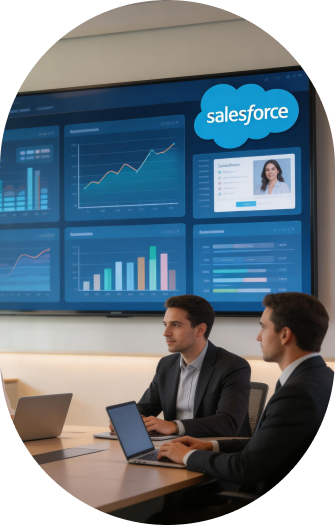
Data Cloud Implementation Service
Our salesforce data cloud implementation sets up a complete Salesforce Data Cloud environment. We configure data streams, unified profiles, segmentation, activation, governance, and monitoring. A typical implementation connecting several systems usually takes about 10–16 weeks.
Identity Resolution Design and Configuration
Identity resolution determines which records across systems belong to the same customer. Through Salesforce Data Cloud consulting, we design deterministic and probabilistic matching rules, survivorship logic, and validation testing to ensure accurate unified profiles in Data360.
Calculated Insights and Segmentation Service
Once unified profiles exist in Salesforce Data Cloud, we configure calculated insights and segments. These metrics and audience groups combine data across systems, allowing teams to identify behavior patterns and activate targeted campaigns through Data Cloud Salesforce capabilities.
Data Governance and Compliance Configuration
We configure governance controls inside Salesforce Data Cloud services, including consent management, retention policies, data masking, and access permissions. This ensures customer data within the Data360 environment follows compliance requirements and remains securely managed.
Data Cloud Integration with External Platforms
Our salesforce data cloud implementation connects Salesforce Data Cloud with data warehouses, marketing platforms, and advertising systems. These integrations allow the Data Cloud Salesforce environment to exchange data continuously across enterprise platforms and activation channels.
Data Cloud Migration Service
When organizations move from another CDP or internal platform, we manage the transition into Salesforce Data Cloud. Our salesforce data cloud consulting includes migration planning, data transfer, validation testing, and parallel operations until the Data360 environment becomes fully operational.
Data Cloud Audit and Health Assessment
For existing environments, we review ingestion pipelines, identity resolution accuracy, segmentation logic, and activation performance. This audit helps determine whether the Salesforce Data Cloud setup is delivering reliable data and identifies improvements within the Data Cloud Salesforce architecture.
Ongoing Data Cloud Management Service
Salesforce Data Cloud environments continue evolving as new systems and data sources appear. Our ongoing Salesforce Data Cloud services monitor pipelines, refine identity resolution, add segments, update governance policies, and maintain the long-term health of your Data360 platform.
Data Cloud Implementation Service
Our salesforce data cloud implementation sets up a complete Salesforce Data Cloud environment. We configure data streams, unified profiles, segmentation, activation, governance, and monitoring. A typical implementation connecting several systems usually takes about 10–16 weeks.
Identity Resolution Design and Configuration
Identity resolution determines which records across systems belong to the same customer. Through Salesforce Data Cloud consulting, we design deterministic and probabilistic matching rules, survivorship logic, and validation testing to ensure accurate unified profiles in Data360.
Calculated Insights and Segmentation Service
Once unified profiles exist in Salesforce Data Cloud, we configure calculated insights and segments. These metrics and audience groups combine data across systems, allowing teams to identify behavior patterns and activate targeted campaigns through Data Cloud Salesforce capabilities.
Data Governance and Compliance Configuration
We configure governance controls inside Salesforce Data Cloud services, including consent management, retention policies, data masking, and access permissions. This ensures customer data within the Data360 environment follows compliance requirements and remains securely managed.
Data Cloud Integration with External Platforms
Our salesforce data cloud implementation connects Salesforce Data Cloud with data warehouses, marketing platforms, and advertising systems. These integrations allow the Data Cloud Salesforce environment to exchange data continuously across enterprise platforms and activation channels.
Data Cloud Migration Service
When organizations move from another CDP or internal platform, we manage the transition into Salesforce Data Cloud. Our salesforce data cloud consulting includes migration planning, data transfer, validation testing, and parallel operations until the Data360 environment becomes fully operational.
Data Cloud Audit and Health Assessment
For existing environments, we review ingestion pipelines, identity resolution accuracy, segmentation logic, and activation performance. This audit helps determine whether the Salesforce Data Cloud setup is delivering reliable data and identifies improvements within the Data Cloud Salesforce architecture.
Ongoing Data Cloud Management Service
Salesforce Data Cloud environments continue evolving as new systems and data sources appear. Our ongoing Salesforce Data Cloud services monitor pipelines, refine identity resolution, add segments, update governance policies, and maintain the long-term health of your Data360 platform.
Data Streams
Data streams connect Salesforce Data Cloud to source systems such as CRM platforms, databases, and cloud data warehouses. Through Salesforce Data Cloud implementation, these streams ingest data in near real time or on scheduled intervals.
Data Model Objects (DMOs)
DMOs structure how data appears inside Salesforce Data Cloud. Standard objects such as "Individual" or "Engagement" allow unified relationships across systems, while custom objects extend the Data360 model for business-specific data.
Identity Resolution
Identity resolution determines which records across systems belong to the same customer. Through Salesforce Data Cloud consulting, deterministic and probabilistic rules match identifiers and maintain accurate identity graphs across the Data Cloud Salesforce environment.
Unified Profiles
Unified profiles combine all customer data from connected sources into a single record. Within Salesforce Data Cloud services, these profiles continuously update as new information enters the Data360 platform.
Calculated Insights
Calculated insights generate metrics from unified profile data. Examples include engagement frequency, product affinity, or lifetime value. In Salesforce Data Cloud, these metrics help teams understand behavior and prioritize actions.
Segments
Segments group customers based on combined attributes from multiple systems. Using Data Cloud Salesforce, teams build audiences for marketing, service prioritization, and sales targeting using unified profile information.
Data Actions
Data actions trigger automated responses when profile conditions change. Through Salesforce Data Cloud implementation, these events can create records, launch journeys, or notify teams when customer activity meets defined criteria.
Activations
Activations publish profile data and segments to connected platforms. Salesforce Data Cloud services ensure that unified data from the Data360 environment reaches Salesforce applications, advertising platforms, and analytics tools that require it.
The Core Capabilities of Data Cloud — Explained for Decision Makers
Salesforce Data Cloud is a technically detailed platform, yet its value becomes clearer when each capability is understood in simple terms. These capabilities form the foundation of a Data360 environment and determine how effectively Data Cloud Salesforce connects systems, builds unified profiles, and supports business decisions.
What a Well-Implemented Data Cloud Environment Delivers
Every Team Works From the Same Customer View
A well-configured Salesforce Data Cloud environment gives every team access to the same customer record. Marketing, sales, service, and operations no longer depend on disconnected systems. Instead, everyone works from the same Data360 profile.
- Sales, marketing, and service teams access the same unified customer profile
- Campaigns avoid customers who already have open support cases
- Sales reps see current account activity before contacting customers
- Support agents recognize long-term or high-value customers quickly
Personalization Uses Real Customer Context
Personalization improves when businesses understand the full customer relationship. Salesforce Data Cloud services combine engagement, purchase history, and support activity into a unified profile used across systems.
- Marketing uses real behavior data for targeted campaigns
- Offers match customer purchase history and activity
- Messaging reflects the customer lifecycle stage
- Teams use Data360 profiles for relevant communication
AI and Agentforce Produce More Reliable Insights
AI tools perform better when they analyze unified data. Salesforce Data Cloud provides a complete customer dataset that helps AI models generate more useful insights.
- AI models analyze complete customer activity across systems
- Einstein predictions improve with unified Data360 data
- Agentforce recommendations reflect full purchase history
- AI insights become more relevant for sales and service teams
Segmentation Becomes More Accurate
Segments built in Salesforce Data Cloud use information from several systems at once. This makes audience targeting more precise than segments created in a single platform.
- Segments combine sales, marketing, and service data
- Audience groups reflect real customer behavior patterns
- Marketing targets customers using complete profile data
- Sales teams prioritize accounts based on unified insights
Compliance and Data Governance Improve
Managing customer data across many systems can create compliance challenges. Salesforce Data Cloud implementation centralizes governance policies and consent management.
- Consent preferences apply across all connected channels
- Data retention policies follow regulatory requirements
- Sensitive fields remain restricted based on access rules
- Compliance processes become automated and easier to manage
New Data Sources Connect Easily
Businesses regularly add new systems, products, or marketing channels. Salesforce Data Cloud consulting allows those sources to connect without rebuilding the entire data structure.
- New systems connect as additional Data360 data streams
- Unified profiles expand automatically with new data
- Existing segments continue working without redesign
- Salesforce Data Cloud services support long-term data growth
The Hidden Cost of Fragmented Data
Most companies store customer data across many systems. However, teams rarely measure the cost of this fragmentation. Marketing, sales, service, and analytics work with partial records, which affects daily decisions.
Marketing Targets the Wrong Customers
Marketing campaigns sometimes reach customers with open service issues or churn signals. Because marketing platforms lack CRM visibility, messages go to the wrong contacts and interfere with active sales conversations.
How We Address This Using Salesforce Data Cloud
We connect marketing, CRM, and support data through Salesforce Data Cloud. Our salesforce data cloud implementation builds unified profiles inside a Data360 environment so campaigns target customers using complete records.
Sales Teams Start Conversations Without Context
Sales representatives often contact customers without seeing support issues, product usage, or marketing engagement. Because CRM data stands alone, conversations start without full context.
How We Address This Using Salesforce Data Cloud
Through Salesforce Data Cloud consulting, we connect CRM with service logs and engagement data. Salesforce Data Cloud provides unified profiles so representatives review complete customer context before calls.
Service Teams Lack a Full Customer Picture
Support agents often handle cases without seeing purchase history, loyalty status, or current sales activity. As a result, long-term customers receive the same treatment as new buyers.
How We Address This Using Salesforce Data Cloud
Our Salesforce data cloud services unify CRM, billing, and loyalty data through Salesforce data cloud architecture. Agents then see complete customer profiles inside service tickets.
AI Systems Work with Incomplete Data
AI tools trained on single systems miss broader customer activity. Without CRM, service, and engagement data combined, predictions and recommendations remain limited.
How We Address This Using Salesforce Data Cloud
We connect Salesforce Data Cloud with Einstein AI. Our Salesforce Data Cloud implementation feeds unified Data360 customer data into AI models, which improves prediction accuracy.
How We Run a Salesforce Data Cloud Engagement
Phase 1:
Data Landscape Discovery
- Identify all systems storing customer data across CRM, marketing, and service
- Review identifiers, duplicates, and data quality before Salesforce Data Cloud setup
- Define business use cases the Data360 environment must support
- Map source system data to DMOs in the data cloud salesforce model
- Design identity resolution rules to match records across systems
- Review the architecture with sales, marketing, and compliance teams
Phase 2:
Data Model and Identity Design
Phase 2:
Data Model and Identity Design
Phase 3:
Salesforce Data Cloud Environment Setup
- Configure the Salesforce Data Cloud org and core system settings
- Set user roles, permissions, and governance access controls
- Enable monitoring tools to track data pipeline health
Phase 4:
Data Ingestion and Integration
- Connect CRM, marketing tools, and databases as Data360 data streams
- Validate that incoming data maps correctly to Data Cloud objects
- Set refresh schedules for real-time or batch data ingestion
Phase 4:
Data Ingestion and Integration
Phase 5:
Identity Resolution and Profile Creation
- Configure identity matching rules across connected systems
- Test match accuracy using representative sample datasets
- Build unified customer profiles inside Salesforce Data Cloud
Phase 6:
Insights, Segments, and Data Activation
- Configure calculated insights from unified Data360 profile data
- Create audience segments using combined multi-system attributes
- Activate data using salesforce data cloud services across platforms
Phase 6:
Insights, Segments, and Data Activation
How Salesforce Data Cloud Connects to Your Salesforce Products
Salesforce Data Cloud works with products you already use. We set up these links during Salesforce Data Cloud implementation. Here’s how connections run in practice.
| Salesforce Product | How Data Cloud Connects | HyphenX Setup Benefit |
|---|---|---|
| Sales Cloud | Unified profiles show in account panels with purchase history, support tickets, and marketing data. Einstein scores use full customer views. Agentforce agents pull complete context. | Our salesforce data cloud services enrich rep views without app switches, so sales starts warmer. |
| Service Cloud | Case records display full profiles: purchases, usage, loyalty, past cases, marketing touches. High-value flags appear auto. Agentforce uses unified data. | HyphenX configures panels in data cloud salesforce, helping agents prioritize VIP cases faster. |
| Marketing Cloud | Segments push to journeys and campaigns. Personalization pulls from all sources. Suppression lists block bad sends. | We build segments via salesforce data cloud consulting, cutting unsubscribes and complaints. |
| Marketing Cloud Account Engagement | Prospect records gain Sales Cloud account data and web behavior for better lead scores. | HyphenX links B2B data in salesforce data cloud services, sharpening nurture targets. |
| Commerce Cloud | Purchase streams build unified buy profiles across channels. Product catalogs feed affinity scores. | Our salesforce data cloud implementation powers recommendations from full histories. |
| Experience Cloud | Portals personalize with complete profiles for content and offers. | HyphenX tunes portals using data cloud salesforce, matching logins to relationship depth. |
| Agentforce | Agents access full profiles for sales, service, or any task. | We ground Agentforce in salesforce data cloud consulting for context-rich responses. |
| CRM Analytics (Tableau) | Profiles and insights feed live dashboards across teams. | HyphenX delivers single-truth reports through salesforce data cloud services, no more spreadsheet patches. |
Industries Where We Delivers Data Cloud Services

Healthcare & Life Sciences

Financial Services

Manufacturing and Industrial

Retail and Consumer Goods

Technology and SaaS

Telecommunications
Why Choose HyphenX for Salesforce Data Cloud
A Salesforce Data Cloud project succeeds when identity, data quality, and governance are designed carefully. Through Salesforce Data Cloud consulting, we focus on building a reliable Data360 foundation so the Data Cloud Salesforce environment supports accurate profiles and meaningful decisions.
Identity Resolution Comes Before Activation
Data Quality and Governance Are Addressed Early
Long-Term Maintainability Is Built Into the Design
Still Working With Fragmented Customer Data? Let’s Fix That Conversation
If your teams see different versions of the same customer, the problem usually sits in disconnected systems. Let’s talk about your data environment and explore how Salesforce Data Cloud can connect everything into one clear customer view.
Get in Touch
We’d love to hear from you. Please fill out the form below to reach out to us.
FAQ’s
Salesforce Data Cloud connects customer data from multiple systems and builds unified profiles. It collects information from CRM, marketing tools, websites, and external databases so teams can work with a complete Data360 customer view.
Businesses usually consider Salesforce Data Cloud when customer data sits across multiple platforms and teams struggle to see a complete view. Data Cloud helps connect those sources and create unified profiles across the Data360 environment.
Salesforce Data Cloud can combine CRM records, marketing engagement, website activity, purchase history, support cases, product usage data, and external datasets into one unified customer profile.
No. In many cases Data Cloud Salesforce can reference data directly from external data platforms such as Snowflake or BigQuery. This approach allows businesses to use their existing data infrastructure alongside Data360.
Yes. Salesforce Data Cloud services can connect data from multiple Salesforce environments. The platform unifies records from each org to build a single customer profile across the business.
During Salesforce Data Cloud implementation, identity resolution rules match records across systems. These rules determine when multiple identifiers belong to the same customer and merge them into a unified Data360 profile.
Marketing, sales, service, analytics, and operations teams all benefit from Salesforce Data Cloud because they gain access to the same unified customer profiles instead of separate data sources.
Yes. The Data360 architecture supports separate data spaces. Each business unit can manage its own data and governance rules while still using the same data cloud Salesforce platform.
Salesforce Data Cloud services include governance features such as access controls, data masking, consent tracking, and retention policies to protect sensitive customer data.