


AI Is Changing What a Strong Salesforce Team Needs
Salesforce teams are working across a wider technical surface than they were a few years ago. Agentforce adds autonomous and assistive agent workflows, while Data 360 supplies customer and operational context for those agents. AI-assisted development changes how code, configuration, tests, and deployment work are produced and reviewed. These shifts are influencing Salesforce hiring trends because titles such as Admin, Developer, Architect, or Business Analyst describe a role, yet they don’t reveal every capability an AI-enabled Salesforce program may need.
Salesforce has made AI fluency part of its recruiting assessment. In its current guidance for candidates, Salesforce says AI fluency is evaluated across roles, with technical candidates expected to demonstrate deeper practical use according to their job. For a Salesforce delivery team, Salesforce AI skills can include platform configuration, process analysis, data grounding, Flow, Apex, integration design, security controls, agent testing, and production support. The precise mix depends on the business process, org architecture, data environment, risk profile, and systems connected to Salesforce.
Responsibilities are spreading across the delivery team. Admins may configure agents, actions, permissions, and Flow-based processes. Developers may extend agents through Apex, APIs, Agent Script, and custom actions. Architects may define system boundaries, identity models, data access, and integration patterns. BAs, QA specialists, data professionals, DevOps engineers, and Product Owners may take on use-case qualification, behavioral testing, deployment controls, production monitoring, documentation, and human escalation. Production experience remains central because every agent operates inside an existing Salesforce environment with business rules, permissions, integrations, dependencies, and release processes that must continue to work reliably.
Why Fast-Moving AI Capability Gaps Change the Build-Versus-Buy Decision
AI work can create capability gaps before an internal team has enough project exposure to build deep experience in every area. A company may already have capable Salesforce Admins and Developers and still need temporary depth in Data 360 grounding, integration architecture, agent testing, security controls, or governance during a specific project phase. The sourcing decision therefore depends on the work required, how long the capability will be used, how much internal ownership matters, and whether the knowledge will remain useful after deployment.
- Upskill an existing employee: Best when the missing Agentforce skills extend a role the company already has, the learning period fits project timing, and the capability will remain useful during normal platform ownership.
- Hire permanently: Suitable when the organization expects sustained demand, needs consistent availability, and wants deep technical knowledge retained inside the Salesforce team.
- Augment the team: Salesforce staff augmentation can add a specialist for a defined implementation stage, workload increase, or temporary capability gap while internal leaders keep control of the roadmap, backlog, and business decisions.
- Use a fractional specialist: Useful when senior architecture, data, security, or governance judgment is required periodically and full-time utilization would be low.
The operating model matters as much as the role itself. Consulting commonly centers on advisory work, solution design, or a defined project outcome. Staff augmentation places additional practitioners inside the client’s delivery process. Managed services assign agreed operational responsibilities to an external provider for an ongoing period. A company choosing among these models should look at project duration, internal capability, technical depth, management capacity, knowledge retention, security requirements, and the ownership expected after implementation.
Map the Salesforce AI Delivery Stack Before You Recruit Anyone
Hiring for an AI-enabled Salesforce program should begin with a capability map. The map starts with the business process, then follows the work through Agentforce, Data 360, Flow, Apex, prompts, APIs, MuleSoft, permissions, testing, deployment, monitoring, and human escalation. Salesforce’s Agentic Development Lifecycle guidance shows how an Agentforce implementation can span the data model, Flow or Apex actions, agent definitions, permissions, deployment, testing, debugging, and production traces. Salesforce AI skills need to be mapped to these individual delivery layers before a new role is added to the hiring plan.
A capability-first view also makes the hiring brief more precise. A requirement labeled “AI Developer” may contain several separate needs, such as retrieval design, Data 360 configuration, cross-system integration, process discovery, security review, test engineering, or architecture. Agents can work through Flow, Apex, prompts, APIs, MCP-based tools, and agent-to-agent patterns according to the system involved and the action being performed. Mapping each dependency gives hiring managers a clearer view of the Salesforce AI talent required for the project and prevents a single role from absorbing unrelated responsibilities simply because AI appears in the project name.
AI delivery layer | Work that must happen | Capability required | Likely existing owner | Potential skill gap |
|---|---|---|---|---|
Business process | Define use case, expected outcome, exceptions, approvals, and human handoff | Process analysis and Salesforce domain knowledge | Business Analyst, Product Owner, CRM lead | Weak process definition or unclear ownership |
Agent design | Configure subagents, instructions, actions, variables, routing, and agent behavior | Agentforce configuration and business-context design | Salesforce Admin, Developer | Limited production agent experience |
Data and grounding | Prepare source data, permissions, retrieval, knowledge, and context | Data 360, RAG, data modelling, retrieval design | Data team, Salesforce data owner | Fragmented sources, weak grounding, poor data quality |
Execution | Build Flow, Apex, prompt, and reusable action logic | Salesforce automation and development | Admin, Developer | Complex actions exceed current engineering depth |
Integration | Connect ERP, SaaS tools, APIs, MuleSoft, MCP tools, or other agents | Integration engineering, authentication, error handling | Developer, integration team | Cross-system actions or unfamiliar connection patterns |
Security and controls | Define identity, permissions, action boundaries, approvals, and sensitive-data access | Salesforce security and architecture judgment | Admin, security lead, Architect | Agent permissions or risk boundaries are unclear |
Test and operate | Test behavior, deploy changes, inspect failures, monitor traces, and manage releases | QA, DevOps, agent evaluation, production support | QA, Developer, DevOps | Existing QA process lacks agent-specific testing |
When Agentforce Requires Deeper Specialist Capability
A Salesforce team with strong platform knowledge already has much of the foundation required for Agentforce. Deeper work appears when agents use enterprise data, execute business actions, cross system boundaries, follow complex permission rules, or support live processes where failures have operational consequences. The required Agentforce skills depend on the use case and the technical depth underneath it. Salesforce’s Agentforce architecture guidance connects agent implementation with Flow, Apex, Data 360, integration patterns, architecture, testing, deployment, and production operations. Teams missing experience in a defined area can also use HyphenX Agentforce services for targeted implementation support while keeping business and platform ownership inside the organization.
Qualify the use case before configuration
A practitioner should understand the business process, expected outcome, exceptions, approval requirements, users, and human handoff before building. An experienced Admin or Business Analyst can often lead this work when the process is documented and the agent operates inside familiar Salesforce workflows. Processes spanning several systems or sensitive actions usually need earlier technical review because the use case affects data access, integration design, permissions, and testing requirements.
Design subagents, instructions, and action boundaries
Current Agentforce terminology uses subagents for the units that handle defined jobs within an agent. Builders need to define responsibilities, instructions, variables, action access, expected inputs, outputs, and handoff behavior. Good agent design also requires knowledge of the Salesforce configuration surrounding each action. Instructions may guide behavior, while permissions, data access, action definitions, and deterministic controls shape what the agent can actually perform.
Build Flow-backed actions for repeatable processes
Flow remains useful when an agent needs to retrieve Salesforce records, update data, create records, trigger approvals, or execute an established process. An Admin with strong Flow experience may cover many of these actions. Greater process complexity increases the need for reusable subflows, fault handling, careful input and output design, permission checks, bulk behavior, documentation, and review by a Developer or Architect.
Use Apex and Agent Script for deeper control
Developers become more relevant when actions require custom business logic, platform extensions, complex validation, callouts, or code-based integrations. Agent Script provides text-based control over instructions, variables, conditions, action sequences, and transitions between subagents. Work at this level calls for sound Apex knowledge, source control, testing discipline, debugging experience, metadata awareness, and an understanding of how Agentforce behavior connects with the rest of the Salesforce platform.
Connect enterprise data and external systems safely
Agents may need Data 360 context, APIs, MuleSoft services, ERP records, billing systems, support applications, or other business tools. The implementation team must understand authentication, data access, source-of-record rules, integration failures, retries, timeouts, and the consequences of an action running against an external application. An integration specialist or Architect becomes useful as the number of systems and security boundaries grows.
Prepare the agent for production ownership
Production work includes expected-behavior testing, permission verification, escalation tests, release management, trace analysis, documentation, support ownership, and incident investigation. Admins, Developers, QA specialists, DevOps engineers, Architects, and Product Owners may share these responsibilities. Deeper specialist experience becomes useful when the internal team has limited exposure to agent evaluation, cross-system failures, production traces, or the release controls required for an agent that can take business actions.
Data 360 and Data Engineering Now Sit Underneath Serious AI Work
Agentforce depends on the quality, permissions, and context of the information available when an agent reasons or takes action. Data 360 can bring Salesforce and external information into a common data layer, and retrieval-augmented generation can supply relevant enterprise knowledge when an agent handles a request. Salesforce’s advanced RAG learning path for Data 360 and Agentforce covers grounding, search indexes, retrievers, prompt templates, and grounded agents as connected implementation work. These capabilities add a deeper data layer to the Salesforce AI skills required for production projects.
Data ingestion and mapping set the foundation
CRM records, external databases, files, knowledge content, event data, and operational systems need clear ingestion and mapping rules. Data Engineers may own pipelines and source connectivity, while Salesforce specialists handle platform objects, Data 360 configuration, mappings, and activation requirements. Teams using HyphenX Salesforce Data Cloud services can add Data 360 experience when their existing Salesforce team has limited exposure to data ingestion, identity work, retrieval, or cross-system data preparation.
Identity and harmonization determine usable context
Customer information can exist under different identifiers across CRM, service, commerce, ERP, billing, and marketing systems. Data 360 implementations may require identity resolution, harmonized data models, source-system knowledge, matching rules, and business decisions about which records contribute to a usable profile. A Data Architect or experienced Data 360 practitioner becomes more relevant when several source systems contain conflicting identities, duplicated profiles, different data ownership rules, or inconsistent field definitions.
Grounding and RAG require retrieval design
RAG gives an agent access to approved knowledge when it handles a request. Search indexes, retrievers, filtering rules, chunking choices, prompt templates, and source selection affect which information reaches the agent. Structured records and unstructured material may require different retrieval approaches. Data quality has an equally practical effect. Incorrect, duplicated, stale, or poorly governed source information can produce weak context even when the retrieval configuration itself works correctly.
Permissions and data ownership need named owners
Business owners decide which information is authoritative for a process and which data an agent may use. Security teams define sensitive-data requirements. Salesforce and data specialists translate those decisions into permissions, access models, retrievers, source connections, and operational controls. Salesforce staff augmentation can support a defined Data 360, RAG, integration, or data-architecture gap while business ownership and long-term governance remain with the company.
Capability and sourcing decision
Capability | Likely long-term owner | When internal upskilling may fit | When added specialist depth may fit |
|---|---|---|---|
Basic Data 360 administration | Salesforce or data team | Platform will be used continually | Initial setup or unfamiliar data model |
Data ingestion and mapping | Data engineering team | Source environment is stable and understood | Several sources require new pipelines or complex mappings |
Identity resolution | Data owner and Data Architect | Customer model is relatively simple | Multiple identities, duplicate records, conflicting matching rules |
RAG and retrieval design | Salesforce and data team | Limited knowledge sources and simple retrieval | Large knowledge sets, advanced filtering, complex retrieval requirements |
Data governance | Business and security owners | Long-term policy ownership already exists | Technical review of permissions, architecture, or controls |
Cross-system data architecture | Data Architect | Existing architecture team has relevant experience | Major migration, new data foundation, or multi-system redesign |
Flow, Apex, Prompts, and Integrations Remain the Execution Layer
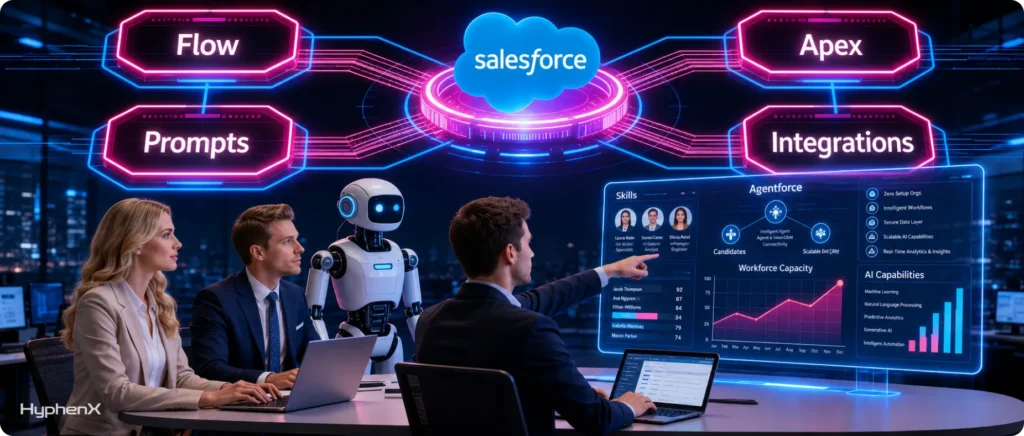
Once an agent understands a request and receives the right context, Salesforce still needs an execution path for the work that follows. Flow can handle declarative CRM operations, Apex can cover deeper logic and callouts, Prompt Builder can generate context-aware output, and integration services can connect Salesforce with external systems. Salesforce’s agentic implementation patterns include technical examples using Flow, Apex, Data 360, MCP, and agent-to-agent communication. This is one reason Salesforce hiring trends increasingly need to account for existing platform engineering capability alongside agent-specific experience.
Flow handles repeatable business actions
Autolaunched Flows can retrieve records, update Salesforce data, create records, start approvals, and run business processes that an agent needs to invoke. Admins may own simpler actions. Larger orchestration work needs careful input and output design, reusable components, permission awareness, fault paths, testing, and maintainable process logic. Complex Flow environments also benefit from clear ownership so agent-triggered automation doesn’t create hidden dependencies across unrelated CRM processes.
Apex supports deeper execution logic
Apex becomes useful when an action requires custom calculations, advanced validation, callouts, complex transformations, platform extensions, or error handling that is awkward to express declaratively. Developers working at this level need unit testing, code review, governor-limit awareness, permission checks, logging, and practical debugging experience. Generated code or AI-assisted coding doesn’t remove those responsibilities because the deployed logic still runs inside Salesforce platform limits and security rules.
Prompt Builder connects generated output with Salesforce workflows
Prompt Builder can bring Salesforce record data, Flow outputs, related information, and Apex-generated context into reusable prompt templates. Teams need to decide what context belongs in a prompt, who may execute the template, what output format downstream automation expects, and how generated responses will be evaluated. Prompt work becomes more technical when templates participate in automated processes instead of being used only for human-reviewed content.
Integrations extend agent actions beyond Salesforce
APIs and MuleSoft can connect agents with ERP systems, billing platforms, service tools, databases, and custom applications. This work requires authentication, source-of-record decisions, timeout handling, error paths, retries, monitoring, and clear ownership when a connected system fails. HyphenX Salesforce integration services can add cross-system engineering capacity when the missing capability sits in API design, middleware, data movement, or external application connectivity.
AI-assisted development still requires engineering review
Coding assistants can support drafts, tests, explanations, refactoring ideas, and debugging work. Developers remain responsible for business logic, security, platform limits, test coverage, source control, documentation, and deployment readiness. Salesforce AI talent becomes more useful when experience with AI-assisted development sits beside practical Flow, Apex, integrations, release management, and production troubleshooting.
Execution-layer capability map
Work type | Admin-level capability | Developer-level capability | Specialist requirement | Architecture involvement |
|---|---|---|---|---|
Flow actions | Standard automation and record operations | Complex orchestration and reusable logic | Advanced Flow design | Cross-cloud or high-dependency processes |
Apex actions | Understand action purpose and inputs | Build, test, debug, and secure code | Advanced platform or integration logic | High-risk or reusable enterprise patterns |
Prompt templates | Configure business context | Programmatic invocation and downstream handling | Advanced grounding or evaluation work | Shared AI design standards |
API integrations | Configure existing connections | Build and maintain callouts | MuleSoft or integration engineering | Several systems and data boundaries |
AI-assisted coding | Basic tool use and review | Review generated code, tests, and dependencies | Deep platform engineering | Architecture and security review |
Evaluate duration, utilization, seniority, and total economic fit
As Agentforce moves into workflows that read sensitive data, trigger business actions, or connect several systems, architecture decisions affect what an agent can access, which systems it can call, and which actions require human involvement. Salesforce’s enterprise agentic architecture guidance covers multi-agent designs, identity, permissions, governance, system boundaries, and observability across connected agent environments. The Salesforce AI skills needed at this level extend into architecture and risk ownership, and the required Agentforce skills sit on top of established Salesforce security, data, and integration knowledge.
Define system and data boundaries
Architects need to identify which Salesforce orgs, Data 360 sources, external applications, APIs, middleware services, and agents participate in a workflow. Those boundaries determine where information originates, which application owns a record, how data moves between systems, and where the agent’s authority ends. Boundary decisions also affect logging, incident response, permissions, data residency requirements, and the teams responsible for production support.
Design identity and permissions around the agent’s job
Every agent needs an identity and an access model appropriate to its assigned work. Permission sets, field-level security, sharing rules, Flow access, Apex access, connected-app permissions, and external credentials can affect what an agent sees or executes. Teams should document the minimum access required for each action, who approves permission changes, and how access will be reviewed as new actions or data sources are introduced.
Put controls around sensitive and external actions
Actions involving customer records, financial information, account changes, credentials, refunds, approvals, or external applications need explicit controls. Human confirmation may be required before selected actions run. External destinations, credentials, action permissions, and input validation need technical review. Testing should also cover prompt manipulation, unexpected instructions, permission failures, and requests that try to push an agent beyond its approved business role.
Plan governance for multi-agent work
Multi-agent environments create additional questions about delegation, shared context, access boundaries, and responsibility when one agent hands work to another. Architects need to document which agent owns each job, which tools it may call, what information can travel between agents, how failures are recorded, and which business owner accepts the operational risk. Governance also needs a change process because new tools, retrievers, instructions, or external connections can alter agent behavior.
Keep architecture decisions traceable
Architecture decision records can capture why a team selected a particular integration pattern, permission model, agent boundary, approval step, retrieval source, or human handoff. These records are useful during security reviews, production incidents, audits, later releases, and knowledge transfer. They also give future developers and administrators context when a configuration looks unusual yet reflects a deliberate business or security decision.
When deeper architecture expertise becomes justified
Deeper or fractional architecture support becomes useful when an implementation spans multiple Salesforce orgs, several connected agents, sensitive data, high-impact business actions, complex identity requirements, regulated processes, or several external applications. Periodic senior support can cover architecture reviews, permission models, integration decisions, threat analysis, and production-readiness checks when daily architecture workload doesn’t require a full-time specialist.
Testing, Evaluation, Observability, and DevOps Create a New Capability Gap
Agent testing reaches beyond checking whether Flow and Apex execute correctly. Teams also need to evaluate behavior, action selection, escalation, permissions, grounding, and production failures. Salesforce’s Agent Development Lifecycle separates agent work into design, development, testing and validation, deployment, and continuous monitoring and tuning. Each stage needs clear ownership because agent behavior depends on instructions, data, actions, permissions, external systems, and the release process around them.
Design: define expected agent behavior
- Document the jobs the agent should perform and the outcomes users should receive.
- Define restricted actions, approval requirements, and human escalation conditions.
- Record the data, permissions, integrations, and test environments required.
- Set acceptance criteria for common requests and known edge cases.
This gives QA specialists, Product Owners, Developers, and business owners a shared reference for evaluating behavior before production. Clear expectations also make later regression testing more useful because the team can compare changes against defined outcomes instead of relying on subjective impressions.
Build: test the components behind each action
- Check Flow logic, permissions, input handling, output handling, and fault paths.
- Test Apex code, security controls, callout errors, and exception behavior.
- Confirm that grounding sources return usable information under the expected access rules.
An agent depends on these components whenever it retrieves information or takes an action. Testing them separately helps the team locate the source of a failure. A broken Flow, expired credential, inaccessible retriever, or malformed API response can produce an agent failure even when the agent’s instructions are working as intended.
Test: evaluate behavior across realistic scenarios
- Test common requests, edge cases, and expected action sequences.
- Run regression checks when instructions, actions, prompts, or data sources change.
- Check escalation, guardrails, ambiguous requests, and adversarial inputs where the use case requires them.
- Record failed outcomes and the conditions that produced them.
Agent responses can vary between interactions, so behavioral evaluation needs repeatable scenarios and clear acceptance rules. Test records should capture the request, relevant context, action chosen, result received, escalation behavior, and reason for failure when one occurs.
Deploy: control how agent changes reach production
- Include agent configuration and related metadata in the release process.
- Retest affected permissions, Flow actions, Apex logic, integrations, and grounding dependencies.
- Define approval steps and rollback procedures for changes that affect live processes.
DevOps teams need visibility into agent assets alongside existing Salesforce releases. A change to an instruction, action, permission, or retrieval source can alter production behavior. Release notes and deployment records should identify those dependencies so support teams know what changed when an issue appears after release.
Monitor and tune: investigate production behavior
- Review traces, failed actions, escalation patterns, and integration errors.
- Watch latency, permission failures, unexpected tool selection, and repeated user corrections.
- Feed recurring production issues into regression tests and later releases.
- Record ownership for defects that cross Salesforce, data, middleware, or external applications.
Salesforce staff augmentation can cover a temporary gap in agent testing, DevOps, or production support when the internal team has limited experience in these areas. QA specialists, Developers, DevOps engineers, Architects, Agentforce practitioners, and Product Owners can divide responsibility according to the workflow, system dependencies, release cadence, and business risk involved.
How Existing Salesforce Roles Change in an AI-Enabled Delivery Team
AI adds responsibilities to roles that already understand the Salesforce platform, business processes, data, and delivery lifecycle. Admins, Developers, BAs, Architects, QA specialists, DevOps engineers, data professionals, and Product Owners can carry different parts of an Agentforce implementation according to their existing strengths. For workforce planning, Salesforce AI skills should be mapped onto the capabilities each role already owns. The strongest Salesforce AI talent combines that platform knowledge with practical experience in agents, grounding, testing, governance, release work, and production support.
Role | Core capability retained | AI capability added | Upskill or specialist? | When augmentation may make sense |
|---|---|---|---|---|
Salesforce Admin | Configuration, permissions, data quality, Flow, user support | Agent configuration, actions, grounding awareness, basic evaluation | Upskill for standard administration; specialist depth for complex behavior | Several agents, complex actions, or unfamiliar controls exceed current experience |
Salesforce Developer | Apex, LWC, testing, integrations, platform engineering | Custom actions, Agent Script, generated-code review, prompt and tool integration | Upskill when agent work extends existing development responsibilities | Advanced Apex, integrations, or agent engineering create a temporary workload or knowledge gap |
Business Analyst | Requirements, process mapping, stakeholder discovery, acceptance criteria | AI use-case definition, action boundaries, escalation design, behavioral acceptance criteria | Existing BAs can build these capabilities through project work and training | Complex discovery needs concentrated agent-process expertise |
Salesforce Architect | System design, integration patterns, security, technical standards | Agentic architecture, data boundaries, AI controls, multi-agent design | Internal architects can extend existing architecture ownership | Architecture demand peaks during design, integration, security review, or production preparation |
QA specialist | Functional testing, regression, defect management, release validation | Agent evaluation, adversarial cases, guardrail checks, trace investigation | Salesforce QA teams can extend their test approach | First production rollout or complex behavior needs deeper agent-testing experience |
DevOps engineer | CI/CD, metadata deployment, environment control, release management | Agent asset deployment, test automation, trace support, rollback planning | Upskill as agent assets enter normal releases | Release tooling needs temporary Agentforce-specific work |
Data professional | Data modelling, quality, pipelines, governance, source management | Data 360, grounding, RAG, retrieval, identity, semantic context | Upskill for manageable data environments | Several data sources or complex identity and retrieval requirements need concentrated expertise |
Product Owner | Roadmap, prioritization, business value, stakeholder ownership | AI use-case selection, risk boundaries, human-agent ownership, outcome evaluation | Internal ownership should remain strong | Temporary advisory support may help during discovery and initial rollout |
For Developer-specific hiring, AI experience should be assessed alongside evidence of practical Salesforce engineering. HyphenX’s guide to hiring Salesforce Developers covers the wider technical evaluation around Apex, platform experience, integrations, communication, and project fit. Agent-related knowledge adds another capability layer to that evaluation, especially when the Developer will own custom actions, Agent Script, external calls, generated-code review, or production debugging.
Decide What to Upskill, Hire Permanently, Augment, or Source Fractionally
Once the missing capability is clear, the sourcing choice should follow frequency of use, expected duration, internal ownership requirements, security sensitivity, project timing, learning time, technical depth, and the amount of knowledge that needs to remain inside the company. Current Salesforce hiring trends make AI fluency relevant across more roles, while advanced Agentforce skills can require concentrated experience during architecture, data preparation, integration, testing, or production rollout. A capability used throughout the roadmap calls for a different workforce model than expertise needed heavily for a defined project stage.
Capability | Long-term ownership need | Typical intensity | Upskill | Permanent hire | Augment | Fractional specialist |
|---|---|---|---|---|---|---|
Standard Agentforce administration | High | Continuous after rollout | Good choice when Admins already own the platform | Consider when workload creates lasting capacity demand | Useful during initial rollout or workload peaks | Low need |
Advanced agent engineering | Medium | High during builds and major changes | Suitable for experienced Developers with learning time | Consider when advanced development becomes continuous | Good choice for defined implementation phases | Useful for periodic design review |
Data 360 administration | High | Ongoing after broad adoption | Suitable for existing Salesforce or data teams | Consider when Data 360 becomes a permanent platform responsibility | Useful during setup, migration, or expansion | Low need for routine administration |
Complex data architecture and RAG | Medium to high | Concentrated around design and major changes | Possible when strong data architecture capability exists internally | Appropriate where complex data work remains continuous | Useful for defined implementation or remediation work | Good choice for architecture review |
Integration engineering | Medium | Varies with project activity | Suitable when existing Developers already own APIs | Consider when integrations require permanent engineering capacity | Useful for migrations, new systems, and temporary build demand | Useful for integration architecture decisions |
AI security and governance | High business ownership | Periodic technical intensity | Internal security and platform owners should build working knowledge | Consider when technical governance workload remains high | Useful for implementation controls and specialist reviews | Good choice for periodic senior oversight |
Agent testing and production readiness | High | Peaks around releases, then continues | Suitable for existing QA and DevOps teams | Consider when agent releases become frequent | Useful when first production rollout exceeds current testing depth | Useful for release-readiness review |
Salesforce architecture | High strategic ownership | Often periodic | Internal architects should retain platform context | Appropriate where architecture demand remains consistently high | Useful when a program creates temporary architecture workload | Good choice when senior judgment is needed at selected stages |
Ongoing platform ownership | Very high | Continuous | Primary path for established internal teams | Appropriate when permanent capacity is missing | Useful for temporary capacity pressure | Low fit for day-to-day ownership |
How to Evaluate Salesforce AI Specialists Before Adding Them to Your Team
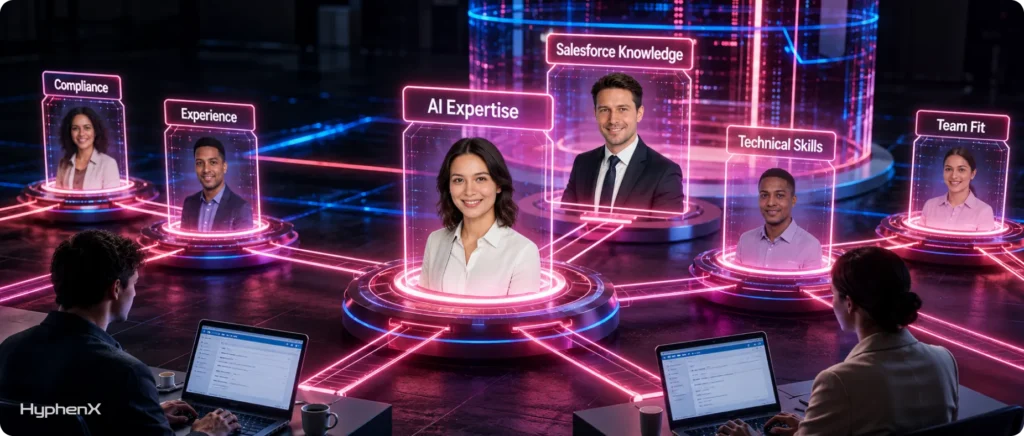
Production delivery requires evidence across Salesforce platform work, Agentforce implementation, data, automation, integrations, security, testing, and handover. Salesforce AI skills should be assessed through technical knowledge, project examples, design decisions, failure analysis, and evidence of work that reached real users. Certifications can support the evaluation by showing structured study. Project experience reveals whether the candidate can make trade-offs, diagnose failures, work inside an existing org, document decisions, and transfer ownership to the team that will maintain the system.
What to evaluate
- Platform foundation: Ask for recent work involving permissions, Flow, Apex, data models, integrations, releases, production support, and technical debt.
- Agentforce delivery: Look for experience defining subagents, instructions, actions, grounding, escalation, testing, deployments, and post-release support.
- Data and integration judgment: Ask how the candidate would select grounding sources, work with Data 360 retrieval, call external systems, and handle failures across system boundaries.
- Security and testing discipline: Review permission design, action boundaries, adversarial cases, regression testing, traces, incident investigation, and release controls.
- Knowledge transfer: Ask how architecture decisions, runbooks, dependencies, operating procedures, known limitations, and unresolved risks would be handed to the internal team.
Scenario-based interview questions
- How would you choose between Flow and Apex for an agent action?
- How would you ground an agent using enterprise information?
- How would you test agent behavior before production?
- Which business actions would require human approval?
- How would you investigate inconsistent responses across similar requests?
- How would you design escalation to an employee?
- How would you transfer the implementation to our internal Salesforce team?
Choose the provider model that matches the work
Salesforce’s Forward Deployed Engineering Partner Network announcement names firms including Accenture, Deloitte, IBM Consulting, Capgemini, Cognizant, PwC, and TCS as participants supporting Agentforce programs. These firms bring large delivery organizations and broad enterprise consulting capability. Specialist Salesforce providers and independent contractors operate under different delivery models. Use the comparison below as a sourcing framework based on project scope, management needs, team ownership, and the amount of specialist capacity required.
Factor | Global SI | Specialist Salesforce provider | Independent contractor |
|---|---|---|---|
Large enterprise transformation | Suited to broad, multi-team programs | Depends on provider depth and scope | Limited by individual capacity |
Embedded specialist capacity | Available within wider engagements | Common delivery model | Common delivery model |
Short specialist requirement | Depends on engagement structure | Well suited to defined capability gaps | Well suited when one person covers the need |
Multi-role Salesforce coverage | Broad teams across disciplines | Strong within provider’s Salesforce practice | Depends on the individual’s background |
Client-owned roadmap | Supported through shared governance | Works well with internal roadmap ownership | Requires direct client management |
Mid-market operating model | Can carry more process and governance overhead | Often suited to focused teams and defined work | Flexible, with more coordination handled by the client |
Knowledge transfer | Depends on engagement governance | Can be built into embedded delivery | Depends heavily on the individual |
Ability to add several specialists | High | Depends on provider bench and practice size | Usually requires several separate contractors |
For a mid-market company that already owns its Salesforce roadmap and needs embedded specialists for defined capability gaps, HyphenX can be a good choice based on its operating model. The company places Salesforce professionals inside the client’s delivery team and covers roles across administration, development, architecture, QA, DevOps, integration, and related Salesforce work. Its guide to Salesforce staff augmentation explains how this model works when companies want additional capacity while retaining control of priorities, backlog decisions, and internal platform ownership. Large global SIs remain relevant when a program requires broad enterprise transformation, extensive cross-functional consulting, or a large multi-region delivery organization.
Red flags
- Demo-only Agentforce exposure with little evidence of production work
- Weak Salesforce platform fundamentals underneath AI terminology
- Vague explanations of data access, permissions, testing, integration failures, or security boundaries
- Certification presented as the primary evidence of implementation ability
- No clear method for documentation, support handover, or knowledge transfer
- Difficulty explaining trade-offs, failed approaches, production incidents, or lessons from previous implementations
Tomorrow's AI skills, certified and available today
AI is reshaping the skills your Salesforce team needs. That's why we invest in proof: 250+ Salesforce certifications held across our delivery and consulting roles. Short on in-house capacity? Augment your team with certified experts who hold these credentials and start contributing from week one. Certified professionals cover AI, data and core platform work, so you fill gaps without risky permanent hires. Curious about the people behind the badges? Meet the HyphenX team.
FAQs About AI Skills and Salesforce Staffing
1. Which AI capabilities matter most in a Salesforce project?
Start with the capabilities tied to the business use case. Common areas include Agentforce design, Data 360 grounding, Flow and Apex actions, integration engineering, permissions, security, behavioral testing, deployment, production monitoring, and human escalation. The required depth changes according to the systems involved, data sensitivity, process complexity, action risk, existing team experience, and the amount of autonomy given to the agent.
2. What should an Agentforce specialist actually know?
A capable specialist should understand agent design, subagents, instructions, actions, Agentforce Builder, Flow, Apex, grounding, Data 360, integrations, permissions, testing, and production support. Senior work can also require Agent Script, architecture judgment, multi-agent designs, MCP-based tool access, trace analysis, release controls, and clear escalation paths. The role should be evaluated against the project being delivered because a configuration-heavy implementation needs a different depth from a cross-system enterprise program.
3. Do Salesforce Developers need AI experience now?
Developers working on agent-enabled projects benefit from practical experience with Agentforce actions, Prompt Builder, Agent Script, grounding, generated-code review, and agent testing. Their existing engineering foundation carries much of the implementation work, especially Apex, LWC, APIs, security, debugging, unit tests, governor limits, source control, and releases. AI experience becomes especially useful when Developers are responsible for custom actions or external system behavior.
4. How much Agentforce experience should Salesforce Admins have?
The required depth depends on the org and the Admin’s responsibilities. Admins supporting agent-enabled workflows should understand agent configuration, permissions, Flow-backed actions, data access, basic grounding concepts, escalation, and testing. Admins who already own business automation can often extend that knowledge into Agentforce. Custom code, complex integrations, advanced architecture, or sensitive cross-system actions can bring Developers and Architects into the same delivery team.
5. Why does Flow matter for Agentforce?
Flow gives agents a way to execute established Salesforce business processes through defined actions. An autolaunched Flow can retrieve records, create or update data, invoke business logic, and return results needed by an agent. Teams also need sound input and output design, fault handling, permissions, reusable automation, documentation, and regression testing so the Flow continues to behave correctly when invoked through an agent.
6. Why does Data 360 matter for Salesforce AI projects?
Data 360 can provide enterprise context used by agents and other Salesforce processes. It supports work around ingestion, mapping, identity, structured information, unstructured content, search indexes, retrievers, and RAG. Its role grows when useful customer or operational context lives across several systems. Teams also need data ownership, permissions, source quality, retrieval design, and governance so agents receive information appropriate to the task.
7. Does every Salesforce AI project need an Architect?
Architecture involvement should match technical complexity and business risk. A contained implementation using familiar Salesforce processes may need periodic architecture review. A program involving several orgs, external applications, complex identity rules, sensitive data, multiple agents, or high-impact actions can require deeper architecture ownership throughout design and release work. The decision should follow the number of dependencies and the consequences of poor technical choices.
8. What testing capability does an AI agent project need?
Teams need conventional Salesforce testing and agent-specific behavioral evaluation. Flow and Apex still require functional and technical tests. Agent work adds expected-behavior scenarios, action-selection checks, grounding tests, permission checks, escalation cases, regression tests, adversarial inputs, trace analysis, and production monitoring. Test ownership can be shared among QA, Developers, DevOps engineers, Product Owners, and agent specialists according to the workflow.
9. Which AI-related capabilities are good candidates for temporary external specialists?
Finite or phase-heavy requirements can suit external specialists. Examples include Data 360 setup, complex integration work, advanced agent engineering, architecture reviews, security assessments, test-framework setup, release preparation, and production stabilization. The sourcing decision should consider project duration, internal learning time, future utilization, access sensitivity, knowledge transfer, and whether the company expects to perform the same work frequently after launch.
10. Which capabilities should a company retain internally?
Business-process ownership, product priorities, data stewardship, risk decisions, roadmap control, user needs, and long-term platform knowledge need clear internal owners. Internal teams also need enough technical understanding to operate and govern what external specialists build. Outside expertise can support implementation and knowledge transfer, while the organization retains people who understand why the system exists, which outcomes matter, and who carries business accountability.
11. How should an IT leader evaluate an Agentforce candidate?
Use scenario questions tied to delivery work. Ask the candidate to choose between Flow and Apex, explain how they would ground an agent, define action permissions, design human escalation, investigate inconsistent behavior, and describe production testing. Ask for examples of failed approaches as well as successful ones. Strong answers should reveal technical reasoning, project experience, trade-off judgment, security awareness, documentation habits, and a clear handover method.
12. Are Salesforce AI certifications enough to prove implementation capability?
Certifications can show structured study of current Salesforce concepts and provide a useful baseline for technical interviews. Pair them with project examples, architecture reasoning, debugging experience, testing discipline, security decisions, documentation quality, production support experience, and evidence that the candidate has worked through real implementation constraints. A practical interview should examine how the person makes decisions when several technically valid options exist.