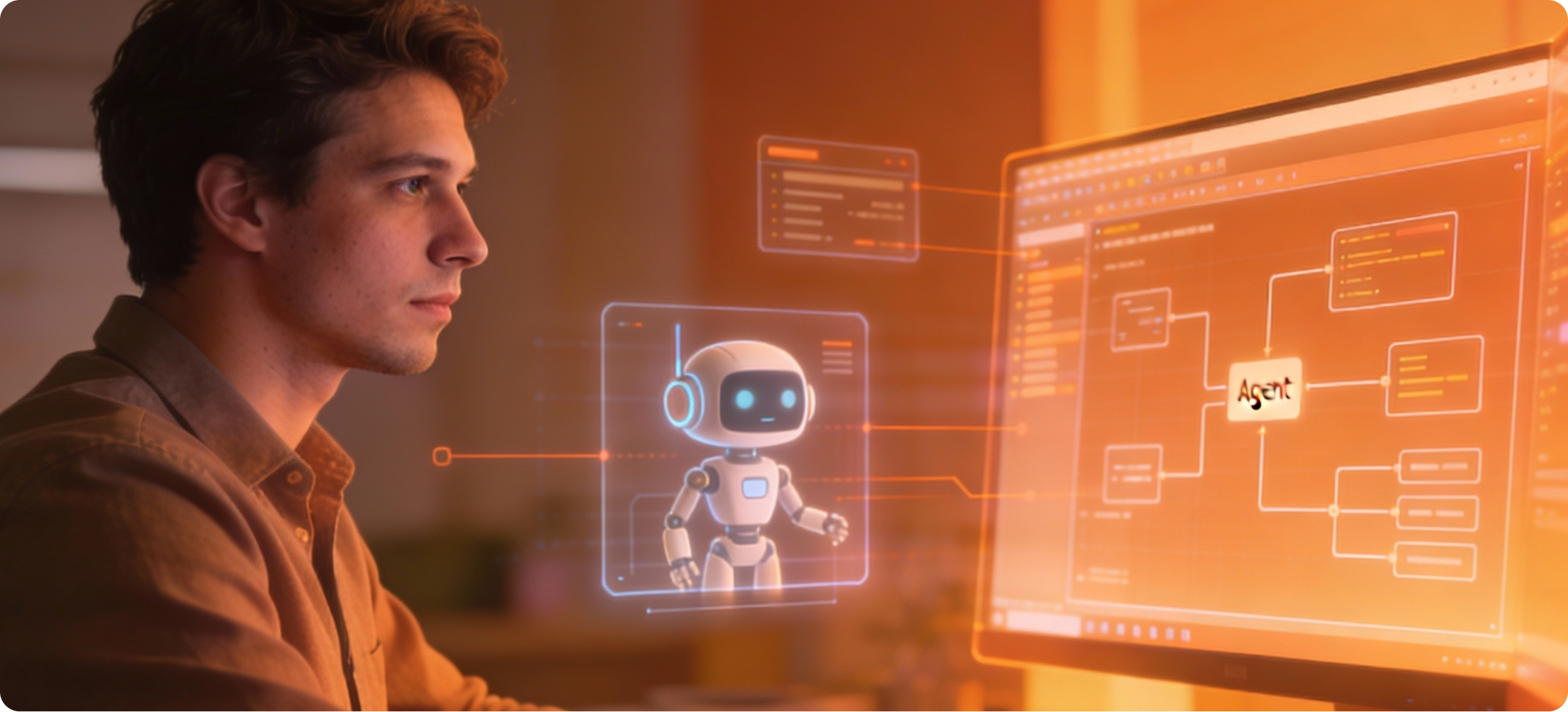
AI security is now a board-level concern as AI agents move into daily business operations. Industry research shows that most CIOs already use AI systems or plan near-term adoption, according to recent Gartner CIO surveys. At the same time, multiple enterprise studies report real incidents involving unintended data access and unapproved actions by AI-driven systems, highlighted in security research from IBM Security and MIT Technology Review. Because of this, safety must be addressed before scale, not after.
As adoption increases, controlling AI becomes essential for trust and stability. While AI alignment sets basic behavioral intent, it does not fully protect systems. Strong AI control requires tighter permission models and clear operational limits. In practice, this means granting AI agents only the minimum access needed for a defined task, which is a core principle recommended in NIST AI Risk Management Framework guidance.
This guide focuses on practical AI security measures that work in real environments. It explains how to design permissions, enforce data boundaries, and apply human-in-the-loop oversight. These controls support AI for security while still allowing teams to benefit from automation. When applied correctly, security AI reduces exposure and helps organizations capture measurable value from AI, a potential impact estimated by McKinsey Global Institute to reach trillions annually across industries.
Understanding AI Agent Permissions
Permissions are the base of AI security, but AI agents change how access must be designed and enforced. These systems act on their own, often without continuous human review. Because of this autonomy, permission models must be more precise, more contextual, and easier to audit than traditional approaches.
What permissions mean for AI agents
For AI agents, permissions go beyond simple access rules. They define what actions an agent can perform, which data it can read or modify, and how it can interact with connected systems. Since agents work at high speed and scale, even small permission gaps can quickly turn into serious risk.
When access is too broad, exposure rises sharply. An overprivileged agent behaves like a permanent super admin that never pauses. This is why controlling AI starts with strict, task-based permissions. Context-aware permissions offer a safer approach. Instead of fixed roles, access decisions are evaluated in real time based on intent, data sensitivity, and execution conditions. This model improves AI control while still allowing agents to operate effectively.
Why traditional access models fall short
Most Identity and Access Management models were created for human users. Static roles, long-lived sessions, and reusable credentials do not align with how AI agents operate.
Problems appear because AI agents:
- Act frequently and for short durations
- Switch tasks that require different access levels
- Operate at machine speed and scale
- Chain actions across systems without pause
Because of this behavior, traditional IAM struggles to control AI safely. Static API keys and service accounts increase risk when used with autonomous systems, weakening overall ai security rather than strengthening it.
Why identity matters for AI agents
Identity provides accountability. Without a clear identity, agent actions cannot be traced, reviewed, or restricted properly. Strong security AI depends on treating every agent as a first-class digital identity.
A practical approach includes:
- Registering each agent as a unique identity
- Assigning purpose-based attributes and limits
- Defining clear ownership and responsibility
Agents should never act as human users. Clear separation keeps access transparent, auditable, and compliant. When identity and permissions stay aligned, AI for security becomes a reliable control layer instead of a weak point.
Setting Data Boundaries for AI Agents
Strong AI security goes beyond identity and permissions. It also depends on clear limits around what data AI agents can access and process. Since data directly shapes agent behavior, weak boundaries increase both security risk and performance issues.

Defining context windows and scope
A context window defines how much information an AI agent can process at one time. It functions like working memory. As this window fills, accuracy drops, a behavior widely discussed in large-model research by OpenAI and Google DeepMind. When older context falls out, agents can make incorrect decisions without warning. Because AI agents choose actions autonomously, scope control becomes critical. Each token consumed reduces the agent’s remaining attention budget. Once that budget is exhausted, reasoning quality declines.
To manage this safely:
- Summarize conversations as context limits approach
- Store long-term notes outside the active context window
- Use sub-agents for focused tasks with clean context
In addition, teams must decide where data belongs. Information tied to measurable outcomes should be prepared for agent use. Everything else should remain in collaboration systems. This separation supports AI control without blocking useful insight.
Preventing data leakage through isolation
AI agents do not create new access. Instead, they activate existing permissions. This turns unused or forgotten access into real exposure. According to Varonis and IBM Security research, the average employee can access millions of files, with a significant portion marked sensitive. To reduce risk, organizations need strict guardrails that control both input and output. In practice, agents should operate in sandboxed environments and avoid direct access to production systems unless required.
In shared environments, isolation should include:
- Logical tenant separation
- Database-level controls
- Container-based execution
Outbound access also matters. Egress allowlists limit where agents can send data, reducing the risk of silent data exfiltration. These steps are essential for controlling AI in real environments.
Using segmentation to limit exposure
Data segmentation further strengthens ai security by reducing unnecessary visibility. Breaking data into defined domains limits what an agent can see and act on.
A safe approach includes:
- Auditing open and over-shared data
- Applying sensitivity labels and DLP policies
- Restricting access based on business purpose
The medallion model offers a practical structure. Raw data stays separate from validated and business-ready datasets. AI agents should mainly access curated layers to avoid errors and inconsistent outcomes. Industry reports from Microsoft Security show a sharp rise in GenAI-related data loss incidents, which highlights why ai for security must include segmentation as a core control.
The goal is not to avoid AI agents. The goal is to deploy them safely. Clear context limits, strong isolation, and disciplined segmentation reduce exposure while preserving value. When these controls are reviewed regularly, security AI becomes a safeguard instead of a liability.
Implementing Human-in-the-Loop Oversight
Human oversight acts as the final safeguard in any strong AI security model. Even with well-defined permissions and firm data boundaries, some decisions still need human judgment. This layer protects users, systems, and outcomes when automation reaches its limits.
When humans should step in
Human review becomes essential when AI agents face uncertainty or higher risk. Industry guidance from NIST and regulatory bodies consistently highlights the need for escalation in sensitive or ambiguous situations.
Human involvement is appropriate when:
- A request is complex, urgent, or sensitive
- A user asks for human support
- The agent lacks enough context to proceed
- The outcome affects revenue, compliance, or customer trust
This approach supports controlling AI without slowing down routine work. The goal is not constant supervision but timely intervention when it matters.
Designing clear escalation paths
Effective oversight depends on planning before deployment. Teams should define which scenarios trigger escalation and where those requests go, such as support queues or specialist teams.
Well-designed escalation paths include:
- Clear messaging that explains the handoff
- Smart routing based on skill and availability
- Full context transfer so users do not repeat details
- Backup paths if escalation fails
Strong handoffs reduce friction and maintain trust. Poor handoffs weaken security ai even if the underlying model performs well.
Balancing autonomy with accountability
The challenge is allowing AI agents to act independently while keeping humans accountable. Regulatory guidance such as the EU AI Act stresses that high-risk systems must support monitoring, intervention, and shutdown when needed.
A practical model uses tiered control:
- Low-risk actions run autonomously
- Medium-risk actions request approval
- High-risk actions escalate to experts
With regular reviews and feedback loops, teams improve AI control over time. This balance allows organizations to scale automation safely while keeping AI for security grounded in human responsibility.
Best Practices for Controlling AI Agents
Strong AI security separates useful automation from hidden risk. When AI agents act on their own, security controls must be deliberate, simple, and enforceable. The following practices focus on what matters most.
Use least-privilege access
Least privilege is the base of AI security for autonomous systems. Each agent should receive only the access needed for a single task. Nothing extra. This limits damage if something goes wrong and blocks sideways movement across systems. In practice, access rules should adjust based on agent role and data sensitivity. Since agents usually handle narrow tasks, permissions should remain narrow as well. This is a core principle for anyone trying to control ai safely.
Apply short-lived tokens and scoped access
Token design is a critical part of controlling AI. Long-lived credentials create standing risk. Short-lived tokens reduce that exposure by expiring automatically. Use scoped tokens that describe exact rights instead of broad access. For example, an agent may read a single resource for a limited time. This aligns with how agents work and strengthens AI control without slowing execution.
Log every agent action
Visibility is essential for security AI. Every agent action should be logged with clear identity and context.
Logs should record:
- What the agent accessed
- When the action occurred
- Which identity and token were used
- Whether the action followed policy
These records support audits, incident review, and early detection of abnormal behavior. Without this trail, AI security weakens quickly.
Keep agent and user identities separate
Agents must never hide behind shared or user identities. Each agent needs its own identity, linked to but separate from the delegating user. This separation creates accountability. Users remain users. Agents remain agents. Authority is delegated, not blurred. This structure improves traceability and keeps AI for security practical and enforceable. Moreover, safe automation depends on discipline. Least privilege, short-lived access, full logging, and clear identity separation together form a reliable AI control model. When these practices stay consistent, AI agents create value without becoming a security liability.
Tools and Frameworks for AI Control
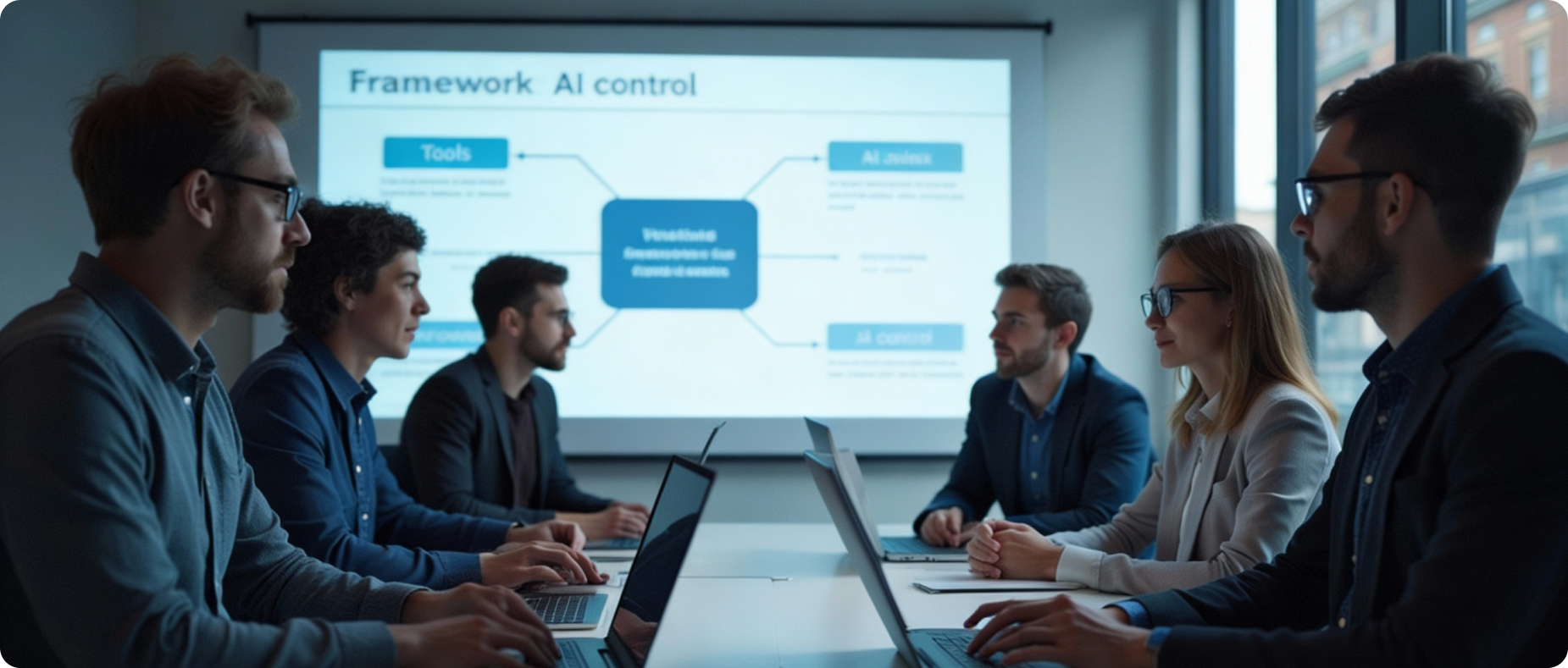
Strong AI security depends on real tools, not theory alone. Today, several frameworks help teams apply clear boundaries, visibility, and enforcement across AI agents.
Using Model Context Protocol (MCP)
Model Context Protocol, or MCP, provides a standard way to connect AI systems with external data safely. Often described as a common connector for AI applications, MCP removes the need for custom integrations for every data source. Its structure separates responsibilities clearly. The model handles reasoning, clients manage communication, and servers expose approved context. This separation supports AI control by limiting how and where agents pull data, while keeping access consistent and auditable.
Agent builders and low-code platforms
Low-code and no-code agent builders help teams deploy AI with built-in safeguards. These tools allow configuration of identity handling, access scope, and content filtering without deep engineering effort. Most platforms offer visual flows that define what an agent can do and when it can act. This makes controlling AI practical even for non-technical teams, while still enforcing guardrails required for AI security.
Monitoring tools and dashboards
Visibility is essential once agents are live. Monitoring platforms provide a clear view into agent behavior, tool usage, and system performance across environments. Logs, metrics, and usage analytics help teams detect issues early, support audits, and refine behavior over time. Without this visibility, security AI quickly loses effectiveness.
Security AI for real-time alerts
Real-time detection adds another layer of protection. Modern systems use AI-driven monitoring to flag unusual patterns such as performance drops, unexpected access, or data shifts. These alerts help teams respond quickly based on severity and impact. When combined with logging and isolation, AI for security becomes proactive rather than reactive. The right tools turn policy into action. Protocols, builders, monitoring, and alerting together create a practical AI control framework that keeps agents useful, visible, and safe.
Conclusion
AI agents offer real and measurable business value. Industry research from McKinsey Global Institute estimates that AI could contribute up to $4.4 trillion annually across industries. However, this value is only achievable when AI security is treated as a core design requirement, not an afterthought. As agentic systems become more autonomous, the cost of weak controls rises just as quickly as the benefits. At the foundation, permissions must be rethought. Autonomous agents operate continuously and at scale, which makes traditional access models ineffective. Strong AI control depends on context-aware permissions and clear identity separation. Agents should function as governed digital entities, not hidden extensions of human users. This shift improves accountability and reduces silent risk.
Equally important, data boundaries protect both security and system quality. Proper context window management, isolation of environments, and disciplined data segmentation prevent leakage while preserving performance. AI agents do not invent new vulnerabilities. Instead, they expose existing weaknesses faster. Because of this, controlling AI requires disciplined data governance long before agents go live. Human oversight remains the final and most important safeguard. Even advanced systems encounter uncertainty, sensitive decisions, or edge cases that demand judgment. Well-designed escalation paths and approval models ensure agents know when to pause and involve people. This balance allows automation to scale while keeping AI for security grounded in responsibility and trust.
Finally, the principle of least privilege ties everything together. Short-lived credentials, detailed audit logs, and separate agent identities form a durable security baseline. With modern frameworks, monitoring tools, and emerging standards, these practices are no longer theoretical. They are practical and achievable today. The future of AI agents depends not only on what they can do but also on how safely they are deployed. Organizations that establish strong guardrails early can unlock innovation while avoiding data loss, unauthorized access, and compliance failures. In the long run, disciplined security AI is not a constraint. It is what makes large-scale AI adoption possible and sustainable.