


Ask five different Salesforce partners how to roll out your implementation, and four of them will eventually say the same unhelpful thing: it depends. They’re not wrong. It genuinely does depend. What they usually skip is the part that actually helps you, which is what it depends on.
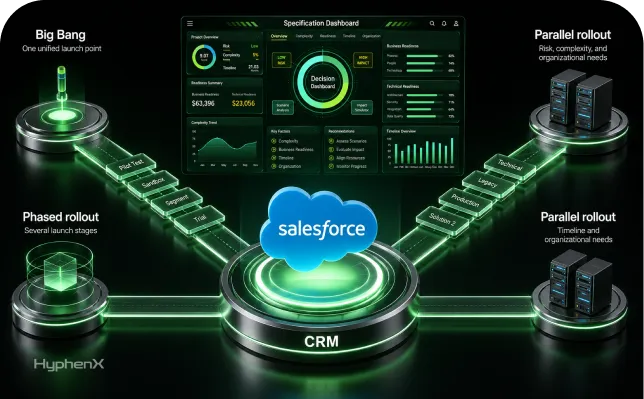
Salesforce implementations get rolled out in one of three ways. You either flip the switch for everyone at once, you bring teams on in stages, or you run the old and new systems side by side until you trust the new one. Every guide on the internet will define those three approaches for you. Almost none of them will tell you how to pick, beyond a vague nod toward “your goals and risk tolerance.”
This guide does the second part. We’ll define the three approaches quickly, because that part genuinely is simple, and then spend most of our time on the five questions that actually decide which one fits your organization. By the end, you shouldn’t need to guess. You should be able to look at your own answers and know.
TL;DR
Big Bang moves everyone to Salesforce at one cutover point. It works best when data is clean, processes are consistent, and the organization can absorb a concentrated change.
Phased rollout moves teams, regions, or business units in stages. It gives each wave time to learn from the previous one, but it extends the rollout and can create temporary dependencies between old and new systems.
Parallel keeps both environments available for a defined validation period. It provides a stronger fallback when failure carries serious consequences, but it also adds system cost, reconciliation work, and operational overhead. Many Salesforce programs combine these approaches across different parts of the business.
The Three Approaches, Defined Properly
Before the decision-making, a fast, honest look at what each approach actually involves, specifically for Salesforce, not generic enterprise software.
Big Bang
Everyone moves to Salesforce at the same cutover point. Every team and workflow begins operating in the new environment together, and the legacy system is retired from active use. It may remain available for historical reference or as part of a controlled fallback plan, but users aren’t gradually moved over team by team.
It’s the fastest path to full value and, on paper, the cheapest, because you’re not paying to run two systems or staff a multi-month rollout. The catch is concentration of risk. If your data migration has a flaw, if a critical workflow wasn’t tested thoroughly enough, if your team isn’t ready, everyone hits that problem on the same day, all at once. There’s no smaller group absorbing the lesson before it reaches the whole company.
Big Bang tends to suit organizations that are smaller, have relatively clean data going in, run fairly standardized processes, and have a team that’s genuinely prepared before launch day. It rewards thorough preparation and punishes anything left undone.
Phased
You break the rollout into stages, usually by team, department, or region, and move each group over in sequence. Sales goes live first, then service, then marketing, each stage building on lessons from the one before it.
Phased rollout often fits larger or more varied organizations because it lets a smaller group go through the transition before the next group moves. Problems can be found and corrected within one phase instead of reaching the entire company at once. The cost is time and sustained project attention. A Phased rollout can unfold over months or longer, and repeated delays can drain momentum before the final group goes live. Phased tends to suit larger organizations, multiple business units or geographies, more complex or varied processes, and teams that can tolerate a longer runway in exchange for lower risk at each step.
Parallel
Both systems remain available for a defined period while Salesforce is validated. The team needs a clear rule for which system is authoritative for each process and how information is synchronized or reconciled between them. The legacy environment provides additional protection while the new one proves it can support the business reliably.
That protection creates extra cost and operational work. Two environments may need licensing, support, integrations, reconciliation, and monitoring at the same time. Some designs may also require limited duplicate entry, but that should be controlled rather than treated as a requirement of every Parallel rollout. Parallel fits situations where the consequences of a failed transition justify the additional work and expense.
Parallel tends to suit situations with genuinely low risk tolerance, often driven by regulatory requirements, a history of failed system changes, or data so critical that verifying it in two places is worth the pain. It’s rarely the cheapest or fastest choice, and it’s usually chosen for a specific reason rather than by default.
Factor | Big Bang | Phased | Parallel |
Go-live | One coordinated cutover | Staged by team, department, region, or business unit | Old and new environments coexist for a defined period |
Speed | Fastest path to full-org cutover when the organization is ready | Longer path to full completion because rollout happens in waves | Includes an additional coexistence or validation period |
Cost | Often lower transition overhead | Higher project overhead across multiple rollout waves | Usually higher while two environments are maintained |
Risk profile | Risk is concentrated around one cutover | Problems can be contained within individual phases | Stronger fallback, with added reconciliation and coexistence risk |
Best fit | Smaller or uniform organizations with clean data and strong readiness | Organizations with clear rollout boundaries across teams, regions, or units | Situations where transition failure carries serious operational or compliance consequences |
Main downside | Problems can affect everyone at once | Longer programs can lose momentum | Dual-system support, reconciliation, and additional cost |
These Aren’t Strictly Separate Lanes
Here’s something most comparisons gloss over: you don’t have to pick exactly one for the entire company. A common and genuinely smart pattern is blending them, Big Bang for your primary business unit or your cleanest, most standardized team, and Phased for the rest of the organization where processes are messier or stakes are higher. The three approaches are tools, not a multiple-choice question with one correct answer.
That’s really the whole thesis of this guide. The question isn’t “which of the three am I.” It’s “given what’s actually true about my organization, how should I combine these three tools.” Which brings us to the part everyone skips.
The Five Questions That Actually Decide It
Generic advice says to weigh your goals, budget, and risk tolerance. That’s true and also nearly useless, because it doesn’t tell you how to weigh them. These five questions do. Answer them honestly about your own organization, and a pattern will emerge fast.
1. How Clean Is Your Data, Really?
Not how clean you assume it is. How clean it actually is, based on someone opening the CRM and looking.
If your accounts, contacts, and records are largely accurate and deduplicated, you can move with confidence, and Big Bang becomes a real option. If your data has years of duplicate accounts, inconsistent naming, and fields nobody’s trusted in a while, moving everyone over at once means everyone inherits that mess on day one. A Phased approach lets you clean and validate data for one group at a time, catching structural problems before they spread. This single question eliminates more options than any other on this list.
2. How Big and How Varied Is Your Organization?
A 40-person company with one sales process is a fundamentally different rollout than a 2,000-person company running five business units across three countries with three different ways of doing the same job.
Smaller, more uniform organizations can often handle one coordinated go-live because there are fewer process variations and stakeholders to manage. Larger organizations may have natural boundaries that make Phased rollout practical, such as regions, business units, or separate operating teams.
3. What’s Your Real Tolerance for Things Going Wrong?
Not your stated risk tolerance in a planning meeting. Your actual, felt tolerance, the one that shows up when a critical report is wrong for two days or a sales rep can’t log an opportunity during a busy week.
Some organizations can absorb a rough week. Retail, tech companies, teams with a culture of moving fast and fixing forward, they can often stomach a Big Bang bump and recover quickly. Others genuinely cannot. Regulated industries, organizations with a track record of a previous system change going badly, teams where a single bad day creates disproportionate damage to trust or compliance, these need the safety net that Parallel or a cautious Phased rollout provides. Be honest here. Overestimating your organization’s tolerance for disruption is one of the most common reasons a Big Bang rollout turns into a crisis.
4. What Does Your Budget Actually Look Like?
Look beyond the total budget and consider how that budget can be spent over time. A tight budget with little room for extended coexistence may make Big Bang attractive when the organization is genuinely ready. A budget that can support multiple rollout waves gives Phased more room. Parallel requires budget for maintaining two environments during the validation period, including licensing, support, integrations, reconciliation, and internal team time.
Teams that pick Parallel without budgeting for its real cost are usually the ones who abandon it halfway through, which is worse than never starting it.
5. How Much Bandwidth Do Your Stakeholders and Users Actually Have?
A rollout doesn’t just need a budget and a technical plan. It needs people, actual humans with actual calendars, available for training, feedback, and adjustment.
If your stakeholders can carve out focused time and your users can absorb a single concentrated change, Big Bang asks less of them across a shorter window, even if that window is intense. If they’re already stretched thin, a Phased approach spreads the demand on their time across a longer period, which is often more sustainable even though the total effort may be similar. Parallel asks the most of everyone for the longest time, since your team is effectively doing two jobs until the old system finally goes away. If bandwidth is your scarcest resource, that fact alone should weigh heavily in your decision.
Reading Your Own Answers
Look at what you just wrote down. If most of your answers point toward clean, contained, and prepared, small, uniform, higher risk tolerance, tight budget, focused bandwidth, you’re likely looking at Big Bang. If they point toward large, varied, and cautious, you’re likely looking at Phased. If risk tolerance is genuinely low and the budget has real room for it, Parallel deserves serious consideration, especially for the specific parts of your business where getting it wrong would be expensive in ways that go beyond money.
Most organizations don’t land cleanly in one column. That’s normal, and it’s exactly why blending approaches by team or business unit, rather than forcing one answer across the whole company, is usually the right move. The next section shows what that actually looks like in three real-world situations.
Three Companies, Three Different Verdicts
The five questions are more useful in motion than in the abstract, so here are three organizations running through them. None of them are real companies, but every detail is the kind of thing that shows up in an actual project. See which one your organization resembles.
Scenario 1: The Fast-Moving Startup
A 60-person SaaS company is replacing a patchwork of spreadsheets and a barely-used free CRM with Salesforce. One sales team, one process, one office. Leadership wants it live before the next board meeting, six weeks out.
Run it through the five questions. Data cleanliness: genuinely good, there isn’t much history to clean up, and what exists is small enough to review by hand. Size and variety: small and uniform, one team doing one job one way. Risk tolerance: high. This is a company used to moving fast and fixing things after the fact, and a rocky first week won’t threaten the business. Budget: tight, and there’s no appetite for paying to run two systems or stretching the project over six months. Stakeholder bandwidth: concentrated but real, the whole company can focus on this for two intense weeks around launch.
Every answer points the same direction. This is a clean Big Bang candidate. The team is small enough to support closely on day one. The data is light enough to migrate with confidence. And the tolerance for a bumpy first week is genuinely there, not just claimed in a planning meeting.
A Phased rollout here would just add months to a project that doesn’t need them, stretching a six-week plan into a quarter for the sake of caution nobody’s actually asking for. Parallel would be worse: paying to babysit a free CRM nobody wants to keep using anyway, just to hedge against a risk this company can comfortably absorb. The support team plans for a busy launch week, leadership blocks two weeks for hands-on help, and the whole thing wraps before the board meeting with time to spare.
Scenario 2: The Mid-Market Manufacturer
A 450-person industrial equipment company is moving off an aging on-premise CRM. It runs three business units, sales, service, and a dealer network, each with its own process, its own data quirks, and its own management chain that doesn’t always agree with the other two.
Data cleanliness: mixed. Sales data is in reasonable shape. The dealer network’s records are inconsistent, duplicated across regions, and nobody’s fully sure which entries are current. Size and variety: large and genuinely varied, three units that don’t operate the same way. Risk tolerance: moderate. A bad week in sales is recoverable; a bad week in the dealer network, which touches external partners, is more sensitive. Budget: reasonable, with the flexibility to spread cost across a couple of fiscal quarters rather than needing everything done in one. Stakeholder bandwidth: thin at any given moment, since none of the three unit leaders can clear their calendar for an intense two-week push, but they can each commit real time in sequence.
This one splits, and that’s the point. Sales, with its cleaner data and more contained scope, could reasonably go first and fast, almost a Big Bang within its own unit. The dealer network, with its messier data and higher sensitivity to external partners, needs the extra runway a genuinely Phased rollout provides, cleaning and validating records as it goes rather than dragging years of duplication into a single go-live day. Service sits in between, clean enough to move with confidence but complex enough to benefit from watching sales go first.
The right call here isn’t Big Bang or Phased for the whole company. It’s an accelerated first phase for sales, a second phase for service once early lessons are in hand, and a deliberately slower, more careful phase for the dealer network, each getting the time its data and its risk actually require. Forcing one label across all three units would have meant either rushing the dealer network or needlessly slowing down sales, and neither serves the business.
Scenario 3: The Regulated Financial Services Firm
A 900-person wealth management firm is replacing a legacy platform that’s been in place for over a decade, deeply embedded in compliance reporting, audit trails, and client-facing workflows that regulators actively examine.
Data cleanliness: this is less the question than accuracy under scrutiny, since every client record has compliance implications if something migrates incorrectly. Size and variety: large, with fairly standardized core processes but extremely low tolerance for any single record being wrong. Risk tolerance: very low, not by preference but by regulatory reality; a visible data error isn’t just inconvenient, it can trigger an audit finding. Budget: substantial, with real room built in for a longer, more cautious transition. Stakeholder bandwidth: high, because compliance and leadership are already deeply engaged given what’s at stake.
Here, the safety net matters more than speed or cost. This firm can afford to run the legacy platform and Salesforce in parallel for a defined period, verifying that every client record, every compliance report, and every audit trail matches before fully retiring the old system.
It’s the most expensive option in this scenario, and it delays the point when Salesforce becomes the single trusted environment. For an organization where an incorrect compliance report can carry regulatory consequences, though, the additional validation period has a clear purpose. It gives the team time to catch discrepancies before the legacy platform is retired and before bad information reaches a downstream report or regulated process.
What the Three Scenarios Have in Common
None of these companies picked their approach because of a stated preference for speed or caution. Each one landed on its answer because of specific, checkable facts about their data, their size, their real risk exposure, their budget shape, and their people’s actual availability. Notice, too, that none of them made the decision in isolation. The startup’s answer changed if you’d swapped in messy data. The manufacturer’s answer changed unit by unit, not company-wide. The financial services firm’s answer would look entirely different for a company the same size operating outside a regulated industry. The approach follows the facts, not the other way around.
That’s the pattern worth taking away. The right approach isn’t a philosophy. It’s a conclusion you reach by looking honestly at five things that are true about your organization right now.
What It Costs You to Pick Wrong
Choosing the wrong approach isn’t usually catastrophic on its own. It’s expensive in a specific, predictable way, and it’s worth knowing what that looks like before you commit.
Pick Big Bang when your data or your organization wasn’t ready for it, and the failure shows up everywhere at once. A single bad migration, a single untested workflow, and every team hits it simultaneously on day one. Because there’s no smaller group that absorbed the lesson first, the fix happens under maximum pressure, with the whole company watching and no fallback to lean on.
The damage rarely appears as one dramatic outage. It can look like a sales team questioning pipeline numbers for two weeks, a support queue building because case routing was configured incorrectly, or leadership losing confidence in a system that appeared ready before go-live. Those problems rarely appear as individual line items in the project plan, but they affect adoption quickly when users experience them during their first days in Salesforce.
Pick Phased when your organization was actually small and simple enough for Big Bang, and the cost is different but still real. You pay for a longer project, a longer period where your team is straddling two ways of working, and a slow erosion of momentum. If go-live dates slip, and on long projects they often do, users start to feel like the rollout will never actually finish, and enthusiasm that was there at the start quietly drains away before the project reaches its final stage.
There’s a budget dimension here too that’s easy to underestimate. A Phased rollout scoped for 6 months that stretches to 10 adds 4 months of partner time, internal project work, and business attention that wasn’t part of the original schedule. The organization also spends longer operating across different processes while later phases wait for their turn. An unnecessarily long rollout can therefore cost more through both project spend and delayed adoption.
Pick Parallel when the risk doesn’t justify the additional overhead, and the cost becomes easier to see. You’re maintaining two environments for a validation period, supporting synchronization or reconciliation between them, and asking internal teams to manage additional operational work. If the organization never needed that level of fallback, the extra cost and complexity buy very little. .
The through-line is this: each approach has a specific failure mode, and that failure mode is almost always the direct result of picking it for the wrong project rather than the approach itself being flawed. Big Bang isn’t reckless. It’s reckless when the readiness isn’t there. Parallel isn’t wasteful. It’s wasteful when the risk didn’t justify the cost.
Approach | What Picking It Wrong Actually Costs | What It Looks Like in Practice |
Big Bang (chosen without readiness) | A single problem can affect the whole organization at once | Untrusted reports, broken workflows, a growing support queue, and confidence falling during the first days after go-live |
Phased (chosen when a faster cutover was realistic) | Additional rollout waves, project time, and internal attention | A 6-month plan stretching to 10, additional partner hours, and teams operating under different processes longer than necessary |
Parallel (chosen without enough risk to justify it) | Additional system, support, synchronization, and reconciliation costs | Two environments remaining operational while teams spend time keeping data and processes consistent between them |
This is why the five questions matter more than the reputation each approach carries. Big Bang has a reputation for being risky, and Parallel has a reputation for being safe, but those reputations describe the approach in the abstract, not your specific project. A well-prepared small company running Big Bang on clean data is taking on far less real risk than a large, messy organization attempting Phased with unclear ownership and no real plan for what happens if a phase slips. The label on the approach matters less than whether the facts about your organization actually support it.
Why a Blended Salesforce Rollout Often Makes More Sense
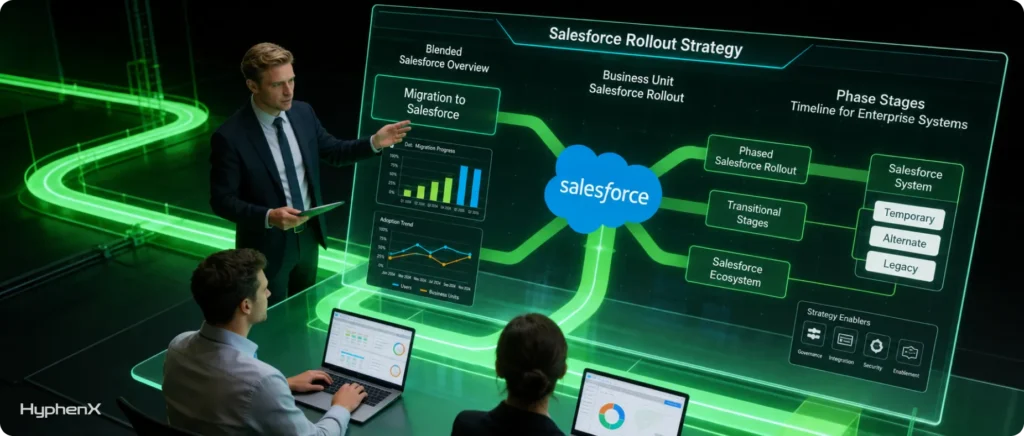
Here’s something worth saying plainly: most real Salesforce rollouts aren’t purely one of these three approaches. They’re a blend, and that’s not a compromise, it’s usually the smartest available option.
Scenario 2 above showed this directly, an accelerated rollout for one business unit and a genuinely Phased approach for the rest. That pattern shows up constantly in practice. A company might use Big Bang for its cleanest, most standardized business unit, where the readiness genuinely exists. It might then use Phased for the units still carrying data or process complexity that needs more time. Another might run Parallel specifically for the small subset of workflows tied to compliance or financial reporting. Everything else moves over in a single, faster cutover, because the safety net only needs to cover the parts where getting it wrong is genuinely expensive.
The mistake most implementation guides make is presenting these three approaches as a single multiple-choice question, as if an entire company has to be uniformly ready or uniformly cautious. Real organizations aren’t uniform. Your sales team and your finance team don’t have the same data quality, the same risk exposure, or the same tolerance for a rough week. Treating the rollout decision as one answer for the whole company usually means either rushing the parts that weren’t ready, or slowing down the parts that were.
The better question isn’t “which of the three are we.” It’s this: which parts of the organization are ready for speed, and which parts need extra structure or a safety net? How should that be sequenced so each part gets what it actually needs? Answer that using the five questions from earlier, team by team or unit by unit, and you’ll usually land on a genuinely blended plan rather than a single label.
This also changes how you should read a partner’s recommendation. If a proposal hands you a single approach for your entire organization without asking about the variation between your teams, that’s worth a second look. Not because a single approach is always wrong. Sometimes it genuinely is the right call for a smaller, uniform business. But the recommendation should follow from questions about your specific teams, not from a template a partner runs on every project regardless of the client in front of them.
How HyphenX Approaches This Decision
Salesforce rollout planning starts with the current environment: business processes, data quality, integrations, technical dependencies, user readiness, and the amount of disruption the organization can absorb. Those findings shape the implementation sequence and go-live plan.
That assessment can point toward one coordinated cutover, multiple rollout phases, a period of parallel validation, or a combination across different parts of the business. The goal is to choose a rollout structure that fits the actual dependencies in the Salesforce implementation rather than applying the same pattern to every organization.
If you’re planning your rollout, our Salesforce implementation services cover discovery, architecture, migration, testing, deployment, and adoption planning. If Revenue Cloud is part of the project, our Salesforce Revenue Cloud services cover the revenue-platform side of that transition.
The Bottom Line
The three approaches aren’t a personality test, and picking between them isn’t about which one sounds more appealing in a planning meeting. It comes down to five checkable facts. How clean your data actually is. How big and varied your organization actually is. How much disruption you can genuinely absorb. What your budget can actually sustain. And how much time your people can actually give it.
Answer those honestly, and Big Bang, Phased, or Parallel stops being a guess and starts being a conclusion. More often than not, the honest conclusion isn’t one label for the whole company. It’s a blend, tuned team by team to what each one actually needs. That’s a harder answer to give in a single sentence, but it’s the one that actually holds up once the project starts.
Frequently Asked Questions
1. What is included in Salesforce rollout planning services?
Salesforce rollout planning can include readiness assessment, deployment sequencing, data migration planning, integration dependencies, testing, training, communication, cutover preparation, support planning, and risk review. The final plan should reflect how different teams, regions, and business processes will move into Salesforce.
2. How much does Salesforce rollout planning cost?
Cost depends on organization size, rollout complexity, number of business units, integrations, data work, testing requirements, and the level of change management involved. A useful estimate usually follows discovery because rollout effort depends heavily on organizational readiness and dependencies.
3. When should Salesforce rollout planning begin?
Rollout planning should begin while solution design and implementation are still underway rather than waiting until testing is nearly complete. Early planning gives teams time to identify cutover dependencies, training needs, data constraints, communication requirements, and business periods that should be avoided.
4. Who should be involved in choosing the Salesforce rollout approach?
The decision should involve Salesforce owners, IT, project leadership, business process owners, data teams, integration owners, training or change leads, and affected department leaders. Each group sees different risks that can influence sequencing, readiness, support needs, and go-live timing.
5. What should a Salesforce rollout readiness assessment include?
A readiness assessment should examine data, integrations, testing status, user preparation, training completion, support capacity, outstanding defects, process decisions, technical dependencies, and cutover tasks. It should also identify issues serious enough to delay a team or business unit’s go-live.
6. What should be included in a Salesforce cutover plan?
A cutover plan should document deployment activities, final data loads, system changes, integration checks, validation steps, communication, ownership, support coverage, and decision points. Teams should know who performs each task, when it occurs, and what confirms successful completion.
7. Should a Salesforce rollout have a rollback plan?
Yes. The project should define what happens if a serious issue appears during cutover. The rollback or contingency plan should specify decision authority, recovery steps, data considerations, communication, and the conditions that justify pausing or reversing the planned transition.
8. How should user training be scheduled around Salesforce go-live?
Training should happen close enough to go-live that users can apply what they learned, while leaving time to resolve questions before launch. Different roles may need different sessions, practice environments, job aids, and follow-up support during the first weeks.
9. What is hypercare after a Salesforce rollout?
Hypercare is the focused support period immediately after go-live when project and support teams watch the new environment closely. It can cover user questions, production defects, integration issues, data problems, workflow adjustments, and faster escalation while the rollout stabilizes.
10. How should business communication be handled during a Salesforce rollout?
Communication should explain who is moving, when the change happens, what users need to do, where training is available, which processes are changing, and where support can be found. Messages should be timed around each affected group’s actual rollout date.
11. How should integrations be handled during a staged Salesforce rollout?
Each integration needs clear rules for which users, records, and systems operate in Salesforce during every rollout stage. The plan should also define data ownership, synchronization, error handling, monitoring, and how legacy-system dependencies will change as additional groups move.
12. Should users keep access to the legacy CRM after Salesforce goes live?
Legacy access may remain useful for historical reference, audits, or records that were intentionally not migrated. The project should define who retains access, whether the environment stays read-only, how long it remains available, and when it can be retired.
13. How should user acceptance testing support the rollout decision?
User acceptance testing should show whether real business processes work for the teams preparing to move. Results can expose training gaps, data issues, workflow problems, or unresolved requirements that affect whether a group is genuinely ready for its planned go-live.
14. What support team should be available on Salesforce go-live day?
Go-live support should include people who can address Salesforce configuration, data, integrations, permissions, user questions, and business-process issues. Responsibilities and escalation paths should be assigned beforehand so problems reach the right owner quickly instead of circulating between teams.
15. What should be included in a Salesforce rollout services statement of work?
The statement of work should define rollout scope, phases, responsibilities, readiness criteria, testing, cutover activities, training, communication, data and integration dependencies, hypercare, deliverables, exclusions, assumptions, acceptance criteria, change control, and the commercial terms attached to each phase.