
Salesforce Implementation Cost starts in the architecture map long before a partner sends a statement of work. A clean Sales Cloud rollout with one data source, standard opportunity stages, modest automation, and a small user group has a very different delivery surface from a multi-cloud program that touches ERP, billing, identity, ecommerce, service operations, analytics, and AI. Every integration endpoint, migration rule, security boundary, exception path, test cycle, and release dependency adds work that must be designed, built, verified, documented, and supported after go-live.
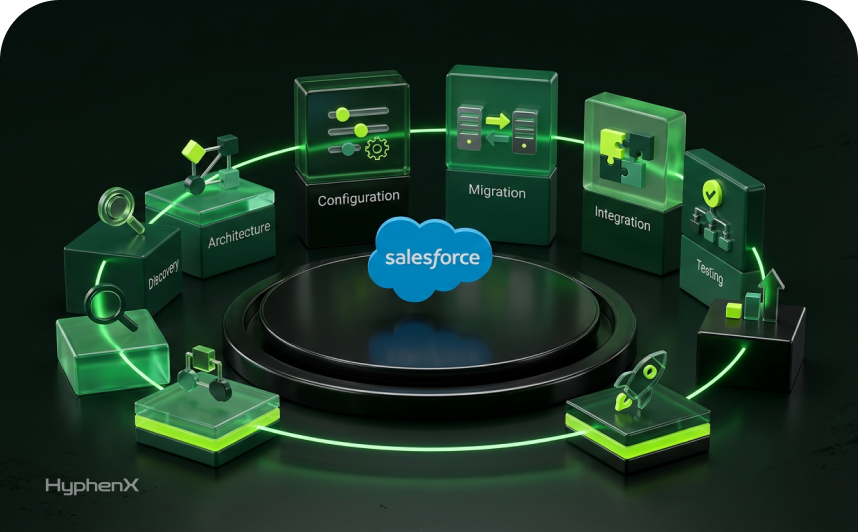
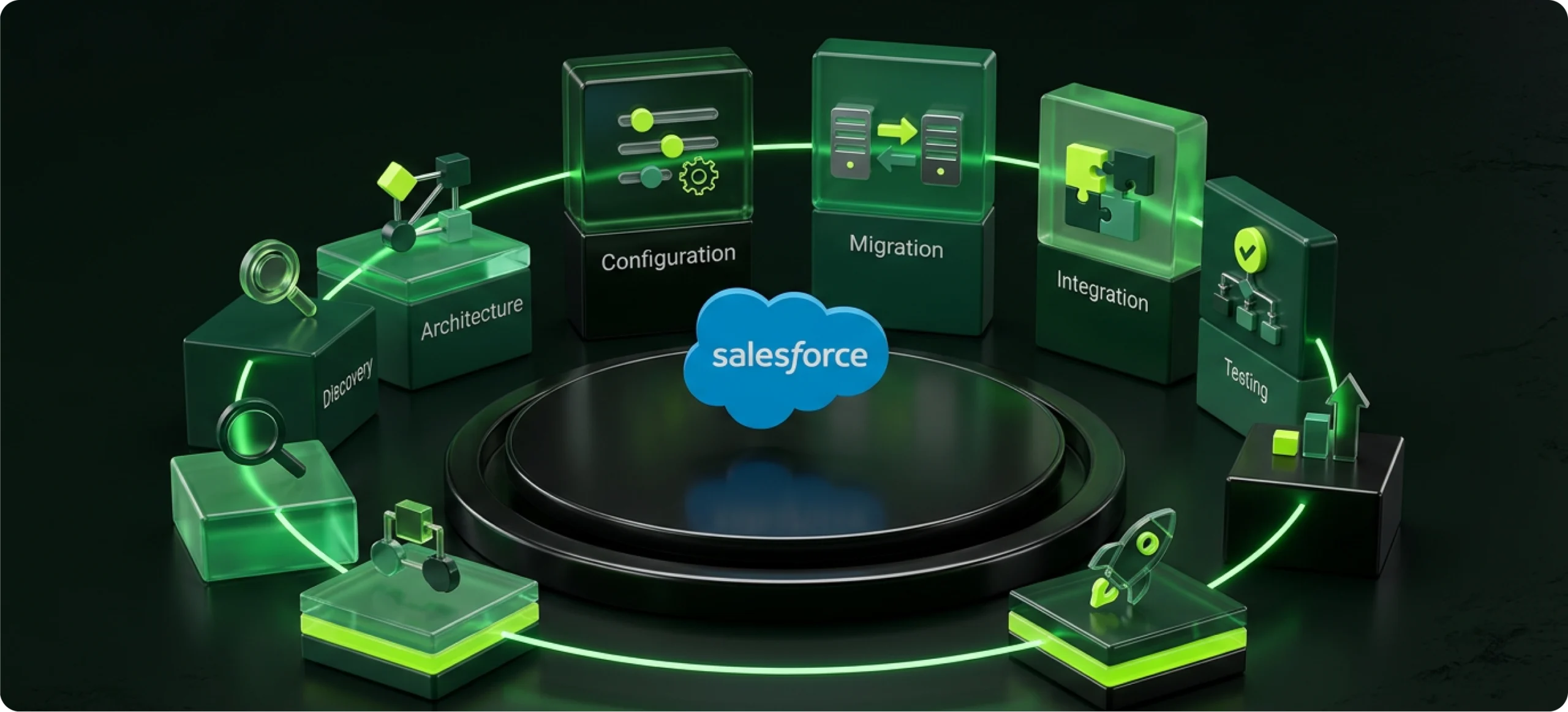
A realistic budget therefore starts by decomposing the system into work packages. Salesforce implementation services cover discovery, architecture, configuration, migration, integration, testing, training, launch, and hypercare. That lifecycle is useful as a cost frame because a low implementation quote often reflects a narrower responsibility boundary, lighter assumptions about migration or QA, or a decision to price future change separately.
This 2026 guide turns the project into line items that finance, procurement, CRM leaders, and delivery teams can inspect. The ranges are planning bands synthesized from current public 2026 implementation pricing and common delivery models, rather than universal partner quotes. Actual Salesforce Implementation Pricing moves with region, role mix, cloud count, data quality, custom code, integration depth, security requirements, timeline pressure, and who owns the work when assumptions change.
TL;DR
Budget lens: A Salesforce Implementation Budget should separate partner labor from licenses, middleware, data tools, testing environments, change management, internal staff time, and post-launch operations. For many projects, the visible statement-of-work fee is only the delivery-services layer. The larger financial question is the first-year cost of getting the platform into dependable production and keeping it there.
Cost mechanics: The largest Salesforce Implementation Fees usually grow around integration, migration, custom development, multi-cloud design, testing, and scope changes. Small implementations with standard processes can stay in the tens of thousands of dollars. Mid-market programs often move into six figures once several departments and integrations enter scope. Large enterprise programs can move far beyond that when data, security, multiple clouds, and global rollout requirements combine.
Buying method: Build the estimate from line items, document assumptions beside each line, and compare partner proposals on the same responsibility map. Ask what is excluded, what triggers a change order, which roles are included, how many migration cycles are priced, how UAT and defects are handled, and what hypercare covers. A useful Salesforce Implementation Estimate makes the uncertainty visible before work begins.
The Quote is a Compressed View of the Delivery System
A Line-item Budget for a Typical Implementation
The table below is a planning model for partner-service spend. It excludes Salesforce subscription charges and should be adjusted for geography, company size, cloud mix, and delivery model. The percentages are useful for budget structure, while the dollar bands show the scale buyers may see when a project moves from a narrow rollout to a complex enterprise program.
Budget line | Typical share | Smaller program | Complex program | What the line actually buys |
Discovery and solution design | 8-15% | $4k-$25k | $15k-$60k | Workshops, process maps, architecture, backlog, acceptance model |
Configuration and automation | 15-25% | $6k-$35k | $30k-$120k | Objects, fields, Flow, security, reports, routing, approvals |
Custom development | 10-25% | $5k-$40k | $25k-$150k+ | Apex, LWC, complex logic, performance work, custom UX |
Data migration | 8-20% | $3k-$25k | $20k-$120k+ | Profiling, cleansing, mapping, loads, reconciliation, rehearsals |
Integrations | 10-30% | $5k-$40k | $30k-$200k+ | APIs, middleware, identity, ERP, billing, monitoring, recovery |
QA and UAT support | 8-15% | $3k-$20k | $15k-$70k | Test design, regression, defects, UAT coordination, evidence |
DevOps and release | 4-10% | $2k-$12k | $10k-$50k | Environments, source control, CI/CD, deployment, rollback |
Training and adoption | 4-10% | $2k-$15k | $10k-$50k | Role training, admin enablement, materials, change support |
Cutover and hypercare | 5-12% | $2k-$15k | $10k-$60k | Launch plan, monitoring, issue response, stabilization |
A buyer should resist adding these bands mechanically. Some projects spend very little on code and a great deal on migration. Others have clean data but expensive integrations. The useful exercise is to force every major cost driver onto its own line so a partner cannot hide a difficult migration inside a broad “configuration” bucket or leave release support outside the quote entirely.
Nine Places where the Budget is Actually Consumed
- Discovery and architecture. This phase turns goals into process decisions, data ownership, security boundaries, integration patterns, and a buildable backlog. Underfunding it often pushes unanswered questions into development, where they become slower and more expensive to resolve.
- Core configuration. Standard objects, custom fields, page layouts, record types, Flow, assignment logic, permissions, reports, and dashboards still require analysis and testing. Standard features reduce code, yet the design effort remains material when several teams use the same data differently.
- Custom engineering. Apex, Lightning Web Components, custom services, advanced automation, and performance work raise the Salesforce Project Cost because they require stronger engineering, code review, unit tests, release controls, and future maintenance ownership.
- Data migration. Extraction, profiling, cleansing, deduplication, transformation, mapping, loading, validation, and reconciliation make Salesforce Data Migration Cost highly sensitive to legacy data quality. Multiple sources and poor identifiers can turn migration into one of the largest workstreams.
- Integration delivery. Salesforce Integration Cost grows with the number of systems, interface patterns, middleware, authentication models, error handling, monitoring, and cross-team release coordination. One integration can be simple; a shared order-to-cash flow can involve several owners and failure paths.
- QA and business acceptance. Regression testing, test data, end-to-end scenarios, defect retesting, and UAT support expand as the org becomes more connected. Regulated programs may also need audit evidence, traceability, segregation of duties, and formal sign-off.
- DevOps and environments. Source control, sandbox strategy, deployment tooling, branching, package boundaries, environment refreshes, release rehearsals, and rollback planning all consume delivery time. Manual deployment practices may look cheap early and become expensive near launch.
- Training and changing work. Role-based training, administrator enablement, communications, job aids, adoption measurement, and process ownership determine whether the system replaces old work habits. A technically correct implementation still carries cost if users keep parallel spreadsheets and workarounds.
- Go-live and stabilization. Cutover planning, data freeze windows, production deployment, smoke testing, monitoring, triage, and hypercare require concentrated staffing. A quote that ends at deployment leaves the buyer to fund the riskiest operational period separately.
Complexity has a Measurable Cost
Implementation budgets become less predictable as dependencies multiply. The Project Management Institute’s Pulse of the Profession 2026 reports that 97% of professionals managed at least one complex project in the previous year and that roughly one-third of complex projects fail, compared with 13% of projects overall. A Salesforce program with several clouds, vendors, business units, data sources, and release teams has exactly the kind of dependency structure that makes early assumptions expensive when they are wrong.
Salesforce Implementation Fees become harder to forecast as project complexity rises. Budget contingency should follow complexity rather than company size alone. A 200-user org with five external systems, inconsistent legacy data, and strict security controls can carry more implementation risk than a 1,000-user org with one cloud and a clean data source. Finance teams should therefore ask for the assumptions that sit behind each line item, then assign contingency to the lines where uncertainty is highest.
Cloud Choice changes the Shape of the Estimate
Sales Cloud: configuration dominates until revenue logic gets complex
A focused Sales Cloud rollout can stay close to standard configuration when lead, account, opportunity, forecasting, and activity processes are clear. Cost rises when the project adds territory models, complex approvals, CPQ or Revenue Cloud dependencies, custom forecasting, partner processes, or heavy ERP synchronization.
Service Cloud: channels and operations add hidden surfaces
Case management alone is predictable. Omni-Channel, telephony, digital engagement, entitlements, knowledge, bots or agents, field service dependencies, and historical service migration add more configuration, integration, testing, and adoption work. Service programs also need realistic load and routing tests because the cost of a routing defect reaches live customer operations.
Revenue Cloud: commercial logic increases design and regression effort
Product models, pricing rules, contracts, amendments, renewals, billing, and approvals create a wide regression surface. Errors can affect revenue recognition, invoices, and customer commitments, so architecture and testing often take a larger share of the Salesforce Implementation Budget than buyers first expect.
Data Cloud and AI: data preparation becomes part of implementation
Data ingestion, identity resolution, consent, access, grounding data, agent actions, monitoring, and governance add work beyond ordinary CRM configuration. Salesforce’s 2025 State of Service report surveyed 6,500 service professionals and found that AI is becoming a much larger part of service operations while security remains a major implementation concern. That shift makes data readiness, access design, testing, and change management material budget items for AI-enabled Service Cloud programs.
Hidden Fees Usually Begin as Hidden Assumptions
Salesforce Implementation Hidden Costs are rarely mysterious. They usually appear when a requirement was omitted, an assumption was too optimistic, or responsibility was left undefined. A clean statement of work should make the following items explicit before the project starts.
- Additional sandbox, middleware, ETL, backup, testing, monitoring, or data-quality tooling that sits outside the partner fee.
- Extra migration cycles after business users reject mappings, duplicates, or transformed values during rehearsal.
- Change requests caused by new workflows, fields, reports, integrations, or security requirements discovered after design sign-off.
- Partner travel, on-site workshops, after-hours cutover, weekend support, and overtime where these are billed separately.
- Client-side subject matter expert time for workshops, UAT, data decisions, approvals, training, and release readiness.
- License upgrades or add-ons required because the selected design needs features that were absent from the original subscription plan.
- Rework from legacy automation, unmanaged packages, duplicated configuration, or an existing org that requires remediation before new build can proceed.
- Post-launch defect support that exceeds the included hypercare window or is reclassified as an enhancement rather than a warranty item.
When an existing org contains years of duplicate automation, poor data, or abandoned metadata, a Salesforce CRM cleanup service can be a separate cost line before expansion. Pricing the new implementation without first understanding that inherited state can make the initial quote look lower while moving remediation cost into the delivery phase.
Three Budget Profiles Buyers can Use as a First Pass
Project profile | Typical delivery surface | Illustrative partner-services band | Typical window | Budget pressure point |
Focused rollout | 1 cloud, <75 users, clean data, 0-2 simple integrations, limited custom code | $15k-$40k | 4-10 weeks | Scope growth after users see the first working build |
Mid-market program | 1-3 clouds, 75-500 users, several teams, 2-6 integrations, migration cleanup | $50k-$200k | 3-7 months | Integration, migration, UAT, and change requests |
Enterprise transformation | Multi-cloud, 500+ users, several regions, complex security, ERP/data platform, custom development | $200k-$1M+ | 6-18+ months | Cross-system dependencies, governance, data, release coordination |
A Salesforce Implementation Estimate should use these only as orientation. These are planning bands, not quotes. Current public 2026 implementation guides show a wide market spread, from small quick-start work in the low tens of thousands to enterprise programs that exceed several hundred thousand dollars. The spread is rational once the buyer separates user count from integration depth, migration quality, cloud count, custom code, security, and change-management effort.
Integration can Consume a Third of the Services Budget

MuleSoft’s 2026 Connectivity Benchmark Report draws on more than 1,000 IT leaders and reports persistent integration and governance pressure as organizations add more AI and connected systems. For Salesforce budgeting, the practical point is straightforward: each external dependency adds design, build, test, security, operational, and release work beyond the CRM configuration itself.
Salesforce Implementation Hidden Costs often appear first inside integration assumptions. A single direct API connection may need only a modest amount of work when the contract is stable and ownership is clear. Salesforce Integration Cost rises quickly when the project needs middleware, event-driven patterns, transformations, multiple consumers, complex authentication, rate-limit management, replay, reconciliation, or coordinated releases with ERP and billing teams. Integration estimates should name each interface, direction, frequency, volume, owner, security model, failure path, and monitoring requirement.
When several enterprise systems are part of the rollout, Salesforce integration services provide a separate delivery model for API, middleware, data synchronization, monitoring, and connected-system work. Keeping that work visible as its own estimate prevents the CRM configuration budget from becoming a catch-all for cross-system engineering.
Migration Cost is Controlled by Data Condition, not Record Count Alone
Salesforce Data Migration Cost is often estimated too early from the number of rows in a legacy system. Volume matters, but the expensive work usually sits in interpretation and correction. Ten million clean records with stable identifiers can be easier than 300,000 records spread across spreadsheets, an old CRM, an ERP, and departmental databases with conflicting definitions.
- Profile every source before estimating transformation effort.
- Identify duplicates, missing keys, orphaned records, invalid values, and inconsistent picklists.
- Define the system of record for shared customer, product, contract, and service fields.
- Price at least one rehearsal load for moderate projects and several rehearsals for high-risk migrations.
- Include reconciliation reports that prove record counts, totals, ownership, relationships, and critical business values after each load.
- Separate archive requirements from live Salesforce migration so historical retention does not silently expand the production data model.
Salesforce Data Migration Cost becomes easier to control when ownership is explicit. The estimate should also state who cleans the data. A partner can build mappings and transformation scripts while the client remains responsible for business decisions and source correction. If that boundary is vague, the partner may bill additional analysis time or the migration may stall while internal teams decide what the source data means.
Security Work Belongs in the Implementation Budget from Day One
IBM’s 2025 data breach cost report puts the global average cost of a data breach at $4.44 million and reports major gaps in AI access controls and governance among organizations experiencing AI-related incidents. Salesforce programs often handle customer, financial, service, identity, and regulated data, so security design cannot be treated as a final review item when the org is almost ready to launch.
Salesforce Implementation Fees for regulated programs often include more security architecture and evidence work. Salesforce Implementation Services Cost also rises when formal security evidence, specialist review, and remediation cycles are included. Security costs can include role hierarchy design, permission sets, sharing rules, field access, SSO, MFA, connected-app controls, encryption decisions, audit logging, integration identities, data masking, environment access, penetration testing, compliance evidence, and formal security review. Highly regulated industries may need additional documentation and approval cycles. These activities raise Salesforce Implementation Services Cost because they require senior architecture, security participation, testing, and rework if the access model is discovered late.
What Partner Rates Actually Pay For?
Salesforce Implementation Cost 2026 comparisons also depend on the role mix behind the proposal. Salesforce Consulting Rates vary widely by geography, seniority, specialist depth, and provider model. Public 2026 guides commonly place certified consulting and implementation work in a broad range around $100 to $300 per hour for many U.S. and Western-market partners, with senior architects and rare specialists sometimes priced higher. Offshore and nearshore delivery can price materially lower. The buyer should treat these figures as orientation, then compare the named team and responsibility boundary behind the rate.
The U.S. Bureau of Labor Statistics March 2026 compensation data reports that wages and salaries represented 69.9% of private-industry employer compensation while benefits represented 30.1%. Partner billing also includes more than the individual professional’s pay: recruiting, bench risk, management, training, delivery operations, replacement coverage, tools, and commercial margin all sit somewhere inside the rate structure.
The Project should Know what Stays Internal
Salesforce Implementation Cost 2026 comparisons also depend on the role mix behind the proposal. Salesforce Consulting Rates vary widely by geography, seniority, specialist depth, and provider model. Public 2026 guides commonly place certified consulting and implementation work in a broad range around $100 to $300 per hour for many U.S. and Western-market partners, with senior architects and rare specialists sometimes priced higher. Offshore and nearshore delivery can price materially lower. The buyer should treat these figures as orientation, then compare the named team and responsibility boundary behind the rate.
The U.S. Bureau of Labor Statistics March 2026 compensation data reports that wages and salaries represented 69.9% of private-industry employer compensation while benefits represented 30.1%. Partner billing also includes more than the individual professional’s pay: recruiting, bench risk, management, training, delivery operations, replacement coverage, tools, and commercial margin all sit somewhere inside the rate structure.
Architecture hours are expensive because they reduce downstream rework
Solution and technical architects carry the highest concentration of design responsibility early in the project. Their time protects the data model, security model, integration boundaries, performance choices, and technical decisions that many later workstreams depend on.
Consultant hours turn business ambiguity into buildable decisions
Functional consultants and business analysts spend heavily in discovery, workshops, configuration choices, UAT, and process ownership. Their contribution affects Salesforce Implementation Pricing because weak requirement decisions usually return later as rework or change requests.
Developer hours carry the custom engineering load
Salesforce developers absorb Apex, LWC, advanced Flow, custom services, integration code, unit testing, remediation, and performance work. Salesforce Project Cost rises when more of the solution requires custom behavior instead of standard configuration.
Data, QA, DevOps, and delivery roles arrive in different peaks
Migration specialists peak around conversion cycles, QA engineers peak before release, DevOps engineers concentrate around environment and deployment work, and project managers run throughout the lifecycle. Salesforce Implementation Services Cost should reflect those changing role peaks rather than assuming one flat team from kickoff through hypercare.
Commercial Models Move Risk Between Buyer and Partner
Model | Best fit | Who carries more uncertainty | What to inspect |
Fixed price | Stable, well-defined scope | Partner carries more estimation risk | Tighter change control; assumptions must be precise |
Time and materials | Evolving requirements or discovery-heavy work | Buyer carries more budget variability | Transparent burn rate and strong backlog governance required |
Milestone / phased | Programs that need funding gates | Risk is reassessed at each phase | Discovery can improve later estimates before full commitment |
Blended / hybrid | Mixed certainty across workstreams | Risk is split by work type | Fixed configuration plus T&M integration or specialist work |
Salesforce Implementation Pricing becomes clearer when the buyer can see which uncertainty sits inside each commercial model. The partner’s rate card matters less when the pricing model hides the unit being purchased. A fixed $120,000 proposal can be excellent value if it includes enough discovery, three migration rehearsals, integration testing, UAT support, and hypercare. A $90,000 proposal can become more expensive if those same items are exclusions. Procurement should convert every proposal into the same line-item structure before deciding which number is lower.
Change Orders are a Budget Mechanism, Not a Project Failure
Salesforce Implementation Hidden Costs can be reduced when uncertainty has an explicit budget path. Some requirements genuinely cannot be known in full before discovery. The financial control is to decide how that uncertainty will be handled. Define the baseline scope, assumptions, change threshold, approval authority, and rate treatment before delivery begins. Keep a visible contingency line rather than forcing every unknown into the fixed fee and then arguing about whether it was implied.
Use 5-10% contingency for a bounded implementation with clean data, few integrations, stable requirements, and a mature client team.
Use 10-20% contingency when several business units, migrations, integrations, or custom components remain partly uncertain after discovery.
Use a separate risk reserve for major legacy replacement, global rollout, regulated environments, or programs where external systems are changing at the same time.
Salesforce Project Cost should show contingency as a controlled reserve rather than burying it inside partner labor. Salesforce Implementation Services Cost should remain visible beside that reserve so actual partner effort can be compared with approved change spend. The reserve should not become automatic spending. Release it against documented changes, risks, or decisions. If the project finishes with unused contingency, that is evidence that the assumptions and controls worked well.
Compare Proposals by Assumptions Before Comparing Totals
Salesforce Implementation Partner Cost should be compared through the same responsibility map. A Salesforce Implementation Estimate is useful only when the buyer can trace the number back to scope. Ask every partner to provide the same decomposition: roles, hours or effort by phase, deliverables, client responsibilities, environments, migration cycles, integrations, testing, training, cutover, hypercare, warranty, exclusions, and change-control method. Then mark every difference between proposals. Most pricing gaps become understandable once the responsibility map is visible.
If the organization still needs to decide process ownership, architecture direction, product boundaries, or sequencing before implementation, Salesforce consulting services fit that decision stage better than simply buying more build hours. Separating advisory work from implementation can also make the later partner estimate cleaner because the requirements and technical boundaries are more stable.
Ten Questions that Expose Hidden Implementation Fees
- How many discovery workshops, architecture reviews, and design revisions are included?
- How many data sources and migration rehearsal cycles are priced?
- Which integrations are included by name, direction, and environment?
- Who pays for middleware, ETL, backup, monitoring, testing, or data-quality tools?
- What level of custom Apex or LWC work is assumed in the base estimate?
- Who creates test cases, regression coverage, test data, and UAT coordination?
- How are defects distinguished from new requirements after UAT starts?
- What cutover, weekend, overtime, or after-hours support charges can apply?
- How many days or weeks of hypercare are included and what is excluded?
- What triggers a change order, who approves it, and which rates apply?
Go-live ends the project budget and starts the operating budget
Salesforce CRM Implementation Cost should include the transition into steady-state operations. Salesforce Consulting Rates for retained specialists should be budgeted separately from the original delivery team. The first-year financial model should include the period after launch. New users will find edge cases. Reports will need refinement. Integrations will produce exceptions. Salesforce releases will introduce platform changes. Admin requests and enhancement work will begin almost immediately. If the implementation partner exits after a short warranty window, the client needs an internal support model or a separate service budget.
At HyphenX, our Salesforce support services cover ongoing administration, issue resolution, and platform support after implementation. For organizations that want broader operational ownership, Salesforce managed services use a different commercial boundary with continuous workload management, maintenance, release work, and improvement. Those costs belong in the total ownership model even when they sit outside the original implementation statement of work.
Salesforce CRM Implementation Cost is easier to forecast when post-launch ownership is defined before go-live. Salesforce Implementation Fees should identify which stabilization work is included and which work moves into a support agreement. A useful first-year budget therefore has at least four layers: Salesforce subscriptions, implementation partner services, internal project participation, and post-launch operations. Treating only the partner statement of work as Salesforce CRM Implementation Cost will understate the actual cash and labor needed to reach stable production.
Build the Budget Around Responsibility, Uncertainty, and Evidence
Salesforce Implementation Cost 2026 planning works best when the buyer can connect every major fee to a delivery responsibility. Salesforce Implementation Cost in 2026 varies because implementations are different engineering systems, not interchangeable configuration packages. The number of users matters, yet data condition, integration count, cloud mix, custom development, security, testing, rollout geography, and change readiness usually explain far more of the variance. The estimate becomes easier to control when each of those surfaces has its own budget line and owner.
Salesforce Implementation Partner Cost becomes easier to judge when exclusions and client responsibilities are explicit. The best financial comparison is a normalized one. Use the same scope map for every provider, convert broad fees into work packages, expose exclusions, document assumptions, and model the cost of client participation. Keep contingency where uncertainty is real. Separate implementation from licenses and ongoing operations. Then judge Salesforce Implementation Partner Cost against the amount of delivery responsibility, risk control, and production readiness actually included.
Salesforce Implementation Pricing should make those conversations more specific. That approach also makes partner conversations more specific. A buyer can ask why migration is 18% of the estimate, why integration requires an architect, why hypercare lasts 3 weeks, or why a fixed-price bid carries a larger contingency. Those questions create a stronger Salesforce Implementation Budget than chasing a single benchmark number that cannot describe the technical shape of the project.
Frequently Asked Questions
What is a typical Salesforce Implementation Cost in 2026?
Small focused implementations can begin in the low tens of thousands of dollars, while mid-market programs commonly move into the $50,000 to $200,000 range once several teams, integrations, migration work, and custom development are involved. Enterprise multi-cloud programs can exceed $200,000 and may reach $1 million or more. The final number depends on scope and responsibility, so these should be used as planning bands rather than quotes.
What is usually included in Salesforce Implementation Pricing?
Salesforce Implementation Pricing commonly covers discovery, solution design, configuration, custom development, migration, integrations, testing, deployment, training, and some level of go-live support. Buyers should verify each item because two partners may use the same phrase while including very different amounts of migration, QA, architecture, or hypercare.
Are Salesforce licenses included in the implementation fee?
Usually no. Salesforce subscriptions and product add-ons are generally separate recurring costs. Middleware, backup, ETL, testing, monitoring, telephony, and other third-party tools may also sit outside the partner fee. The first-year budget should show those technology charges beside implementation services.
What makes Salesforce Implementation Partner Cost increase?
Salesforce Implementation Partner Cost rises with the scope and role mix. The biggest drivers are cloud count, custom development, data quality, integration depth, security requirements, number of business units, rollout geography, testing burden, timeline compression, and uncertainty in the requirements. Senior architecture and specialist roles also raise the rate mix when the work needs deeper experience.
How much should I budget for the Salesforce Data Migration Cost?
Salesforce Data Migration Cost can consume roughly 8% to 20% of partner-services spent in a typical program, but poor legacy data can push it higher. Price profiling, cleansing, mapping, transformation, rehearsal loads, validation, and reconciliation separately. Record count alone is a weak cost predictor when data definitions and identifiers are inconsistent.
Why can Salesforce Integration Cost become so high?
Salesforce Integration Cost grows because integrations add work across API design, middleware, authentication, mapping, security, retries, monitoring, reconciliation, and coordinated releases with external-system teams. The more systems and failure paths involved, the more architecture, testing, and operational design the project needs.
What Salesforce Implementation Hidden Costs should I expect?
Salesforce Implementation Hidden Costs commonly include extra migration cycles, middleware or testing tools, license add-ons, internal subject matter expert time, after-hours cutover, travel, scope changes, legacy cleanup, additional security reviews, and post-launch support beyond the warranty window. A good statement of work makes these assumptions visible.
How should I compare Salesforce Consulting Rates between partners?
Salesforce Consulting Rates should be compared through the named role, seniority, location, expected independence, and included delivery support behind the rate. A higher architect or specialist rate can reduce total project effort when the person resolves difficult decisions quickly. Compare total effort and responsibility rather than hourly rates in isolation.
Should I choose fixed-price or time-and-materials implementation?
Fixed price fits stable requirements where deliverables and acceptance criteria can be defined tightly. Time and materials fit work where requirements will continue to evolve. Phased or hybrid models are useful when some work is clear and other work, such as integration or migration, carries more uncertainty.
How much contingency belongs in a Salesforce Implementation Budget?
A bounded project with stable requirements may use roughly 5% to 10% contingency. Programs with several integrations, migrations, business units, or uncertain custom requirements may need 10% to 20% or a separate risk reserve. Contingency should be controlled through documented approval rather than treated as automatic spend.
What should a Salesforce Implementation Estimate show?
A Salesforce Implementation Estimate should show phases, roles, effort, deliverables, assumptions, client responsibilities, data sources, named integrations, migration cycles, testing, training, cutover, hypercare, warranty, exclusions, and change-order mechanics. A single total without those details is difficult to compare or govern.
What costs continue after Salesforce goes live?
Salesforce CRM Implementation Cost should be viewed beside post-launch ownership. Post-launch costs include administration, support, enhancement work, release testing, integration monitoring, data quality, user enablement, and platform governance. Some organizations handle these internally, while others use support or managed-service arrangements. Include these costs in the first-year ownership model even when they are outside the implementation contract.