
Most businesses invest in Salesforce expecting cleaner sales operations, stronger customer visibility, faster automation, and connected data across teams. Yet somewhere between implementation planning and go-live, things slowly start drifting. Workflows get configured without operational clarity. Teams struggle with adoption. Reports begin showing inconsistent numbers. Eventually, the CRM that was supposed to improve business performance starts behaving like an oversized customer database with disconnected processes behind it.
The difference between what Salesforce is capable of and what businesses actually experience usually has very little to do with the platform itself. In most cases, the real issue sits inside strategy, workflow planning, reporting structure, and long-term CRM thinking. That is where experienced Salesforce CRM consultants create long-term operational impact.
This is not another surface-level guide explaining what a Salesforce consultant does. You already know Salesforce consulting services help businesses implement CRM systems. What matters more is the strategic role consultants play across workflow discovery, Salesforce CRM optimization, automation planning, reporting visibility, user adoption, and operational scalability. For businesses evaluating Salesforce CRM consulting support, the sections ahead deserve careful attention.
Why Businesses Struggle With Salesforce Before Consulting Enters the Picture
A familiar pattern plays out across industries. A business invests in Salesforce, assigns internal teams to manage implementation, and works aggressively toward a launch deadline. A few months later, the CRM is technically active but operationally inconsistent. Sales teams update opportunities differently. Marketing campaigns run with incomplete customer data. Service departments handle cases without full account history. Leadership reviews dashboards that look polished but fail to reflect actual business performance.
Most of these issues are not caused by Salesforce itself. They usually begin with weak Salesforce CRM strategy, rushed workflow planning, and the absence of experienced Salesforce CRM consultants during implementation.
Disconnected Systems and Siloed Data
Most organizations operate across multiple platforms at the same time. Finance teams rely on ERP systems. Marketing works inside separate automation tools. Customer support manages tickets elsewhere. E-commerce and billing data often sit in different environments entirely. Without proper Salesforce integration consulting, Salesforce becomes another disconnected system instead of a centralized operational layer.
Over time, teams begin dealing with duplicate customer records, reporting mismatches, inconsistent forecasting, and manual reconciliation work that slows daily operations. Sales may work inside Salesforce while finance tracks data elsewhere, creating visibility gaps across departments. The operational impact quietly spreads across onboarding delays, missed renewal opportunities, slower response times, and inconsistent customer experiences. Strong Salesforce consulting services help businesses reduce these issues by building connected workflows and structured CRM ecosystems that support cleaner operational visibility.
CRM Adoption Problems That No Software Update Can Solve
CRM adoption problems rarely begin with technology limitations. In most cases, Salesforce gets implemented without properly understanding how teams actually work during daily operations.
Sales representatives stop logging updates because workflows feel complicated. Managers continue using spreadsheets outside the CRM. Teams gradually lose confidence in the system because the process feels disconnected from real operational needs. Once adoption weakens, data quality declines quickly. Poor data affects reporting accuracy, forecasting reliability, and automation performance. Experienced Salesforce CRM consulting focuses heavily on workflow usability, operational alignment, and long-term user adoption because CRM success depends on consistent system usage across departments.
Reporting Gaps and Forecasting Blind Spots
Businesses often expect Salesforce reporting to provide immediate operational clarity. Yet reporting quality depends entirely on how workflows, automation logic, and data structures were originally configured.
Weak Salesforce implementation consulting often leads to incomplete pipeline tracking, unreliable forecasting, and dashboards that fail to support real business decisions. Leadership teams then rely on assumptions instead of accurate CRM insights, which eventually affects revenue planning, customer retention visibility, and operational efficiency.
What Salesforce CRM Consultants Actually Do (Beyond the Obvious)
Most businesses assume Salesforce CRM consultants mainly handle implementation and configuration. In reality, the stronger impact comes from the strategic work that happens before setup begins and the operational improvements that continue after deployment. From our experience at HyphenX, successful Salesforce CRM consulting usually starts with one thing: understanding how the business actually works before deciding how Salesforce should be built.
Workflow Discovery and Process Mapping
Experienced Salesforce consultants begin by studying how work moves across departments. Sales, marketing, operations, and customer service teams may follow different internal processes, even when leadership believes everything is already connected. During discovery, consultants often uncover gaps that directly affect CRM performance.
- Sales stages that marketing cannot properly track
- Manual renewal steps managed outside Salesforce
- Customer escalations hidden inside email threads
- Teams relying on spreadsheets instead of CRM workflows
CRM Architecture Planning and Data Structuring
Strong Salesforce implementation consulting depends heavily on CRM architecture planning. Early decisions around data structure, object relationships, permissions, and workflow logic affect how usable and expandable the CRM remains as the business grows. Without a clear Salesforce CRM strategy, companies often end up with systems that become harder to manage over time.
- Poorly structured customer records
- Duplicate data across departments
- Reporting inconsistencies
- Automation conflicts during scaling
Automation Strategy and Workflow Design
Salesforce workflow automation works best when it supports real operational needs. Consultants study where delays, manual approvals, follow-ups, or repetitive tasks slow teams down before building automation flows. The goal is to make everyday work cleaner, faster, and easier to manage.
- Automated lead routing and approvals
- Task reminders and follow-up workflows
- Faster quote and case handling
- Reduced manual operational work
Integration Planning Across Business Systems
Modern businesses rarely run on Salesforce alone. CRM consulting services often include integration planning across ERP systems, finance tools, marketing automation platforms, customer support software, and communication channels.
At HyphenX, we usually look at Salesforce integration consulting from an operational angle first. The main question is simple: which system needs to talk to which system, what data should move, and how will that improve visibility, reporting, and workflow continuity across teams?
How Salesforce Consulting Transforms Business Operations in Practice
Strong Salesforce CRM consulting changes far more than system configuration. Once workflows, reporting structures, automation, and integrations begin operating correctly together, the impact starts showing across daily operations, customer management, forecasting visibility, and long-term business growth. The change is rarely isolated to one department. Sales, marketing, service, operations, and leadership teams all begin working with better visibility and cleaner operational consistency.
Sales Productivity and Pipeline Accuracy
A properly structured Salesforce environment improves how sales teams operate every day. Representatives spend less time updating records manually and more time focusing on active opportunities. Pipeline stages become easier to track because workflows reflect how deals actually move through the business instead of following generic CRM structures.
Experienced Salesforce CRM consultants usually design workflows around practical forecasting needs. The focus stays on capturing meaningful sales signals rather than filling dashboards with unnecessary data fields that teams eventually ignore.
As reporting quality improves, leadership gains better forecasting visibility, cleaner pipeline tracking, and stronger confidence in revenue planning. From our experience at HyphenX, businesses often see the biggest improvements when Salesforce workflow automation removes friction from repetitive sales processes without making the CRM harder to use.
Customer Lifecycle Management and Retention
Salesforce consulting services also influence how businesses manage long-term customer relationships. Instead of handling renewals, onboarding, or escalations reactively, teams begin operating with earlier visibility into customer behavior, engagement patterns, and account health indicators. Well-planned Salesforce CRM strategy helps businesses trigger renewal workflows earlier, identify churn risks faster, and give customer-facing teams complete relationship context before conversations happen.
For recurring revenue businesses, these operational improvements directly affect retention performance and customer lifetime value over time.
Salesforce Consulting Impact Across Business Functions
| Business Function | Before Consulting | After Consulting |
|---|---|---|
| Sales Operations | Manual updates and inconsistent tracking | Automated workflows and cleaner forecasting |
| Customer Service | Limited customer visibility | Faster resolution with complete account context |
| Marketing Alignment | Weak lead lifecycle visibility | Connected campaign and pipeline tracking |
| Reporting & Analytics | Disconnected dashboards | Real-time operational reporting |
| System Integration | Siloed business platforms | Unified customer and operational data |
Operational Scalability Without Proportional Cost Growth
One major advantage of strong Salesforce implementation consulting is operational scalability. As automation improves, systems connect cleanly, and reporting becomes more reliable, businesses can manage higher customer volumes without increasing operational complexity at the same pace.
Consultants who plan Salesforce architecture with future growth in mind help businesses avoid expensive rebuilds later while supporting cleaner expansion across teams, workflows, and customer operations.
Why Salesforce Implementations Fail Without Experienced Consulting

Salesforce implementation failures usually follow familiar patterns. The system goes live, but teams avoid using it. Reports look incomplete. Automation breaks at handoff points. Customer data stays messy. Over time, the business starts questioning the CRM investment when the real issue began much earlier, during planning, architecture, migration, and adoption design. Experienced Salesforce CRM consultants help prevent these problems by looking beyond launch timelines. They focus on how the system will support real users, cleaner data, stronger reporting, and long-term business growth after go-live.
Over-Customization Without Strategic Purpose
One common Salesforce implementation mistake is building too many custom features too early. Custom objects, flows, fields, and approval rules may solve immediate requests, but they can also make the CRM harder to manage if every decision lacks strategic purpose. A good Salesforce consultant will question each customization before it enters the build. The discussion should cover business value, maintenance effort, reporting impact, user experience, and future changes. At HyphenX, this kind of review helps keep Salesforce customization useful instead of turning the system into a heavy setup that becomes harder to adjust later.
Poor Data Migration Strategy
Data migration often receives less attention than it deserves. Many businesses move years of customer records into Salesforce with duplicate accounts, missing fields, inconsistent naming, and outdated activity history. Poor migration damages trust quickly. Sales teams find duplicate contacts. Leaders see inaccurate reports. Service teams struggle with incomplete customer context. Once users lose confidence in CRM data, adoption becomes much harder to rebuild. Strong Salesforce implementation consulting includes data cleansing, field mapping, migration testing, validation checks, and governance planning before go-live.
Lack of Scalability Planning
Many Salesforce environments are built only for current business needs. That may work for a short period, but growth brings new products, regions, teams, approval layers, integrations, and reporting expectations. Without scalability planning, every expansion creates more pressure on the CRM structure. Automation becomes harder to control. Reporting becomes less reliable. Integrations become more fragile. Experienced consultants design Salesforce CRM strategy with future growth in mind, so the system can support expansion without requiring expensive rebuilds every few years.
The Adoption Gap That No Feature Solves
A Salesforce system can be technically correct and still fail if teams don’t use it properly. Adoption depends on usability, workflow fit, training, and trust in the data. Successful Salesforce CRM consulting involves users early, studies how teams actually work, and shapes CRM workflows around daily operations. When Salesforce reduces effort instead of adding steps, adoption becomes far easier to sustain.
Modern Salesforce Consulting — What Forward-Thinking Businesses Expect Today
Salesforce consulting has changed significantly over the last few years. Earlier, most businesses approached Salesforce consulting services mainly for implementation support, integrations, and CRM setup. Today, consulting discussions have moved far beyond deployment. Businesses now expect Salesforce CRM consultants to help improve customer intelligence, AI-driven workflows, automation strategy, omnichannel operations, and real-time decision visibility across departments.
As Salesforce capabilities continue expanding in 2026, companies increasingly need consulting partners who understand both operational workflows and modern CRM ecosystem planning.
AI-Powered CRM Workflows and Salesforce Einstein
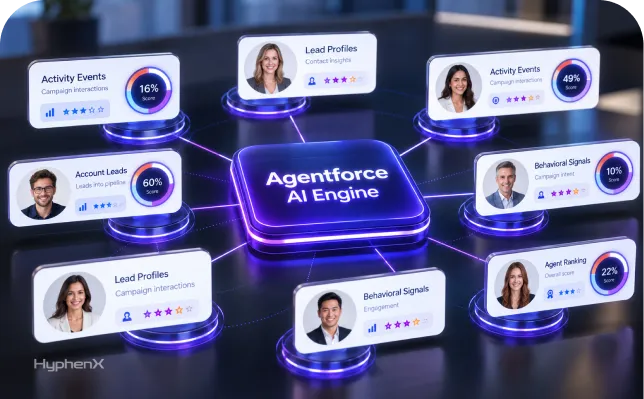
AI has become a much larger part of Salesforce CRM strategy through Einstein AI and Agentforce capabilities. Still, enabling AI features alone does not automatically improve business performance. The real value comes from applying AI in areas where it improves operational decision-making. Experienced Salesforce consultants help businesses identify practical AI use cases that support sales, service, and customer management workflows. That may include predictive lead scoring, automated case prioritization, opportunity risk alerts, or AI-assisted recommendations inside the sales cycle.
At HyphenX, we often see stronger results when AI supports existing workflows naturally instead of forcing unnecessary automation into every process.
Salesforce Data Cloud and Customer Intelligence
Salesforce Data Cloud has become increasingly important for businesses managing customer data across multiple systems. Companies now need unified visibility across CRM records, website activity, service interactions, purchase history, and marketing engagement data. Salesforce CRM consulting now involves helping businesses structure customer intelligence strategies that support personalization, segmentation, and lifecycle visibility across departments. Without a connected data environment, customer experiences often become fragmented and inconsistent.
Omnichannel Customer Operations and Communication
Customer communication expectations have changed rapidly. Businesses now manage conversations across email, WhatsApp, phone systems, live chat, mobile apps, and support platforms simultaneously. Modern Salesforce consulting services increasingly focus on omnichannel workflow design so customer interactions remain connected regardless of where conversations begin. This helps teams maintain cleaner communication history, faster responses, and stronger operational continuity across channels.
Analytics Visibility and Executive Decision Intelligence
Salesforce reporting has evolved far beyond static dashboards. With tools like Tableau, Einstein Analytics, and real-time operational reporting, businesses now expect deeper visibility into pipeline health, forecasting, customer retention, and team performance. Strong Salesforce CRM consultants help organizations design reporting structures that support practical decision-making instead of overwhelming leadership with disconnected metrics and unused dashboards.
How to Evaluate a Salesforce Consulting Partner — What Decision-Makers Should Actually Look For

The Salesforce ecosystem includes thousands of consulting providers, but choosing the right Salesforce consulting partner requires far more than comparing certifications, hourly pricing, or implementation counts. Businesses dealing with operational complexity, multiple departments, integrations, and long-term growth need consultants who understand business processes as deeply as they understand Salesforce itself.
A strong consulting relationship affects workflow efficiency, reporting visibility, automation stability, scalability planning, and long-term CRM performance well beyond the initial implementation phase.
Strategic Understanding vs. Technical Competence
Technical Salesforce expertise is important, but it should be the starting point, not the differentiator. Experienced Salesforce CRM consultants spend more time understanding operational workflows, business objectives, customer journeys, and revenue processes before discussing configuration decisions. During early conversations, decision-makers should pay attention to the types of questions consultants ask. Strong consulting teams usually focus on sales processes, customer lifecycle management, reporting challenges, automation gaps, and growth expectations before discussing timelines or technical features.
At HyphenX, we often see stronger Salesforce CRM consulting outcomes when implementation decisions are tied directly to operational goals instead of isolated feature requests.
Implementation Methodology and Project Governance
The way a Salesforce implementation consulting project is structured matters heavily. Strong consulting teams follow organized discovery phases, milestone-based delivery, stakeholder reviews, workflow validation, and clear governance processes throughout the engagement. Without a structured implementation methodology, businesses often end up with reactive CRM decisions that create reporting gaps, adoption issues, and workflow inconsistencies later.
Post-Implementation Optimization Capability
Salesforce environments continue evolving after go-live. New automation needs appear, reporting expectations change, business operations expand, and customer engagement processes mature over time.
Businesses should evaluate whether a Salesforce consulting partner provides ongoing optimization support, workflow refinement, reporting improvements, automation reviews, and scalability planning after deployment. Long-term consulting support usually creates far stronger CRM maturity than one-time implementation projects alone.
Evaluating Salesforce Consulting Partners
| Evaluation Criterion | What Strong Partners Do | What to Watch Out For |
|---|---|---|
| Discovery Approach | Deep workflow and business analysis | Immediate technical discussions |
| Customization Philosophy | Prioritize maintainable CRM architecture | Excessive custom development |
| Adoption Strategy | Focus on workflow usability and adoption | Training added only at the end |
| Scalability Thinking | Plan for future operational growth | Build only for current needs |
| Post-Go-Live Support | Continuous optimization guidance | Support ends after deployment |
| AI and Modern Capability | Discuss Data Cloud, Einstein, automation strategy | Limited focus on modern CRM evolution |
Conclusion
Salesforce CRM consulting becomes a long-term business investment when it is guided by real operational understanding. Strong consultants study how teams sell, serve, report, automate, and manage customer relationships before shaping the CRM environment around those needs. The difference becomes visible in cleaner leadership decisions, stronger customer experiences, better sales and service productivity, and faster response to market changes. For businesses planning a new Salesforce implementation, fixing an underused CRM, or preparing for a larger CRM transformation, the right consulting partner can change the direction of the entire project. At HyphenX, that kind of Salesforce consulting starts with business clarity first, then technology.