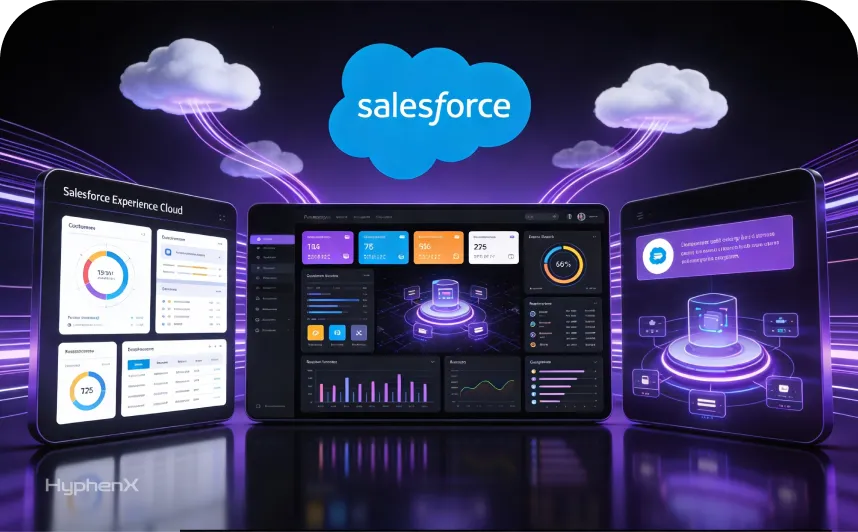

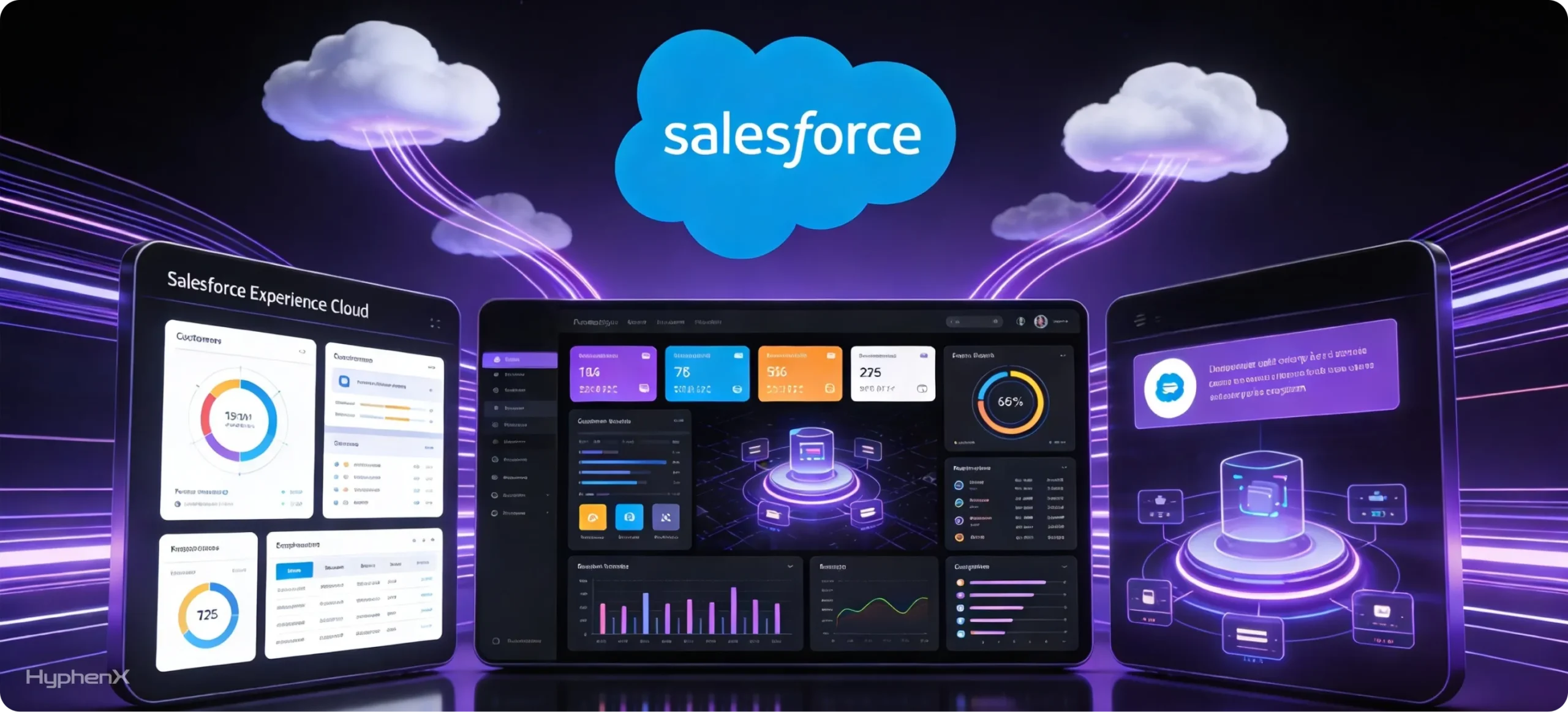
In an AI-first service environment, customer portals are no longer just a convenient support layer. They have become a core part of how businesses deliver faster self-service, connected experiences, and smoother AI-to-human handoffs. Salesforce now positions self-service around a unified portal experience that combines customer access with Agentforce, knowledge, and CRM data so users can search, get answers, and take action in one place. That shift makes Salesforce Experience Cloud Portal Development more important than it was in a basic ticket-submission model.
Salesforce Experience Cloud supports branded digital experiences built on Salesforce data, which means portals can do far more than surface static FAQs. In practice, they can connect customers, partners, or employees to account information, service workflows, case updates, knowledge content, and AI-powered assistance inside a single environment. At HyphenX, we help businesses use Salesforce Experience Cloud Portal Development to build portals that are better prepared for AI-driven service, stronger self-service adoption, and more scalable support delivery. In this blog, we’ll look at why these portals matter more now, how AI raises the value of self-service, and what businesses should consider when building an AI-ready Salesforce portal strategy.
The AI-First Service Landscape and Portal Requirements
Customer service is moving into an AI-first model, but that shift is not just about adding a chatbot to an existing support flow. It changes where service begins, how customers get answers, and how work moves between automation and human teams. Salesforce’s current service research points to this direction clearly: by 2027, half of service cases are expected to be resolved by AI, up from 30% in 2025. At the same time, Salesforce is positioning self-service portals as part of a broader Agentforce-powered service model, where AI, knowledge, automation, and CRM data work together inside one connected experience. That is why Salesforce Experience Cloud Portal Development now carries more strategic weight than it did in older support models.
What AI-First Service Actually Means
AI-first service means AI becomes the first layer of support rather than a fallback tool. In practice, that can include AI answering common questions, surfacing knowledge, guiding users through next steps, or routing requests before a human agent steps in. Salesforce describes Agentforce as an autonomous AI layer that can answer questions, take actions, and work across the Salesforce ecosystem around the clock. In that model, human teams still matter, but they are used more intentionally for complex, sensitive, or high-judgment cases.
Growing Gap Between Customer Expectations and Traditional Support
This shift matters because customer expectations are rising while traditional support performance is still under pressure. Forrester’s 2024 U.S. Customer Experience Index found that customer experience quality in the U.S. declined for the third consecutive year, while the UK Customer Satisfaction Index fell to its lowest level since 2015. At the same time, Salesforce’s service research says customer expectations are higher than they used to be, and self-service becomes a competitive advantage only when it actually helps customers resolve issues with speed and accuracy. In other words, businesses are under pressure to deliver faster, more connected support, but older service models are struggling to keep up.
Where Salesforce Experience Portal Fits in This Evolution
This is where Experience Cloud portals become more important. Salesforce defines a customer portal as a secure self-service environment where users can access information, manage accounts, and interact with support independently, while Experience Cloud provides the branded digital layer that connects those interactions to CRM data and workflows. In an AI-first service environment, that portal becomes the place where self-service, knowledge, case updates, AI assistance, and human escalation can all connect in one experience. At HyphenX, we use Salesforce Experience Cloud Portal Development to help businesses build that kind of connected portal environment, so AI does not sit beside service operations but works inside a portal experience customers can actually use.
Core Advantages of Experience Cloud Portal in AI-Driven Environments

As customer service becomes more AI-led, businesses need more than standalone automation tools. They need a digital environment where AI, human support teams, customer data, and service workflows can operate together without friction. That is where Experience Cloud becomes increasingly valuable. Instead of treating AI as a separate layer, businesses can use the portal as the place where self-service, support interactions, and intelligent automation come together. At HyphenX, we help organizations use Salesforce Experience Cloud Portal Development to create portal experiences built for this new service model.
Seamless AI Agent Integration Without Custom Development
One major advantage of Experience Cloud is how naturally it fits into the broader Salesforce ecosystem. Businesses can introduce Agentforce, chatbot experiences, embedded messaging, and workflow automation directly within the portal environment without rebuilding service infrastructure from scratch. Because the portal already connects with Salesforce data and service processes, AI can be layered into existing journeys more efficiently. That helps businesses move faster while avoiding long custom development cycles.
Core takeaways:
- AI tools can be added inside the portal experience
- less custom build effort is often required
- faster deployment improves time to value
- Salesforce-native integration reduces complexity
Single Source of Truth for AI and Human Interactions
AI performs best when it has access to accurate and connected data. If service history, account details, orders, and support records are spread across systems, both AI and human teams struggle to respond consistently. Experience Cloud portals built on Salesforce help solve this by connecting users to a shared data foundation. Customers, AI assistants, and support agents can work from the same real-time information, which improves continuity and reduces duplicated effort.
Core takeaways:
- connected data improves AI accuracy
- human and AI teams use the same context
- fewer silos improve service consistency
- shared records reduce repeated questions
Multi-Channel Consistency Across Service Touchpoints
Customers rarely stay in one channel. They may start with chat, move to email, return through a portal, or request live support later. In disconnected environments, they often have to repeat information each time. Experience Cloud helps maintain continuity by keeping interactions tied to one customer record and one service history. That makes handoffs smoother and improves the overall experience across channels.
Core takeaways:
- customers move between channels naturally
- consistent history reduces repetition
- smoother handoffs improve satisfaction
- connected journeys strengthen trust
Built-In Analytics for AI Performance Tracking
AI-driven service also needs visibility. Businesses need to know whether automation is helping, where escalations are rising, and how portal usage is changing over time. Salesforce analytics tools help track service activity, case trends, response patterns, and AI performance signals. That visibility allows teams to refine automation rather than guess whether it is working.
Core takeaways:
- analytics reveal AI effectiveness
- escalation trends highlight friction points
- usage data supports portal improvement
- better insight leads to smarter optimization
At HyphenX, we use Salesforce Experience Cloud Portal Development to help businesses turn these advantages into practical service outcomes, not just technical features.
Practical AI Applications Within Salesforce Experience Cloud Portal
AI inside an Experience Cloud portal becomes far more useful when it is tied to actual service workflows rather than treated as a surface-level chatbot feature. The value comes from helping customers get answers faster, reducing manual work for service teams, and creating a smoother path between self-service and human support. In an AI-first service model, the portal becomes the place where these interactions happen in a more structured and connected way. At HyphenX, we approach Salesforce Experience Cloud portal development with that goal in mind, building portal experiences where AI can support real service outcomes across customer, partner, and employee journeys.
Autonomous Case Resolution Through Smart Routing
One of the most practical uses of AI in an Experience Cloud portal is handling straightforward service requests before they ever reach an agent. AI can review the request, identify the issue type, pull relevant context, and guide the user toward the right answer or next step. When the issue needs human attention, routing can happen more intelligently based on priority, complexity, product area, or previous interactions. That helps reduce delays while making sure cases reach the right queue or person faster. Instead of sending every request through the same path, the portal can support more efficient case movement from the start.
Personalized Customer Journeys Based on Behavior
AI can also make portal experiences more relevant by responding to how users behave over time. Activity history, service patterns, product usage, and previous portal interactions can all help shape what content, actions, or recommendations appear next. That makes the portal feel more useful because customers are not starting from the same generic experience every time they log in. Personalization in this context is not about making the interface look smarter. It is about helping users find what matters to them faster and reducing friction during support or account-related tasks.
Proactive Issue Detection and Prevention
Another important application is using AI to identify potential issues earlier. Portals can be connected to service data, account activity, or operational signals that indicate when something may need attention before the customer raises it directly. That could include delays, repeated service problems, or patterns that suggest a case is likely to escalate. A more proactive portal experience gives businesses a chance to respond earlier, communicate more clearly, and reduce avoidable support pressure.
Voice and Chat Bot Integration
Voice and chat experiences also play a growing role inside modern portals. Customers increasingly expect immediate assistance, whether they are typing a question, navigating guided support, or moving into a voice interaction. AI can help manage these conversations at scale by answering routine questions, surfacing case details, and handing the interaction to a live agent when needed. The portal becomes more valuable when those interactions feel connected rather than separate from the rest of the support journey.
Self-Learning Knowledge Base Systems
Knowledge access is another area where AI can make a portal more effective. Instead of relying only on static search, AI can surface answers based on intent, guide users to the most relevant content, and support continuous improvement of the knowledge experience over time. As support teams identify recurring questions and resolution patterns, the portal can become better at directing users to accurate answers without unnecessary effort.
Partner and Employee Portal AI Extensions
The same approach also extends beyond customer-facing portals. Partner and employee portals can use AI to support onboarding, training access, internal help, deal collaboration, and role-specific guidance. At HyphenX, we use Salesforce Experience Cloud Portal Development to help businesses apply these AI capabilities in ways that support real usage, better service delivery, and more connected digital experiences across every portal audience.
Building AI-Ready Portal Strategies
Building an AI-ready portal strategy takes more than adding an assistant to a digital experience. The portal has to be supported by reliable data, clear operating models, and a way to measure whether AI is actually improving service outcomes. Salesforce’s current AI-readiness guidance frames this well: AI readiness depends on aligning people, processes, and technology, not just deploying tools. In the context of Salesforce Experience Cloud Portal Development, that means the portal must be designed as part of a wider service architecture rather than as a standalone front end.
Essential Data Architecture Considerations
Data quality and data design are the foundation of any AI-ready portal. Salesforce’s guidance on unified data and data governance stresses that fragmented systems make it harder to deliver consistent, trusted interactions, while unified data gives teams and AI access to a single, cohesive view. Salesforce also notes that modern data architectures should support both structured and unstructured information if businesses want better personalisation, stronger operational efficiency, and more reliable AI performance. For portal strategy, that means customer records, case history, knowledge content, and supporting documents need to be connected and governed before AI can be trusted to act on them.
Change Management for AI-Augmented Support Teams
AI-ready portals also require change management on the human side. Salesforce’s AI-readiness and human-AI collaboration guidance emphasizes that teams need preparation, role clarity, and practical support if AI is going to improve work instead of creating uncertainty. Salesforce’s 2025 worker-readiness research also found that 53% of workers specifically want AI-related training, which makes enablement a real adoption requirement, not a secondary step. In practice, businesses need defined learning time, clear handoff models between AI and support teams, and performance expectations that reflect how work changes once AI handles more routine interactions.
ROI Metrics That Matter in AI-Enabled Portals
An AI-enabled portal strategy also needs ROI measures that go beyond launch success. Salesforce positions AI-powered service around faster resolution, stronger self-service, productivity gains, and customer satisfaction, so those are the metrics worth tracking closely. For many businesses, that means measuring automated resolution rate, escalation rate, response time, portal containment, and satisfaction across both AI-assisted and human-assisted interactions. At HyphenX, we use this kind of measurement approach in Salesforce Experience Cloud Portal Development so businesses can judge portal performance by service outcomes, not just by whether new AI features are live.
Conclusion
Salesforce Experience Cloud Portal Development is becoming far more than a digital add-on in the AI-first service era. As businesses rely more on AI for self-service, routing, and faster support delivery, the portal becomes a central part of how those experiences are actually delivered. It is where data, workflows, AI assistance, and customer interactions come together in a more connected way.
The real value comes when the portal is built with the right foundation. Strong data architecture, practical AI integration, and clear performance measurement all matter. At HyphenX, we help businesses approach Salesforce Experience Cloud Portal Development as a long-term service strategy, so the portal is better prepared to support rising expectations, smoother support experiences, and more scalable service operations.