
Salesforce Marketing Automation


Build Salesforce Marketing Automation That Does More Than Send Campaigns
We help businesses turn Salesforce marketing automation into a more dependable driver of pipeline, engagement, and growth. Whether you need Salesforce pardot marketing automation for B2B lead nurturing or Salesforce marketing cloud automation for B2C customer journeys, we design and improve programs that fit the way your teams actually market. Instead of relying on manual campaigns and disconnected tools, you get marketing automation with Salesforce that supports better timing, stronger personalization, clearer lifecycle movement, and more measurable results across the customer journey.
How We Help You Build Salesforce Marketing Automation That Actually Supports Growth
We help businesses build Salesforce marketing automation around real marketing and revenue goals, not just around platform setup. We work closely with marketing teams, CRM leaders, and operations stakeholders to understand where automation can create the most value, and then we design it in a way that supports better segmentation, stronger journeys, cleaner reporting, and more consistent execution. Whether the need is marketing automation for Salesforce in a B2B environment or B2C marketing automation Salesforce programs, we focus on building automation that is easier to manage and more useful to the business over time.
Build automation around real pipeline, engagement, and growth goals
Improve segmentation logic for more targeted campaign execution
Connect journeys with CRM data and lifecycle stage movement
Strengthen reporting tied to marketing and revenue outcomes
Reduce manual campaign work through better automation design
Support both Pardot and Marketing Cloud use cases effectively
What We Cover Under Salesforce Marketing Automation
Our Salesforce marketing automation service covers the full path from early planning to live program improvement. We help businesses build, launch, manage, and refine automation in a way that supports stronger engagement, cleaner execution, and better alignment between marketing activity and business goals.
Strategy and Platform Setup
We assess readiness, define goals, and shape the right marketing automation for Salesforce approach based on your business model. We also configure the platform properly so automation starts from a stronger, more usable foundation.
Segmentation and Audience Structure
We build audience logic that supports more relevant communication across campaigns and journeys. This includes list structures, segmentation rules, contact organization, and data setup that help marketing automation in Salesforce work with better targeting.
Lead Scoring and Lifecycle Logic
We design scoring, grading, and lifecycle rules that help teams identify stronger leads and improve handoff quality. This is a key part of Salesforce and marketing automation when marketing and sales need clearer alignment.
Automation Workflows and Journeys
We build automated programs that respond to customer or prospect behavior through nurture flows, triggered actions, and lifecycle movement. This helps marketing automation with Salesforce support both ongoing engagement and more consistent campaign execution.
Personalization and Customer Experience
We create personalized messaging using contact data, behavior, and stage-based logic so communication feels more relevant. This supports both Salesforce Marketing Cloud automation and Salesforce Pardot marketing automation across B2C and B2B environments.
Reporting, Testing, and Optimization
We set up reporting, performance tracking, testing, and ongoing review so automation can improve over time. This helps marketing automation Salesforce programs stay measurable, easier to optimize, and more closely tied to real business outcomes.
Supporting Both B2B and B2C Salesforce Marketing Automation
Our Salesforce marketing automation services support both B2B and B2C use cases, depending on how your business markets, sells, and engages customers. At HyphenX, we help clients choose the right platform, shape the right automation strategy, and build programs that fit their sales cycle, audience model, and customer journey goals.
| Marketing Model | Platform | How We Support It | Best Fit |
|---|---|---|---|
| B2B Marketing Automation | Salesforce Account Engagement (Pardot) | We use Salesforce Marketing Automation Pardot to build nurture programs, lead scoring, grading, segmentation, and stronger sales-marketing alignment inside Salesforce. | Technology companies, SaaS businesses, professional services, financial services, and other B2B teams with longer sales cycles |
| B2C Marketing Automation | Salesforce Marketing Cloud | We implement Salesforce Marketing Cloud automation to support personalized journeys across email, SMS, push, advertising, and broader customer engagement at scale. | Retail, eCommerce, travel, hospitality, financial services, and brands managing large consumer audiences across multiple channels |
Our Marketing Automation Approach
Our Salesforce marketing automation work follows a clear process from early review to live optimization. At HyphenX, we tailor the approach to your current maturity level, whether you are starting fresh, rebuilding the foundation, or improving an existing marketing automation with Salesforce setup.
Phase 1:
Discovery and Audit
- Review current campaigns, automation, CRM setup, and data quality
- Identify gaps, inefficiencies, and areas limiting marketing results
- Confirm business goals, audience needs, and lifecycle priorities
- Define the automation roadmap based on goals and use cases
- Plan segmentation, scoring, journeys, and reporting structure
- Align platform direction with business and team requirements
Phase 2:
Strategy and Planning
Phase 3:
Platform Setup and CRM Integration
- Configure the platform based on the agreed automation plan
- Connect Salesforce CRM data needed for automation to function
- Establish the structure needed for reliable sync and execution
- Map audience movement across lifecycle stages and touchpoints
- Design nurture flows, triggers, and personalization paths clearly
- Structure content needs for each journey and campaign stage
Phase 4:
Journey Design and Content Structure
Phase 5:
Build and Testing
- Build workflows, journeys, campaigns, and automation logic fully
- Test data flow, timing, logic, and cross-channel performance
- Review edge cases and fix issues before launch begins
- Support go-live with monitoring and early performance review
- Measure results against goals, engagement, and conversion signals
- Improve journeys through testing, reporting, and refinements
Phase 6:
Launch and Optimization
How We Take You From Idea to Live Store
1. Discovery and Audit
- Review current campaigns, automation, CRM setup, and data quality
- Identify gaps, inefficiencies, and areas limiting marketing results
- Confirm business goals, audience needs, and lifecycle priorities
2. Strategy and Planning
- Define the automation roadmap based on goals and use cases
- Plan segmentation, scoring, journeys, and reporting structure
- Align platform direction with business and team requirements
3. Platform Setup and CRM Integration
- Configure the platform based on the agreed automation plan
- Connect Salesforce CRM data needed for automation to function
- Establish the structure needed for reliable sync and execution
4. Journey Design and Content Structure
- Map audience movement across lifecycle stages and touchpoints
- Design nurture flows, triggers, and personalization paths clearly
- Structure content needs for each journey and campaign stage
5. Build and Testing
- Build workflows, journeys, campaigns, and automation logic fully
- Test data flow, timing, logic, and cross-channel performance
- Review edge cases and fix issues before launch begins
6. Launch and Optimization
- Support go-live with monitoring and early performance review
- Measure results against goals, engagement, and conversion signals
- Improve journeys through testing, reporting, and refinements
Build Marketing Automation That Responds to People, Not Just Schedules
We build Salesforce marketing automation programs that do more than send emails on a timer. We help businesses create smarter journeys that respond to interest, behavior, lifecycle stage, and customer context. Whether the goal is stronger B2B lead nurture or more connected B2C engagement, we design automation that supports better timing, better relevance, and better customer experience across the funnel.
Lead Nurture Journeys That Keep Prospects Moving
We build nurture programs that guide prospects through the funnel with more structure and better timing. This helps marketing automation for Salesforce support education, qualification, and conversion without relying on repeated manual follow-up from the marketing team.
- Map nurture stages based on interest, behavior, and funnel position
- Build multi-step sequences aligned to audience intent and timing
- Refine paths to support stronger engagement and lead movement
Re-Engagement Flows That Bring Audiences Back
We create automation for contacts who have gone quiet or started losing interest over time. This makes marketing automation in Salesforce more useful for rebuilding engagement and keeping valuable contacts from dropping out of the journey too early.
- Identify inactivity signals and define re-engagement entry rules
- Build win-back flows with stronger timing and message relevance
- Track response patterns and improve follow-up logic over time
Lifecycle Automation Built Around Real Customer Stages
We design automation around the full customer lifecycle, from onboarding through retention, upsell, and renewal. This helps marketing automation with Salesforce support more than acquisition by connecting communication to the moments that matter after conversion too.
- Define lifecycle stages across onboarding, retention, and renewal
- Trigger journeys based on customer movement and business events
- Align messaging with each stage of the customer relationship
Personalization That Feels More Relevant at Scale
We help businesses personalize content using CRM fields, audience attributes, behavior, and lifecycle data. This strengthens marketing automation Salesforce programs by making messages feel more relevant without forcing teams to manage everything manually.
- Use CRM and behavior data to shape message variations
- Personalize content by role, segment, interest, or account context
- Reduce manual campaign work through scalable content logic
Omnichannel Journeys That Stay More Connected
For teams running broader engagement programs, we build cross-channel journeys across email, SMS, push, and other touchpoints. This supports B2C marketing automation Salesforce use cases where consistency across channels matters as much as the message itself.
- Plan channel coordination across email, SMS, push, and ads
- Build journey logic that keeps customer experiences consistent
- Improve cross-channel timing based on behavior and engagement
Trigger-Based Automation That Responds at the Right Time
We create automation that reacts to actions such as form fills, page visits, purchases, or CRM updates. This helps Salesforce Marketing Cloud automation and Salesforce Pardot marketing automation respond faster and with more relevance when customer intent is highest.
- Define trigger events based on actions, updates, or milestones
- Launch immediate responses tied to customer or prospect behavior
- Validate timing, logic, and follow-up across trigger scenarios
Better Salesforce Marketing Automation Starts with Better CRM Alignment
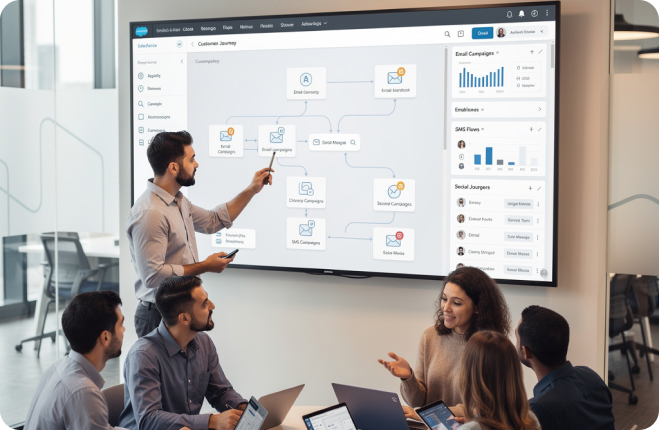
We know Salesforce marketing automation only works well when the data, CRM structure, and automation logic are aligned from the start. If the sync is weak, the lifecycle is unclear, or the segmentation rules are unreliable, automation creates more noise than value. That is why we help businesses connect Salesforce CRM data with the right automation structure so campaigns, journeys, scoring, and reporting support real business outcomes across both B2B and B2C environments.
Clean CRM Data That Automation Can Actually Use
We align lead, contact, account, and related CRM fields with your marketing platform so data moves more cleanly between systems. This helps marketing automation in Salesforce run on better inputs and reduces issues caused by inconsistent or incomplete records.
A Lead Lifecycle Both Marketing and Sales Can Work With
We define lifecycle stages, qualification points, handoff logic, and stage movement so marketing and sales work from the same structure. This makes Salesforce and marketing automation more useful for pipeline progression, lead quality, and team alignment.
Smarter Segmentation for Better Audience Targeting
We build segmentation rules using CRM data, behavioral signals, and lifecycle conditions so automation reaches the right audience at the right time. This strengthens marketing automation with Salesforce by making campaigns and journeys more targeted and more relevant.
Reporting That Connects Automation to Real Business Results
We help connect campaign activity to Salesforce reporting so teams can see how automation supports engagement, pipeline, and revenue outcomes. This gives Salesforce for marketing automation a clearer business view instead of leaving performance trapped inside isolated platform metrics.
Industry-Specific Salesforce Marketing Automation Use Cases
We apply Salesforce marketing automation differently based on how each industry markets, sells, and retains customers. That helps businesses use the right journeys, segmentation, and platform approach for their sales cycle, audience behavior, and growth goals.

Professional Services

Financial Services

Manufacturing

eCommerce

Healthcare and Life Sciences

Technology and SaaS

Retail

Real Estate
Why Businesses Choose HyphenX for Salesforce Marketing Automation
Choosing the right partner for Salesforce marketing automation is about more than platform knowledge. At HyphenX, we combine strategy, execution, and Salesforce expertise to help businesses build automation that is scalable, practical, and aligned with real marketing and revenue goals across both B2B and B2C environments.
Expertise Across Salesforce Marketing Platforms
Strategy-First, Not Just Platform Setup
Salesforce-Native, CRM-Aligned Automation
End-to-End Delivery with Business-Focused Guidance
The Right Marketing Automation Setup Can Change More Than Just Campaign Performance
It can improve lead flow, customer experience, reporting clarity, and team efficiency. Let’s talk about how we can build Salesforce and marketing automation around the way your business actually grows.
Get in Touch
We’d love to hear from you. Please fill out the form below to reach out to us.
FAQ’s
You do not need a perfect setup to begin, but you do need clear goals, usable customer data, and a basic understanding of your audience journey. We help assess readiness and identify what needs to be improved before automation starts.
No. We help businesses understand which platform fits their model better. Salesforce Pardot marketing automation is usually better for B2B lead management, while Salesforce Marketing Cloud automation is often better for B2C journey orchestration and large-scale engagement.
Yes. Many businesses begin with simple email sends, limited segmentation, or inconsistent follow-up. We help turn that into a more structured marketing automation for Salesforce setup that can grow over time without becoming difficult to manage.
That depends on the platform, campaign complexity, data readiness, and integration needs. A simpler setup can move faster, while a broader marketing automation in Salesforce rollout with journeys, scoring, and reporting will usually take longer.
Yes. Many teams already have automation in place but are not getting enough value from it. We often help improve scoring, journey logic, segmentation, reporting, and CRM alignment without rebuilding everything from scratch.
Most projects need input from marketing, CRM, and sometimes sales or revenue operations. We guide the process, but your team helps define goals, audience logic, approvals, and business rules so the final Salesforce marketing automation setup fits real operations.
Yes. Good automation should help teams qualify, segment, and nurture leads more effectively. That is one of the main reasons businesses invest in Salesforce and marketing automation instead of relying only on campaign volume and manual follow-up.
No. Mid-sized and growing businesses can benefit too, especially if campaigns are becoming harder to manage manually. The right marketing automation Salesforce setup can help smaller teams work more efficiently and communicate more consistently.
Yes, if the business supports both models. We help shape the strategy based on audience type, sales cycle, and platform fit, so marketing automation with Salesforce supports each motion without forcing the same structure on both.
Automation should be reviewed regularly, not left untouched after setup. Performance, audience behavior, business goals, and lifecycle movement can all change, so ongoing review helps keep Salesforce marketing automation useful and effective over time.
Yes. Automation is often just as useful after conversion as it is before. Businesses use it for onboarding, renewal reminders, upsell communication, loyalty journeys, and re-engagement programs, especially in B2C marketing automation Salesforce environments.
That is common, and it should be addressed early. Automation depends on data quality, so we usually review CRM structure, fields, segmentation logic, and sync behavior before expanding Salesforce for marketing automation too far.
Yes. One benefit of a structured automation program is that it reduces scattered messaging and disconnected campaign execution. It helps teams work from clearer rules, cleaner audience logic, and more consistent customer communication.
That depends on your current maturity and business pressure. Some teams need fast improvements first, while others benefit from a broader roadmap. We usually recommend a practical path that gives early value without losing sight of long-term structure.
The difference is usually not just platform knowledge. A stronger partner understands journey design, CRM alignment, audience logic, reporting, and business goals together. That is what makes Pardot Salesforce Marketing Automation, or Marketing Cloud, work more effectively in real use.