Choosing a CRM in 2026 is no longer a back-office decision. It sits at the center of how revenue teams operate, how leadership forecasts growth, and how sales and marketing align around the pipeline. Businesses today expect their CRM to do far more than store contacts. They expect it to automate follow-ups, surface insights, flag at-risk deals, and connect every part of the revenue operation.
Zoho and Salesforce are two of the most compared platforms in this space. Both are mature, capable, and widely used. But they serve very different business needs, and choosing the wrong one creates friction that compounds over time in productivity, visibility, and ultimately, revenue.
This blog breaks down how Zoho and Salesforce compare in 2026 across the areas that matter most to revenue teams: automation, reporting, scalability, integrations, and ROI. The goal is to help sales leaders, RevOps professionals, and business decision-makers make the right call, not just for today, but for where the business is headed.
Zoho vs Salesforce in 2026: A Quick Overview
Before comparing features, it helps to understand what each platform is actually built for and where each one earns its reputation. Both have evolved significantly over the last few years, and both carry distinct product philosophies that shape the experience from day one.
What Zoho CRM Is Best Known For
Zoho CRM has built a strong reputation as an affordable, all-in-one CRM for small and mid-sized businesses. It offers a solid feature set, including lead management, workflow automation, email integration, and reporting, without the enterprise price tag. For businesses that need a functional CRM quickly and want to keep costs low, Zoho delivers real value. Its broader Zoho suite of products, including Zoho Books, Zoho Desk, and Zoho Campaigns, also makes it attractive to companies that want a tightly bundled stack from a single vendor.
What Salesforce Is Best Known For
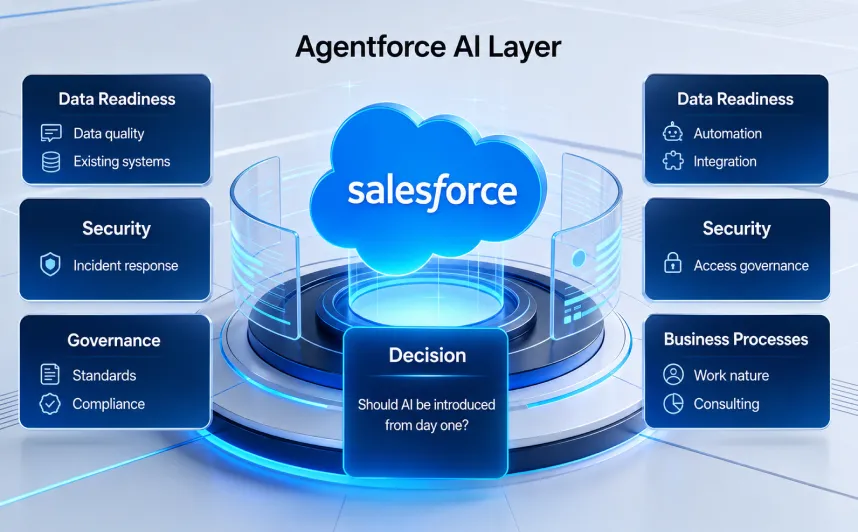
Salesforce is the market leader in CRM for a reason. It is purpose-built for scale, offering deep customization, enterprise-grade automation, advanced reporting, and one of the largest third-party integration ecosystems available. Sales Cloud, Service Cloud, Revenue Cloud, and the Einstein AI layer together create a platform that can support complex, multi-team revenue operations. Salesforce is where businesses go when they have outgrown simpler tools and need a system that can grow with them.
The Biggest Difference Between the Two Platforms
The core difference is not price. It is ceiling. Zoho is an excellent entry point. Salesforce is a long-term infrastructure investment. Zoho gets teams operational fast. Salesforce gets revenue operations mature. This distinction becomes more important as teams scale, pipelines get complex, and leadership starts demanding predictive, not just historical, visibility into revenue.
Why Revenue Teams Compare Zoho and Salesforce
The comparison comes up most often at a specific inflection point: when a business has grown past the basics and needs more from its CRM than it is currently getting. Teams start asking why their forecasts are unreliable, why the pipeline is hard to read, or why reporting requires too much manual work. That is often when Salesforce enters the conversation.
Ease of Use and Adoption
A CRM only delivers value when the people who need to use it actually do. Adoption is one of the most underrated factors in any CRM decision, because a powerful system sitting unused is worse than a simple one being used consistently.
Zoho’s Simple Setup for Smaller Teams
Zoho CRM is genuinely easy to get started with. The interface is clean, the onboarding is guided, and most small teams can be up and running within days. For businesses without a dedicated CRM administrator or technical resources, this is a meaningful advantage. The lower configuration complexity also means fewer dependencies when making changes.
Salesforce’s Learning Curve and Long-Term Payoff
Salesforce requires more upfront investment in setup and training. It is a more layered platform, and getting it configured correctly, especially for complex sales processes, multi-team workflows, or enterprise reporting, requires expertise. This learning curve is real and should not be dismissed. However, it exists precisely because Salesforce is built to handle far more depth. Teams that invest in a proper implementation and training program consistently report stronger long-term outcomes in pipeline visibility, automation, and forecasting accuracy.
User Adoption Across Sales, Marketing, and Service Teams
Zoho adoption tends to be straightforward for core sales teams. Where it gets harder is cross-functional alignment, getting marketing, customer success, and service teams working from the same data and workflows. Salesforce, when implemented well, creates a single source of truth across departments. Shared pipeline data, unified customer histories, and connected handoff workflows between teams are where Salesforce starts to show a clear advantage.
Which CRM Is Easier to Scale Across Departments?
Scaling Zoho across departments often requires adding products from the Zoho suite and managing integration between them. Salesforce scales differently. It is designed to accommodate more users, more processes, and more data within a single platform structure. For businesses planning growth across sales, marketing, service, and operations, Salesforce offers a more coherent path forward.
Sales Automation and Pipeline Management
Pipeline management is where CRM impact on revenue becomes most direct. The ability to automate repetitive tasks, prioritize the right deals, and give sales reps clear visibility into where each opportunity stands determines how productive a team actually is.
Lead and Deal Management in Zoho
Zoho CRM handles lead and deal management competently for most standard sales processes. Reps can track leads through stages, set follow-up tasks, and run basic workflow automations like email triggers or field updates. For smaller teams with linear sales cycles, this works well. The limitations start to show when processes become more complex, such as multi-step sequences, territory management, or advanced lead scoring based on behavioral data.
Advanced Sales Workflows in Salesforce
Salesforce’s workflow capabilities are in a different category. Flow Builder, Process Builder, and the broader automation layer allow revenue teams to build complex, conditional workflows without code, automating task creation, deal routing, approval processes, and multi-step follow-up sequences. Sales teams using Salesforce effectively spend less time on administrative work and more time selling. That is not a marketing claim. It is the structural outcome of well-designed automation.
Pipeline Visibility and Forecasting
Forecasting is where many businesses feel the gap most sharply. Zoho offers basic forecasting views, but they require manual inputs and lack the depth needed for accurate revenue prediction. Salesforce’s Collaborative Forecasting tool gives sales managers and executives a real-time, role-based view of the pipeline with commit levels, best-case scenarios, and historical trend data. For any business where accurate revenue forecasting matters, which is to say, most businesses, this is a significant advantage.
Why Salesforce Gives Revenue Teams More Control
Control in a CRM context means being able to see what is happening, intervene when needed, and adjust workflows without rebuilding them from scratch. Salesforce gives revenue teams that control at every stage of the funnel, from how leads are scored and routed to how deals progress through approval gates and how revenue is reported to leadership. Zoho can handle pieces of this, but not the full picture at the same depth.
Reporting, Analytics, and Revenue Intelligence

Reporting separates operational CRMs from strategic ones. A CRM that tells you what happened last month is useful. One that tells you what is likely to happen next quarter and why is transformational.
Zoho’s Reporting Strengths and Limits
Zoho CRM includes a solid reporting engine that covers standard sales metrics, including activity reports, deal stage breakdowns, revenue by rep, and conversion rates. For small teams that need basic visibility, it is more than sufficient. The limitations appear when teams need cross-object reporting, highly customized dashboards, or deeper behavioral analytics. Getting the right data out of Zoho often requires workarounds or reliance on Zoho Analytics as a separate add-on.
Salesforce Dashboards and Custom Analytics
Salesforce’s reporting layer is one of its strongest assets. Reports and dashboards in Sales Cloud are highly customizable, support complex filtering, and can be built across any combination of objects and fields. Executive dashboards showing ARR, win rates, average deal velocity, and pipeline coverage can be configured precisely to how leadership needs to see the data. Salesforce also integrates cleanly with enterprise analytics tools like Tableau, now part of the Salesforce ecosystem, for teams that need deeper data modeling.
AI-Driven Insights and Predictive Forecasting
Einstein AI is embedded throughout Salesforce and delivers functionality that Zoho cannot match in 2026. Einstein Lead Scoring prioritizes inbound leads based on historical conversion data. Einstein Deal Insights flags deals showing signs of risk. Einstein Forecasting uses machine learning to build predictive revenue projections rather than relying solely on rep-entered data. Zoho has introduced its own AI assistant, Zia, with some useful capabilities, but the depth, reliability, and integration of Einstein across the Salesforce platform are considerably more advanced.
Which CRM Gives Leadership Better Revenue Visibility?
For business owners, sales directors, and RevOps leaders who need to make decisions based on reliable data, Salesforce consistently delivers better visibility. The combination of real-time dashboards, AI-driven insights, and integrated forecasting tools means leadership is working with intelligence, not just information.
Integrations, Customization, and Scalability
No CRM operates in isolation. The ability to connect with other tools in the stack and customize the CRM around unique business processes directly determines how much value it can deliver over time.
Zoho’s Ecosystem and Affordability
Zoho has built a wide ecosystem of native apps across sales, finance, HR, and marketing. For businesses already using Zoho products, the integration experience within that suite is smooth and cost-effective. Zoho also connects to popular third-party tools through Zapier and native connectors. For small businesses that want to consolidate software spend without managing too many vendors, this is a genuine advantage.
Salesforce AppExchange and Enterprise Integrations
Salesforce AppExchange is the largest CRM marketplace in the world, with thousands of pre-built integrations covering virtually every business function, including marketing automation, billing, ERP, customer support, document management, data enrichment, and more. Enterprise tools like HubSpot, Marketo, SAP, NetSuite, DocuSign, and Slack all integrate deeply with Salesforce. For businesses running complex stacks across multiple departments, this breadth matters enormously.
Customization for Complex Revenue Operations
Salesforce’s customization capabilities go well beyond renaming fields and adjusting layouts. Custom objects, custom metadata types, Apex code, Lightning components, and API-first architecture allow businesses to model their CRM around their exact revenue process, not the other way around. This is critical for businesses with non-standard sales motions, industry-specific requirements, or multi-layered approval and pricing processes.
Why Scalability Matters as Teams Grow
A CRM that works for a ten-person sales team may struggle for a hundred-person one. Salesforce is designed to scale in users, data volume, process complexity, and cross-functional use. Businesses that implement Salesforce early with growth in mind spend far less time rearchitecting their CRM later. That structural durability is part of what justifies the investment.
Pricing, ROI, and Final Verdict

Cost is always part of the CRM conversation, but price and value are not the same thing. The right question is not which CRM costs less. It is which CRM generates more revenue relative to what it costs.
Zoho’s Lower Entry Cost
Zoho CRM is significantly more affordable than Salesforce at entry level. Plans start as low as $14 to $20 per user per month, and even the more advanced tiers remain well below Salesforce pricing. For startups, early-stage businesses, or teams with tight budgets and straightforward sales processes, this cost advantage is real and meaningful. Getting a functional CRM in place quickly without a large financial commitment has clear value in the right context.
Salesforce’s Higher Investment but Stronger Revenue Potential
Salesforce licensing starts higher and scales with users and features. Implementation, customization, and training add to the upfront cost. For businesses evaluating Salesforce purely on subscription price, the number can feel steep. But the return on that investment, when implementation is done well, comes from measurable improvements in pipeline accuracy, sales productivity, forecast reliability, and revenue operations efficiency. Businesses that use Salesforce to its capability consistently outperform peers still working with simpler tools.
Which CRM Offers Better Long-Term ROI?
For small businesses with simple needs, Zoho’s ROI is stronger in the short term simply because the cost is lower and the setup is faster. For companies with growing teams, complex sales processes, and serious revenue targets, Salesforce delivers substantially better long-term ROI. The automation savings, forecasting accuracy, and data-driven decision-making that Salesforce enables translate directly into revenue outcomes that justify the investment many times over.
Final Verdict: Salesforce Is the Better Choice for Revenue Growth
Zoho is a legitimate CRM with real strengths. For small businesses, cost-conscious teams, or companies in the early stages of CRM adoption, it is a sensible choice. But for businesses that want to build a scalable revenue engine, one that gives leadership real visibility, empowers sales teams with serious automation, and grows with the company, Salesforce is the stronger platform. The gap between the two widens as business complexity increases.
Conclusion
The Zoho vs Salesforce 2026 debate does not have a universal answer, but it does have a clear one for most growth-minded businesses. Zoho earns its place as a practical, affordable CRM for smaller teams that need to get moving fast without heavy investment. Salesforce earns its market-leading position because it does what mature revenue teams actually need: deep automation, reliable forecasting, powerful reporting, and a platform that scales without hitting ceilings.
If your business is at the point where the CRM question is really a revenue operations question, where you need the pipeline to be predictable, the data to be trustworthy, and the system to grow with you, Salesforce is the right investment. For teams planning to adopt, customize, or get more from Salesforce, HyphenX helps businesses turn CRM investment into a stronger, more connected revenue system.