
Healthcare organizations are under real pressure to connect fragmented systems, respond faster to patients and members, and do all of it without loosening their grip on privacy and security. Many of the teams we speak with already run Salesforce somewhere in the business, yet the healthcare side of the operation still lives in spreadsheets, call scripts, and disconnected portals.
That gap is where a healthcare-specific CRM earns its place. In this guide we walk through how Salesforce for healthcare actually works in 2026, what Health Cloud does that a standard CRM cannot, where AI and Agentforce fit, and how compliance responsibilities are shared between you, Salesforce, and your implementation partner. The aim is to help you make informed decisions, so we have kept the language practical and grounded in how these systems behave once they are live.
We approach every engagement the same way, whether it begins as a fresh build or the rescue of a stalled project. If you want the wider context for how we think about the platform, our Salesforce consulting approach sets the tone for everything that follows.
What Salesforce Health Cloud Is in 2026, and How It Differs From a Standard CRM
Health Cloud is Salesforce’s healthcare and life sciences platform, built on the core CRM but shaped around patients, members, providers, and care teams rather than generic sales contacts. It ships with a person-centric data model and prebuilt capabilities that a standard org simply does not have.
A standard Salesforce CRM organizes the world into accounts, contacts, leads, opportunities, and cases. That works well for a sales pipeline. Healthcare needs a different center of gravity. Health Cloud adds healthcare-aware objects and consoles: unified patient and member profiles, care plans, care teams, provider networks, and workflows for intake, referrals, and appointments.
It is worth being precise about the boundary. Health Cloud is a relationship and engagement layer. It does not replace your electronic health record, your billing or claims engine, or any clinical or diagnostic system. It sits alongside those systems and coordinates the work that happens around care.
Standard CRM compared with Health Cloud
Dimension | Standard Salesforce CRM | Salesforce Health Cloud |
Core data model | Accounts, contacts, leads, opportunities | Person-centric patient and member profiles, care plans, provider relationships |
Primary focus | Sales pipeline and general service | Patient, member, provider, and care-team engagement |
Prebuilt healthcare features | None out of the box | Intelligent appointment management, referral management, care coordination, contact center for health |
Interoperability | Generic APIs and connectors | FHIR-aligned data model and healthcare integration patterns |
Compliance posture | General purpose | HIPAA-eligible editions with business associate agreement support when contracted |
What Health Cloud is not
To keep expectations realistic, it helps to name the systems Health Cloud complements rather than replaces:
- It is not an EHR or EMR. Clinical documentation, orders, and lab results stay in your record system.
- It is not a billing or claims engine, and it is not a substitute for revenue-cycle tools.
- It is not a diagnostic or clinical decision system. It engages, coordinates, and routes, while clinical judgment stays with your clinicians and their systems.
The Salesforce Products That Power Healthcare Engagement
Health Cloud rarely works alone. Most healthcare programs combine several Salesforce products, each doing a specific job. Here is how the main pieces tend to fit together in a healthcare setting.
- Sales Cloud: supports provider relationship management, life sciences commercial teams, and referral-source tracking, giving business development a clear view of relationships and activity.
- Service Cloud: runs contact center operations, case management, and patient or member service requests, with omni-channel routing across phone, chat, email, and messaging.
- Experience Cloud: delivers patient, member, and provider portals for self-service, where people can submit requests, check status, and access approved information.
- Data Cloud: unifies records from many systems into a governed profile, resolving identities and reducing the duplicate, conflicting data that undermines both service and analytics.
- Agentforce: provides the AI agent layer for assistive service and administrative automation, which we cover in its own section below.
- MuleSoft: acts as the integration backbone for connecting EHR and EMR platforms, payer systems, and other applications using APIs and healthcare interoperability patterns.
- Tableau: turns operational data into reporting and dashboards for service performance, access and scheduling operations, and program management.
- Flow: automates the repetitive workflow behind intake, follow-ups, task creation, and approvals, so staff spend less time on manual steps.
Data quality is usually the difference between a platform that helps and one that frustrates. A well-planned Salesforce Data Cloud implementation gives care teams a unified, governed profile to work from, which is also the foundation that makes reporting and AI trustworthy later on.
Health Cloud Across the Patient, Member, and Provider Journey
The clearest way to understand Health Cloud is to follow the work it supports across a person’s journey. The scenarios below are the ones we see most often when healthcare teams move from disconnected tools to a single platform.
Patient intake and onboarding
Intake is where first impressions and first data-quality problems are made. Guided intake flows capture demographics, consent, and program details once, then create a clean patient profile that downstream teams can trust. Automated tasks and reminders keep onboarding moving instead of stalling in an inbox.
Care coordination and referral management
Care coordination brings the care team, tasks, and care plan into one place, so nothing depends on someone remembering to follow up. Referral management tracks referrals from creation through acceptance and closure, which reduces the leakage and lost handoffs that happen when referrals live in faxes and phone calls.
Provider relationship management
For provider and network teams, Health Cloud and Sales Cloud together give a structured view of provider relationships, outreach, and engagement history. That helps relationship managers stay organized across a large network without falling back on personal spreadsheets.
Contact center, service requests, and appointments
In the contact center, agents work service requests and cases from a single console with the patient or member context in front of them. Intelligent appointment management supports scheduling, rescheduling, and post-visit follow-up, and automated sequences handle appointment reminders and check-ins across channels.
Member services and case management
On the payer side, member services teams handle inquiries, benefit questions, and issue resolution through structured case management. Consistent routing and clear ownership mean members are less likely to repeat themselves or fall through the cracks.
Healthcare marketing journeys
Marketing journeys support education, program enrollment, and appropriate outreach, always subject to consent and communication preferences. The point is relevance and timing rather than volume, which matters a great deal in a regulated setting.
Medical device and life sciences use cases
For medical device and life sciences organizations, Health Cloud supports commercial workflows such as sales agreements, account and product planning, and field engagement. These teams get structure around complex, relationship-driven selling without stepping into clinical territory.
Journey stage | How Health Cloud supports it |
Intake and onboarding | Guided flows, consent capture, clean profile creation, automated onboarding tasks |
Care coordination | Shared care team, care plans, tasks, and referral tracking end to end |
Service and contact center | Unified console, case management, omni-channel routing, appointment workflows |
Member services | Structured cases, consistent routing, clear ownership and follow-up |
Engagement and outreach | Consent-aware journeys for education, reminders, and enrollment |
AI Agents and Agentforce in Healthcare

AI is the topic that generates the most excitement and the most anxiety in healthcare, often in the same meeting. Used well, it removes administrative drag. Used carelessly, it creates risk. The difference comes down to scope, grounding, and governance.
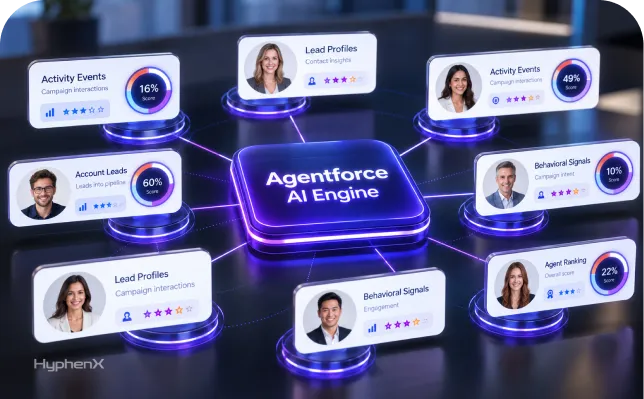
Agentforce is the agent layer that sits on top of Salesforce data and workflows. In a healthcare context, the most valuable use cases tend to be assistive and administrative rather than clinical.
- AI-assisted service: agents draft replies and surface relevant knowledge so human staff respond faster and more consistently.
- Summarization: long case or interaction histories are condensed so a coordinator can pick up context quickly.
- Routing: inbound requests are classified and directed to the right queue or team, reducing back-and-forth.
- Workflow support: agents help with steps like scheduling assistance and status updates within approved boundaries.
- Administrative automation: repetitive tasks such as data entry follow-ups and reminders are handled with less manual effort.
Keeping AI safe: governance, supervision, and escalation
Salesforce grounds this with the Einstein Trust Layer built into Agentforce, which includes protections such as dynamic grounding, zero data retention with the model provider, toxicity detection, and configurable guardrails. Salesforce also recommends that a human review AI responses before they reach the end user for most use cases, which fits healthcare well.
Technology alone does not make an agent trustworthy. The operating model around it does. A responsible rollout usually includes the following:
- A tightly scoped purpose, so each agent does a defined job rather than everything at once.
- Grounding in approved, permissioned data, so answers reflect your records and access rules.
- Clear guardrails and topics the agent must not handle.
- Sandbox testing against real scenarios and edge cases before production.
- Human supervision, with defined escalation paths to a person when confidence is low or the topic is sensitive.
- Ongoing monitoring and tuning based on how the agent actually behaves.
This is the heart of our Agentforce design and governance work: we treat an AI agent as a data, process, and oversight project first, and a configuration exercise second.
Integration, Interoperability, and Data Migration
A healthcare CRM is only as good as its connections. Health Cloud has to exchange data with clinical and operational systems, and it has to be populated with accurate history. Both integration and migration deserve careful planning.
EHR and EMR integration considerations
The goal of EHR and EMR integration is coordination, not duplication. Health Cloud does not replace the record system. It reads and writes the specific, permitted data that engagement and coordination require, while the record system remains the clinical source of truth.
Early on, it helps to decide which direction data flows for each object, whether updates need to be real time or can run in batches, and how you will avoid creating conflicting versions of the same patient. Getting these patterns right prevents the slow drift that erodes trust in the data.
HL7 and FHIR interoperability
HL7 and FHIR are the standards that make healthcare interoperability practical. FHIR in particular has become the common language for exchanging healthcare data through modern APIs, and Health Cloud’s data model is designed to align with it. Aligning your integration to FHIR resources early makes future connections easier and keeps mapping consistent across systems.
Reliable interoperability is an engineering discipline. Our approach to secure Salesforce integrations and middleware focuses on connecting systems with clear contracts, controlled access, and error handling that holds up under real-world load.
Data migration, validation, and reconciliation
Migration is where quiet risk hides. Moving patient, member, and provider data into Health Cloud calls for careful mapping, cleansing, and deduplication, followed by validation and reconciliation so the numbers in the new system match the source.
- Map source fields to the Health Cloud model before moving anything, and document the decisions.
- Cleanse and deduplicate so a person does not arrive as three different records.
- Validate migrated data against the source and reconcile totals, not just samples.
- Apply migration controls and access restrictions so sensitive data is handled correctly in transit and at rest.
This discipline is central to our Salesforce data migration services, where validation and reconciliation are planned from the start rather than bolted on at the end.
HIPAA and Compliance as a Shared Responsibility
Compliance is the area where clarity matters most, so we will be direct about it. Neither Salesforce nor a partner like us can make your organization HIPAA compliant on its own. Compliance is the outcome of the platform, your configuration, your policies, and your people working together.
Under HIPAA, when a covered entity engages a business associate to handle protected health information, it must have a written contract requiring that associate to safeguard the data, and business associates are directly liable for certain provisions. You can read this in the HHS guidance on covered entities and business associates. In practical terms, that means a business associate agreement is a starting point, not a finish line.
With Salesforce specifically, a few facts shape every healthcare project. Salesforce signs a business associate agreement only for eligible services and editions, and only when it is explicitly contracted. Protected health information should live only on covered services, and a BAA on one product does not automatically extend to another. From there, how you configure the platform determines your posture.
Where responsibility sits
Area | What Salesforce provides | What you and your partner own |
Legal basis | A business associate agreement for eligible, contracted services | Executing the BAA and keeping PHI on covered services only |
Security features | Encryption, access controls, and audit capabilities in the platform | Configuring them correctly and enforcing least-privilege access |
Data handling | A compliant infrastructure foundation | Consent management, retention rules, and minimum-necessary practices |
Integrations | APIs and connection capabilities | Securing each integration and controlling vendor access |
People | Documentation and guidance | Staff training, internal policies, and ongoing governance |
A practical compliance checklist
This is not legal advice, and every organization should validate its own obligations. As a working starting point, most healthcare teams need to confirm the following:
- A business associate agreement is in place and covers the exact services holding PHI.
- Protected health information sits only on HIPAA-eligible editions and services.
- Access follows the minimum-necessary principle, enforced through role-based permissions.
- Encryption is applied to sensitive data, and audit logging is retained for a meaningful period.
- Consent and communication preferences are captured and honored.
- Integrations are secured, and third-party vendor access is scoped and reviewed.
- Data migration is controlled, validated, and logged.
- Staff are trained, and governance is an ongoing routine rather than a one-time event.
Risk in this space is manageable when it is named early and paired with concrete controls. The organizations that struggle are usually the ones that treated compliance as a checkbox at go-live rather than a design input from day one.
A Practical Health Cloud Implementation Roadmap, and How We Support You

A Health Cloud program runs more smoothly when it follows a clear sequence. The roadmap below reflects how we structure engagements, adjusted to each organization’s starting point and priorities.
- Readiness assessment and workflow discovery. We start by understanding your current systems, data, and the real workflows your teams follow, not just the ones on paper.
- Architecture and design. We define the data model, security model, and how Health Cloud fits alongside your record and operational systems.
- Configuration and build. We configure the intake, coordination, service, and engagement capabilities your program needs, favoring maintainable design over complexity.
- Integration and interoperability planning. We plan EHR and EMR connections and align integration to HL7 and FHIR so data flows are consistent and controlled.
- Data migration and validation. We map, cleanse, migrate, validate, and reconcile so the platform launches on trustworthy data.
- AI enablement with Agentforce. We design scoped agents, ground them in permissioned data, and build in human review and escalation.
- Security, permissions, and governance. We set role-based access, audit logging, and the ongoing governance that keeps the platform aligned with your policies.
- Testing and human escalation paths. We test workflows and edge cases in a sandbox and confirm that escalation to a person works as intended.
- Training and adoption. We prepare your teams so the platform becomes part of daily work rather than a system people work around.
- Go-live and ongoing optimization. We support launch and then keep refining the platform as needs change.
If you are planning a build, our Salesforce implementation services bring this roadmap together into a single, accountable delivery, from assessment and architecture through integration, migration, AI enablement, testing, and training.
Where to go from here
If you are weighing Health Cloud, untangling a stalled implementation, or trying to add AI without adding risk, we are glad to help you think it through. We can run a readiness assessment, shape the architecture, plan your EHR and FHIR integrations, handle migration and validation, design and govern your Agentforce agents, and stay on afterward for managed support and ongoing optimization.
Tell us where you are today and what you are trying to improve, and we will map out a practical path built around your workflows, your data, and your compliance obligations. That is the kind of partnership we aim for: steady, expert, and focused on results you can measure.