If you’ve spent the last few weeks trying to hire a Marketing Cloud Account Engagement specialist in India, you already know something feels off. Job boards show hundreds of Salesforce Marketing Cloud profiles. Almost none of them actually touch Account Engagement, the platform most people still call Pardot.
We run into this constantly at HyphenX. Teams come to us after two months of searching, holding resumes for Sales Cloud admins and Apex developers, with nothing that matches what they need.
This guide is built to answer that problem end to end. We’ll cover what the role really involves, why the India talent gap exists, what the current market data says, how to screen candidates properly, what every hiring path costs, and what to do when direct hiring is simply too slow.
None of this is a knock on India’s Salesforce talent pool. It’s one of the largest and most capable anywhere. The issue is a mismatch between where that talent concentrates and where most hiring managers assume it sits.
TL;DR
The Talent Gap Hiding Inside a Huge Ecosystem
India’s Salesforce workforce is enormous, but it clusters around Sales Cloud, Service Cloud, and Apex development. Marketing Cloud Account Engagement sits in a far narrower corner, so the pool you’re actually searching when you hire an MCAE specialist is much smaller than headline numbers suggest.
Why Your Search Keeps Stalling at Month Three
Two product names split the candidate market, certifications signal study rather than delivery, and most resumes listing “Salesforce Marketing Cloud” mean the B2C tool. Meanwhile the open seat costs you unscored leads and paused campaigns, a cost that never shows up on any invoice.
Matching the Hiring Path to Your Actual Timeline
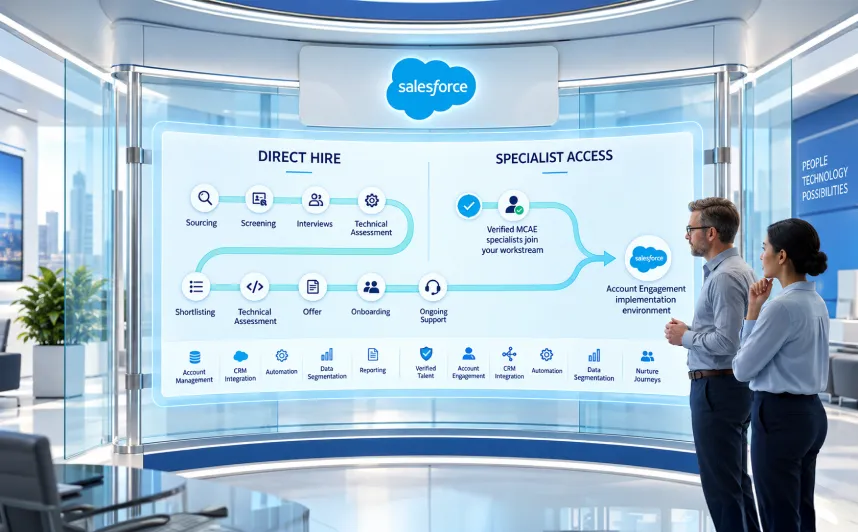
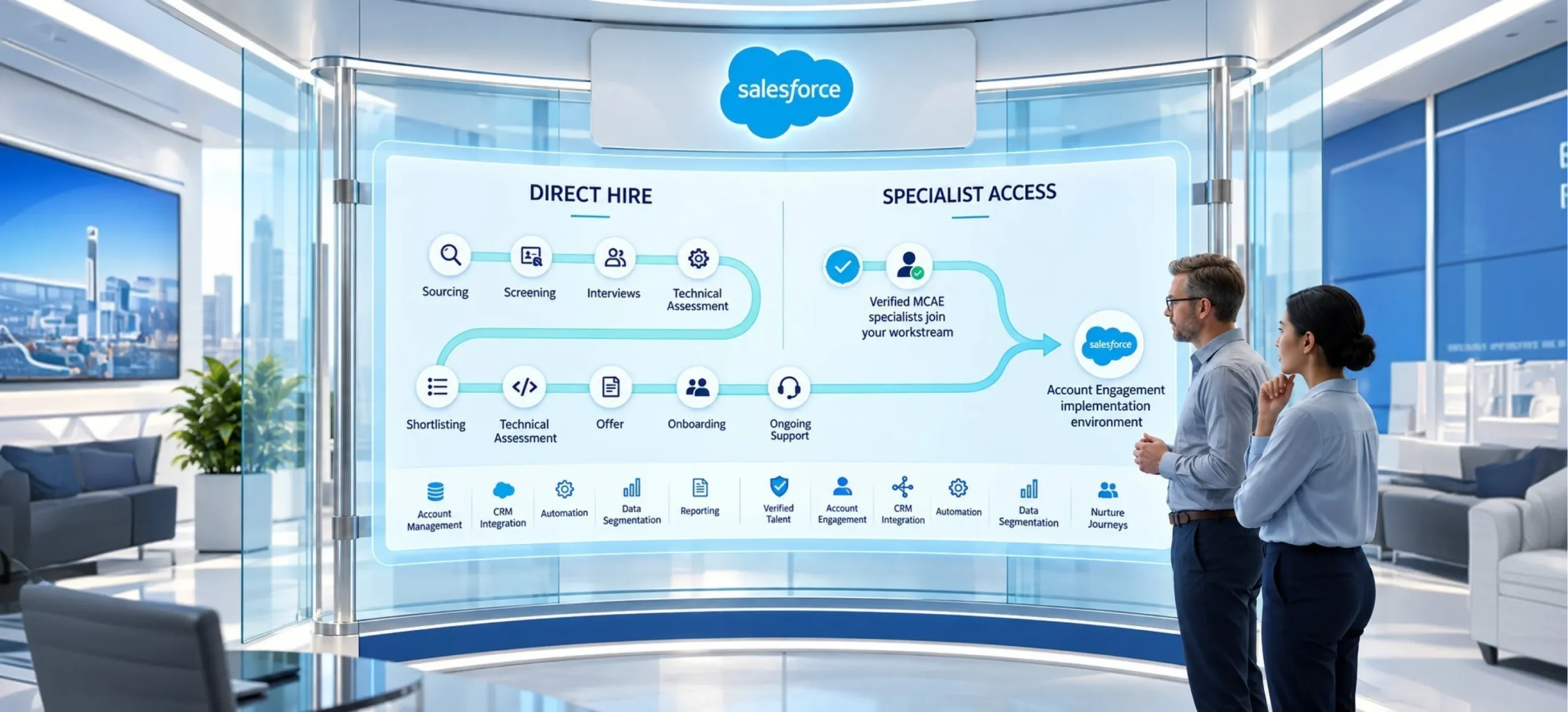
We break down all five routes with real cost ranges, screening checklists, and interview questions that expose genuine Pardot experience. When direct hiring can’t move fast enough, our Salesforce staff augmentation puts a vetted MCAE specialist on your project within days.
What This Guide Covers
- What a Marketing Cloud Account Engagement specialist actually does, and how the role differs from Salesforce Marketing Cloud
- Why hiring a Pardot specialist in India takes longer than most teams plan for
- Current market data on salaries, rates, agency fees, and talent concentration
- A 12-point listicle of the real blockers, ranked by how often we see them
- A printable hiring checklist covering skills, screening, and onboarding
- A five-way comparison of hiring paths with cost, speed, and vetting side by side
- A full costings breakdown across full-time, freelance, agency, and staff augmentation
- How our Salesforce staff augmentation works when direct hiring stalls
What Is a Marketing Cloud Account Engagement Specialist?
Marketing Cloud Account Engagement is Salesforce’s B2B marketing automation platform. Most of the industry still calls it Pardot, and we’ll use both names throughout this guide, because both show up in job titles, resumes, and search results.
A Marketing Cloud Account Engagement specialist builds and maintains the systems that turn website visitors and form fills into qualified leads inside Salesforce.
What the Role Involves Day to Day
- Designing and tuning lead scoring and grading models tied to real sales handoff criteria
- Building multi-step nurture programs in Engagement Studio
- Managing email templates, sends, and deliverability health
- Creating and troubleshooting forms, form handlers, and landing pages
- Maintaining the connector sync between Account Engagement and the core Salesforce org
- Keeping prospect data clean across two connected systems
- Building reports that tie marketing activity to pipeline, not just opens and clicks
What It Is Not: MCAE vs Salesforce Marketing Cloud
This is where most hiring confusion starts. Salesforce Marketing Cloud, sometimes called Marketing Cloud Engagement, is a separate B2C product built for large-scale email, mobile messaging, and journey orchestration. Account Engagement runs on a different codebase, built for B2B lead nurturing and sales handoff.
The two products get confused constantly on resumes and in job postings. A candidate who lists “Salesforce Marketing Cloud” may have never opened Account Engagement in their life. Here’s the practical difference.
Dimension | Marketing Cloud Account Engagement (Pardot) | Salesforce Marketing Cloud (Engagement) |
Primary use case | B2B lead nurturing and sales handoff | B2C mass email, mobile, and journey orchestration |
Core objects | Prospects, synced to Leads and Contacts | Subscribers and data extensions |
Automation tool | Engagement Studio, automation rules | Journey Builder, Automation Studio |
Key skill | Scoring, grading, connector sync, form handling | AMPscript, SQL queries, data extension modeling |
Typical buyer | B2B marketing and sales ops teams | B2C, retail, and high-volume consumer brands |
If you want the fuller technical picture of what the Account Engagement platform covers, our Marketing Cloud Account Engagement services page walks through it in detail. Our broader Salesforce Marketing Cloud services page covers the B2C side, if that’s actually what you need.
Why the Role Sits Between Marketing and IT
One reason this hire is tricky is that it doesn’t fit neatly into either a marketing job description or a Salesforce job description.
A pure marketer often doesn’t have the technical depth to manage the connector sync, troubleshoot API errors, or build governance into an org. A pure Salesforce admin often hasn’t spent time thinking about lead lifecycle stages, nurture sequencing, or what actually moves a prospect toward sales-ready.
The specialists who do this well sit at the intersection. That combination is rarer than either skill alone, which is why a straightforward marketing job posting and a straightforward Salesforce job posting each pull in the wrong half of the candidate pool.
Why Is It So Hard to Hire a Marketing Cloud Account Engagement Specialist in India?
Short answer: India’s Salesforce talent pool is huge, but it’s concentrated in Sales Cloud, Service Cloud, and Apex development. Account Engagement sits in a much smaller, more specialized corner of that ecosystem, and a 2022 product rename split how the remaining specialists describe themselves.
Here’s what’s happening underneath that.
The Specialist Pool Is Smaller Than the Ecosystem Suggests
India’s Salesforce ecosystem has grown fast. IDC research commissioned by Salesforce projects the Salesforce economy and its partner ecosystem will generate well over a million jobs in India, and most large Indian IT services firms run sizeable Salesforce practices out of Hyderabad, Bengaluru, Pune, Chennai, and Jaipur, where we’re based ourselves as a Salesforce consulting partner.
That scale is real. It’s also concentrated in CRM and platform development work, not marketing automation. Account Engagement is a B2B marketing tool, and most Salesforce careers in India get built around the CRM and development side of the platform.
So when you post a role to hire a Marketing Cloud Account Engagement specialist, you’re searching a far smaller pool than a generic “Salesforce developer India” search would suggest.
The Pardot Rebrand Split How People Describe Their Own Skills
Salesforce renamed Pardot to Marketing Cloud Account Engagement in 2022, as part of an initiative to make its Marketing Cloud product names consistent. The intent made sense. Salesforce wanted the Marketing Cloud family to read as one connected suite instead of a set of acquired tools with unrelated names.
In practice, it created a hiring problem. Search interest data has consistently shown people searching “Pardot” far more often than “Account Engagement,” and job titles haven’t caught up either.
Some specialists still list “Pardot Consultant” on LinkedIn. Others switched fully to “Marketing Cloud Account Engagement Specialist.” A fair number use a generic title like “Salesforce Marketing Specialist” that tells you nothing about what they’ve actually worked on.
If your job posting or your LinkedIn search uses only one version of the name, you’re invisible to candidates using the other one. That alone can halve your usable pool.
Certifications Hide the Gap Between Studied It and Delivered It
Salesforce offers a dedicated Account Engagement Specialist certification, plus a separate Consultant credential aimed at more complex implementation work. Holding either tells you someone studied the platform and passed an exam.
It doesn’t tell you they’ve built a working lead-scoring model under real sales pressure, resolved a sync conflict inside a messy Salesforce org, or diagnosed a deliverability problem that was quietly killing open rates for months.
This pattern runs across the wider Salesforce market. The Salesforce Administrator certification, which used to make a candidate competitive for a wide range of roles, is now treated as a baseline expectation rather than a differentiator. The roles causing the most hiring pressure need product-specific depth backed by real project history.
A candidate can pass the Account Engagement Specialist exam after a few weeks of focused study. Building a scoring model that survives contact with a real sales team takes actual hours in the platform that no exam substitutes for.
Most of India’s Salesforce Talent Was Trained for a Different Job
Career guidance aimed at Salesforce professionals in India tends to push people toward Apex, Lightning Web Components, CPQ, and general administration, because that’s where the bulk of consulting and services work sits. Marketing operations, lead lifecycle design, and B2B nurture strategy get far less attention in most training paths and bootcamps.
The result is that even strong Salesforce professionals in India often haven’t worked hands-on with Account Engagement, even when their resume lists “Salesforce Marketing Cloud” as a skill.
Attrition Makes an Already Narrow Pool Move Fast
Demand for Salesforce skills in India has been high enough for long enough that job-hopping is common. Professionals with in-demand specialist skills move roles more often than the market average, because a narrow, high-demand skill set gives them leverage.
The practical effect: a specialist you interview today may already be fielding two or three other offers, and a candidate pool that looked adequate last month can shrink by the time you’re ready to make one. Moving fast matters more for this role than for a broader Salesforce hire.
Market Research: What the Current Data Says About MCAE Hiring in India
We pulled together the public benchmarks that actually bear on this hiring decision, so you’re not planning off guesswork. Everything below is directional, because almost no public salary dataset separates Account Engagement from the broader Marketing Cloud suite. Treat these as planning ranges, not quotes.
Compensation and Rate Benchmarks
Data point | Figure | Source type | What it means for you |
Salesforce Marketing Cloud Consultant, India average | ~₹11.5 lakh per year | Glassdoor self-reported salary data | A reasonable midpoint anchor for an experienced MCAE hire |
Salesforce Marketing Cloud Developer, India range | ~₹4.5 lakh to ₹15.4 lakh (25th to 75th percentile) | Glassdoor, 52 reported salaries | Wide band; experience and product depth drive the spread |
Offshore Salesforce specialist rate, India | $25 to $55 per hour | Salesforce staffing market reporting | Your realistic staff augmentation cost benchmark |
Offshore Salesforce architect rate, India | $40 to $70 per hour | Salesforce staffing market reporting | Applies if the role needs org-wide architecture input |
Recruitment agency fee, India standard roles | 8.33% to 16.67% of annual CTC | Multiple India recruitment market reports | One-time cost on top of salary, paid on joining |
Recruitment agency fee, niche technical roles | Up to 20% to 25% of CTC | India recruitment market reports | MCAE qualifies as niche; expect the upper band |
Freelance Pardot rate, general marketplaces | As low as $10 per hour | Freelance platform rate guides | Cheap, but vetting is self-reported and inconsistent |
Freelance Pardot rate, vetted platforms | $60 to $100+ per hour | Curated freelance platform rate guides | Closer to real specialist pricing once screening is applied |
Talent Market Signals
- Search interest in “Pardot” has consistently outpaced “Account Engagement” since the rename, meaning candidates and recruiters often search different terms for the same skill.
- Salesforce’s India hiring hubs cluster in Hyderabad, Bengaluru, Pune, Chennai, and Noida, concentrated in product companies and large IT consultancies. That pulls senior talent toward broad platform work rather than a single specialist product.
- Industry analysis of the 2026 Salesforce skills gap points to product-specific roles like CPQ, Data Cloud, and Marketing Cloud as the ones generating the most hiring urgency, not general administration.
- US-market retainer benchmarks for ongoing Account Engagement consultant access sit around $1,500 to $5,000 per month, with project work around $5,000 to $15,000 per quarter. India-based staff augmentation typically lands well below those figures for comparable skill.
How to Read This Data
The salary band is wide because the title is imprecise. Two candidates with identical job titles can differ enormously in actual Account Engagement depth, which is why screening matters more here than in a role with cleaner market signals.
Agency fees for niche roles push toward the top of the range precisely because the search is hard, so you pay more for a search that’s also slower. And the gap between the $10 freelancer and the $75 freelancer reflects a real quality difference, not a negotiation opportunity. The cheaper option often costs more once you count the rework.
12 Reasons Your Search for a Pardot Specialist in India Keeps Stalling
These are the blockers we see most often, roughly ordered by how frequently they show up in conversations with teams who’ve been searching for a while.
1. Your Job Title Only Uses One Product Name
Posting for a “Marketing Cloud Account Engagement Specialist” without mentioning Pardot filters out a large share of experienced people who still describe themselves the old way. Use both names in the title and the body.
2. You’re Screening for Salesforce Marketing Cloud by Mistake
Resumes that say “Salesforce Marketing Cloud” frequently mean the B2C product. If your screening question doesn’t distinguish the two, you’ll waste interview cycles on candidates who’ve never touched Engagement Studio.
3. The Certification Filter Is Doing Too Much Work
Filtering strictly by certification removes experienced practitioners who never bothered to certify, while letting through candidates who studied for three weeks and passed. Use certification as a signal, not a gate.
4. Your Job Description Reads Like a Generic Salesforce Admin Role
If the posting lists Apex, Flow, and reporting but never mentions scoring models, Engagement Studio, or deliverability, actual MCAE specialists will scroll past it. They won’t recognize their own job in it.
5. You’re Searching Only in the Big Metros
Bengaluru and Hyderabad have the highest concentration of Salesforce roles and the fiercest competition for them. Remote-first arrangements and tier 2 hubs widen the pool meaningfully for a role that rarely needs to be on-site.
6. Your Interview Panel Can’t Assess the Skill
If nobody on your side knows Account Engagement well, you’re evaluating confidence rather than competence. This is one of the most common reasons a search produces a hire who doesn’t work out.
7. The Salary Band Was Set Against the Wrong Benchmark
Anchoring to a general Salesforce admin salary underprices a specialist role. Anchoring to a Marketing Cloud architect salary overprices it. Both mistakes stall the search in different directions.
8. You’re Moving Slower Than the Candidate Market
Specialists with in-demand skills field multiple offers. A three-week gap between final interview and offer letter is often enough to lose someone in this market.
9. The Role Is Actually Two Jobs
Job descriptions that combine MCAE ownership with campaign copywriting, design, and paid media management describe a unicorn. Splitting the role, or supplementing it with external support, usually fills faster.
10. You Need the Work Done Now, Not in Three Months
Even a well-run search takes weeks. If the underlying business need is a launch date or a stalled campaign backlog, hiring is the wrong instrument for the timeline, regardless of how well you run it.
11. You’re Relying on a Generalist Recruitment Agency
A generalist agency working on contingency prioritizes searches they can fill fast. A niche MCAE mandate is not that search, so it drifts down their priority list while you wait.
12. Nobody Has Defined What Good Looks Like
If the hiring team can’t articulate what the specialist should accomplish in the first ninety days, no candidate will look obviously right, and the search stays open indefinitely.
The Complete MCAE Hiring Checklist
Work through this before you post the role, while you screen, and after you hire. Print it or copy it into your own doc.
Checklist 1: Before You Post the Role
☐ Define the first ninety days: what specifically should this person deliver?
☐ Confirm whether the need is really Account Engagement or Salesforce Marketing Cloud
☐ Decide whether this is genuinely a full-time role or a project-sized need
☐ Include both “Pardot” and “Marketing Cloud Account Engagement” in the title and body
☐ Set a salary band benchmarked against specialist, not generalist, Salesforce roles
☐ Identify who on your side can technically assess candidates, or arrange outside screening
☐ Open the role to remote candidates outside the top metros
☐ Agree an internal decision timeline so offers don’t sit for weeks
Checklist 2: Core Skills to Screen For
☐ MCAE administration: users, business units, and day-to-day platform settings
☐ Salesforce integration: connector behaviour across leads, contacts, and campaign members
☐ Engagement Studio: multi-step nurture design, not just single autoresponders
☐ Scoring and grading: has built a model tied to real sales handoff criteria
☐ Forms and landing pages: progressive profiling, hidden fields, form handlers
☐ Email operations: deliverability fundamentals including SPF, DKIM, and DMARC
☐ Data management: duplicate handling and field mapping conflicts across two systems
☐ Reporting: connects marketing activity to pipeline and revenue
☐ Governance: naming conventions, folder structure, campaign hygiene
☐ Troubleshooting: can diagnose sync errors and automation conflicts independently
☐ Certification: Account Engagement Specialist or Consultant, with real projects behind it
Checklist 3: Interview Questions That Separate Experience From Familiarity
Resumes are easy to pad for a platform this specific. These questions ask for a decision rather than a definition, which is much harder to fake.
☐ Walk me through a lead scoring and grading model you built. What did you weight, and why?
☐ A batch of leads stopped syncing to Salesforce overnight. Where do you start looking?
☐ Email open rates dropped sharply for one segment. What do you check first?
☐ How do you decide what belongs in Engagement Studio versus a simple automation rule?
☐ Describe a time an Account Engagement setup you inherited was a mess. What did you fix first?
☐ How do you keep prospect data clean when marketing and sales both edit records?
A candidate with real delivery experience answers with specifics: a field name, a rule they built, a mistake they caught. Someone who’s only used the platform lightly answers in generalities. That contrast is usually all the signal you need.
Checklist 4: After You Hire or Onboard
☐ Give them documented access to both Account Engagement and the connected Salesforce org
☐ Walk them through your current lead lifecycle definitions and sales handoff criteria
☐ Agree what they should audit first, usually scoring, sync health, and deliverability
☐ Set naming and governance conventions early, before more debt accumulates
☐ Establish a reporting cadence tied to pipeline, not activity metrics
☐ Confirm who they escalate to for core Salesforce changes outside their scope
Comparison: The Five Ways to Get MCAE Talent
There isn’t one right way to fill this need. There are five common paths, and each trades off cost, speed, and control differently.
Full Comparison Table
Hiring path | Approx. cost | Speed | Flexibility | Technical vetting | Continuity | Best fit |
In-house hire | Full salary plus benefits and onboarding | Slow: weeks to months | Low, fixed headcount | Depends on your own team’s knowledge | High once settled | Long-term ongoing MCAE ownership |
Freelance marketplace | $10 to $100+ per hour | Fast | High | Inconsistent, self-reported | Low | Small, well-defined one-off tasks |
Recruitment agency | 8.33% to 20%+ of annual CTC | Medium: several weeks | Low once hired | Varies by agency specialization | High if the hire sticks | Permanent hires with a clearly scoped role |
Staffing / RPO partner | Ongoing service fee or markup | Medium | Medium | Usually stronger over time | Medium to high | Recurring hiring across multiple roles |
Staff augmentation | $25 to $70 per hour | Fast: days to two weeks | High, scale up or down | Strong, vetted before you meet them | High, backed by a bench | Urgent, project-based, or ongoing MCAE support |
Path 1: Building an In-House MCAE Team
You get full control and the deepest institutional knowledge over time. You also take on the slowest and riskiest path for a skill this niche.
You’re hiring for a role that’s hard to find, hard to interview accurately if your own team doesn’t know Account Engagement well, and expensive to leave vacant while the search drags on. It’s the right answer when the workload genuinely justifies a permanent seat and you can absorb a long search.
Path 2: Freelance Marketplaces
Good for small, well-defined tasks: fixing one broken automation rule, rebuilding a form, cleaning up a template set.
Weaker for anything needing sustained ownership. Vetting is inconsistent, most freelancers juggle several clients, and continuity disappears the moment they take a bigger contract elsewhere.
Path 3: Traditional Recruitment
Works when the role is clearly scoped and the market has enough candidates to search properly. For Account Engagement specifically, a generalist agency often can’t distinguish a real specialist from someone who touched the platform briefly during a broader project.
If you go this route, pick an agency with a demonstrable Salesforce specialization and expect fees at the upper end of the standard band.
Path 4: Staffing or RPO Partner
Makes sense for companies hiring repeatedly, since the sourcing relationship compounds. The tradeoff is that most RPO models are built around permanent placement timelines, which doesn’t help if you need someone working next week.
Path 5: Salesforce Staff Augmentation
This sits closest to the problem most teams actually have. You get a specialist already vetted for Account Engagement, working inside days rather than months, and you scale the engagement as the work changes. If you’re weighing a direct hire against augmented staff, our hire a developer page breaks that decision down further.
How Company Size Changes the Answer
Company size and internal Salesforce maturity often point toward the right path faster than cost alone.
A small marketing team with no in-house Salesforce expertise is usually better served by staff augmentation or a staffing partner, since they need both the specialist skill and some guidance on process.
A larger organization with an established Salesforce center of excellence can absorb an in-house hire more easily, because existing admins and architects support onboarding and catch mistakes early.
Costings: What Each Hiring Path Actually Costs in India
Most public salary data blends Salesforce Marketing Cloud, the B2C product, with Account Engagement, the B2B one. Treat everything below as directional planning ranges rather than fixed quotes.
Full-Time Hiring Costs
Glassdoor puts average Salesforce Marketing Cloud Consultant pay in India at roughly ₹11.5 lakh a year, with Marketing Cloud developer roles reported between about ₹4.5 lakh and ₹15.4 lakh across the 25th to 75th percentile. Senior professionals with architect-level Marketing Cloud skills can reach considerably higher at the top of the market.
Account Engagement specific roles tend to sit toward the lower to middle of that range, since it’s a narrower product than the wider Marketing Cloud suite.
Base salary isn’t the full cost. Statutory benefits like provident fund contributions and gratuity typically add somewhere in the range of 15% to 25% depending on how the package is structured. Add recruiter fees, onboarding time, and the ramp-up period before a new hire is productive on your specific instance.
Freelance and Contract Costs
Freelance Pardot and Account Engagement talent on general marketplaces starts around $10 to $25 an hour for less experienced freelancers. Vetted senior specialists on curated platforms run $60 to $100 an hour or more.
That range reflects a genuine quality gap. A $10 resource and a $75 resource are rarely solving the same class of problem.
Recruitment Agency Fees
Agencies in India generally charge 8.33% to 16.67% of annual CTC for standard placements, with niche or senior technical roles pushing toward 20% or higher.
For a candidate hired at ₹12 lakh a year, that’s a placement fee of roughly ₹1 lakh to ₹2.4 lakh, paid once the hire joins. For a niche MCAE mandate, budget nearer the top of that band.
Staff Augmentation Costs
Offshore Salesforce staff augmentation out of India typically runs $25 to $55 an hour for experienced developers and specialists, with architect-level resources closer to $40 to $70 an hour.
For comparison, US-market retainer benchmarks for ongoing Account Engagement consultant access sit around $1,500 to $5,000 a month, with project work around $5,000 to $15,000 a quarter. India-based staff augmentation generally comes in well below those figures for comparable skill.
Cost Summary by Path
Hiring path | Typical cost range (directional) | When the cost is justified |
Full-time hire | ~₹6 to ₹15+ lakh base, plus 15% to 25% statutory loading | Ongoing workload genuinely fills a permanent seat |
Freelance, general marketplace | $10 to $25 per hour | Small, isolated, low-risk tasks |
Freelance, vetted platform | $60 to $100+ per hour | Short specialist engagements where quality matters |
Recruitment agency | 8.33% to 20%+ of annual CTC, one-time | You’re committed to a permanent hire and need sourcing reach |
Staff augmentation | $25 to $70 per hour | You need capability now, with flexibility on duration |
The Cost Most Teams Forget to Count
None of these numbers include the cost of the empty seat. Every week the role sits open, campaigns slow down, leads sit unscored, and whoever’s covering the gap is doing it on top of their actual job. That cost doesn’t appear on an invoice, but it’s often larger than the difference between hiring paths. For a sense of how scope affects effort more broadly, our post on what your team has to do during a Salesforce implementation breaks it down by role.
Regional Cost Differences Within India
Cost shifts by city, though less dramatically than it once did. Established hubs like Bengaluru and Hyderabad carry a premium for senior in-demand skills, because that’s where large product companies and consultancies compete hardest for the same people.
Tier 2 hubs and remote-first arrangements bring the cost down for comparable experience. That’s one reason staff augmentation providers, including us, can offer rates below what a Bengaluru-based full-time hire would cost while still matching you with someone who has real delivery experience.
How to Get MCAE Capability When Direct Hiring Is Too Slow
If you’ve been searching for weeks and the resumes still don’t match, direct hiring isn’t the fastest way to solve the problem in front of you. Here’s the practical alternative, step by step.
Step 1: Separate the Business Need From the Headcount Question
Write down what actually has to happen in the next sixty days. A campaign launch, a scoring model rebuild, a migration, a sync cleanup. Then ask whether filling a permanent seat is the only way to get that done.
Most of the time it isn’t, and the two questions have different answers on different timelines.
Step 2: Scope the Work in Hours, Not Job Titles
Estimate roughly how many hours a week the Account Engagement work genuinely requires. Many mid-market teams need somewhere between a half and a full FTE of MCAE attention, which is exactly the range where staff augmentation beats a permanent hire on both cost and speed.
Step 3: Bring In a Vetted Specialist to Clear the Backlog
A specialist who already knows the platform doesn’t start from zero the way a new hire does. In most engagements we run, the first few weeks go to clearing the backlog that built up while the role sat open. Our Salesforce staff augmentation page covers how we structure this.
Step 4: Decide on the Permanent Seat With Better Information
After a couple of months of real work, you’ll know how much ongoing MCAE effort your business actually generates. That’s a far better basis for a headcount decision than a guess made under deadline pressure.
Some teams convert to a permanent hire at that point. Others realize the ongoing need is genuinely part-time and keep the augmented arrangement. Either way, you decide with the work already moving.
Why Certification Alone Isn't Enough: Judging Quality Properly
A certification badge is a starting point, not proof of delivery. When we evaluate Account Engagement talent, whether for our own team or for a client engagement, we look past the credential to a few specific things.
Hands-On Delivery History
Ask for real examples. A lead scoring model they built. A sync issue they resolved. A deliverability problem they diagnosed and fixed. Listen for specifics rather than platform marketing language.
Broader Salesforce Ecosystem Knowledge
Account Engagement rarely operates alone. Someone who understands how leads, contacts, and campaigns behave on the core Salesforce side causes far fewer surprises than someone who’s only worked inside the Account Engagement interface. This matters most on connector and Salesforce integration work, where the two systems meet.
Structured Technical Screening
Go deeper than a resume review. A short scenario-based test, like asking a candidate to walk through debugging a specific sync error or a scoring model that’s drifted, tells you more in ten minutes than an hour of unstructured conversation.
Governance Capability
Easy to overlook, expensive to ignore. Someone who understands naming conventions, folder structure, and campaign hygiene saves you months of cleanup work later.
Resource Continuity and Partner Track Record
Freelancers move between clients, and a single point of contact leaving mid-project can stall an entire workstream.
This is why buyers increasingly look toward named, certified partners with a visible delivery history rather than a single freelancer profile, whether that’s a firm like VALiNTRY360 on the Salesforce staffing side or another established name in the ecosystem. Checking delivery history matters more than checking a certification badge. We built our own screening process around these same checks, because we’ve seen how much a certification alone leaves out.
Communication and Overlap Hours
Worth checking for India-based specialists supporting US or European marketing teams. A specialist used to working with sales and marketing stakeholders directly, rather than only through a project manager, surfaces problems earlier and asks better questions before building the wrong automation.
How HyphenX Helps You Access MCAE Talent Without the Hiring Delay
We built our Salesforce staff augmentation practice around exactly this gap. Instead of waiting for the right full-time resume to appear, you get access to vetted specialists already doing this work, matched to what your project actually needs.
Roles We Can Bring In
- MCAE administrators for day-to-day platform management
- Pardot and Account Engagement specialists for automation, scoring, and email operations
- Salesforce consultants for broader org alignment and strategy
- Integration specialists for Account Engagement to Salesforce sync work
- Marketing automation resources for nurture strategy and campaign builds
- Short-term project specialists for launches, audits, or fixes
- Contract-to-hire resources when you want to evaluate fit before committing
- Ongoing administration and support for teams needing a steady hand rather than a project
- Additional capacity for implementation, migration, optimization, or business-as-usual work
How an Engagement Usually Starts
A short discovery call to understand what the work actually involves. A matching step where we identify specialists whose background fits the specific gap. Then a start date measured in days once you’re ready to move.
We keep this practical. You tell us what the work looks like, and we match resources to it, rather than pushing a fixed package that doesn’t fit.
Why Sitting Inside a Consulting Practice Matters
A specialist we place isn’t working in isolation. They have architects, developers, and consultants around them who understand the rest of your Salesforce org, which matters the moment an issue touches both Account Engagement and core Salesforce at once. If you need broader support alongside MCAE, our Salesforce consulting services, Salesforce managed services, and Salesforce support services cover the rest of the platform.
Which Hiring Model Fits Your Situation?
Match your situation to the recommendation below.
Your situation | Recommended approach | Why |
Need someone urgently | Staff augmentation | Vetted specialist working in days, not months |
Want long-term internal ownership | In-house hire, bridged by staff aug | Keeps the seat productive while the search runs |
Have defined project-based work | Contract or staff aug, scoped to the project | No paying for idle time once the work is done |
Running a full implementation | Staff aug plus an implementation partner | MCAE work happens alongside the build, not after it |
Need ongoing administration only | Managed support or retained staff aug | Keeps the instance healthy without full headcount |
Need several Salesforce skills at once | Broader staff augmentation | Faster and cheaper than three parallel hiring processes |
If you’re running a full implementation alongside this, our Salesforce implementation services page covers what that looks like end to end.
And if you’re not sure which one fits yet, that’s normal for a role this specific. A short conversation about your current setup and timeline is usually enough to point you in the right direction before you commit to a job posting or an agency contract.
See How This Has Worked for Other Teams
We’ve helped teams across healthcare, financial services, manufacturing, and nonprofit sectors bring in Salesforce and Account Engagement expertise without stretching out their hiring timelines.
Some needed a specialist for a single migration. Others needed ongoing administration after their internal team moved to other priorities. The pattern repeats: a clearly scoped need, a vetted specialist, and a start date measured in days.
Our case studies page walks through real engagements, including the screening and delivery approach described above. It’s worth a look before you decide which hiring model to commit to.
If you’re stuck between an empty seat and a search that’s dragging on, talk to us about staff augmentation before committing to another month of interviews that go nowhere.
Frequently Asked Questions
- How long does it typically take to hire an MCAE specialist in India?
Most teams plan for four to six weeks and end up at two to three months. Niche skills, split job titles, and competing offers stretch the timeline well past what a standard Salesforce admin search would need. - Can I upskill an existing Salesforce admin into an Account Engagement role?
Yes, though budget three to six months before they’re independent. Admins pick up the interface quickly, but scoring strategy, nurture design, and deliverability judgement come from repetition, not training modules alone. - How many hours a week does MCAE administration actually require?
Most mid-market B2B teams need somewhere between a half and a full FTE. Campaign-heavy months push higher, quiet quarters lower, which is exactly why fixed headcount often fits this role awkwardly. - What’s the difference between an MCAE administrator and an MCAE consultant?
An administrator keeps the platform running day to day: users, sends, forms, sync health. A consultant designs the strategy behind it, including lead lifecycle, scoring models, and how Account Engagement fits your wider Salesforce architecture. - Does experience with HubSpot or Marketo transfer to Account Engagement?
The marketing automation concepts transfer well. The Salesforce-specific parts don’t. Expect a capable Marketo user to need real ramp-up time on the connector, prospect syncing, and Salesforce campaign behaviour. - Should I hire an MCAE specialist in India or onshore?
Depends on your budget and collaboration needs. India-based specialists cost significantly less for comparable skill. Onshore hires give easier real-time collaboration if your marketing team works in tight daily cycles. - How do time zone differences affect working with an India-based MCAE specialist?
Most engagements run on three to four hours of daily overlap, which covers standups and reviews. Async handoffs handle the rest. Agree overlap hours upfront rather than assuming them. - What should an MCAE specialist accomplish in their first 90 days?
Audit sync health, scoring accuracy, and deliverability first. Then clean up governance and naming. Building new campaigns before understanding what’s already broken usually compounds the existing problems. - Is contract-to-hire a sensible model for MCAE roles?
It works well here. You see real platform work before committing to a permanent seat, and the specialist sees whether your org and workload actually justify a full-time position. - What are the risks of hiring a very cheap freelance Pardot developer?
Misconfigured scoring, broken sync rules, and deliverability damage are common. These issues surface months later and cost more to untangle than the original savings, especially once prospect data is affected. - Can a marketing agency handle Account Engagement instead of a specialist hire?
Agencies handle campaign execution well. Platform architecture, connector troubleshooting, and Salesforce data governance usually fall outside their scope, so most teams end up needing technical support alongside agency work. - Do I still need an MCAE specialist if I already work with a Salesforce partner?
Often yes, if the partner’s focus is Sales or Service Cloud. Account Engagement expertise isn’t automatic across Salesforce practices, so confirm it’s genuinely on their bench before assuming coverage. - What happens if my MCAE specialist leaves mid-project?
Without documentation and governance conventions, the next person restarts from discovery. This is the strongest argument for insisting on naming standards and handover notes from day one, whatever hiring model you choose. - What team size justifies a dedicated Account Engagement specialist?
Less about headcount, more about campaign volume and database size. Teams running continuous nurture programs across several segments generally hit the threshold; teams sending occasional broadcast emails usually don’t. - Can one person manage both Account Engagement and Salesforce Marketing Cloud?
Rarely well. They’re different codebases needing different skills, AMPscript and data extensions versus scoring and Engagement Studio. Expecting both from one hire is a common reason roles stay unfilled.