
Salesforce’s own AppExchange consulting directory lists thousands of consulting partners serving the US market. Scroll it for 10 minutes and you’ll notice a strange problem: you can’t move for options, yet barely a handful would suit your particular company.
And here’s the part nobody puts in their pitch deck. When a Salesforce project fails, the software is rarely the culprit. Weak scoping, poor change management, and a partner mismatched to the company’s size do the damage. What decides your outcome is whether the team you hire has built for your kind of business before at your scale on your kind of budget.
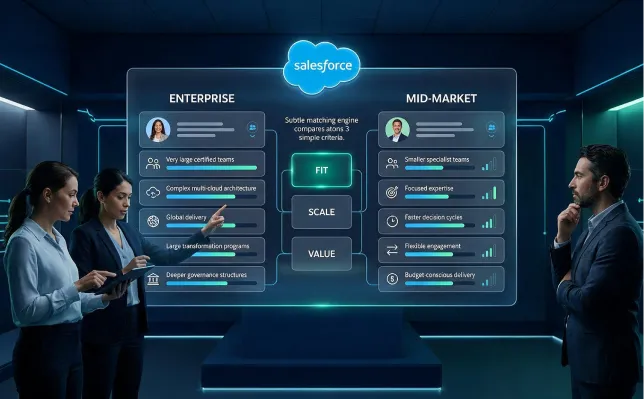
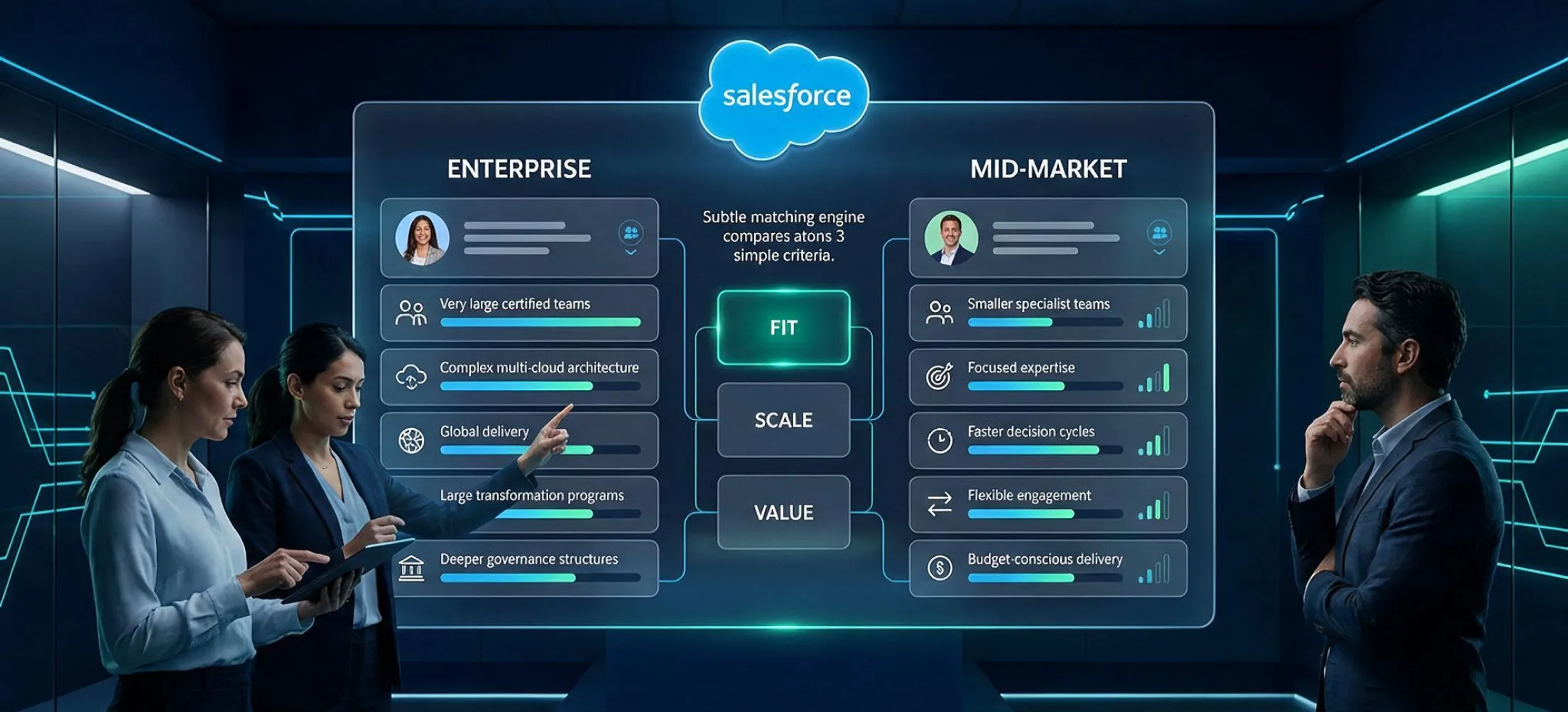
So this guide covers the top Salesforce implementation partners in USA for 2026 across the full spectrum, from global integrators with tens of thousands of certified consultants to focused firms of a few dozen people. We’ve split it by market segment: 7 partners for enterprise programs, 7 for mid-market budgets, each with a verdict on who they fit and an honest trade-off. You’ll also find how partner tiers work this year, an industry-fit table, pricing context, a selection process you can run internally, and what your first year should look like.
One thing before we go further. This is our site, and we’ve put ourselves in the mid-market list at number 2. That entry is marked clearly and held to the same standard as every other, trade-off included. And wherever we couldn’t verify a figure about any firm, ours included, we left it out.
Partner Tiers in 2026, and Why They Don't Mean What You Think
Quick primer, because tier badges will be all over every proposal you receive. Salesforce scores its consulting partners quarterly on customer outcomes, certifications, and growth, and places them in tiers. Summit has been the top tier, held by a small fraction of partners.
The system is changing this year, though. In March 2026, Salesforce announced an overhaul that consolidates the legacy tiers into 2, Select and Summit, and replaces the sprawl of legacy badges with a smaller set of core competencies measured by certifications, delivered projects, and customer satisfaction. The change rolls out through the coming fiscal year, so during the transition you’ll see partners carrying either labeling. If 2 proposals show different tier systems, that’s the transition, and neither firm is being sloppy.
Now, what does a tier actually tell you? That the partner has sustained delivery performance and a credentialed team. What doesn’t it tell you? Whether they know your industry, work with companies your size, or fit your budget. Treat the tier as a filter for building your long list, then let case studies, references, and the actual people who’d staff your project make the decision.
We’ve watched buyers skip that second half and pick on badge alone. It goes badly often enough that we’d call it the most expensive shortcut in this market.
The 3 Kinds of Partner You'll Meet
Before we name names, it helps to know the shapes these firms come in, because pricing, attention, and delivery style all follow the shape.
Global system integrators like Accenture, Deloitte, and Cognizant field thousands of certified consultants and run multi-country, multi-cloud programs for the Fortune 500. Rates sit at the top of the market and minimum project sizes are large.
Mid-market specialists are firms of roughly 20 to 200 people with deep expertise in particular clouds or industries and delivery models built for companies running 50 to 500 Salesforce users. Engagement structures flex between fixed price, time and materials, and retainers. We live in this category, and so does VALiNTRY360.
Boutique and niche firms are smaller still, often built around a single vertical or cloud. They offer the most personal attention and the lowest rates, with less capacity for complex multi-system programs.
Not sure which bucket you’re shopping in? Count your Salesforce users and be honest about your budget. Under 500 users and under $150,000, you’re a mid-market buyer no matter how ambitious the roadmap is. None of the 3 categories wins outright; your size, scope, and budget pick the category for you, which is exactly how the 2 lists below are organized.
The Top 7 Salesforce Implementation Partners in USA for Enterprise Companies
These firms are built for 500+ users, multiple clouds, heavy integration, and formal governance. All 7 hold Summit status. If that’s your world, this is your shortlist. If it’s clearly bigger than your world, skip ahead to the mid-market 7 and save yourself some reading.
1. Accenture
Best for: Fortune 500 companies running global, multi-cloud, multi-country deployments with deep integration needs.
Accenture operates the largest Salesforce practice in the world, with a certified workforce that public estimates put in the tens of thousands. An engagement typically comes with a full program office: dedicated architects, industry strategists, change teams, and offshore build capacity under one governance structure.
Salesforce routinely names the firm among its lead partners when new AI and Agentforce programs launch, which tells you where it sits in the ecosystem’s pecking order. If your board wants a name nobody gets fired for choosing, this is that name.
Trade-off: you pay for all of it. Rates top the market, minimums are large, and a $100,000 project buys a thin slice of attention. Mid-market buyers almost never belong here.
At a glance: Summit tier | HQ Dublin, Ireland, delivering in 100+ countries | Known for scale, Agentforce programs, and multi-cloud transformation
2. Deloitte Digital
Best for: Large enterprises in regulated industries that want strategy, customer experience design, and implementation delivered together.
Deloitte Digital pairs Salesforce delivery with management consulting, creative CX design, and change management. That combination matters most when the hard part of your program is people and process rather than configuration.
Analyst evaluations of Salesforce service providers consistently place Deloitte among the leaders, usually alongside Accenture and PwC. Its industry practices run deep enough that a healthcare or financial services program gets consultants who’ve done the same work at your competitors.
Trade-off: advisory-heavy engagements run longer and cost more. If you already know what to build and simply need it built, you’re paying for strategy capacity you won’t use.
At a glance: Summit tier | US HQ New York | Known for strategy-led CRM programs, industry depth, and change management
3. IBM Consulting
Best for: Banks, insurers, and other enterprises that need Salesforce wired into legacy core systems and AI infrastructure.
IBM built its Salesforce practice on the 2016 acquisition of Bluewolf, one of the earliest large Salesforce consultancies. The Bluewolf DNA still shows in platform-native depth, while the wider firm contributes what a pure Salesforce shop can’t: security engineering, data platforms, and integration patterns for core banking and policy administration systems.
Trade-off: everything arrives wrapped in enterprise process. Smaller or faster-moving projects can feel buried under it.
At a glance: Summit tier | HQ Armonk, New York | Known for Service Cloud, Financial Services Cloud, and complex legacy integration
4. Slalom
Best for: Upper mid-market and enterprise companies that want senior consultants in the room without Big 4 overhead.
Slalom is a Seattle-headquartered consultancy that staffs projects from local offices, so your consultants tend to live in your city. Workshops happen at your office, standups happen in your time zone, and the same faces stay through the program. For executives burned by an integrator that rotated staff every quarter, that continuity often decides the deal.
The firm has invested heavily in Data Cloud, Einstein, and Agentforce delivery and was among the earliest members of Salesforce’s Agentforce partner programs.
Trade-off: premium pricing with little offshore capacity behind it, so high-volume build work costs more here than at an offshore-heavy integrator.
At a glance: Summit tier | Founded 2001, HQ Seattle | Known for local delivery, Data Cloud, and AI programs
5. Capgemini
Best for: Multinational enterprises running commerce-led, multi-region transformation.
Capgemini has been one of Salesforce’s global strategic partners for well over a decade, with particular strength in Commerce Cloud and API-led integration through its large MuleSoft practice.
Its value shows in the unglamorous middle of a transformation: product catalogs spread across ERPs, order flows crossing 4 systems, and storefronts in 12 countries that all need one customer record. Integration-first architecture habits keep those programs from collapsing under their own data.
Trade-off: the machinery is tuned for large budgets and multi-region scope. A single-cloud, single-country project won’t get its best work.
At a glance: Summit tier | Founded 1967, HQ Paris, strong US and European coverage | Known for Commerce Cloud and MuleSoft integration
6. Cognizant
Best for: High-volume enterprise rollouts where a blended onshore-offshore rate decides the business case.
Cognizant built one of the largest certified Salesforce benches in the market, partly through acquisitions like SaaSfocus and ATG, and public estimates put its certified professionals well into the thousands. Onshore architects own the design while offshore teams handle the volume of configuration, testing, and data work.
When the governance is right, clients get enterprise output at a blended rate no onshore-only firm can touch, with particular depth in banking, insurance, and Revenue Cloud inherited from ATG.
Trade-off: offshore-heavy delivery demands strong governance from your side. Time zones, handoffs, and documentation discipline decide whether you capture the savings without the friction.
At a glance: Summit tier | HQ Teaneck, New Jersey, delivery across US, Europe, and India | Known for scale pricing and CPQ depth
7. PwC
Best for: Regulated enterprises where audit, compliance, and risk sit inside the CRM decision.
PwC treats Salesforce as one thread in a larger transformation, pulling risk, compliance, and strategy into the same engagement. A PwC program might redesign the target operating model, map controls to the new workflows, and assess the revenue recognition impact of a CPQ change while the implementation runs.
No pure implementer offers that, and no regulated CFO wants to coordinate 3 separate firms to get it.
Trade-off: strategy-firm pricing applies even to technical build work. If your program is 90% configuration, you’re overpaying for the other 10%.
At a glance: Summit tier | US HQ New York | Known for compliance-first programs in financial services, insurance, and healthcare
The Top 7 Salesforce Implementation Partners in USA for Mid-Market Companies
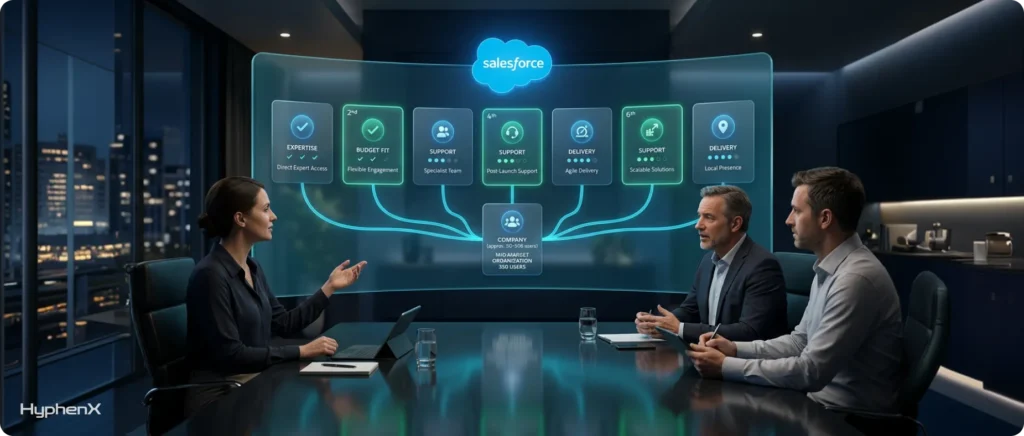
Mid-market here means roughly 50 to 500 Salesforce users and project budgets that published US market data generally places between $25,000 and $150,000. This is where generic top-10 lists help least, because the right answer is rarely a global integrator, and it’s also where most of our own clients live, so we know the buying pressure firsthand.
What you actually need at this size differs from the enterprise checklist. Senior people doing the work rather than supervising it. Pricing that leaves budget for licenses and training. A partner who stays reachable after go-live, because a 5-person ops team can’t absorb a broken flow the way an enterprise IT department can. The 7 firms below clear that bar. And if you’re still weighing firm size itself, we’ve written separately about when a boutique Salesforce partner beats a big consulting firm.
The Top 7 Salesforce Implementation Partners in USA for Mid-Market Companies
Mid-market here means roughly 50 to 500 Salesforce users and project budgets that published US market data generally places between $25,000 and $150,000. This is where generic top-10 lists help least, because the right answer is rarely a global integrator, and it’s also where most of our own clients live, so we know the buying pressure firsthand.
What you actually need at this size differs from the enterprise checklist. Senior people doing the work rather than supervising it. Pricing that leaves budget for licenses and training. A partner who stays reachable after go-live, because a 5-person ops team can’t absorb a broken flow the way an enterprise IT department can. The list below mixes focused specialists with the mid-market arms of much larger firms, because both can clear that bar in different ways. And if you’re still weighing firm size itself, we’ve written separately about when a boutique Salesforce partner beats a big consulting firm.
- HyphenX Solutions
Best for: Mid-market companies that want senior-led delivery at hybrid pricing and teams rebuilding after a rough first implementation.
Yes, this is us, on our own list. Read this entry with that in mind, then check us the same way you’d check anyone else here. We’d honestly prefer that you did.
We cover the full Salesforce lifecycle: consulting, implementation, integration, managed services, and staff augmentation. Our delivery model is hybrid: senior architects lead every engagement while offshore engineering keeps blended rates well below onshore-only firms. That structure is the whole point. At mid-market size, you usually face a choice between paying onshore rates for senior attention or accepting a junior offshore team to hit budget. A hybrid model gets you both. It’s also why we sit next to VALiNTRY360 rather than against it: they’re the stronger choice when onshore-only delivery is a hard requirement, and we’re the stronger fit when budget efficiency matters and your team works comfortably with a distributed partner.
A growing share of our work is rescue work, auditing and rebuilding implementations that stalled under a previous partner, alongside newer Agentforce and AI projects. Engagements run 3 ways: fixed-scope quickstarts, dedicated teams, and monthly retainers after go-live.
Trade-off: we’re a boutique. A 6-country enterprise program with thousands of seats belongs with a global integrator, and we’ll tell you that on the first call.
At a glance: Hybrid onshore-offshore delivery | Full lifecycle plus staff augmentation | Healthcare, financial services, manufacturing, real estate
- VALiNTRY360
Best for: US mid-market companies in healthcare, manufacturing, retail, or technology that want 100% onshore delivery and high adoption rates.
VALiNTRY360 is a 100% US-based partner headquartered in Winter Park, Florida, with offices in Dallas and Nashville. Its published figures on valintry360.com show 1,600+ completed engagements and 100+ certifications spanning Sales Cloud, Service Cloud, Health Cloud, Marketing Cloud, MuleSoft, CPQ, and Pardot.
Why do we rank a firm we compete with this high? Because for a specific kind of buyer, they’ve earned it. Two things set VALiNTRY360 apart. Delivery is entirely onshore, which suits companies that want US working hours and US data handling. And it provides Salesforce staffing through its sister company, so a client can move from project delivery to hiring permanent Salesforce staff through the same relationship.
Client reviews repeatedly mention consultants asking why before building, then pushing back where a process change beats a customization. That’s the behavior you want from a mid-market partner.
Trade-off: fully US-based delivery costs more per hour than hybrid or offshore models, and the bench is smaller than a global firm’s, so very large multi-cloud programs can stretch capacity.
At a glance: HQ Winter Park, Florida | 100% US-based | 100+ certifications, 1,600+ engagements | Healthcare, manufacturing, retail, technology
- Advayan
Best for: Mid-market companies whose Salesforce roadmap runs alongside SAP or heavy integration work and who want one partner across all of it.
Advayan is a US-facing consultancy with over a decade of delivery experience and offshore centres in Pune, Indore, and Jaipur. Its Salesforce practice runs the full stretch: development, implementation, integration, Vlocity, Pardot, Sales and Service Cloud, and ongoing L1 and L2 support, alongside developer staffing for teams that want to extend capacity.
What makes it a distinct pick on this list is what sits next to the Salesforce practice. Advayan also runs SAP, MuleSoft, and cloud development practices under the same roof. For a mid-market manufacturer or healthcare company where CRM and ERP change at the same time, one accountable partner across both sides saves a lot of vendor management, and the offshore-led model keeps rates at the accessible end of the market.
Trade-off: multi-platform breadth means Salesforce is one practice among several. Ask for Salesforce-specific case studies and the named certifications of the exact team you’d get.
At a glance: Salesforce, SAP, and MuleSoft under one roof | Offshore delivery centres in Pune, Indore, and Jaipur | Healthcare, IT, telecom, construction
- Infosys (Simplus)
Best for: Upper mid-market companies that want global-firm resources behind a practice built specifically for their segment.
Infosys bought its way into mid-market Salesforce credibility in 2020 by acquiring Simplus, at the time one of the most respected Quote-to-Cash and mid-market implementation specialists in the US. That heritage still anchors the practice, with particular depth in CPQ, billing, and revenue processes.
The appeal is the combination. You get the delivery scale, security posture, and offshore-backed pricing of a global firm, with a practice whose DNA was shaped by exactly the kind of projects mid-market buyers bring.
Trade-off: you’re still contracting with a global integrator. Confirm your project gets the specialist-style attention the Simplus name implies rather than a slot in a large delivery queue.
At a glance: Global scale with an acquired mid-market specialist at the core | CPQ and Quote-to-Cash depth | Offshore-backed pricing
- Wipro (Appirio)
Best for: Cost-conscious, larger mid-market rollouts that need global capacity and mature delivery process.
Wipro acquired Appirio in 2016, one of the most recognized names from the first generation of cloud-native Salesforce consultancies, and folded that expertise into a global practice that now spans every major Salesforce cloud.
For a mid-market buyer, the case is straightforward: proven delivery method, deep certified bench, and blended onshore-offshore rates that undercut US-only firms on volume work. Industry strength runs through technology, manufacturing, and financial services.
Trade-off: big-firm account management comes with the territory. Smaller projects should pin down a named delivery lead and a clear escalation path before signing.
At a glance: Global integrator with cloud-CRM heritage via Appirio | Blended onshore-offshore delivery | Technology, manufacturing, financial services
- Perficient
Best for: US companies that want a large, onshore-led digital consultancy without Big 4 pricing.
Perficient is a US-headquartered consultancy out of St. Louis with a longstanding Salesforce practice covering Sales, Service, Marketing Cloud, and CPQ, backed by global delivery centres that keep blended rates competitive. Healthcare and financial services are where its industry work runs deepest.
It sits in a useful middle ground: bigger and more process-mature than a boutique, more accessible than a global strategy firm, and US-led in a way many mid-market buyers find easier to work with day to day.
Trade-off: Perficient works across many platforms beyond Salesforce, so ask for the Salesforce practice’s own references and the certifications of your named team.
At a glance: US-headquartered, St. Louis | Onshore-led with global delivery centres | Healthcare and financial services depth
- Persistent Systems
Best for: Banking, insurance, and healthcare programs that want engineering depth at offshore-led rates.
Persistent Systems is a publicly listed engineering firm whose Salesforce practice grew partly through acquiring European specialists PARX and Youperience. Its roots are in product engineering, which shows in the quality of custom development, AppExchange work, and integration-heavy builds.
That engineering DNA suits mid-market companies whose Salesforce needs go past configuration: complex integrations, custom applications, or industry products built on the platform. Financial services and healthcare are its strongest lanes.
Trade-off: the culture is engineering-first. If your project leans heavily on business-process consulting and change management, plan to own more of that internally or pair it with strong executive sponsorship.
At a glance: Publicly listed engineering firm | Salesforce practice expanded through European specialist acquisitions | Banking, insurance, healthcare
Which Partner Fits Your Industry
Give industry fit more weight than feels natural because it’s worth more than most buyers realize. A partner who has already built for your sector arrives with data models, compliance patterns, and honest estimates. One learning your industry on your dime builds the tuition for you. Here’s how our 14 map to the sectors we get asked about most.
|
Industry |
Shortlist From This Guide |
Why |
|
Healthcare and life sciences |
VALiNTRY360, HyphenX, PwC |
Health Cloud work, HIPAA-aware builds, compliance-first design |
|
Financial services and insurance |
IBM, PwC, Cognizant |
Financial Services Cloud, legacy core integration, regulatory reporting |
|
Consumer goods and retail |
Corrao Group, Capgemini |
Consumer Goods Cloud, TPM, Commerce Cloud, retail execution |
|
Public sector and nonprofit |
Coastal Cloud, Deloitte Digital |
Procurement rules, compliance, citizen and constituent portals |
|
Technology and SaaS |
Kicksaw, Cyntexa, HyphenX |
RevOps alignment, multi-cloud growth paths, API-heavy builds |
|
Manufacturing |
HyphenX, Cognizant, Capgemini |
ERP integration, CPQ, dealer and channel workflows |
|
Service and contact centers |
NeuraFlash, IBM |
Agentforce in production, telephony, case deflection |
|
Real estate |
HyphenX |
CRM roadmaps for developers, brokers, and property teams |
Two caveats on that table. First, it’s a starting shortlist, so a firm missing from your row can still be a great fit if it proves sector experience in the first call. Second, some industries split by sub-segment: a hospital system and a medical device startup both read “healthcare” but need very different partners, so let the case studies settle it.
All 14 Partners at a Glance
|
Partner |
Segment |
Best For |
Standout Strength |
|
Accenture |
Enterprise |
Fortune 500 multi-cloud, multi-country programs |
Largest certified workforce and scale |
|
Deloitte Digital |
Enterprise |
Programs where adoption and process redesign are the risk |
Strategy, CX design, and change management |
|
IBM Consulting |
Enterprise |
Banks and insurers with legacy core systems |
Complex integration and agentic AI |
|
Slalom |
Enterprise |
Enterprises wanting local, agile senior teams |
Data Cloud, AI, and in-market delivery |
|
Capgemini |
Enterprise |
Commerce-led, multi-region transformation |
Commerce Cloud and MuleSoft integration |
|
Cognizant |
Enterprise |
High-volume rollouts on tight cost per hour |
Offshore scale plus CPQ depth from ATG |
|
PwC |
Enterprise |
Regulated programs with board-level stakes |
Compliance-first, strategy-led delivery |
|
VALiNTRY360 |
Mid-market |
US firms wanting 100% onshore delivery |
Onshore consulting plus Salesforce staffing |
|
HyphenX Solutions |
Mid-market |
Senior-led delivery at hybrid pricing; rescue work |
Full lifecycle with cost-efficient hybrid model |
|
NeuraFlash |
Mid-market |
Service-heavy orgs deploying AI agents |
Agentforce, Service Cloud, and AWS depth |
|
Coastal Cloud |
Mid-market |
Public sector, nonprofit, and regulated buyers |
Onshore multicloud delivery, now TCS-backed |
|
Cyntexa |
Mid-market |
Multi-cloud builds on mid-market budgets |
Breadth across clouds at competitive rates |
|
Corrao Group |
Mid-market |
Consumer goods and retail execution |
Consumer Goods Cloud and TPM specialization |
|
Kicksaw |
Mid-market |
RevOps teams wanting an ongoing partner |
Fractional, embedded operations model |
A quick note on reading this table. Start with the segment column and rule out the wrong half immediately. Then use the best-for column to shortlist 2 or 3 names, and treat the standout strength as the thing to pressure-test in your first call. If a firm can’t demonstrate the very thing it’s known for, that conversation is over.
What These Partners Cost in 2026
Let’s talk money, since it’s the question everyone saves for last and should ask first. Published US market data is fairly consistent on rates, and the pattern maps cleanly onto the 3 partner categories.
|
Delivery Model |
Typical US Rates |
What You’re Paying For |
|
Global integrators |
$200 to $400+ per hour, large minimums |
Program offices, global capacity, any specialty on demand |
|
US onshore specialists |
$125 to $250 per hour |
Senior attention, US hours, compliance comfort |
|
Hybrid and offshore delivery |
Blended rates well below onshore |
Senior architects onshore, volume build work offshore |
Project totals follow the same split. Mid-market implementations commonly land between $25,000 and $150,000, while enterprise programs start in the hundreds of thousands and climb into the millions. We break the drivers down line by line in our Salesforce implementation pricing guide.
One budgeting trap worth naming: implementation services are only part of your first-year spend. Licenses, integration middleware, data tools, and training all stack on top, and partners differ sharply in how honestly they surface those numbers during scoping. A partner who right-sizes your licenses in the proposal is signaling how the whole engagement will go.
And if the real question is a retainer versus a hire, our comparison of an in-house Salesforce admin versus a consulting partner covers that math.
One negotiating note from the partner side of the table: rates move more than you’d expect. Multi-phase commitments, flexible start dates, and quarter-end timing all create room, and a partner who won’t discuss structure at all is telling you how change orders will go later.
The 5-Step Process We'd Use to Pick a Partner
If we were on your side of the table, this is exactly how we’d run it. Buyers who follow a structured process get better partners at better prices, and the whole thing takes 3 to 4 weeks.
- Write the brief before talking to anyone. Which clouds, how many users, which systems must integrate, what your data looks like, your budget range, and what success means 90 days after launch.
- Build a long list of 5 to 8 firms. Use the AppExchange directory, this guide, and peer referrals, filtered by segment and industry. Verify tier, reviews, and certifications on the directory rather than the partner’s own site.
- Send the same brief to everyone. Ask for a proposed approach, timeline, named team, and rough estimate. At this stage the quality of their thinking matters more than the price on the page, and a famous logo means little if your team is 3 juniors.
- Hold discovery sessions with your 2 or 3 finalists. Judge the questions they ask about your data quality, your sales process, and your internal capacity. Ask for Agentforce and Data Cloud work running in production, with a reference, since slideware is everywhere in 2026.
- Check references, then negotiate terms. Call 2 clients in your industry per finalist. Before signing, pin down scope, milestones, change-order triggers, documentation handoff, and what happens after go-live.
While you’re at it, watch for the red flags. A firm that won’t name your team, can’t explain its pricing, says yes to everything, or goes quiet about post-launch support is showing you the engagement in miniature. We’ve published a fuller walkthrough in our guide to choosing the right Salesforce consulting partner, including the questions that expose a weak fit early.
What the First Year Actually Looks Like
One more thing worth knowing before you sign anything: the shape of a healthy engagement. Knowing the delivery arc helps you read proposals critically, spot the ones cutting corners, and set expectations with your own team.
Discovery, weeks 1 to 4. A serious partner starts with stakeholder interviews, a data audit, process mapping, and integration scoping, and hands you a written scope document at the end. A partner quoting a price without this phase is quoting blind.
Build, weeks 4 to 12 and beyond. A single-cloud rollout for 30 users can land in 8 weeks. A multi-cloud program with middleware integrations can take 6 months or more. Sprint reviews on a fixed cadence keep you in control either way.
User acceptance testing. Your team validates the build against the agreed requirements. Give this 2 weeks minimum with room for feedback cycles, because UAT squeezed into a weekend is where adoption problems are born.
Go-live and hypercare. The 2 to 4 weeks after launch should come with intensified support: bug triage, training reinforcement, and data monitoring. Ask how hypercare is staffed before you sign, since it’s where cheap proposals quietly cut corners.
Ongoing improvement. The best implementations treat go-live as a starting line. Quarterly optimization, release management, and continued training keep the org healthy, whether through a retainer or a growing internal team.
If a proposal compresses this arc into half the time at half the price, something on this list got cut. Usually it’s discovery or UAT, and those are precisely the phases that decide whether your team adopts the thing you paid for.
Why We Put Ourselves on This List

Fair question, so let’s answer it head on. Ranking ourselves first was never the plan, and we haven’t. This guide exists because choosing a partner shapes your Salesforce outcome more than any other decision you’ll make, yet most top-partner lists online are marketing pages with the publisher planted at number 1.
Here’s where we honestly fit: mid-market companies, senior-led hybrid delivery, full lifecycle from consulting through managed services, and a growing rescue practice for implementations that went sideways. If that matches your situation, we’re worth a call. If your program is enterprise-scale, the first 7 firms in this guide will serve you better, and we’d rather say so here than 3 months into a mismatched project.
The Bottom Line
There’s no single best partner, and any list claiming otherwise is selling you something. The top Salesforce implementation partners in USA for 2026 split cleanly by segment: global integrators for enterprise scale, focused firms for mid-market speed and senior attention.
So match the partner to your size and budget first. Verify their claims on AppExchange second. And weigh honest trade-offs over polished pitches, because every firm on this list has both. Do those 3 things and you’ll land in the right column of the table above, with a partner whose incentives actually line up with your project.
Serving US teams with 250+ Salesforce certifications
US businesses need partners who deliver on time and communicate clearly. Our answer is 250+ Salesforce certifications held across our delivery and consulting roles, applied to every implementation project. Short on in-house capacity? Augment your team with certified experts who hold these credentials and start contributing from week one. You get regular updates, clear ownership and certified people who understand your goals. Want to know who holds them? See who we are.
Frequently Asked Questions
- Can a Salesforce implementation partner work with our existing org instead of starting over?
A partner can assess your current Salesforce org, identify usable components, and improve weak areas without automatically rebuilding everything. The review should examine configuration, automation, custom code, security, and technical debt before recommending targeted repairs or a broader redesign.
- Do we need an internal Salesforce administrator before working with a partner?
You can begin without a dedicated Salesforce administrator, but assign an internal owner who can make decisions, gather feedback, approve priorities, and coordinate stakeholders. That person gives the partner reliable business context and keeps knowledge inside your company after implementation.
- Who owns the custom code and configuration created by a Salesforce implementation partner?
Ownership should be defined in the contract before development starts. Your company should know which configurations, code, deployment assets, documentation, and credentials it receives. Partner-owned accelerators and reusable frameworks, including licensed components, should be identified separately with clear usage rights.
- How much access should we give a Salesforce implementation partner?
Grant only the access required for assigned work, using named accounts and appropriate permissions. Production administrator access should have a clear business reason. Your security team should also define authentication, logging, approval rules, and account removal when the engagement finishes.
- Can a Salesforce partner work without using real customer data in development?
Many development activities can use sandboxes with representative test records or protected datasets instead of unrestricted production information. Ask how the partner separates environments, limits sensitive data exposure, and handles confidential records while testing integrations, automations, reports, or custom features.
- Can we require a Salesforce consulting partner to sign our NDA, DPA, or BAA?
Legal and data-protection agreements can be part of vendor onboarding before system access is granted. The documents depend on your industry and data obligations. Confirm that the partner can complete your security review and contractual requirements before project work begins.
- Can a Salesforce implementation partner use subcontractors on our project?
Partners may use subcontractors or affiliated delivery teams, depending on their operating model. Your agreement should identify who can access your systems, where work may occur, how outside resources are approved, and which company remains accountable for delivery and security.
- What happens if our assigned Salesforce consultant leaves during the project?
Ask how the partner replaces key personnel and transfers project knowledge before you sign. Requirements, architecture decisions, project notes, credentials, repositories, and unresolved issues should remain accessible to the wider delivery team so a replacement can continue with minimal disruption.
- Can we switch Salesforce implementation partners in the middle of a project?
A partner change is possible, although the incoming team will need enough information to understand the current build. Keep company-controlled access to documentation, repositories, environments, requirements, integration details, test results, and open issues so the transition is easier to manage.
- Should our Salesforce partner use standard features or custom development?
Standard Salesforce capabilities should be considered first when they meet the requirement cleanly. Custom development is useful when configuration cannot support an important business need. Ask the partner to explain maintenance, testing, upgrade, and dependency implications before approving custom code.
- Can a Salesforce partner work within our existing DevOps and release process?
Yes, provided the delivery model is agreed before development begins. Share your repository standards, branching rules, deployment controls, testing requirements, and approval process early. The partner should adapt its workflow so Salesforce changes fit your existing engineering and governance practices.
- Who should control Salesforce integration users, connected apps, and API credentials?
Your company should retain visibility and administrative control over integration identities and credentials used in Salesforce. Define who creates them, where secrets are stored, how permissions are limited, and when access must be rotated or revoked after partner involvement ends.
- Can a Salesforce implementation partner help consolidate multiple Salesforce orgs?
Yes. Org consolidation can involve record matching, duplicate management, security redesign, automation conflicts, integration changes, and decisions about which processes survive. A partner should assess each org first and define the target operating model before moving data or rebuilding functionality.
- Can we ask a Salesforce partner to prove a solution before approving a larger build?
A limited prototype or proof of concept can help validate uncertain architecture, integrations, automation, or user experience before committing to broader development. Define what the exercise must prove, which assumptions are being tested, and what happens to prototype work afterward.
- What should happen to partner accounts and credentials when the Salesforce project ends?
Closeout should include removing unnecessary partner users, revoking temporary permissions, rotating shared secrets where applicable, and confirming ownership of connected services. Keep an access checklist so former delivery resources cannot retain unnoticed entry to Salesforce, repositories, middleware, or supporting systems.