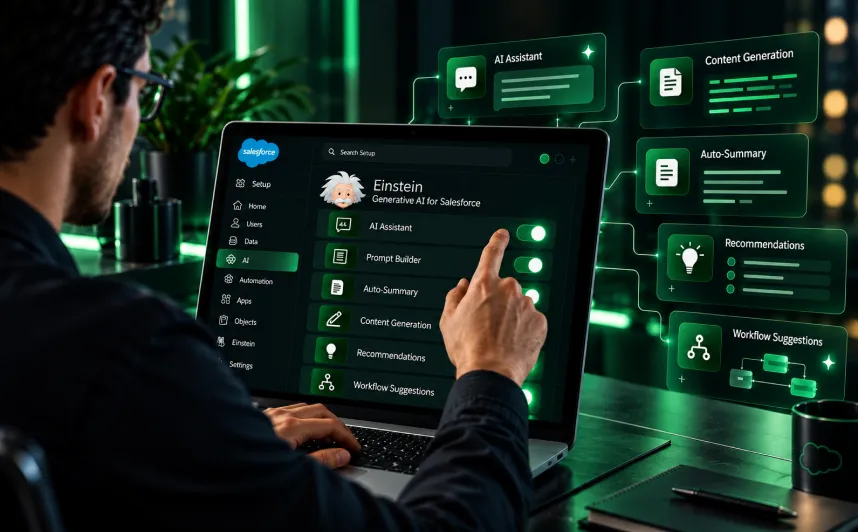



In 2026, Salesforce stopped being a CRM with a few AI features bolted on. After the Agentforce 360 rollout, Salesforce now describes itself as an AI platform that happens to run your customer relationships, and the product line reflects that. Sales Cloud has been rebranded as Agentforce Sales, Data Cloud is now Data 360, and capabilities like Multi-Agent Orchestration and the Agentforce Trust Layer have pushed AI out of the demo and into the systems your teams touch every day.
That shift creates real opportunity. It also raises the stakes on one deceptively simple decision: who you hire to build it. Independent reporting in 2026 puts a sobering number next to the hype. Fewer than one in ten organizations have scaled Agentforce beyond a pilot, and a typical production rollout takes somewhere between five and eleven months. The technology is capable. The gap between a stalled pilot and a system that pays for itself almost always comes down to the person steering the implementation.
This guide is for anyone weighing an investment in Salesforce AI, whether that is Einstein predictive analytics, Agentforce agents, workflow automation, or all three. You will find why the right consultant matters now, what the wrong partner actually costs, nine red flags worth watching for, the skills that separate real expertise from a polished sales pitch, and a checklist and set of interview questions you can use before you sign anything.
Why the Right Salesforce AI Consultant Matters in 2026
The platform changed, and the risk profile changed with it. Earlier Salesforce AI mostly suggested things: a recommended next step, a draft email, a lead score. Agentforce agents act. They read from your data, make decisions, trigger workflows, and increasingly coordinate with one another to complete multi-step tasks. When software moves from advising to acting, the quality of the design, the data behind it, and the guardrails around it stop being nice-to-haves and become the difference between a helpful colleague and an expensive liability.
A strong Salesforce AI consultant is really three roles in one. They are a strategist who ties the build to outcomes you can measure. They are an architect who understands how data, integrations, security, and automation fit together. And they are a change manager who gets your people to actually use what is built. Weakness in any one of those areas is usually where projects quietly go wrong.
A capable consultant directly shapes:
- Scope and sequencing — which use cases go first, and which wait until the foundation is ready.
- Your data foundation — whether agents are grounded in clean, relevant, permissioned information.
- Security posture — how the Trust Layer, sharing rules, and access controls are configured before anything goes live.
- Adoption — whether your teams trust and use the system, or quietly route around it.
- Total cost — because consumption-based pricing means design decisions carry a direct, recurring dollar impact.
The Real Cost of Choosing the Wrong Partner
Choosing the wrong partner rarely fails loudly on day one. It fails slowly, and the bill arrives in several forms.
The most visible is wasted spend. Agentforce pricing is tied to usage, often around two dollars per conversation, so a poorly designed agent that loops, escalates unnecessarily, or handles queries it should have deflected is not just annoying; it costs you money on every interaction. Add licensing and the consultant’s own fees, and an unfocused build gets expensive fast.
The quieter costs do more damage. A failed pilot burns executive goodwill and makes the next AI proposal a harder sell. Weak security and permission design can expose data an agent was never meant to surface. Brittle automation and shortcut architecture become technical debt your team inherits long after the consultant has moved on. And low adoption, the single most common reason these projects stall, means you pay for a capability nobody uses.
Dimension | The right partner | The wrong partner |
Starting point | Begins with your business outcomes and works backward to the technology | Opens with a product demo and looks for a place to apply it |
Data | Audits readiness and fixes the foundation first | Assumes existing data is good enough to switch on |
Security | Designs permissions and the Trust Layer into the build | Treats security as a step to handle later, if at all |
Timeline | Commits to realistic phases and honest trade-offs | Promises enterprise-wide go-live in days or weeks |
Adoption | Plans training, enablement, and feedback loops | Considers the job done at go-live |
Cost | Designs for efficiency and monitors consumption | Ignores the recurring cost of inefficient agents |
Handover | Leaves documentation, governance, and an owner | Leaves a black box only they understand |
9 Red Flags to Avoid When Hiring a Salesforce AI Consultant
No consultant will be perfect on every dimension, and a single weakness is not automatically disqualifying. But the following nine patterns tend to predict trouble, and the more of them you see together, the more caution is warranted.
1. They lead with the tool, not your business outcomes
The clearest early signal is what a consultant does in the first conversation. Strong ones ask questions about your revenue goals, your bottlenecks, and how your teams actually work. Weaker ones open with a feature tour and try to reverse-engineer a problem to fit it.
In practice: A consultant spends the discovery call showing how quickly Agentforce can spin up a service agent, but never asks what your current resolution times are, where customers drop off, or what a win would look like in numbers. You leave impressed by the demo and no clearer on whether it solves anything for you. If the solution arrives before the problem is understood, be cautious.
2. They wave away data readiness
AI agents are only as good as the data grounding them. Duplicate records, stale fields, inconsistent picklists, and unstructured knowledge that has never been curated all degrade an agent’s answers. A consultant who tells you your data is fine without looking at it is skipping the least glamorous and most important part of the work.
In practice: You are told agents can go live next week on your existing setup. Nobody has checked whether your knowledge articles are current, whether accounts are deduplicated, or whether the fields the agent will rely on are actually populated. Two weeks after launch, the agent is confidently giving customers outdated information, because that is what it was grounded in.
3. They treat Agentforce like a glorified chatbot
There is a meaningful difference between a scripted FAQ bot and an agent that is grounded in your data, takes actions, respects permissions, and can be tested and improved systematically. In 2026 that includes understanding grounding, topics and instructions, guardrails, tools and actions, and increasingly Multi-Agent Orchestration for workflows that span more than one agent. A consultant who only talks about canned question-and-answer flows is describing yesterday’s technology.
In practice: Asked how they will keep the agent accurate and safe, the consultant talks only about writing good responses. There is no mention of grounding sources, no testing approach, no guardrails, and no plan for what the agent should refuse to do. You are getting a chatbot with a modern name.
4. They are vague about security, permissions, and the Trust Layer
When software can take action on your data, security stops being a checkbox. A credible consultant can explain, in plain terms, how the Agentforce Trust Layer handles your data, how field-level security and sharing rules constrain what an agent can see and do, and how the 2026 shift from Connected Apps to External Client Apps affects integrations. Vagueness here is a serious warning sign.
In practice: You ask how you will prevent an agent from surfacing sensitive records to the wrong user. The answer is a reassuring the platform handles that, with no specifics about permissions, roles, or data governance. Security by hand-wave is how avoidable breaches happen.
5. They promise unrealistic timelines and guaranteed results
Given that most organizations take five to eleven months to get Agentforce fully into production, anyone promising an enterprise-wide rollout in days, or guaranteeing a specific percentage cost reduction before understanding your environment, is either inexperienced or overselling. Honest consultants talk in phases and ranges, and they are candid about what could slow things down.
In practice: A proposal guarantees a 40 percent support-cost reduction and a two-week go-live across all channels, sight unseen. No discovery, no data assessment, no pilot. A guarantee like that is not confidence; it is a red flag dressed up as one.
6. They lack real integration and architecture depth
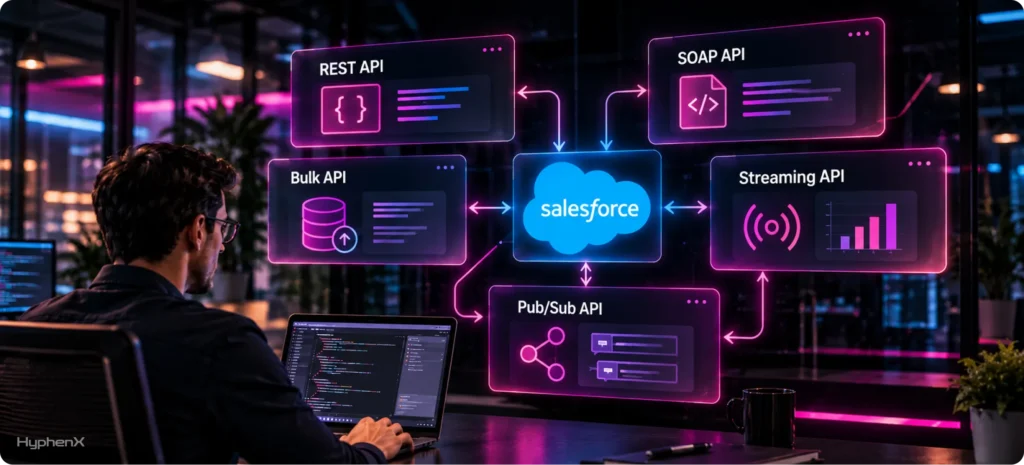
Agents rarely live in a vacuum. They often need to read from an ERP, a data warehouse, or third-party systems, which means real integration work: APIs, MuleSoft, Data 360, and an eye on latency and reliability. A consultant who cannot describe how your systems will connect, or who assumes everything the agent needs already lives tidily in Salesforce, will hit a wall mid-project.
In practice: The plan assumes the agent can instantly pull order status from your external fulfilment system, but no one has mapped how that connection works, how fast it responds, or what happens when it times out. The demo works on sample data; production quietly does not.
7. They have no prompt or agent design methodology
Good agent behavior is not luck; it is engineered. That means a structured approach to topics and instructions, clear guardrails, and a repeatable way to test and evaluate the agent before and after launch. Salesforce’s Testing Center exists precisely for this. We will just adjust the instructions if something is wrong is not a methodology; it is guessing in production.
In practice: There is no plan to test the agent against realistic scenarios before customers see it, and no way to measure whether a change made things better or worse. Every fix is a shot in the dark, and quality drifts with each edit.
8. They ignore change management and adoption
The most common reason Salesforce AI projects stall is not the technology; it is that people do not use it. A consultant whose plan ends at go-live, with no training, enablement, or feedback loop, is setting you up to pay for a tool your teams route around. Adoption is a deliverable, not an afterthought.
In practice: The agent launches, an announcement goes out, and that is the extent of the rollout. Reps do not trust the recommendations, are not shown how it fits their workflow, and quietly go back to doing things the old way. Six months on, usage is near zero and the return-on-investment conversation is awkward.
9. They have no plan for measurement, governance, or life after launch
A build without metrics cannot be judged, and a system without an owner drifts. Strong consultants define KPIs up front, set up monitoring, establish who governs the agent over time, and put guardrails around consumption so costs stay predictable. If the engagement ends at it is live, with no measurement or handover, you are inheriting a black box.
In practice: There are no agreed success metrics, no dashboard for how the agent is performing, no cost monitoring, and no documentation. When something breaks or the bill spikes, no one internally knows how the system works, and the consultant is on to the next client.
The Must-Have Skills to Look For
The red flags above are mostly the absence of the skills below. When you evaluate a consultant, you are really assessing how deep they go across nine areas. The strongest partners are fluent in all of them; most are stronger in some than others, so weigh your priorities against your project.
Skill | Why it matters in 2026 | Signs of real competence |
Salesforce AI strategy | Ties the build to outcomes and sequences use cases sensibly | Starts with your goals; will say no to low-value use cases |
Data readiness | Agents are only as good as the data grounding them | Audits data first; talks about grounding, dedup, and quality |
Prompt and agent design | Reliable behavior is engineered, not lucky | Uses topics and instructions, guardrails, and structured testing |
Agentforce knowledge | The platform is deep and changing quickly | Fluent in grounding, actions, Trust Layer, orchestration; often certified |
Automation planning | Agents work alongside Flow and orchestration | Designs clean, maintainable automation, not brittle shortcuts |
Integration experience | Agents need data from beyond Salesforce | Comfortable with APIs, MuleSoft, Data 360, latency trade-offs |
Security awareness | Acting agents magnify security mistakes | Explains permissions, Trust Layer, External Client Apps clearly |
Change management | Adoption is where projects live or die | Plans training, enablement, and feedback from the start |
Business process understanding | AI on a broken process just breaks faster | Maps how your teams really work before automating anything |
Of these nine, three are the ones buyers most often underestimate, and the ones that most reliably sink projects when they are missing.
Data readiness. It is tempting to treat this as prep work to rush through, but an agent grounded in duplicated, stale, or poorly structured data will produce confident, wrong answers at scale. A consultant who insists on understanding and improving your data foundation before switching anything on is not slowing you down; they are protecting you from an expensive, public failure.
Security awareness. Because Agentforce agents can act on data and increasingly reach into external systems, a permissions mistake does not just show the wrong dashboard; it can expose the wrong records to the wrong people, or let an agent take an action it should not. Fluency with the Trust Layer, sharing rules, and the move to External Client Apps is now a baseline requirement, not a specialty.
The human and process side. The best-architected agent in the world delivers nothing if your teams do not trust it, and automating a broken process only makes the mess faster. Consultants who take change management and business-process mapping seriously, with training, enablement, feedback loops, and a real understanding of how work actually flows, are the ones whose projects still show value a year later.
Your Salesforce AI Consultant Evaluation Checklist

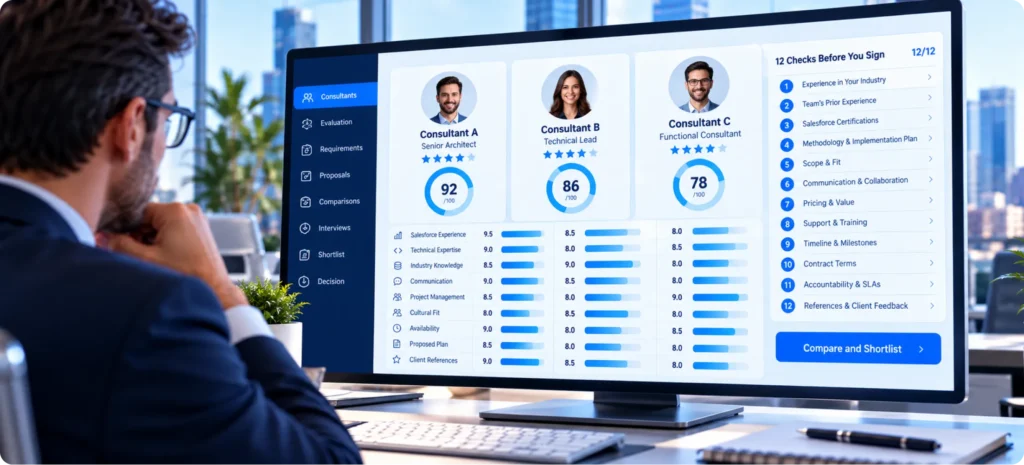
Use this checklist as you shortlist and compare candidates. You will not need every box ticked for every project, but consistent gaps, especially in the same area, are worth taking seriously.
Strategy and discovery
- Asks about your business outcomes and success metrics before proposing a solution
- Can point to comparable Salesforce AI work and explain what did and did not go well
- Recommends starting with a focused, high-value use case rather than everything at once
- Is willing to tell you when AI is not the right answer
Technical, data, and security
- Proposes a data readiness assessment before any agent goes live
- Explains grounding, guardrails, and how the agent will be tested
- Can describe how integrations to your other systems will actually work
- Explains the Trust Layer, permissions, and data governance in plain language
- Accounts for the Connected Apps to External Client Apps transition where relevant
Delivery, adoption, and governance
- Presents a phased plan with realistic timelines and honest trade-offs
- Includes training, enablement, and a user feedback loop
- Defines KPIs and how the agent’s performance will be monitored
- Plans for cost governance around usage-based pricing
- Commits to documentation and a clear internal owner at handover
Interview Questions to Ask Before You Hire
Bring these to your shortlist conversations. The goal is not to catch people out; it is to hear how they think. Strong candidates welcome these questions and answer them specifically. Weaker ones deflect, generalize, or steer back to a demo.
On strategy and outcomes
- Walk me through how you would decide which use case we should tackle first, and which we should hold off on.
- How do you define and measure success for a Salesforce AI project?
- Tell me about a time you advised a client not to build something.
On data and architecture
- How would you assess whether our data is ready for Agentforce?
- Our agent will need information from another system. How would you approach that integration, and what could go wrong?
- How do you keep an agent grounded in accurate, current information?
On Agentforce and AI depth
- How do you design and test an agent’s behavior before it reaches customers?
- When would you use multiple agents working together versus a single agent?
- What guardrails do you put in place, and how do you decide what an agent should refuse to do?
On security and governance
- How do you make sure an agent only accesses data the user is allowed to see?
- Explain the Agentforce Trust Layer to me as if I were on the board.
- How does the shift to External Client Apps affect how you would set up our integrations?
On change and adoption
- What is your plan for getting our teams to actually use this?
- How do you handle the situation where users do not trust the agent’s recommendations?
- What happens after go-live? Who owns it, and how do we keep improving it?
Listen for specifics, honesty about trade-offs, and a willingness to disagree with you. A consultant who has genuinely done this work will reach for concrete examples; one who has not will stay abstract.
Making the Final Hiring Decision

Once you have compared candidates against the red flags, the skills, and the questions above, the final decision usually comes down to fit, honesty, and engagement model. There is no single right answer; the best choice depends on your project’s size, your internal capability, and how much ongoing support you will need.
Model | Strengths | Watch-outs | Best fit |
Independent consultant | Cost-effective, direct access to expertise, flexible | Limited bandwidth; a single point of failure | Focused projects; teams with some in-house Salesforce capability |
Boutique specialist firm | Deep, current AI focus; senior attention; agile | Smaller teams can be capacity-constrained | Ambitious AI programs that need specialist depth |
Large systems integrator | Scale, broad skill coverage, established process | Can be pricey; senior talent may be spread thin | Complex, enterprise-wide, multi-system rollouts |
Whichever model you choose, weight a few things heavily. Prioritize a partner who is honest about timelines and trade-offs over one who promises the fastest, cheapest path; the first will save you money that the second will cost you. Always check references, and ask specifically about projects that were hard, not just the showcase wins, because how a consultant handled a difficult rollout tells you more than a polished case study. And favor an engagement that starts small, a well-scoped pilot with clear success metrics, over a big-bang commitment. A pilot lets you see how a consultant actually works before you bet the whole program on them.
Avoid the red flags with certified Agentforce expertise
Plenty of consultants talk about AI. Fewer can prove it. We hold 250+ Salesforce certifications across our delivery and consulting roles, and the ones that matter here are Agentforce Specialist and AI Associate. Want them working alongside your people? Hire certified Salesforce experts from that same bench and skip the months-long hiring cycle. You get people who build agents, not just read about them. Want to know who holds them? See who we are.
Final Thoughts
Salesforce AI in 2026 is genuinely capable. Agentforce, Einstein predictive analytics, and the automation around them can reshape how your teams sell, serve, and operate. But capability is not the same as results, and the low share of organizations that have scaled beyond a pilot is a reminder that success is earned in the details: the data, the design, the security, and above all the people. The right consultant is the one who takes all of those seriously, tells you the truth about what it will take, and leaves you with something your teams own and use, rather than a black box you cannot maintain.
If you are planning a Salesforce AI initiative this year, use the red flags, skills, checklist, and questions in this guide to steer your conversations. Look for a partner who starts with your business outcomes rather than a feature demo, who is candid about trade-offs, and who can speak fluently to strategy, data, security, and adoption in the same discussion. Take the time to find that partner before you build. It is the single decision that most determines whether your investment in Salesforce AI pays off.