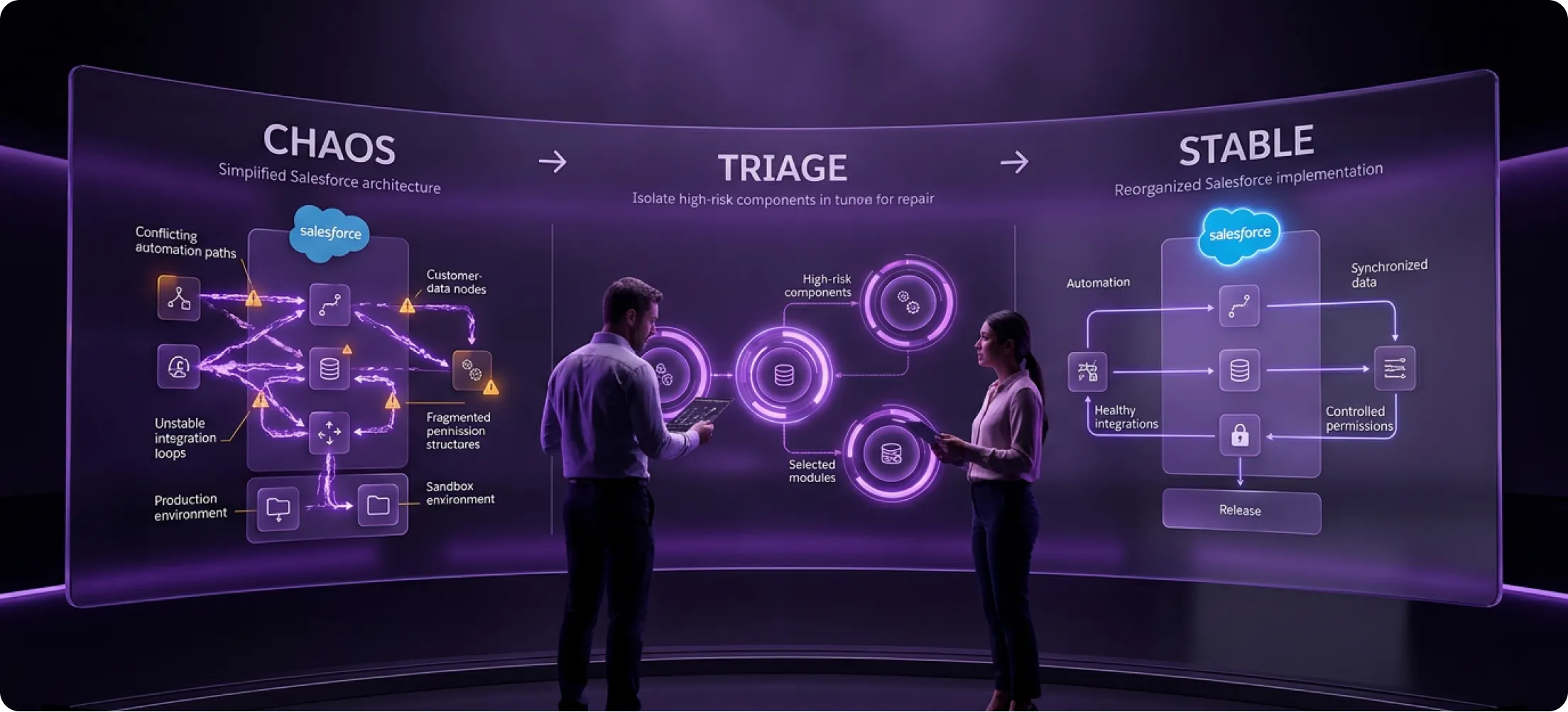
A Failed Salesforce Implementation usually announces itself through system behavior before anyone formally calls the program a failure. Flows fire twice. Apex automation competes with declarative logic for the same transaction. Profiles, permission sets, and sharing rules no longer match the operating model. Integrations retry without a clear idempotency rule. Duplicate customer records distort reporting. Sandboxes drift from production. Test coverage exists on paper while regression risk remains high because the test data does not represent real business paths. The visible symptoms may look unrelated, but they often trace back to a smaller set of architecture, governance, data, release, and ownership decisions that accumulated during implementation.
A rescue effort therefore needs a different operating mode from an ordinary implementation. The team cannot keep delivering the old backlog while simultaneously diagnosing the org, because every new change can alter the evidence. The first objective is to stabilize the environment, capture the current state, and identify which defects threaten revenue, service, compliance, data integrity, or release continuity. A 30-day Salesforce Org Triage plan works when it treats recovery as a controlled technical investigation with named decision owners, a frozen risk window, and explicit criteria for what can return to normal delivery.
When the problem spans architecture, configuration, data, integrations, and deployment, Salesforce implementation services provide a useful boundary for understanding the work that may need to be re-examined. A rescue still starts with evidence rather than a rebuild assumption. The org may need targeted Salesforce Org Remediation, a redesigned delivery process, or a narrower set of repairs. The 30-day plan below is built to tell the difference before the organization commits another quarter of budget to the wrong fix.
TL;DR
What is failing: A Failed Salesforce Implementation is rarely one defect. It is usually a system of dependencies where data quality, automation, security, integrations, release mechanics, and ownership have stopped supporting the business process cleanly. The first week should stop avoidable change, preserve evidence, identify critical business paths, and separate production incidents from long-term Salesforce Technical Debt.
What 30 days should produce: The goal of Salesforce Implementation Rescue is a verified current-state map, a prioritized defect and debt register, a repaired critical path, a reset backlog, and an operating model that makes future changes safer. The plan should show which work can be fixed inside the existing architecture, which parts require redesign, and which issues are adoption or process problems rather than platform defects.
How to run the recovery: Use days 1-5 to stabilize and collect evidence, days 6-12 to complete the Salesforce Org Audit, days 13-20 to repair the highest-risk paths, days 21-26 to validate data, integrations, security, and releases, and days 27-30 to hand control back to a normal delivery cadence. Every repair should have an owner, proof of failure, proof of correction, rollback logic, and a defined business outcome.
Failure is a System Condition, Not a Ticket Count
A program can close hundreds of Jira tickets and still produce a Salesforce Implementation Failure. Ticket completion measures activity. Rescue work needs to measure whether the org can support its highest-value business paths without manual workarounds, uncontrolled risk, or repeated production repair. A sales process that requires spreadsheet reconciliation, a service process that bypasses assignment automation, or a quote process that fails when one integration is delayed are system conditions. They persist even when the original implementation stories are technically marked done.
The rescue team should define failure in operational terms. Which transactions cannot be trusted? Which user groups avoid the platform? Which reports require manual correction? Which integrations have no named owner? Which automations are too risky to change? Which releases regularly create emergency fixes? This language turns Salesforce Implementation Problems into observable conditions that can be tested and prioritized. Those same Salesforce Implementation Problems can then be tracked against the business path they interrupt instead of being managed as unrelated tickets.
PMI’s 2026 Pulse of the Profession reports that 31% of complex projects fail to achieve the full scope of their intended benefits. A Salesforce rescue should therefore examine benefit loss alongside schedule and budget. If the org went live but users cannot complete core work reliably, the implementation is still underperforming against its intended outcome.
A First-Pass Triage Map
|
Observed symptom |
Likely fault area |
Immediate evidence |
First containment move |
|
Users maintain side spreadsheets |
Data model, usability, trust |
Workarounds, duplicate edits, report disputes |
Freeze new fields and capture the missing workflow |
|
Flows or triggers collide |
Automation design |
Debug logs, failed interviews, duplicate actions |
Disable only the harmful path with rollback ready |
|
Reports disagree with operations |
Data quality or definitions |
Duplicate records, stale fields, conflicting formulas |
Name source-of-truth fields and stop bulk cleanup |
|
Releases cause recurring incidents |
ALM and environment drift |
Hotfixes, manual deployments, missing tests |
Pause nonessential production changes |
|
Integration failures are hard to trace |
API ownership and observability |
Retries, dead letters, inconsistent IDs |
Add correlation evidence before redesign |
|
Too many users have broad access |
Security model |
Profiles, permission sets, sharing, inactive users |
Contain critical access without mass permission edits |
|
Adoption remains low |
Process fit, training, governance |
Login patterns, workarounds, skipped stages |
Interview users before changing screens |
Days 1-5: Stop the Org From Changing Underneath the Investigation
The first five days are about containment and evidence. That does not mean shutting down all Salesforce work. It means creating a short change-control window where only production incidents, legal or compliance changes, and genuinely time-sensitive business work can enter production. The team needs a stable enough baseline to determine whether a defect existed before the rescue, appeared during a recent release, or is being created by another active workstream.
Build the evidence room
- Export the current backlog, production incident history, release calendar, deployment logs, open integration defects, known data-quality issues, and unresolved security findings.
- Capture org metadata and source-control state so the team can compare production with the repository and identify unmanaged changes.
- List every active integration with business owner, technical owner, authentication method, middleware, endpoint, error path, retry behavior, and operational contact.
- Inventory active Flows, Apex triggers, scheduled jobs, platform events, approval processes, validation rules, and automation that touches the same core objects.
- Identify the 5-10 business transactions whose failure creates the largest operational consequence, such as lead conversion, quote approval, order handoff, case routing, entitlement, renewal, or billing sync.
The output is not a perfect architecture document. It is a controlled evidence set. If documentation disagrees with production behavior, production behavior wins for triage purposes. The team can repair documentation after it understands the current system. This early Salesforce Org Triage also gives the rescue lead a defensible baseline for later Salesforce Implementation Recovery decisions.
Create one decision path for the rescue
A Failed Salesforce Implementation often has too many unofficial decision makers. Business teams ask admins for direct changes. Developers patch logic locally. A partner owns one workstream while internal architects own another. The rescue needs one named technical authority, one business priority owner, and one release decision path. Without that structure, Salesforce Project Recovery becomes another competing workstream rather than the temporary operating model for the whole org.
If the organization cannot determine whether the main problem is architecture, process design, or delivery governance, Salesforce consulting services can be used as a separate diagnostic model from implementation execution. The important distinction is ownership: diagnosis should clarify what must change before additional build capacity is added.
Days 6-12: Audit the Org by Failure Surface
The second phase is the main Salesforce Org Audit. Do not inspect the org alphabetically by object or metadata type. Audit by failure surface so the team can connect technical findings to business consequences. This makes the Salesforce Org Health Check useful for prioritization rather than turning it into a long inventory of observations.
Automation collisions
Map every automation that can run on the same transaction. Look for duplicated rules, recursive updates, order-of-execution assumptions, synchronous work that should be asynchronous, and old Process Builder or Workflow logic that still overlaps with Flow or Apex. Record which automations are business-critical and which can be retired.
Data integrity
Measure duplicates, required-field completeness, stale ownership, invalid picklist values, orphaned relationships, broken external IDs, inconsistent account structures, and fields that carry different meanings across teams. Separate bad historical data from current processes that continue to create bad data.
Security and access
Review profiles, permission sets, permission-set groups, sharing, public groups, queues, integration users, inactive users, session controls, login policies, and privileged access. Fixing access by bulk restriction can break operations, so every high-risk permission change needs a user-impact test.
Integrations and interfaces
Trace how data enters and leaves Salesforce. Check authentication, API versions, error handling, retries, idempotency, mapping ownership, rate limits, timeouts, monitoring, and reconciliation. The audit should be able to show the last successful and failed state for a critical transaction.
Release mechanics
Compare source control, sandboxes, production metadata, CI/CD configuration, test strategy, deployment approvals, and hotfix handling. Identify changes that bypass the normal path and metadata that exists in production but not in the repository.
User workflow and adoption
Watch how real users complete work. Record fields they ignore, screens they bypass, stages they manipulate, manual exports they depend on, and steps that require help from admins. A technically valid configuration can still be the source of Salesforce Adoption Problems when it does not fit the operating process.
Salesforce’s State of Data and Analytics surveyed more than 10,000 analytics, IT, and business leaders and describes continuing difficulty with securing and harmonizing large data volumes. That is directly relevant to Salesforce Data Quality Issues during rescue work: cleanup should be tied to governance and source ownership, otherwise the org can recreate the same defects after the first correction pass.
Do not clean data until you know what creates the dirt
Data cleanup is one of the easiest ways to spend a rescue budget twice. Teams merge duplicates, normalize values, backfill required fields, and then discover that an integration, import process, user workflow, or automation continues creating the same error. Salesforce Org Cleanup should therefore begin with defect-generation paths, not record counts.
- Identify whether each bad field is authored by a user, integration, automation, import, formula, or downstream synchronization.
- Name the system of record for customer, product, contract, pricing, and other shared data before changing mappings.
- Protect external IDs and matching rules before a duplicate merge so connected systems do not lose references.
- Test cleanup scripts in a representative sandbox with production-like volume and edge cases.
- Create a reconciliation report that proves the corrected state and catches recurrence after the fix.
The result should be a prevention rule beside every major cleanup task. If the team cannot explain why the data became wrong, it is not ready for a bulk repair. This discipline converts Salesforce Data Quality Issues from a one-time migration exercise into an operational control. It also keeps Salesforce Org Cleanup from becoming a recurring manual project after every release or migration.
Days 13-20: Repair the Critical Path Before the Backlog

By day 13 the team should know which issues threaten the highest-value business paths. The repair sequence should follow dependency order. A broken security model can invalidate testing. Bad data can make automation appear defective. An unstable integration can make users distrust a correct Salesforce screen. Fixing low-risk usability tickets while those dependencies remain unresolved creates the appearance of progress without restoring the org. This is where Salesforce Implementation Problems should be converted into a ranked repair queue, and where Salesforce Org Remediation becomes specific enough to assign to named owners.
|
Priority |
Repair class |
Proof before change |
Proof after change |
Release rule |
|
P0 |
Security, data loss, blocked revenue/service |
Reproducible failure + owner |
Critical path passes + no new exposure |
Emergency path with rollback |
|
P1 |
Repeated production failure |
Incident history + root cause |
Regression evidence + monitoring |
Controlled rescue release |
|
P2 |
Technical debt that slows change |
Dependency map + impact |
Simpler dependency or retired component |
Normal rescue train |
|
P3 |
Usability and backlog cleanup |
User evidence + acceptance need |
User validation |
Return to standard backlog |
Repair automation as a dependency graph
Do not convert every legacy automation to Flow simply because the org contains old tooling. First determine the business rule, execution order, transaction boundary, failure behavior, and ownership. Consolidate only where consolidation reduces conflicting state changes or makes maintenance safer. Some automation can be retired. Some can be moved asynchronously. Some Apex logic may remain the clearer choice for complex transactional behavior. The measure is predictable behavior, not one preferred metadata type.
Treat integration recovery as production engineering
For each critical interface, reproduce a successful transaction and at least one known failure. Confirm authentication, mapping, timeout behavior, duplicate handling, retries, monitoring, and reconciliation. Add correlation identifiers where support cannot follow a transaction across systems. If failures repeatedly cross middleware, ERP, identity, or finance systems, the rescue needs explicit cross-system ownership.
At HyphenX, our Salesforce integration services describe this broader interface boundary across APIs, middleware, data flows, and enterprise systems. In a rescue, that boundary matters because an apparent Salesforce defect can actually be an upstream contract, transformation, authentication, or downstream processing failure.
Postman’s 2025 State of the API Report reports that 93% of API teams still face collaboration blockers. That statistic is broader than Salesforce, but it explains why interface recovery must include ownership, documentation, and coordination. An API can be syntactically correct and still be operationally weak when teams disagree about schemas, versioning, retries, or failure responsibility.
Security triage needs evidence before permission surgery
A rescue often uncovers years of access shortcuts: cloned profiles, direct permissions, shared integration credentials, inactive users with active access, broad object rights, public groups with unclear owners, and emergency admin grants that became permanent. Security correction is urgent, but mass permission changes can stop sales, service, billing, or integrations if the team does not know which access paths the business uses.
Start with privileged users, integration identities, external access, sensitive objects, and high-risk sharing. Record who needs the permission, which process depends on it, and how removal will be tested. Then move toward a cleaner permission-set model with named owners and a recurring review process. Salesforce Org Remediation should reduce unexplained privilege while preserving the business paths that were verified in the first week.
Verizon’s 2026 Data Breach Investigations Report reports that third-party involvement and the human element remain prominent across breach patterns, while vulnerability exploitation and credential abuse continue to appear as common entry paths. A Salesforce rescue should treat partner access, integration identities, credentials, and privileged user cleanup as part of operational recovery rather than a separate compliance exercise.
Days 21-26: Prove the Org Can Survive Change Again
By the fourth week, Salesforce Implementation Recovery should stop being judged by whether repaired features work in isolation. The org needs to prove that it can accept change safely. That means running regression around the critical business paths, validating data reconciliation, testing integration failures, reviewing access changes with real user profiles, and executing at least one controlled release through the intended deployment path.
- Regression: Critical business paths pass with representative data, including negative and exception scenarios.
- Data: Reconciliation reports show expected counts, ownership, external IDs, and no recurrence of corrected patterns.
- Integration: Retries, duplicates, timeouts, authentication failures, and downstream rejection can be observed and recovered.
- Security: Named user groups retain necessary access while high-risk privilege is removed or documented.
- Release: Source control, approvals, automated tests, deployment, rollback, and post-release verification follow one path.
- Operations: Support can identify who owns an incident, where evidence lives, and when to escalate to architecture or security.
Google Cloud’s 2025 DORA research report describes AI as an amplifier of existing organizational strengths and weaknesses. The same operating lesson applies to rescue work more broadly: adding faster tools or more automation to an unstable delivery system can increase the speed at which defects move. Recovery needs stronger tests, ownership, feedback, and release controls before the team increases delivery velocity again.
A release is the recovery exam
Choose a meaningful but bounded change for the first controlled release. It should touch enough of the real delivery system to test source control, environments, automation, QA, approvals, and monitoring without exposing the program to a large cutover. Capture the deployment plan, pre-release checks, rollback criteria, post-release verification, and incident owner. If the release still depends on undocumented manual steps, the Salesforce Project Recovery is not complete.
If the org needs a period of structured incident and maintenance ownership after the rescue, Salesforce support services fit a different operating need from the 30-day triage itself. The rescue should end with a clear choice about who owns recurring support, enhancements, monitoring, and release work after the temporary recovery team exits.
Adoption problems belong inside technical triage
Salesforce Adoption Problems are often described as a training failure too early. Users may be avoiding Salesforce because the system takes more steps than the old process, required fields do not match how decisions are made, reports are distrusted, duplicate data creates rework, mobile paths are poor, or automation produces unpredictable results. Training cannot compensate for a workflow that users correctly perceive as inefficient or unreliable.
Interview users after the technical team has mapped the current state but before redesigning screens. Ask them to complete real tasks while the rescue team observes where they pause, leave Salesforce, ask another team for help, or maintain external notes. Compare the observed process with the configured process and the business policy. Salesforce Adoption Problems often reveal missing ownership between business design and technical implementation.
Prosci’s Best Practices in Change Management research draws on more than 10,800 responses across 38 industries and 101 countries, with active sponsorship and frontline engagement among recurring contributors to change success. For a Salesforce rescue, adoption work should therefore include the people who use the system and the leaders who define why the process matters, rather than treating training as a final communications task.
A 30-day rescue calendar
|
Window |
Primary objective |
Core outputs |
Exit condition |
|
Days 1-5 |
Contain and preserve evidence |
Change gate, incident map, critical paths, ownership |
Org is stable enough to investigate |
|
Days 6-12 |
Complete failure-surface audit |
Automation, data, security, integration, ALM, adoption findings |
Risks have owners and evidence |
|
Days 13-20 |
Repair critical dependencies |
P0/P1 fixes, prevention controls, updated tests |
Highest-risk paths work predictably |
|
Days 21-26 |
Validate change safety |
Regression, reconciliation, access tests, controlled release |
Org can accept bounded change safely |
|
Days 27-30 |
Reset operating model |
Backlog, debt register, governance, handover, 60-90 day plan |
Normal delivery resumes with controls |
Days 27-30: Reset the Backlog and the Ownership Model
The last four days should convert rescue knowledge into a delivery system. This final Salesforce Org Triage stage turns the investigation into a governed operating model. The team needs a backlog that distinguishes production defects, mandatory remediation, Salesforce Technical Debt, business improvements, and future architecture work. Every item should have a reason for its priority. Items that cannot be linked to business risk, maintainability, compliance, or measurable user value should not automatically survive because they existed before triage.
- Close or rewrite backlog items whose assumptions changed during the audit.
- Create a technical-debt register with the owner, affected components, operational consequence, and recommended treatment window.
- Name durable owners for architecture, data governance, integrations, security, release management, and business process decisions.
- Define what requires architecture review and what can move through normal configuration or development review.
- Set a 60-90 day follow-through plan for work that is too large or risky for the 30-day window.
- Measure the recovered business paths again after normal delivery restarts so the rescue is judged by stability, not by the number of fixes shipped.
Where the remaining requirement is continuous workload management rather than temporary triage, Salesforce managed services can define a longer operating boundary for administration, maintenance, releases, incident handling, and improvement work. The decision should follow the ownership model created during rescue, not simply extend the rescue team indefinitely.
What Should Wait Until After the 30-Day Window?
Salesforce Implementation Rescue fails when every improvement is declared urgent. Large redesigns, broad UI modernization, cloud expansion, new AI features, major analytics rebuilds, and wholesale refactoring should usually wait unless they are required to restore a critical business path. The 30-day objective is to establish control and recover reliability. It is not enough time to rewrite every weak component safely.
The same restraint applies to Salesforce Org Cleanup. Salesforce Org Remediation should preserve this discipline after the 30-day window. Remove unused metadata only when dependencies are understood. Retire fields only after reporting, integrations, formulas, automation, and downstream consumers are checked. Replace custom logic only when the team can prove a simpler design preserves required behavior. A smaller, verified remediation set is safer than an aggressive cleanup that creates a second failure cycle.
Signs the Rescue has Actually Worked
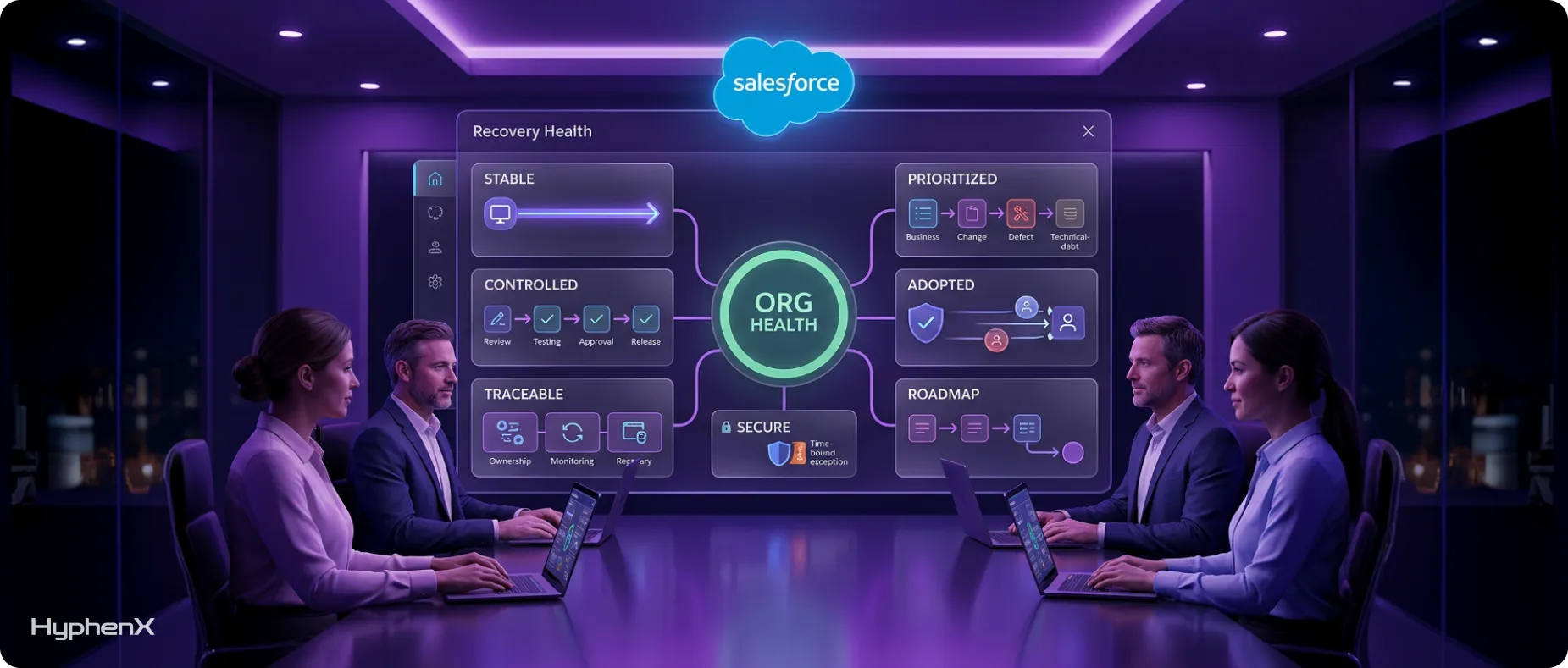
- The highest-value business transactions can be completed without known manual repair or unexplained system state.
- Production changes move through one documented path with source control, review, tests, approvals, and post-release verification.
- Critical integrations have owners, traceable failures, documented recovery, and reconciliation evidence.
- Security exceptions are named and time-bound rather than hidden inside broad profiles or shared credentials.
- The backlog separates business change from defects and technical debt, with priorities tied to consequence.
- Users can explain the intended process and no longer maintain major shadow workflows solely because Salesforce is unreliable.
- The team knows which issues remain and has a realistic 60-90 day remediation plan rather than claiming the org is fully repaired.
The 30-Day Plan is a Control Reset
Salesforce Implementation Rescue works when the team restores the ability to make safe decisions about the org. Salesforce Implementation Recovery then becomes a controlled return to normal delivery rather than a declaration that every defect is gone. That starts with containment, evidence, and a shared definition of failure. It continues through a Salesforce Org Audit that connects automation, data, security, integrations, release mechanics, and adoption to real business paths. The repair phase then follows dependency and risk instead of the age of the ticket. That ordering keeps Salesforce Implementation Problems visible in the context that caused them.
A Failed Salesforce Implementation does not automatically require a complete rebuild. Salesforce Implementation Failure can come from governance and delivery mechanics as easily as from code or configuration. A second Salesforce Implementation Failure cycle is most likely when those operating causes survive the technical repair. Some orgs need a narrow architecture correction, stronger data governance, a repaired integration layer, or a safer release model. Others have accumulated enough Salesforce Technical Debt that selected components should be redesigned. The triage plan exists to produce that decision with evidence before more scope is approved.
For interfaces where API behavior itself is part of the failure, Salesforce API integration services illustrate the level of design, testing, deployment, and follow-up ownership that may be required. The broader lesson is consistent across the org: recovery is complete only when the business path works, the technical behavior is observable, and the permanent team knows how to maintain it.
Frequently Asked Questions
1. What is a Failed Salesforce Implementation?
A Failed Salesforce Implementation is an org or program that does not reliably deliver the intended business process, user adoption, data integrity, security, or delivery stability. The platform may be live and technically available while still failing operationally because users rely on workarounds, releases repeatedly break production, integrations cannot be trusted, or reporting does not reflect the real business state.
2. Can a failed Salesforce implementation be rescued without rebuilding the org?
Yes. Many rescue programs can retain the existing org and correct the highest-risk architecture, data, automation, integration, security, and governance problems. A rebuild should be considered only when evidence shows that repair would preserve unsafe or unmaintainable foundations. Salesforce Implementation Failure alone is not enough evidence for a rebuild. The 30-day triage is designed to produce that evidence before a rebuild decision is made and to keep Salesforce Project Recovery tied to verified dependencies.
3. What should happen in the first week of Salesforce Implementation Rescue?
The first week should create a change-control window, capture production and source-control evidence, map critical business paths, collect incidents, inventory major automation and integrations, and name the technical and business decision owners. The goal is to stabilize the system enough to investigate it without the baseline changing every day. This is the first practical Salesforce Org Health Check under the rescue operating model.
4. What is included in a Salesforce Org Audit during rescue?
A Salesforce Org Audit should inspect automation, data quality, security, sharing, integrations, environments, source control, testing, release practices, user workflows, and ownership. Salesforce Data Quality Issues should be traced to their creation path, not only counted. The same Salesforce Data Quality Issues should be retested after repair to confirm they are no longer being generated. The audit should also show where Salesforce Org Cleanup can proceed safely and where it would disturb active dependencies. The audit is most useful when findings are tied to business paths and operational consequences rather than delivered as a generic inventory of metadata.
5. How is a Salesforce Org Health Check different from a full rescue?
A Salesforce Org Health Check identifies conditions that may need attention, such as security settings, architecture weaknesses, data issues, or technical debt. A rescue goes further by containing active risk, prioritizing findings, implementing critical repairs, validating the repaired business paths, and resetting the operating model for future delivery.
6. How should Salesforce Technical Debt be prioritized?
Prioritize Salesforce Technical Debt by consequence and dependency. Debt that creates production incidents, prevents safe releases, blocks important changes, weakens security, or forces repeated manual work belongs ahead of cosmetic cleanup. Each debt item should state the affected components, business consequence, owner, and recommended treatment window.
7. When should data cleanup happen in a rescue?
Data cleanup should happen after the team identifies the processes that create or corrupt the data. Correct source ownership, integration mappings, automation, import rules, and user workflows first where necessary. Then clean existing records with reconciliation evidence so the organization can prove that the bad pattern is not immediately returning.
8. How do integrations affect Salesforce Project Recovery?
Integrations can make a Salesforce defect appear local when the failure actually sits in authentication, middleware, data mapping, retries, external systems, or reconciliation. Recovery needs an end-to-end view of each critical transaction, including who owns the interface and how support can trace a failed message across system boundaries.
9. What causes Salesforce Adoption Problems after implementation?
Common causes include workflows that do not match real work, too many required steps, unreliable automation, poor data trust, weak reporting, confusing access, insufficient role-based training, and business rules that were never agreed before configuration. User interviews should distinguish a training problem from a process or system-design problem. That distinction prevents Salesforce Adoption Problems from being pushed into training when the real cause is design or data trust.
10. How many issues should a 30-day triage try to fix?
There is no useful universal target. The team should fix the smallest set of issues required to restore critical business paths and safe delivery. A rescue that closes 80 low-risk tickets while leaving one unstable integration or security exposure is less successful than a smaller repair set that restores predictable operation.
11. What should happen after the 30-day rescue?
Normal delivery should resume under a clearer operating model. The team should have a prioritized backlog, a technical-debt register, named owners, a documented release path, monitoring and reconciliation for critical interfaces, and a 60-90 day plan for larger remediation work that was intentionally kept outside the triage window. That plan should keep Salesforce Project Recovery and Salesforce Org Remediation separate from ordinary feature demand until the highest-risk debt is controlled.
12. How do we know the Salesforce Implementation Recovery is complete?
Recovery is complete when the critical business paths work predictably, known risks have owners, releases can move through a controlled process, users can complete core work without major shadow processes, and the permanent team can operate the org without depending on undocumented rescue knowledge. Remaining debt can exist, but it must be visible and governed.