

For mid-market companies with 50 to 500 employees, shortlist HyphenX Solutions and Advayan. For multi-country enterprise programs, the 8 firms to know are Accenture, TCS, Infosys, Deloitte Digital, Persistent Systems, Wipro, Cognizant and Capgemini. Match the partner to your project’s size and integration load first, then check its current tier and competencies in Salesforce’s own consultant directory before you sign.
Type the obvious search and you’ll get a dozen lists, and almost every one follows the same script: a stack of company names, a paragraph of praise for each, and the publisher ranked first with no explanation. That format doesn’t help you pick. You finish reading and still can’t tell which firm fits a 120-person manufacturer in Coimbatore versus a bank rolling out CRM across 14 countries, or what any of them will actually cost.
Choosing among Salesforce implementation partners in India comes down to more than company size or brand recognition. What actually decides whether a project succeeds is Salesforce expertise, implementation methodology, customization depth, integration capability, migration planning, user adoption, and the quality of support after go-live. Those are the factors that determine whether an org gets used every day or quietly abandoned 6 months later.
So we built this list of Salesforce implementation partners in India differently. We’re HyphenX Solutions, a Salesforce partner ourselves, and we’ve given every firm here a specific focus area: the kind of work its practice is genuinely built around. No 2 firms share a focus area. Every entry carries verified specifics, an honest trade-off, and a clear read on who should hire them. We’re on the list too, at number 1 for our segment, and we explain exactly why at the end so you can judge our bias for yourself.
The market is worth this homework. Salesforce India’s revenue grew 47% year over year to ₹13,384.5 crore in the year ended 31 March 2025, according to Salesforce’s own filing announcement, making India one of Salesforce’s fastest-growing markets anywhere. Growth like that pulls plenty of thin operations into the partner ecosystem alongside the genuine article, which is exactly why a list with real trade-offs beats a list of compliments.
The 10 Partners at a Glance
Partner | Best For | Watch Out For |
|---|---|---|
HyphenX Solutions | Mid-market rollouts where 1 team owns scoping through post-launch support | Not built for 20-country programs |
Advayan | Salesforce projects tied to SAP and MuleSoft | Broader consultancy, so confirm the named team’s Salesforce certifications |
Accenture | Multi-country programs that need heavy governance | Top-of-market rates; small rollouts get junior-heavy teams |
TCS | Enterprises already running TCS-managed ERP and legacy systems | Slower mobilization for smaller companies |
Infosys | CPQ to Revenue Cloud migrations and quote-to-cash redesign | Needs strong program management on your side |
Deloitte Digital | Regulated BFSI and healthcare programs shaped by the DPDP Act | Premium, consulting-first pricing |
Persistent Systems | Agentforce, Data Cloud and engineering-heavy enterprise builds | Lighter business-process consulting |
Wipro | Marketing Cloud and Experience Cloud customer-experience builds | Practice quality varies by account |
Cognizant | Healthcare, payer and pharma CRM | Outside its strong verticals, 1 GSI among several |
Capgemini | Indian arms of EU multinationals and manufacturing | More structure than a domestic mid-market rollout needs |
The 2026 Partner Tier Change, in 60 Seconds
Before you evaluate anyone, know this: in March 2026, Salesforce collapsed its 4 consulting partner tiers (Base, Ridge, Crest and Summit) into 2, Select and Summit, as Salesforce Ben reported. Only Summit partners now carry a tier badge on their directory listing. Crest survives only in Salesforce’s separate reseller program, so a firm calling itself a Crest consulting partner today is quoting a retired label. We explain how Select and Summit work now in a separate guide.
Why we’re telling you this up front: a surprising number of Indian partner websites still display the old badges. That’s a small thing that predicts a big thing. A firm that hasn’t updated its own credentials page since March isn’t tracking platform changes for its clients either, and Salesforce ships 3 major releases a year that someone has to absorb on your behalf.
One caution in the other direction: a tier badge tells you about the firm, never about the specific team assigned to you. We’ve seen Summit-badged projects fail on staffing and unbadged boutiques deliver beautifully. Use the tier as a filter, never as the decision.
What We’d Check Before Shortlisting Anyone
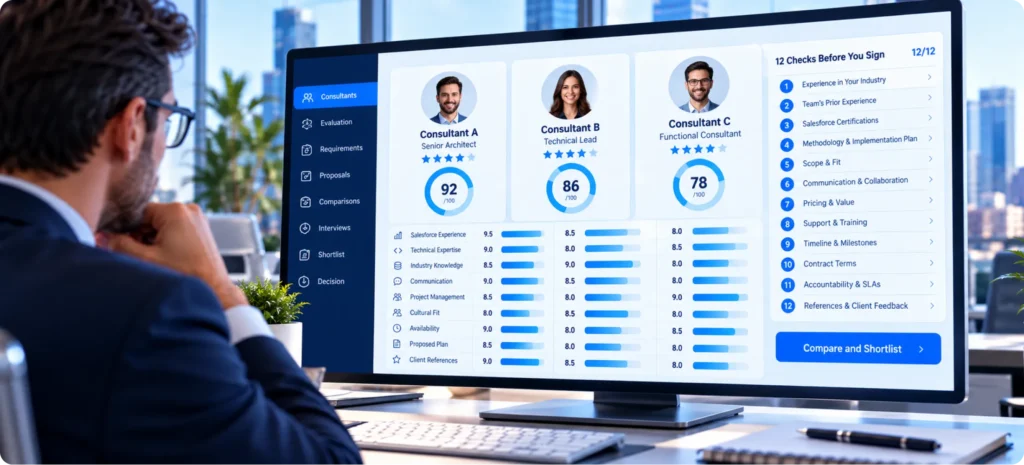
Every firm below passed the same 4 checks we’d ask you to run on anyone, us included.
Verify Credentials Where the Partner Can’t Edit Them
Every partner’s website says they’re excellent. Check the 2 places they can’t edit: the Salesforce consultant directory, which shows current tier, competencies, certified people and verified customer reviews; and the Clutch directory of Salesforce consultants in India, which carries interview-verified client reviews with project budgets attached.
Read the written reviews, skip the star counts. A review describing how a firm handled a problem mid-project tells you more than 10 reviews saying everything went smoothly.
Ask for Sector Evidence, Never Sector Claims
If you’re in BFSI, healthcare, manufacturing, or pharma, ask for 2 or 3 named projects in your sector and what went wrong in each. Every experienced partner has war stories; only inexperienced ones claim otherwise.
Sector depth shows up as fewer surprises in week 1: the partner already knows your approval structures, your data rules, and where compliance will bite. A generalist discovers those things on your budget.
Meet the People Who’ll Actually Do the Work
The most common implementation failure in this market has nothing to do with technology. Firms sell with senior architects and deliver with rotating juniors, and by the time you notice, you’re 3 months in.
So ask directly: who is the lead consultant on our account, what are their certifications, and can we speak with them before we sign? Watch how the firm answers. Hesitation here is the cheapest red flag you’ll ever get.
Make Month 6 Part of the Contract Conversation
Go-live is the midpoint of a Salesforce journey, never the end. Ask every candidate what month 6 looks like: who owns the 3 annual releases, who fixes what breaks, what response times apply to critical issues, and how admin knowledge transfers to your team. A partner with no defined post-go-live support model is handing that burden straight back to you at the moment your team is least ready for it.
The firms that answer this question in specifics rather than reassurances are, in our experience, the ones worth paying.
Our Picks for Mid-Market and Growing Companies
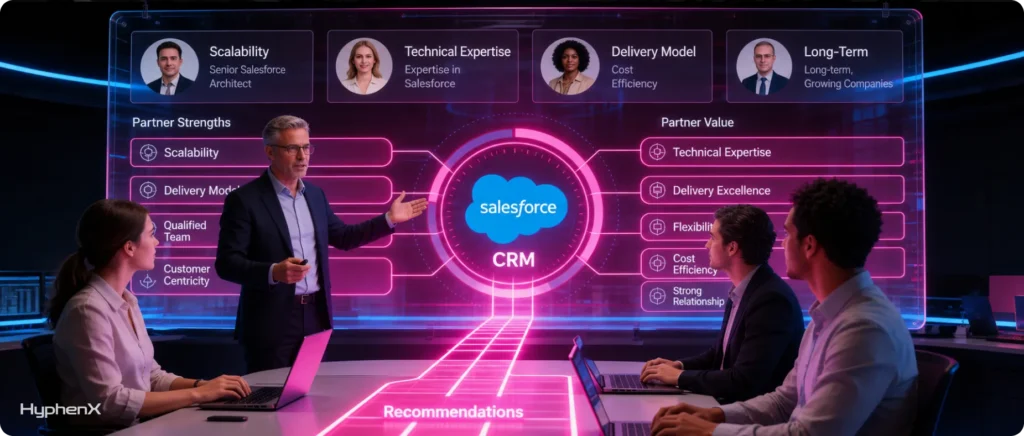
This is our own segment, so read these 2 entries with that disclosure in mind. We’ve kept direct competitors off the list entirely rather than ranking them below us, which felt more honest than the alternative. Each of these entries covers a different kind of work, and each has a stated limit.
1. HyphenX Solutions: 1 Team From Scoping Through Support
At HyphenX, the full lifecycle sits with 1 team, from scoping through post-launch support, so nothing gets handed off between vendors and nothing gets lost between them.
Here’s the problem that model solves. Most mid-market implementations in India involve 2 or 3 vendors across their life: 1 firm scopes and builds, another handles integrations, and a third picks up support when the first one moves on. Every handoff loses context. The support vendor doesn’t know why the build vendor made the decisions it made, so it works around them instead of with them, and technical debt compounds quietly until someone calls it a “failed implementation” and starts over.
Our answer is structural. Consulting, implementation, integration, data migration, and managed services after launch all sit under 1 roof in Jaipur. The people who scoped your org are reachable by the people supporting it in year 2, because they’re the same team.
That structure also shapes how a project starts and how it gets proven before go-live. Our engagements begin with a discovery phase that maps your existing business processes against Salesforce’s data model before any configuration work starts, so the architecture reflects how your teams actually sell and service customers rather than a generic template. Configuration and customization then get validated in sandbox environments against real user workflows before deployment, and admin training runs alongside go-live rather than after it, so the people using Salesforce on day 1 already know how to work in it.
The second thing we do differently is treat go-live as the point where governance starts, never as the finish line. That means structured quarterly reviews, release management across Salesforce’s 3 annual updates, and deliberate adoption and user enablement work, because a technically perfect org that your sales team ignores is still a failed project.
The same thinking applies as your business grows. An org built around clean process design and documented architecture absorbs new teams, new clouds, and new integrations without a rebuild, which is usually where mid-market companies lose money in year 3.
And the part of our model that surprises people: we’re structured to make you need us less over time. We transfer knowledge to your admins deliberately, with the stated goal that your dependency on external support shrinks year on year. Most vendors in this market are built to make you need them more each year, and on a mid-market budget, that difference changes the 5-year math more than any line item in the proposal.
Engagement-wise, there are 2 doors in. Teams that want speed and a contained budget start with a fixed-scope quickstart package that gets a first team live in weeks. Companies with bigger ambitions run the full discovery-led project, and our Agentforce practice covers the AI side as those use cases mature.
Trade-off: We’re a mid-market specialist, and we’re honest about it. A 20-country rollout with a 4-vendor governance board belongs with the enterprise firms below, and we’ll tell you that in the first call rather than the tenth.
2. Advayan
Advayan’s practice spans Salesforce, SAP, and MuleSoft together, which fits the stack where many Indian mid-market integrations run into trouble.
Here’s why that combination matters more than it sounds. In most Indian manufacturers, distributors, and consumer-goods companies, Salesforce is never the system of record for orders or inventory. SAP is. So the CRM project is really an integration project wearing a CRM badge: quoting has to reach SAP order management, master data has to sync both ways, and MuleSoft usually sits in the middle carrying the load. Hire a Salesforce-only firm for that, and you end up managing 2 more vendors yourself.
Advayan’s structure fits the brief. Headquartered in Dover, Delaware, it runs India offices in Bengaluru, Indore and Jaipur, with offshore delivery centres in Pune, Indore and Jaipur, per its own contact page. That gives you Indian delivery economics behind a US commercial front. Its portfolio runs wider than CRM alone: Salesforce development, Pardot, Vlocity and L1 and L2 support, SAP implementations including SAP FLM for public-sector units, and its own products such as an e-signature tool and an e-clinical platform.
That breadth suits a Salesforce program that touches 3 systems and a government stakeholder, where hiring 3 separate specialists would add coordination work rather than remove it.
Trade-off: Advayan is a broader digital consultancy rather than a pure-play Salesforce shop. That breadth is the source of its focus area and also the thing to manage: confirm the Salesforce certifications of your named team before signing, exactly as our checklist above says to do with everyone.
The Enterprise Heavyweights
8 large firms for programs measured in crores and years. We don’t compete with these companies, which makes it easier to be straight about where each one focuses and where its size works against you. A pattern worth naming before the entries: every global systems integrator on this list has brilliant Salesforce teams and mediocre ones, and which you get depends on account size and negotiation. The sections below tell you where each firm’s strongest teams concentrate. Your job in procurement is making sure that’s the team you get.
3. Accenture
Accenture runs one of the largest Salesforce practices in the world, with governance built for programs many firms would struggle to manage.
A substantial share of that global delivery capacity sits in India, which matters 2 ways: Indian enterprises get world-class program machinery close to home, and multinationals get Indian delivery economics inside a global governance wrapper.
The real product Accenture sells at this level is coordination. When a program spans 15 countries, 4 ERP instances, a data-residency matrix, and a change-management workstream, the technology is rarely what fails; the orchestration is. Accenture’s industry playbooks have been refined across hundreds of enterprise rollouts, and its bench depth means a resignation in month 7 never stalls the program.
Trade-off: cost and process weight. Rates sit at the top of the market, and the operating model assumes programs measured in years. A 50-user Sales Cloud rollout gets a junior-heavy team inside a process designed for something 10 times its size, which is why we’d never send a mid-market reader here.
4. TCS
Tata Consultancy Services can deliver Salesforce alongside the ERP, data, and legacy estates it often already manages for Indian enterprises.
That existing footprint is the whole argument. For a conglomerate already running TCS-managed core systems, folding Salesforce into the same relationship collapses vendor governance: 1 master agreement, 1 escalation path, 1 throat to choke when the integration between CRM and the 20-year-old billing system misbehaves at quarter close. No pure-play Salesforce firm can offer that, because no pure-play firm is already inside the rest of your estate.
TCS is also spending serious money to deepen the Salesforce bench itself. In October 2025 it bought ListEngage, a Summit partner known for Agentforce, Marketing Cloud and Commerce Cloud work. 2 months later it agreed to acquire Coastal Cloud, a US Summit partner with 400+ professionals and 3,000+ certifications, for $700 million in cash, as Salesforce Ben reported. TCS says the 2 deals put it among the top 5 Salesforce advisory and consulting firms globally.
Trade-off: TCS optimizes for large, long-running engagements. Smaller companies consistently report slower mobilization than Salesforce-native firms offer, and inside a company of that size, the CRM practice competes with hundreds of other service lines for the best people.
5. Infosys
Infosys built its Salesforce practice partly through acquiring quote-to-cash specialists, which lines up with the wave of CPQ to Revenue Cloud migrations happening in 2026.
The timing is the story. Salesforce’s CPQ end-of-sale has pushed thousands of companies into forced Revenue Cloud migrations, and these are treacherous projects: years of accumulated pricing rules, discount approvals, and contract logic have to be untangled and rebuilt, and every shortcut taken in the original CPQ build surfaces during the move. Migrations like that reward process thinking over build speed.
That’s exactly Infosys’s instinct. Its acquired consulting DNA leads with process redesign, mapping how deals actually get priced and approved before anyone configures anything, which is the single biggest predictor of whether a Revenue Cloud migration lands or gets bypassed by the sales team it was built for.
Trade-off: as with any GSI, outcomes depend heavily on which team you get. Enterprises with strong internal program management extract great value; companies expecting the partner to drive everything find the model demanding, and quote-to-cash projects punish passive clients more than most.
6. Deloitte Digital
Deloitte Digital’s value sits around the platform: operating-model design, regulatory alignment, and organizational change.
India’s DPDP Act has changed what a CRM implementation even is for regulated companies. Consent has to be captured and honored across systems, data residency and retention need architectural answers, and the audit trail has to survive a regulator’s attention. In BFSI and healthcare, those questions decide the design before a single field gets configured, and answering them is consulting work rather than configuration work.
That’s the layer Deloitte actually sells. Its industry-cloud depth in Financial Services Cloud and Health Cloud is a working strength rather than a listed service, and its access to legal and risk expertise inside the same firm is something no technology-only partner can replicate.
Trade-off: premium pricing and a consulting-first culture. If you already know what you want built and just need excellent execution, you’re paying for strategy capacity you won’t use, and several firms on this list will build it for less.
7. Persistent Systems
Persistent pairs enterprise scale with an engineering-first culture, and its AI-layer practice is verifiably deep.
The numbers are public and unusually specific. Persistent reports 2,800+ Salesforce engineers, 11,500+ certifications and 2,200+ engagements, and ISG named it a Leader in its 2026 Provider Lens report on Salesforce ecosystem partners for professional services, per Persistent. It’s headquartered in Pune rather than New York, and for an engineering organization of that size, the concentration on 1 platform is rare.
Why the focus area names Agentforce and Data Cloud specifically: those are the 2 hardest things to buy well in 2026. AI agents that take real actions inside production orgs and customer-data architectures that feed them are engineering problems before they’re consulting problems, and plenty of firms selling “AI transformation” have never shipped either. Persistent has an active practice in both, plus a managed-services offering that keeps optimizing after go-live instead of disappearing.
For technically complex enterprise programs, that mix of scale and engineering culture is worth a place on the shortlist.
Trade-off: business-process consulting is lighter than at the Big 4. Persistent works best when your team owns the “what” and wants a partner to master the “how.”
8. Wipro
Wipro’s Appirio acquisition folded one of the ecosystem’s best-known Salesforce consultancies into an Indian GSI’s delivery engine.
Appirio was a name that meant something in the Salesforce world long before the deal, particularly in customer-experience work, and that heritage still shapes where Wipro’s practice is strongest: Marketing Cloud programs, Experience Cloud portals, and the design-plus-CRM combinations where Salesforce is the backbone of a digital experience rather than a sales database.
For an Indian consumer brand building a loyalty program, or an enterprise standing up a customer portal that has to feel like a product rather than a form, that’s the right specialization to hire. The design sensibility and the CRM engineering live in the same practice instead of in 2 vendors arguing over an API.
Trade-off: practice quality varies by account, the familiar GSI pattern. Push for named Appirio-lineage or dedicated Salesforce studio talent on your team rather than accepting a general delivery pool, and get those names into the contract.
9. Cognizant
Healthcare is Cognizant’s deepest industry vertical, and that domain knowledge carries directly into its Salesforce work.
Healthcare CRM punishes generalists more than any other sector. Consent and privacy rules constrain every field, clinical and commercial workflows collide, and the stakeholder map includes people who can veto a design for reasons no technology partner would anticipate. A partner that already understands those constraints removes months of expensive education from the project.
Cognizant has spent decades inside healthcare operations, payers, providers, and pharma alike, and its large India delivery organization keeps those programs at Indian economics. For hospital networks, health-tech companies, and pharma commercial teams, that domain depth is the reason to have the conversation.
Trade-off: outside its strong verticals, Cognizant is 1 large GSI among several, and the same team-variability caveat applies. Hire it for the domain depth or pick from the rest of this list.
10. Capgemini
Capgemini’s European roots and manufacturing depth suit the Indian arms of EU multinationals.
The fit is cultural as much as technical. European parent companies bring GDPR-shaped data instincts, works-council sensitivities, and reporting expectations that US-centric partners keep tripping over. Capgemini has operated inside those expectations for decades, and its India delivery centers give the commercial model teeth.
On the technical side, its Salesforce work is strongest where CRM meets shop-floor and supply-chain systems: dealer management, field service tied to installed equipment, and the quote-to-order flows that manufacturing runs on. If your Salesforce program has to coexist with a European ERP template rolled out from headquarters, this is the shortlist entry.
Trade-off: for a purely domestic Indian mid-market rollout, its enterprise machinery is more structure than the project needs, at a price the project doesn’t need either.
What Salesforce Implementation Costs in India
The 2026 market clusters into recognizable bands, and knowing them protects you in both directions: from overpaying an enterprise firm for a mid-market job and from believing a quote that’s too good to be real. Salesforce doesn’t publish partner rates, so the bands below come from the proposals and rescue projects we see across the market.
Project Type | Typical Range |
|---|---|
Focused single-cloud rollout for a small team | INR 3 to 12 lakh |
Mid-complexity multi-cloud project for 50 to 200 users | INR 10 to 40 lakh |
Enterprise program with custom development, ERP integration and change management | INR 1 crore and up |
On hourly terms, certified India-based specialists generally charge $25 to $75 per hour against $125 to $200 for comparable US-based talent, which is why every firm on this list serves clients well beyond India from Indian delivery centers. The engagement model shifts the math too: fixed-price quickstarts cap your exposure on small scopes, time-and-materials suits evolving requirements, and managed-services retainers usually beat ad-hoc support billing within the first year for any org with real usage. For a line-by-line view, see our Salesforce implementation cost breakdown.
Treat quotes far below these bands with suspicion. The cheapest implementation usually becomes the most expensive one after you pay someone else to fix it, and a fair share of our own inbound work starts exactly that way: a rescue of an org that was “implemented” for half the market rate 18 months earlier.
How We’d Shortlist if We Were You
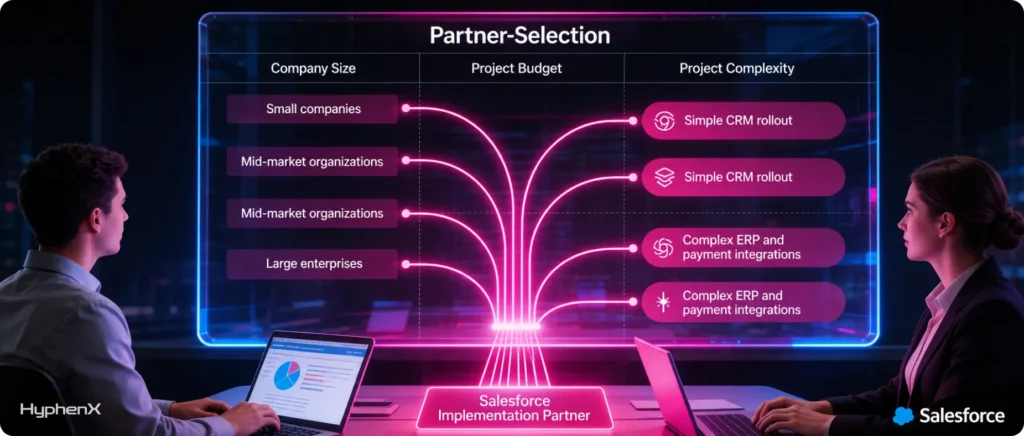
Skip the RFP-to-everyone approach. It generates polished documents and teaches you nothing. Match on 3 variables, talk to 3 firms, and ask each of them the month-6 question from our checklist. Our guide to choosing the right Salesforce consulting partner has the interview questions.
By Company Size
Under 50 employees: a fixed-scope quickstart from a mid-market firm beats anything the enterprise group can price. You need speed, adoption, and someone who answers the phone, none of which improves with firm size.
50 to 500 employees: the mid-market segment above is your bracket, with Persistent worth adding to the conversation once technical complexity climbs. Above 500 employees or multi-country: the enterprise heavyweights matched to the focus area that fits your industry and program shape.
By Budget
Under INR 10 lakh, buy a tightly scoped package and resist customization; every “small tweak” at this budget level costs disproportionately later. Between INR 10 and 50 lakh, you can afford proper discovery and a support retainer, so weigh partners on their post-go-live model, since that’s where this budget band most often leaks money.
Above INR 50 lakh, you’re buying program governance as much as delivery, and the enterprise group earns its premium, provided the program genuinely needs that machinery.
By Project Complexity
Plain CRM rollout: prioritize responsiveness and adoption support over tier badges. Heavy ERP or payment-system connections: prioritize proven integration delivery and ask to see a comparable architecture before you commit, since integration risk is the most underestimated line in every Salesforce budget.
AI and Agentforce ambitions: verify live agent deployments and the Agentforce competency on the partner’s directory listing, because in 2026 that’s the fastest way to separate practitioners from press releases. An agent that takes real actions in a production org is a different achievement from a demo, and the partners who’ve done it can name the projects.
Why We Put Ourselves at Number 1
Fair question, and here’s the honest answer. We rank ourselves first for mid-market because our model, 1 team across the lifecycle with governance after go-live and a stated goal of reducing your dependency on us, is genuinely rare in this market and because this is our site and pretending otherwise would insult you.
What we’ve done to keep the list useful anyway: every other firm gets a real focus area and a real trade-off; we removed direct mid-market competitors from the list rather than ranking them below us; and we’ve told you plainly where our model runs out of road. If you’re running a global enterprise program, the heavyweights above are built for that scale. If your project is a pure Marketing Cloud experience build or a telecom industry cloud, that work sits outside what we focus on, and the specialists above are the sensible call.
And if you’re mid-market in India, talk to us and at least 2 others. Ask all 3 who your lead consultant would be, what month 6 looks like, and what happens to your team’s independence over 3 years. We like our odds in that conversation, which is the whole reason we’re comfortable publishing a list with real alternatives in it.
If you’re comparing Salesforce implementation partners in India for a mid-market rollout, a short conversation is usually enough to tell whether the fit is right. We’re happy to look at your current Salesforce environment, talk through integration and migration needs, and sketch what a realistic implementation roadmap would look like for your team. Comparing partners outside India too? See our list of top Salesforce implementation partners in the USA.
An India-Based Partner With 250+ Salesforce Certifications
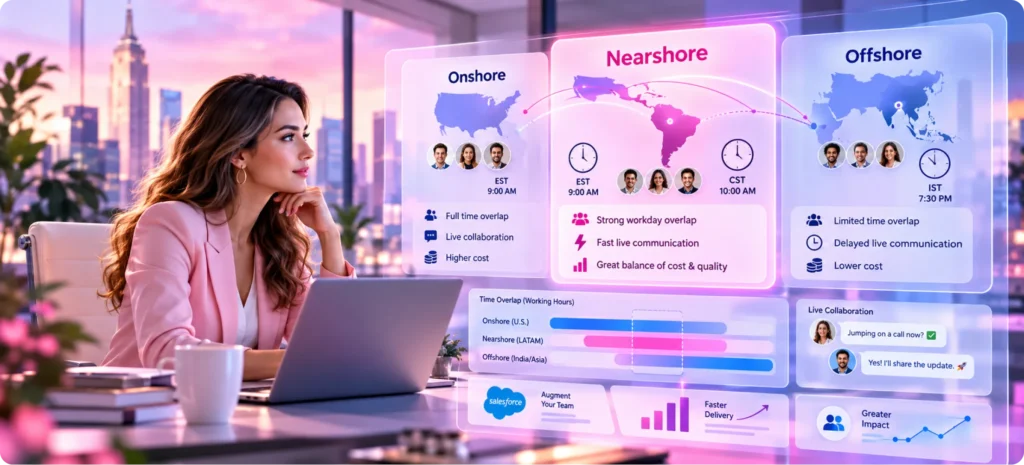
India’s Salesforce talent pool is deep, but quality varies. Our answer is 250+ Salesforce certifications held across our delivery and consulting roles, applied to every implementation project. Short on in-house capacity? Augment your team with certified experts who hold these credentials and start contributing from week 1. You get India’s cost advantage with consistent, certified quality and clear communication. Curious about the people behind the badges? Meet the HyphenX team.
An India-based partner with 250+ Salesforce certifications
India's Salesforce talent pool is deep, but quality varies. Our answer is 250+ Salesforce certifications held across our delivery and consulting roles, applied to every implementation project. Short on in-house capacity? Augment your team with certified experts who hold these credentials and start contributing from week one. You get India's cost advantage with consistent, certified quality and clear communication. Curious about the people behind the badges? Meet the HyphenX team.
Frequently Asked Questions
1. Who are the top Salesforce implementation partners in India in 2026?
For mid-market projects, HyphenX Solutions and Advayan. For enterprise programs, Accenture, TCS, Infosys, Deloitte Digital, Persistent Systems, Wipro, Cognizant and Capgemini. The right choice depends on company size, budget and integration load, so match on those before you compare names.
2. How do I check a Salesforce partner’s tier in India?
Search the firm in Salesforce’s consultant directory at appexchange.salesforce.com/consulting. Since March 2026 the consulting tiers are Select and Summit, and only Summit shows a badge. Ask any firm without a badge to confirm its tier in writing, then check its competencies for the products you’re buying.
3. Are Salesforce licenses included in an implementation partner’s project fee?
Usually, no. Salesforce licenses are generally purchased separately from implementation services. Before signing, confirm which Salesforce editions, add-ons, sandbox capacity, and third-party apps you must buy directly, and which costs are included in the partner’s statement of work.
4. How long does a typical Salesforce implementation take?
Implementation time depends on scope, data quality, integrations, customization, and decision speed. A contained rollout may take several weeks, while multi-cloud or integration-heavy programs can take months. Ask for milestone dates, dependencies, and client-side approval deadlines before kickoff.
5. What should our company prepare before the Salesforce implementation starts?
Prepare clear business goals, process owners, existing system details, data samples, integration requirements, and decision-makers. Your partner should also know who can approve workflows, validate migrated data, attend testing, and resolve questions quickly when configuration choices affect multiple teams.
6. Who owns the Salesforce configuration and custom development after the project?
Your contract should clearly define ownership of custom code, documentation, integration assets, and reusable partner components. Your company should retain appropriate administrative control of its Salesforce org and receive enough technical documentation to maintain or transfer the implementation later.
7. Can Salesforce be implemented without interrupting our current CRM operations?
Yes, many projects reduce disruption by building and testing outside production, validating migrated data, and planning a controlled cutover. The exact approach depends on your current systems, integration dependencies, data volume, and whether both platforms must operate temporarily in parallel.
8. Should a Salesforce partner build and test everything in a sandbox first?
For most implementation work, development and testing should happen in appropriate sandbox environments before production deployment. Sandboxes allow teams to test configuration, integrations, migration behavior, and user workflows without exposing the live organization to unfinished or insufficiently validated changes.
9. What is user acceptance testing in a Salesforce implementation?
User acceptance testing, or UAT, is where selected business users verify that Salesforce supports agreed real-world workflows before go-live. Define test scenarios, expected results, issue severity, retesting rules, and the person authorized to provide final business sign-off.
10. How much time will our internal team need to commit to the implementation?
Your internal workload depends on project complexity, but the partner will still need timely access to business owners, IT, administrators, and decision-makers. Plan capacity for discovery, data review, workflow decisions, testing, training, approvals, and issue resolution throughout the project.
11. Can we migrate only selected historical data into Salesforce?
Yes. Many organizations choose which records, fields, attachments, and historical periods are genuinely useful before migration. Define retention needs, reporting requirements, duplicates, ownership rules, and archive options first, then test the agreed migration set before moving production data.
12. What happens if our requirements change during the Salesforce project?
Changes should follow a documented change-control process rather than informal requests. The partner should explain how each change affects scope, cost, timeline, testing, and dependent work, then obtain approval before adding it to the active implementation plan.
13. How should third-party integrations be tested before Salesforce goes live?
Test integrations with realistic scenarios covering successful transactions, failures, duplicate records, permissions, field mappings, API limits, and recovery steps. Business users and technical owners should validate end-to-end outcomes, not just confirm that 2 systems can exchange a sample record.
14. What documentation should a Salesforce partner provide at project handover?
Ask for documentation covering system architecture, configurations, custom code, integrations, data mappings, automation, permissions, deployment history, known limitations, and administrator procedures. The handover should let a capable internal admin or future partner understand the org without reverse-engineering the implementation.
15. How should a Salesforce implementation partner access our production org securely?
Provide controlled, auditable access appropriate to the work being performed. Avoid casual credential sharing. Agree on named users or approved privileged-access procedures, multi-factor authentication, permission levels, access duration, and a process for removing partner access when work ends.
16. Can we implement Salesforce in phases instead of launching everything at once?
Yes. A phased rollout can separate departments, clouds, regions, integrations, or priority workflows into manageable releases. Define what each phase must deliver, how shared data and architecture will work across phases, and which later requirements could influence early design decisions.
17. What acceptance criteria should be included in a Salesforce implementation statement of work?
Acceptance criteria should describe measurable conditions for completed configuration, integrations, migrated data, testing, documentation, training, and deployment. Include who approves each deliverable, how defects are classified, how long review periods last, and what happens when a deliverable is rejected.