
Marketing Cloud Account Engagement implementation cost in India runs roughly ₹2.5 lakh to ₹45 lakh for the implementation work itself, depending on how complex your setup is. Add the platform licence and your realistic first-year total lands between ₹18 lakh and ₹1 crore or more.
That’s a wide range, and the spread is the whole story. Two Indian B2B companies with similar headcount routinely get quotes that differ by 5x, and both quotes can be honest. What separates them is business units, data quality, integrations and how much of the work your own team can absorb.
What This Guide Covers
We’ve broken the Marketing Cloud Account Engagement implementation cost into every line item you’ll actually see on an invoice. Licensing by edition with current official pricing converted to INR. Implementation fees by project size. Monthly admin retainers. The hidden costs that surface in month three. You’ll also get three complete first-year budgets for a small B2B company, a mid-market business and an enterprise rollout, plus a breakdown of what pushes your number up or down. It’s written for marketing heads, founders and finance teams who need a defensible figure before they walk into a vendor conversation.
The Short Version
- Salesforce publishes MCAE pricing in USD even on its India site, so your licence cost moves with the exchange rate
- Growth+ starts at $1,250 per org per month, roughly ₹1.19 lakh, billed annually
- Implementation typically costs ₹2.5 lakh to ₹45 lakh depending on scope
- Indian certified Salesforce specialists bill around $25 to $75 an hour, well below US rates of $125 to $200
- Ongoing admin support runs ₹25,000 to ₹4 lakh a month based on hours
- Every edition includes only 10,000 contacts, and overage is a real budget line
All USD to INR conversions here use ₹95 to the dollar, the approximate mid-market rate on 9 September 2026. Rates move, so treat the INR figures as planning numbers and recheck before you sign.
How Much Does Marketing Cloud Account Engagement Implementation Cost in India?
Short answer: Implementation alone costs ₹2.5 lakh to ₹45 lakh. First-year total including licence runs ₹18 lakh to over ₹1 crore.
Here’s the headline view before we break each piece apart.
| Company Profile | Licence (Year 1) | Implementation | First-Year Total |
|---|---|---|---|
| Small B2B, one business unit, under 10,000 contacts | ₹14.25 lakh (Growth+) | ₹2.5 lakh to ₹6 lakh | ₹18 lakh to ₹24 lakh |
| Mid-market, integrations and migration | ₹31.35 lakh (Plus+) | ₹6 lakh to ₹18 lakh | ₹42 lakh to ₹58 lakh |
| Enterprise, multiple business units | ₹50.16 lakh (Advanced+) | ₹18 lakh to ₹45 lakh | ₹75 lakh to ₹1.1 crore |
Notice that licensing dominates. For most Indian B2B companies the Marketing Cloud Account Engagement implementation cost is smaller than the annual subscription, which surprises teams who budget for the project and forget the recurring line.
What Does Marketing Cloud Account Engagement Licensing Cost in India?
Salesforce publishes four Account Engagement editions on its official India pricing page. These are the current list prices as published, converted at ₹95 to the dollar.
| Edition | USD/Org/Month | INR/Month | INR/Year | Contacts Included |
|---|---|---|---|---|
| Growth+ | $1,250 | ₹1,18,750 | ₹14,25,000 | 10,000 |
| Plus+ | $2,750 | ₹2,61,250 | ₹31,35,000 | 10,000 |
| Advanced+ | $4,400 | ₹4,18,000 | ₹50,16,000 | 10,000 |
| Premium+ | $15,000 | ₹14,25,000 | ₹1,71,00,000 | 75,000 |
Every edition is priced per org rather than per user, which works in your favour if you have a large marketing team. All of them require an annual contract, so monthly billing is not an option.
The Currency Detail Indian Buyers Keep Missing
Look closely at that pricing page and you’ll notice something. Salesforce lists USD, EUR, AUD, JPY, SEK and GBP. There is no INR price.
This matters more than it looks. Your licence cost is denominated in dollars, so a rupee movement of 3 percent changes your annual spend by roughly ₹43,000 on Growth+ and ₹1.5 lakh on Advanced+. Finance teams that budget a flat INR figure at the start of the year get caught by this. Build a currency buffer of 5 to 8 percent into your annual marketing automation budget. We’ve watched teams treat this as a rounding error and then have an awkward conversation at renewal.
What Each Edition Actually Includes
The jump from Growth+ to Plus+ is the one most Indian B2B teams face, and it’s worth understanding what your extra ₹17 lakh a year buys.
| Capability | Growth+ | Plus+ | Advanced+ | Premium+ |
|---|---|---|---|---|
| Forms and landing pages | 50 each | Unlimited | Unlimited | Unlimited |
| Automation rules | 50 | 100 | 150 | 150 |
| Engagement history dashboards | 5 | 10 | 20 | 20 |
| Business units | No | No | Yes | Yes |
| AI-powered scoring | No | Yes | Yes | Yes |
| B2B Marketing Analytics | No | Yes | Yes | Yes |
| Developer sandboxes | No | No | Yes | Yes |
| Dedicated IP address | No | No | Yes | Yes |
| API calls per day | 25,000 | 50,000 | 100,000 | 100,000 |
| File hosting | 100 MB | 500 MB | 10 GB | 10 GB |
The 50 form and 50 landing page cap on Growth+ is the limit that bites first. A B2B company running content marketing properly burns through 50 landing pages inside a year.
Business units only appear at Advanced+. If you operate separate brands, regions or product lines that need isolated databases, you’re looking at ₹50 lakh a year in licensing before anyone writes a line of configuration.
The 10,000 Contact Ceiling
Every edition below Premium+ includes 10,000 contacts. Premium+ includes 75,000.
Indian B2B companies with an established database blow past 10,000 quickly, especially after importing years of event leads and legacy CRM records. Additional contact blocks are purchased separately, and this is the single most common reason a budget goes over in year one.
Before you sign anything, count your actual mailable prospect records. Not your CRM total, your mailable count. Then decide honestly how much of that legacy database is worth carrying, because you’re paying for every record.
Add-Ons That Sit Outside the Edition Price
Salesforce lists several capabilities as chargeable extras depending on your edition. These are easy to miss when you compare editions on headline price alone.
| Add-On | Cost | Which Editions Pay for It |
|---|---|---|
| Advanced dynamic content | $400 a month, roughly ₹38,000 | Chargeable on Growth+, included from Plus+ upward |
| Advanced email analytics and rendering preview | $400 a month, roughly ₹38,000 | Chargeable on Growth+, included from Plus+ upward |
| Customised object integration | $400 a month, roughly ₹38,000 | Chargeable on Plus+, included from Advanced+ upward |
| SMS | Add-on pricing | All editions, purchased separately |
| Add-on pricing | All editions, purchased separately | |
| Unified conversations for SMS and WhatsApp | Add-on pricing | Available from Plus+ upward |
| Additional contact blocks | Quoted by volume | All editions above the included allowance |
Run this arithmetic before choosing Growth+ on price. If you need advanced dynamic content and advanced email analytics, that’s an extra $800 a month, roughly ₹9.12 lakh a year. At that point Plus+ at ₹31.35 lakh compares differently against Growth+ at ₹14.25 lakh plus ₹9.12 lakh in add-ons.
WhatsApp matters specifically for Indian B2B teams. It’s a primary business channel here in a way it isn’t in the US or Europe, and it is not included in any Account Engagement edition. Budget for it separately if it’s part of your outreach plan.
What Does the Implementation Itself Cost?

Short answer: ₹2.5 lakh for a clean single-business-unit setup, ₹6 lakh to ₹18 lakh for mid-market, ₹18 lakh to ₹45 lakh for complex multi-business-unit work.
Implementation is where quotes diverge wildly, so let’s be concrete about what sits inside each band.
| Project Size | Typical Effort | Investment | What It Covers |
|---|---|---|---|
| Small, single business unit | 80 to 150 hours | ₹2.5 lakh to ₹6 lakh | Salesforce connector setup, tracking code, up to 10 forms, 3 to 5 email templates, one nurture programme, basic scoring and grading, standard reporting, admin training |
| Mid-market | 200 to 400 hours | ₹6 lakh to ₹18 lakh | Everything above plus data migration from an existing platform, 2 to 4 integrations, custom scoring model, preference centre, 15 to 25 forms, multiple nurture tracks, B2B Marketing Analytics setup, team training |
| Enterprise, multi business unit | 450 to 900+ hours | ₹18 lakh to ₹45 lakh | Multi-business-unit architecture, complex CRM configuration, ERP or data warehouse integration, large-volume migration with cleanup, custom objects, advanced attribution, governance framework, phased rollout, change management |
What Indian Salesforce Consultants Actually Charge
Published 2026 benchmarks put India-based certified Salesforce specialists at roughly $25 to $75 an hour. GoodFirms research from August 2026 reported a median around $37 an hour across Indian firms it reviewed.
At ₹95 to the dollar, that’s about ₹2,375 to ₹7,125 an hour, with a median near ₹3,500. Comparable US-based specialists bill $125 to $200 an hour, which is why so much MCAE delivery work runs from Indian centres regardless of where the client sits. Rate alone tells you very little, though. A ₹2,400 an hour consultant who needs 300 hours costs more than a ₹5,000 an hour consultant who needs 120 hours and gets the architecture right first time. We’d rather be judged on total delivered cost than hourly rate.
If you’re comparing providers, the same logic we applied in our guide to top Salesforce implementation partners in India holds here. Ask for effort estimates by workstream rather than a single number, because that’s the only way to compare two quotes fairly.
Where the Hours Actually Go
Here’s a mid-market implementation broken into workstreams, so you can see what you’re buying. This is the ₹11 lakh build from our budget table below, itemized.
| Workstream | Hours | Cost | What Happens |
|---|---|---|---|
| Discovery and architecture | 25 to 35 | ₹1,20,000 | Requirements, data model review, business unit decisions, integration mapping |
| Connector and technical setup | 20 to 25 | ₹90,000 | Salesforce connector, tracking code, domains, DKIM and sending authentication |
| Forms and landing pages | 35 to 45 | ₹1,60,000 | 20 forms with handlers, page templates, progressive profiling |
| Email templates | 18 to 25 | ₹80,000 | Responsive template build and testing across clients |
| Scoring and grading | 25 to 30 | ₹1,10,000 | Scoring categories, grading profile, sales alignment and threshold tuning |
| Nurture programmes | 40 to 50 | ₹1,80,000 | Multiple Engagement Studio tracks with branching and exit rules |
| Preference centre and consent | 25 to 35 | ₹1,20,000 | Purpose-based preferences, consent fields, opt-out sync |
| Reporting and analytics | 25 to 35 | ₹1,20,000 | B2B Marketing Analytics setup, dashboards, attribution |
| Testing and QA | 18 to 25 | ₹80,000 | End to end testing, sync validation, deliverability checks |
| Training and handover | 10 to 12 | ₹40,000 | Admin enablement and documentation |
Ask any provider for this level of detail. A quote that arrives as a single number with no workstream breakdown gives you nothing to negotiate against and no way to spot what’s been left out.
How Long Does the Money Take to Spend?
Implementation cost and timeline move together, so it helps to see the phasing.
| Phase | Duration | What Gets Delivered |
|---|---|---|
| Discovery | 1 to 2 weeks | Requirements, data audit, integration inventory, architecture decisions and a locked scope |
| Foundation | 2 to 3 weeks | Connector, tracking, domains, authentication, user setup and permissions |
| Build | 3 to 6 weeks | Forms, pages, templates, scoring, nurture programmes, preference centre |
| Data migration | 1 to 3 weeks | Cleanup, mapping, staged import and validation, running in parallel with build |
| Testing | 1 to 2 weeks | End to end validation, sync testing, deliverability checks and fixes |
| Launch and stabilisation | 2 to 4 weeks | Go-live, monitoring, issue resolution and team training |
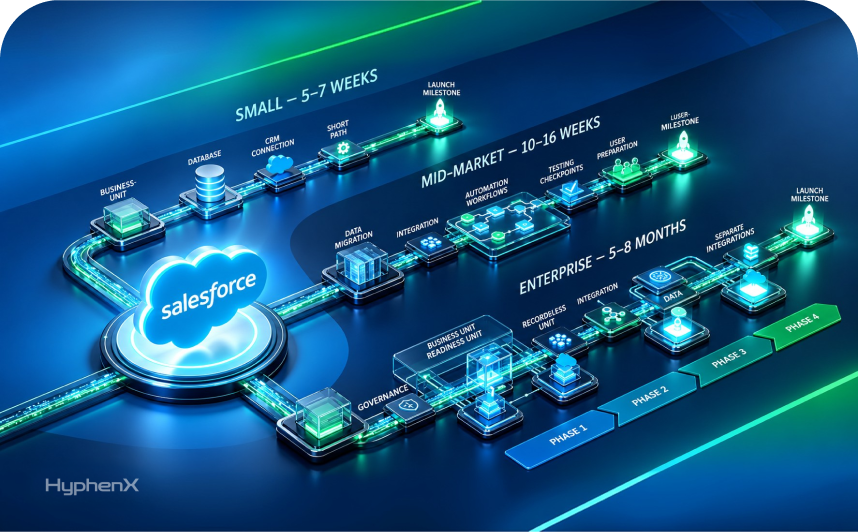
A small single-business-unit implementation compresses this to 5 or 6 weeks. Mid-market typically runs 10 to 14 weeks. Enterprise multi-business-unit programmes take 4 to 8 months, usually phased by business unit rather than launched at once.
What Does Ongoing MCAE Admin and Support Cost per Month?
Short answer: ₹25,000 to ₹60,000 a month for light support, ₹60,000 to ₹1.5 lakh for standard cover, and ₹1.8 lakh to ₹4 lakh for full managed operations.
This is the line teams forget entirely, then discover six months in when campaigns stall because nobody owns the platform.
| Support Level | Monthly Hours | Monthly Cost | Best Suited To |
|---|---|---|---|
| Light maintenance | 8 to 15 | ₹25,000 to ₹60,000 | Small teams with an internal marketer who can run campaigns and needs help only with configuration and troubleshooting |
| Standard support | 20 to 40 | ₹60,000 to ₹1,50,000 | Mid-market teams running regular campaigns who need build support, automation changes, reporting and optimisation |
| Full managed operations | 60 to 100+ | ₹1,80,000 to ₹4,00,000 | Organisations with no internal MCAE administrator, or complex multi-business-unit environments needing continuous governance |
What that retainer typically covers: MCAE administration and user management, campaign build and QA, automation and Engagement Studio maintenance, form and landing page creation, list hygiene and database health, deliverability monitoring, sync error resolution, reporting and dashboard upkeep, and platform release management.
A retainer usually beats ad hoc billing within the first year, because ad hoc work carries context-switching overhead every single time. Our Salesforce managed services engagements are built around this, since a platform nobody maintains quietly loses value every month.
What Are the Hidden Costs of a Pardot Implementation?
Here’s where budgets break. None of these are hidden by anyone acting in bad faith. They’re simply absent from most initial quotes because they sit outside the implementation scope.
| Cost Item | Typical Range | Why It Appears |
|---|---|---|
| Additional contact blocks | ₹2 lakh to ₹12 lakh a year | Your database exceeds the 10,000 included contacts |
| Salesforce CRM licences | ₹1.5 lakh to ₹12 lakh a year | MCAE needs an active Salesforce org, and you may need more seats |
| Data cleanup before migration | ₹1 lakh to ₹8 lakh | Duplicate records, missing fields and bad email data have to be fixed before import, and this is almost always underestimated |
| Email template design and build | ₹40,000 to ₹3 lakh | Responsive templates need design and HTML work beyond configuration |
| Landing page design | ₹30,000 to ₹2.5 lakh | Branded, converting pages take design time |
| Content production for nurture | ₹1 lakh to ₹6 lakh | A nurture programme with nothing to send is an empty shell |
| Additional integrations | ₹1 lakh to ₹8 lakh each | Webinar platforms, ERP, event tools and data warehouses each need work |
| Custom object integration | $400 a month on Plus+ | Included at Advanced+ and above, chargeable below it |
| Advanced dynamic content | $400 a month on Growth+ | Included from Plus+ upward |
| Team training | ₹50,000 to ₹3 lakh | Beyond basic admin handover, especially for larger teams |
| Certification for internal staff | ₹15,000 to ₹40,000 per person | Exam fees plus preparation time |
| DPDP compliance work | ₹1.5 lakh to ₹10 lakh | Consent architecture, preference centre redesign and retention workflows |
| SMS and WhatsApp | Add-on pricing | Not included in any edition, purchased separately |
| Post-launch stabilisation | ₹1 lakh to ₹5 lakh | The first 60 days always surface issues nobody predicted |
The compliance line deserves attention. India’s DPDP Rules bring consent, notice, retention and erasure obligations into force around May 2027, and marketing automation databases sit right in scope. Teams implementing MCAE now should build consent capture properly during the project rather than retrofitting it later at higher cost.
What Changes If You Are Migrating from HubSpot or Marketo?
Short answer: Add ₹2 lakh to ₹9 lakh depending on database size and how much activity history you need to preserve.
Most Indian companies buying MCAE are switching from something, and migration is the line item that most often gets underquoted. The cost driver is not record count on its own. It’s how much history you want to keep and how clean the source data is.
| Migration Element | Typical Cost | What Makes It Harder |
|---|---|---|
| Contact and prospect records | ₹80,000 to ₹3,50,000 | Volume, duplicate rates, inconsistent field structures across sources |
| Custom field mapping | ₹50,000 to ₹2,00,000 | Large numbers of custom fields with no clean equivalent in MCAE |
| Activity and engagement history | ₹1,00,000 to ₹4,00,000 | Historical opens, clicks and form submissions rarely transfer cleanly between platforms |
| List and segment rebuild | ₹40,000 to ₹1,50,000 | Segmentation logic has to be rebuilt rather than imported |
| Automation rebuild | ₹1,00,000 to ₹5,00,000 | Nurture programmes cannot be exported between platforms and must be recreated |
| Template recreation | ₹50,000 to ₹2,50,000 | Email and landing page designs need rebuilding in MCAE |
Be realistic about activity history. Teams often insist on migrating years of engagement data and then never use it, having paid several lakh for the privilege. In most cases the last 12 to 24 months is enough for scoring and segmentation to work properly.
Automation rebuild surprises people too. There is no export path for nurture programmes between marketing automation platforms, so every Engagement Studio track is built from scratch regardless of what you had before. If you’re running 15 complex programmes elsewhere, price that honestly.
The other thing worth doing before migration is deciding what not to bring. A database cleanup that removes 30 percent of dead records pays for itself twice, once in migration effort and again in contact block costs every year afterwards.
Real Budget Tables by Company Size
These are complete first-year budgets rather than implementation quotes. We’ve built each one from the components above.
Small B2B Company
Profile: 30 to 60 employees, one business unit, around 8,000 contacts, an existing Salesforce org, moving from a basic email tool.
| Line Item | Cost | Notes |
|---|---|---|
| MCAE Growth+ licence | ₹14,25,000 | $1,250 a month, annual contract |
| Implementation | ₹3,50,000 | Connector, tracking, 10 forms, templates, one nurture track, scoring |
| Data migration and cleanup | ₹1,00,000 | Roughly 8,000 records from an existing tool |
| Email and landing page design | ₹75,000 | 5 templates, 5 pages |
| Training | ₹60,000 | Two-day admin and user sessions |
| Ongoing support (12 months) | ₹4,20,000 | ₹35,000 a month, light maintenance |
| Contingency at 10 percent | ₹2,43,000 | Currency movement and scope creep |
| First-year total | ₹26,73,000 | Year 2 onward drops to roughly ₹19 lakh |
Mid-Market Company
Profile: 150 to 400 employees, one or two brands, around 25,000 contacts, migrating from HubSpot or Marketo, three integrations.
| Line Item | Cost | Notes |
|---|---|---|
| MCAE Plus+ licence | ₹31,35,000 | $2,750 a month, annual contract |
| Additional contact blocks | ₹4,50,000 | 15,000 contacts above the included 10,000 |
| Implementation | ₹11,00,000 | Full build, custom scoring, preference centre, 20 forms, multiple nurture tracks |
| Data migration and cleanup | ₹4,00,000 | 25,000 records with deduplication and field mapping |
| Integrations | ₹4,50,000 | Webinar platform, event tool, BI connection |
| Design and content | ₹3,00,000 | Templates, pages, nurture content |
| Training | ₹1,50,000 | Marketing team plus admin enablement |
| DPDP consent architecture | ₹3,00,000 | Consent fields, preference centre, retention workflow |
| Ongoing support (12 months) | ₹12,00,000 | ₹1 lakh a month, standard support |
| Contingency at 10 percent | ₹7,48,500 | Currency and scope buffer |
| First-year total | ₹82,33,500 | Year 2 onward drops to roughly ₹48 lakh |
Enterprise Organisation
Profile: 1,000+ employees, four business units across regions, around 90,000 contacts, ERP integration, phased rollout.
| Line Item | Cost | Notes |
|---|---|---|
| MCAE Advanced+ licence | ₹50,16,000 | $4,400 a month, business units included |
| Additional contact blocks | ₹22,00,000 | 80,000 contacts above the included 10,000 |
| Implementation | ₹32,00,000 | Multi-business-unit architecture, governance, phased rollout |
| Data migration and cleanup | ₹9,00,000 | 90,000 records across legacy systems |
| Integrations | ₹12,00,000 | ERP, data warehouse, event platform, analytics |
| Design and content | ₹6,00,000 | Templates and pages across four business units |
| Training and change management | ₹5,00,000 | Multi-region team enablement |
| DPDP compliance programme | ₹8,00,000 | Consent architecture, rights workflows, documentation |
| Ongoing support (12 months) | ₹30,00,000 | ₹2.5 lakh a month, full managed operations |
| Contingency at 12 percent | ₹20,90,000 | Currency, scope and integration risk |
| First-year total | ₹1,95,06,000 | Year 2 onward drops to roughly ₹1.1 crore |
Two patterns hold across all three. Year one is always the expensive year, typically 60 to 80 percent higher than the steady state. And ongoing support plus licensing, not implementation, dominates your long-term cost.
The Three-Year Cost Nobody Models
Most Indian companies budget year one and stop. That’s the mistake that makes a marketing automation decision look cheaper than it is.
The figures below assume a 7 percent annual increase covering both the Salesforce contract escalator and rupee movement against the dollar.
| Company Size | Year 1 | Year 2 | Year 3 | Three-Year Total |
|---|---|---|---|---|
| Small B2B | ₹26.7 lakh | ₹19.0 lakh | ₹20.3 lakh | ₹66.0 lakh |
| Mid-market | ₹82.3 lakh | ₹48.0 lakh | ₹51.4 lakh | ₹1.82 crore |
| Enterprise | ₹1.95 crore | ₹1.10 crore | ₹1.18 crore | ₹4.23 crore |
Look at what that means for a mid-market company. The implementation was ₹11 lakh, roughly 6 percent of the three-year cost. Licensing and support account for most of the rest.
Two practical conclusions follow. Negotiate hard on the multi-year licence escalator rather than only the implementation fee, because that’s where the money is. And treat the implementation as the place to invest properly, since it’s a small share of total cost and it determines whether the platform earns its keep for three years. This is also why we push clients to be honest about database size early. Every unnecessary contact you migrate gets paid for three times over.
What Drives Marketing Cloud Account Engagement Implementation Cost Up or Down?
If you want to move your number, these are the levers that actually matter.
| Factor | Pushes Cost Up | Pulls Cost Down |
|---|---|---|
| Business units | Multiple brands or regions needing isolated databases, each with its own configuration | A single business unit with shared assets |
| Data quality | Duplicates, inconsistent fields, no email validation, records from several sources | A clean, deduplicated database with consistent field structure |
| Migration volume | Large legacy databases with years of activity history to preserve | A small database, or a deliberate decision to migrate only active records |
| Integrations | ERP, data warehouse, custom applications, anything without a standard connector | Standard connectors to common platforms only |
| Automation complexity | Many nurture tracks, complex branching, custom scoring across multiple categories | A small number of well-defined programmes built to a template |
| Forms and pages | High volume, custom design per campaign, complex form handler logic | Templated forms and pages reused across campaigns |
| Reporting | Custom attribution models, BI integration, executive dashboards | Standard MCAE reporting and B2B Marketing Analytics as delivered |
| Compliance | DPDP consent architecture, GDPR alongside it, purpose-level preference management | Simple consent capture built in during the project |
| Internal expertise | No Salesforce admin, no marketing ops capability, everything delegated | An experienced admin who can own configuration after handover |
| Decision-making | Many stakeholders, changing requirements, slow approvals | One accountable owner with authority to decide |
Data quality is the one that surprises people most. We’ve seen a mid-market migration double in cost purely because nobody checked the source database before scoping, and 40 percent of records turned out to be duplicates or undeliverable.
Audit your database before you ask anyone for a quote. It’s the highest-return hour you’ll spend on the whole project.
Why Two Providers Quote the Same Project at 5x Apart
This happens constantly and it unsettles buyers, so it’s worth explaining what’s usually going on underneath.
Different scope assumptions are the most common cause. One provider assumes you’ll supply email content and migrate your own data. Another prices both in. Neither is wrong, and comparing the totals tells you nothing until you normalise the scope.
Different seniority mixes matter too. A quote built on junior configuration hours looks cheaper and takes longer, with more rework. A quote built on senior architecture hours looks expensive and often finishes faster.
Some providers exclude data migration entirely and raise it after signature. Others exclude testing, or training, or the stabilisation period after launch. The gap always appears later, usually as a change order. And some quotes are simply optimistic. A provider who has never handled a multi-business-unit MCAE build may genuinely believe it takes 200 hours. You’ll discover otherwise together.
Normalise every quote against the same scope list before you compare. Ask each provider to price the same workstreams, name their assumptions on record counts and integrations, and state clearly what sits outside scope. The cheapest honest quote is usually visible within ten minutes of doing this.
How to Reduce Your Implementation Cost Without Cutting Corners

Some savings are real and some are borrowed from next year’s budget. These are the real ones.
- Clean your database before migration rather than paying consultants to do it at hourly rates
- Migrate only active records, since carrying dead contacts costs you in both migration effort and contact blocks
- Start with the edition you need today, because moving up later is straightforward and paying for unused capacity is not recoverable
- Phase the rollout, launching one business unit or one nurture track properly before building the rest
- Train an internal admin during implementation so your ongoing retainer can sit at the lighter end
- Template your forms and email designs instead of commissioning bespoke work per campaign
- Build consent capture correctly during the project rather than retrofitting it before the DPDP deadline
- Negotiate the annual escalator in your Salesforce contract, not only the first-year price
The false economy we see most often is skipping proper scoping to save two weeks. Every project that starts without a documented data audit and integration inventory ends up costing more than the scoping would have.
When Staff Augmentation Costs Less Than a Fixed-Scope Project
Not every organisation needs a full implementation engagement. Some have the plan and lack the hands. That’s the situation Salesforce staff augmentation is built for. You keep ownership of priorities and sequencing, and we place certified administrators, developers, consultants and architects into your team for as long as you need them.
On cost, the models work out differently depending on your situation.
| Situation | Better Fit | Why |
|---|---|---|
| Clear scope, fixed deadline, no internal capability | Fixed-scope project | You’re buying an outcome and transferring delivery risk |
| Requirements still evolving | Staff augmentation | Change orders on a fixed-scope project typically add 10 to 30 percent |
| Internal team exists but lacks MCAE depth | Staff augmentation | You pay for the specific skill gap rather than a full delivery team |
| Long-running programme across quarters | Staff augmentation | Repeated project mobilisation costs more than continuous capacity |
| One-off migration or integration | Fixed-scope project | Well-defined work with a clear finish line |
Where augmentation genuinely helps on a Marketing Cloud Account Engagement implementation: administration and configuration, consent and data architecture, campaign operations, automation build, integration work, migration and cleanup, reporting, and ongoing platform support after go-live.
The situations that point toward extra capacity are consistent. No dedicated MCAE administrator. An inherited Pardot environment nobody documented. Integration complexity nobody can map. A large legacy database. We covered the evaluation criteria in more depth in our look at Salesforce staff augmentation companies, and the same questions apply whether you hire us or somebody else.
How We Quote a Marketing Cloud Account Engagement Implementation
We’d rather show you the arithmetic than hand over a single number.
Every quote we produce breaks effort down by workstream, so you can see where the hours go and challenge any line you disagree with. Discovery and architecture. Connector and technical setup. Forms and templates. Automation and scoring. Data migration. Integrations. Reporting. Training. Post-launch stabilisation. We name our assumptions explicitly, particularly around record counts, integration endpoints and data quality, because those are the three things that move a Marketing Cloud Account Engagement implementation cost most. If an assumption turns out wrong, you can see exactly which line changes and by how much.
Our work covers the full lifecycle rather than stopping at go-live. Planning and Salesforce consulting up front, then the build itself, integration work where systems need connecting, customization where standard configuration falls short, and Marketing Cloud services for the campaign operations that follow.
The right shape differs by organisation. A growing company usually needs a tight initial build and light ongoing cover, which is how we structure Salesforce work for Indian startups. A multi-region business needs governance from day one, closer to our enterprise CRM engagements. We work with teams across India from our base in Jaipur.
One thing we’ll always tell you plainly: if MCAE is the wrong fit for your database size and sales motion, we’d rather say so during scoping than deliver a platform you regret paying for.
Is MCAE Worth the Cost for Your Business?
We’d rather help you answer this honestly than sell you a platform you regret.
Marketing Cloud Account Engagement earns its cost when several things are true at once. You run a genuine B2B sales cycle with multiple stakeholders and a considered purchase. You already use Salesforce as your CRM, and the native data model matters to how sales and marketing work together. You have somebody who will actually run campaigns. And your deal values justify a marketing automation spend starting at ₹14 lakh a year.
It struggles to justify itself in other situations. If your sales cycle is short and transactional, the nurture capability goes unused. If you have no Salesforce CRM, you’re paying for integration depth you don’t benefit from. If nobody owns marketing operations, the platform sits idle and you pay for it anyway.
Run the simple arithmetic. At Growth+ your platform cost is ₹14.25 lakh a year. If your average deal value is ₹5 lakh and you close at 20 percent, MCAE needs to generate roughly 15 additional qualified opportunities a year just to break even on licensing, before implementation and support.
For plenty of Indian B2B companies that’s a low bar. For others it isn’t, and knowing which one you are before signing an annual contract is worth an afternoon of honest modelling.
Questions to Ask Before You Accept Any Quote
Take these into your vendor conversations. They surface the gaps that turn into change orders later.
- Can you break the estimate into workstreams with hours against each one?
- What record count and data quality have you assumed, and what happens to the price if the audit shows worse?
- Is data migration included, and does that cover cleanup and deduplication or only the import?
- How many integrations are in scope, and what does each additional one cost?
- Who produces email templates and landing page designs, us or you?
- Is content for nurture programmes included, or are you building empty shells?
- What happens in the 30 days after launch, and is stabilisation support included?
- What is your change order rate, and how are scope changes priced?
- Which seniority levels are on this project, and who actually does the configuration?
- What does handover include, and will our team be able to run the platform without you?
The last one matters more than people expect. An implementation that leaves you permanently dependent on your partner is more expensive than it looks, whatever the quote said.
Frequently Asked Questions
-
How much does MCAE cost for 50,000 contacts in India?
Growth+, Plus+ and Advanced+ include only 10,000 contacts, so you’d buy 40,000 additional contacts on top. Budget roughly ₹8 lakh to ₹15 lakh annually for that overage, added to your base edition licence.
-
Does Salesforce charge GST on Marketing Cloud Account Engagement in India?
Salesforce bills Indian customers in USD through its overseas entity, so you typically self-assess GST under reverse charge rather than receiving an Indian tax invoice. Confirm the treatment with your finance team before budgeting.
-
Can we pay for MCAE monthly instead of annually?
No. Salesforce states that all per-month Account Engagement products require an annual contract. You commit to twelve months upfront, which makes edition selection a bigger decision than the monthly figure suggests.
-
What is the cheapest way to start with Marketing Cloud Account Engagement in India?
Growth+ at roughly ₹14.25 lakh a year with a tightly scoped ₹2.5 lakh implementation. Keep your database under 10,000 contacts, use templated forms and pages, and train an internal admin during the build.
-
How much does a Pardot consultant cost per hour in India?
India-based certified specialists bill roughly $25 to $75 an hour, about ₹2,375 to ₹7,125 at ₹95 to the dollar. Published 2026 benchmarks put the median near $37, roughly ₹3,500 an hour.
-
Is it cheaper to hire an in-house MCAE admin or use a partner?
A full-time Indian marketing automation specialist typically costs more annually than a standard support retainer. In-house makes sense once you need over 40 hours of platform work a month consistently.
-
How much should we budget for MCAE contingency?
Ten percent for straightforward projects, twelve to fifteen percent where integrations or large migrations are involved. This covers currency movement, scope changes and the data-quality surprises that surface after the audit.
-
Does the MCAE implementation cost include email content writing?
Usually not. Standard implementation covers template build and configuration, while the copy inside your nurture emails is quoted separately. Budget ₹1 lakh to ₹6 lakh for content production on a mid-market programme.
-
What does a Salesforce connector setup cost in India?
Connector configuration typically sits within the technical setup workstream at ₹90,000 for a mid-market build, covering roughly 20 to 25 hours including tracking code, domains and sender authentication.
-
Can we negotiate MCAE pricing with Salesforce?
Yes. Contract length, bundle size and timing within the Salesforce sales cycle all affect the outcome. Negotiate the multi-year escalator rather than only the first-year price, since that drives long-term cost.
-
How much does adding a second business unit cost?
Business units require Advanced+ at ₹50.16 lakh annually, up from Plus+ at ₹31.35 lakh. Add configuration effort of roughly ₹4 lakh to ₹10 lakh per additional unit depending on complexity.
-
What is the cost difference between implementing MCAE in India versus the US?
Indian delivery runs 40 to 60 percent below US rates at comparable certification levels, since Indian specialists bill $25 to $75 hourly against $125 to $200. Licence cost stays identical worldwide.
-
Do we need to budget separately for WhatsApp marketing in MCAE?
Yes. WhatsApp and SMS are add-ons in every Account Engagement edition, purchased separately from your base subscription. Given how central WhatsApp is to Indian B2B outreach, price it during scoping.
-
How much does it cost to fix a badly implemented MCAE instance?
Remediation typically runs ₹3 lakh to ₹15 lakh, depending on whether scoring, sync configuration and automation need rebuilding. It usually costs more than doing the original implementation properly would have.
-
What ROI should we expect from MCAE in the first year?
At ₹14.25 lakh licensing on Growth+, a company with ₹5 lakh average deals closing at 20 percent needs roughly 15 additional qualified opportunities annually to break even before implementation and support costs.