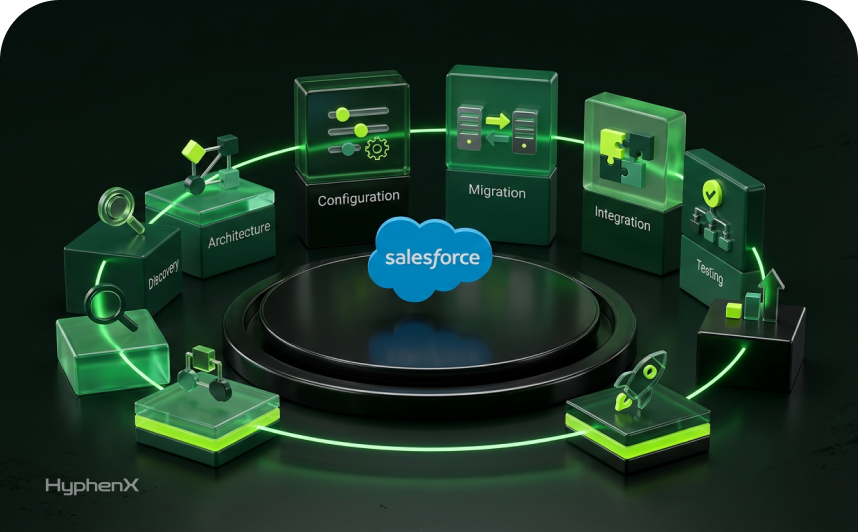

A Salesforce delivery team can have enough people on paper and still move slowly. The bottleneck often sits inside the operating system around the team: one architect reviews every design, QA enters too late, admins and developers work from different definitions of done, integration specialists are borrowed from another program, and release decisions wait for people who are spread across several initiatives. Add an augmented specialist without fixing those handoffs and the team gets larger without becoming faster.
The technical question is therefore broader than headcount. A high-performing Salesforce team needs clear ownership of architecture, configuration, code, testing, data, integrations, release management, and business acceptance. It also needs enough Salesforce Delivery Capacity at each stage of the work so that one scarce role does not become the queue for every sprint. Salesforce Staff Augmentation can add that capacity, but the performance gain depends on how the added people are placed inside the delivery model.
This guide focuses on that operating design. It explains how to diagnose a Salesforce Skills Gap, decide which roles should stay internal, add external specialists without creating a second team, establish common engineering standards, measure performance, and scale Salesforce Project Staffing as the roadmap changes. The objective is a Salesforce Delivery Team that behaves like one unit even when employment models, locations, and contract terms differ.
TL;DR
The concern: Salesforce teams often underperform because capacity is uneven rather than universally low. A program may have enough developers but too little architecture time, plenty of admins but no integration specialist, or strong build capacity with weak QA and release management. Adding people without correcting those constraints creates more work in progress, more review queues, and more coordination. The real Salesforce Skills Gap is usually visible at specific handoffs, not in the total team size.
The overview: A High-Performing Salesforce Team combines a permanent core with targeted Salesforce Team Augmentation where demand is temporary, specialized, or too urgent for a normal hiring cycle. Internal leaders should retain product ownership, business context, architecture authority, and final accountability. Augmented Salesforce Certified Professionals can add development, administration, QA, DevOps, integration, data, and cloud-specific expertise while working from the same backlog, release calendar, documentation standards, and quality controls as employees.
The approach: Map the work before adding people. Measure current Salesforce Delivery Capacity by role, identify the constraint, select the smallest staffing change that removes it, onboard external specialists into the same delivery system, and review outcomes through cycle time, blocked work, defects, release stability, and knowledge transfer. Salesforce Staff Augmentation Services work best when the organization treats staffing as part of delivery design rather than as a procurement shortcut.
Team Performance Starts with the Shape of the Work
The first mistake is asking, “How many Salesforce people do we need?” before asking what kind of work is flowing through the system. A mature Salesforce roadmap may contain configuration, Apex and Lightning Web Components, integrations, data migration, Experience Cloud, Service Cloud, CPQ, Data Cloud, Agentforce, analytics, security, support, and technical debt at the same time. Those work types draw on different skills and create different review paths.
The labor market makes that distinction more important. The World Economic Forum’s Future of Jobs Report 2025 found that 63% of employers identified skills gaps as a major barrier to transformation and that close to 40% of skills required on the job are expected to change by 2030. The implication for an Enterprise Salesforce Team is practical: the mix of skills needed next year may be materially different from the mix that built the org three years ago.
A useful capacity review separates the work into demand lanes. Routine administration may be steady. Integration demand may spike during ERP changes. QA load may rise before a large release. A Data Cloud specialist may be needed for twelve weeks, while a product owner is needed for years. Salesforce Resource Augmentation gives the team a way to respond to those uneven demand curves without treating every temporary requirement as a permanent role.
Build the Team Around Six Delivery Responsibilities
A Salesforce org may use ten job titles, but most delivery work can be mapped to six responsibilities. That makes it easier to see what should remain internal and where Salesforce Team Extension can help.
| Delivery responsibility | What must be owned | Typical roles | Common failure when coverage is weak |
| Product direction | Priority, scope, acceptance, business trade-offs | Product owner, CRM lead, business analyst | Backlog grows without a clear order |
| Architecture | Data model, integration patterns, security, technical boundaries | Solution architect, technical architect | Local fixes create long-term debt |
| Build and configuration | Flows, objects, Apex, LWC, cloud configuration | Admins, developers, consultants | Work piles up behind a few builders |
| Quality | Test strategy, regression, UAT readiness, defect prevention | QA engineer, automation engineer, BA | Releases look fast until production defects appear |
| Release and operations | CI/CD, environments, deployment, monitoring, support | DevOps, release manager, admin | Completed work waits days to reach users |
| Knowledge continuity | Documentation, handover, standards, decision history | Every role, led by delivery owner | External expertise leaves with the contract |
The table changes the staffing conversation. If architecture review is the bottleneck, adding three Salesforce developers will increase the queue. If testing is the constraint, Salesforce Developer Staff Augmentation alone can make throughput look worse because more code arrives at the same QA gate. If the team has strong builders but weak release discipline, adding a DevOps specialist may create more usable capacity than adding another developer.
This is also where Salesforce consulting services can be relevant before staffing begins. A short architecture or delivery review can identify whether the problem is missing capacity, poor process design, unresolved technical debt, or a combination of all three. Staff should be added after the constraint is understood.
Diagnose the Skill Gap from Blocked Work, not Résumés
A Salesforce Skills Gap is easiest to see in the backlog. Look for work that repeatedly waits for the same person, the same certification, or the same type of approval.
- Architecture queue: stories are ready, but designs wait for one senior reviewer.
- Integration queue: Salesforce work stops because API contracts, middleware changes, or source-system decisions are unresolved.
- Admin queue: small configuration items accumulate while developers work on larger builds.
- QA queue: completed stories sit in testing or production defects rise after every release.
- Release queue: teams finish work but deployment windows, change sets, or environment conflicts delay value.
- Data queue: migration, deduplication, identity resolution, or reporting work depends on skills the core team does not have.
- Cloud-specialist queue: CPQ, Marketing Cloud, Data Cloud, MuleSoft, or Agentforce work waits for a specialist who is needed only for part of the roadmap.
The strongest signal is age, not volume. A large backlog may simply reflect low-priority ideas. A smaller group of tickets that remain blocked for several sprints often shows the real constraint. Measure blocked days by skill category and compare them with cycle time. That gives Salesforce Project Staffing a concrete target.
Salesforce Staffing Services should then fill the specific gap. A six-month integration program may justify one senior integration engineer and a part-time architect. A support backlog may need an experienced admin. A release problem may need DevOps for ten weeks. Salesforce Resource Augmentation is most effective when each external role has a measurable reason to exist.
Decide What Stays Internal Before Extending the Team
A mixed staffing model performs better when several responsibilities remain clearly inside the enterprise. Product ownership should stay close to business leaders because priorities, policy, commercial trade-offs, and stakeholder relationships depend on internal context. Architecture authority also needs a durable owner, even when an external architect contributes heavily. Someone inside the organization must remain accountable for the decisions that will outlive a contract.
Business-process knowledge is another internal asset. An augmented consultant can improve requirements, but the organization still needs people who understand how sales, service, finance, operations, and compliance actually work. The same applies to data ownership. External specialists can design migration logic or integrations, while internal owners decide which system is authoritative and which data risks are acceptable.
Everything else can be more flexible. Salesforce Team Augmentation works well for temporary build demand, specialist clouds, QA, test automation, DevOps, integration work, data work, and surge support. A Salesforce Team Extension should add capability around a stable internal spine, not replace the spine itself.
Use a Staffing Mix Instead of One Hiring Model
A High-Performing Salesforce Team rarely consists entirely of employees or entirely of contractors. The stronger pattern is a portfolio of staffing choices matched to duration, scarcity, and accountability.
| Need pattern | Best staffing response | Why it fits |
| Permanent business ownership | Internal employee | Context and accountability compound over time |
| Permanent platform leadership | Internal employee with external advisory support | Keeps architecture and governance durable |
| 3–9 month specialist demand | Salesforce Staff Augmentation Services | Capacity can enter and leave with the work |
| 6–12 month build surge | Salesforce Team Extension or small pod | Adds throughput while the core team retains control |
| Short technical review | Consulting engagement | Advice is more important than daily backlog capacity |
| Steady operational ownership | Managed services | Service levels and continuity matter more than sprint-by-sprint control |
Recruiting speed is part of this decision. SHRM’s 2026 Recruiting Executives Benchmarking reports a median time-to-fill of 39 calendar days for nonexecutive positions and notes that more than two-thirds of organizations reported difficulty hiring for open roles. A Salesforce Project Staffing need that lasts eight or twelve weeks can be badly served by a recruiting cycle that consumes a large share of the project window before onboarding begins.
That does not mean Salesforce Staffing Services should replace permanent hiring. Use permanent roles where demand is durable and utilization will remain high. Use Salesforce Team Augmentation where timing, uncertainty, or specialization make permanent hiring inefficient.
Onboard Augmented Specialists as Engineers, Not Guests
External professionals often lose their first two weeks to preventable friction. Access is late. Environments are undocumented. Nobody explains the release path. The person is invited to stand-up but excluded from architecture meetings. Their first ticket looks simple until it touches an integration nobody mentioned.
A structured onboarding sequence protects both speed and quality:
- Day 0: Prepare access. Create named accounts, repository access, sandbox access, ticketing permissions, documentation access, and communication channels before the start date. Apply least privilege rather than broad production access.
- Days 1–2: Teach the system. Walk through the org architecture, key clouds, integration map, data ownership, deployment method, coding standards, test approach, security expectations, and current technical debt. Record the walkthroughs so future team members can reuse them.
- Days 3–5: Exercise the delivery path. Give the person a small real ticket that moves through analysis, build, review, test, and deployment. The ticket is less important than proving that the delivery system works end to end.
- Week 2: Increase scope. Move the specialist into normal sprint work only after the team confirms they can use the repository, testing process, release process, and escalation path without constant help.
- Week 3 onward: Review contribution and fit. Check output, review quality, communication, blocked time, and documentation. Salesforce Certified Professionals still need context. Certification verifies platform knowledge, not familiarity with your org.
For development-heavy roles, a dedicated developer model is designed around direct integration into the client’s delivery process. The same principle should apply regardless of provider: augmented people work on the same board, with the same standards, and through the same release path as internal staff.
One Backlog is the Boundary Between One Team and Two
Separate backlogs create separate priorities. Once employees and augmented resources pull from different boards, the organization has created two delivery systems whether it intended to or not.
Use one prioritization model. A story should not receive a different definition of done because a contractor built it. Architecture reviews should use the same templates. QA should apply the same regression standard. Releases should use the same source-control and approval path. Sprint reviews should show work by outcome or product area, not by employment type.
This matters because coordination consumes real time. Atlassian’s State of Teams 2025 research surveyed 12,000 knowledge workers and 200 executives and found that leaders and teams waste about 25% of their time searching for answers. A fragmented Salesforce Delivery Team adds another layer of searching: which board has the ticket, who owns the decision, where the design was documented, and whether the external team saw the latest change.
A single source of priority reduces that friction. Salesforce Delivery Capacity becomes easier to manage because leaders can see the entire queue and reassign work based on constraints rather than team boundaries.
Define Engineering Standards Before Measuring Velocity
Velocity rises quickly when a Salesforce Delivery Team adds people. That can be a false positive. More stories closed means little if defects, rollback frequency, rework, or review time rise at the same pace.
Set the technical standards first:
- Source control is mandatory for code and supported metadata.
- Pull requests require peer review and clear ownership.
- Apex changes meet agreed test and coverage expectations beyond the platform minimum.
- Flows, validation rules, and configuration changes receive review proportional to risk.
- Integration changes include error-handling and monitoring requirements.
- Every story has acceptance criteria and a test path before build begins.
- Release notes and operational impacts are documented before production deployment.
- Production hotfixes are reconciled back into source control immediately.
The 2025 DORA report from Google Cloud reinforces why leaders should look beyond a simple output metric. DORA’s research describes team archetypes that combine delivery performance, stability, and well-being, showing that basic delivery metrics tell leaders what is happening but do not fully explain why. That is a useful model for Salesforce: track speed and stability together.
Salesforce Developer Staff Augmentation should therefore be measured against team-level quality controls. The developer is part of the system. If the system rewards ticket volume without quality, augmentation will amplify that behavior.
Give Every Role a Visible Decision Boundary
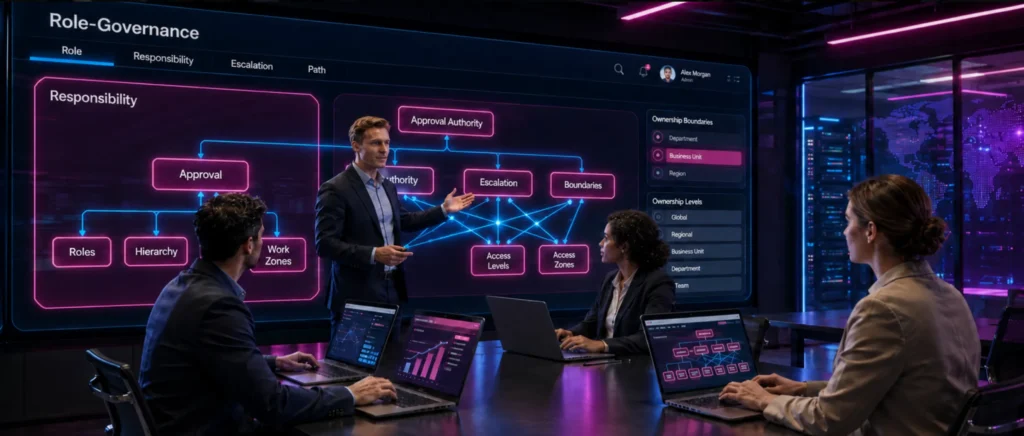
Ambiguous ownership creates delays that look like staffing problems. A business analyst thinks the architect owns a decision. The architect thinks the product owner must approve it. The developer waits. The sprint absorbs two days of silence.
A compact decision map prevents that pattern:
| Decision | Accountable role | Contributors | Escalation trigger |
| Backlog priority | Product owner | BA, business leads | Competing business priorities |
| Solution pattern | Architect | Developer, admin, integration lead | Cross-cloud or security impact |
| Build approach | Developer/admin lead | Architect, QA | Standard cannot be met |
| Test acceptance | QA lead + product owner | Developer, BA | Critical defect or unclear requirement |
| Release readiness | Release manager | QA, architect, product owner | Failed regression or deployment risk |
| Production incident | Support owner | Developer, admin, integration lead | Severity threshold breached |
The augmented person should know where they can decide independently and where approval is required. That reduces unnecessary meetings while preserving control. Salesforce Certified Professionals tend to perform better when the organization gives them a decision boundary rather than requiring approval for every small technical choice.
Treat Integrations as their Own Workstream
Integration work can quietly dominate a Salesforce roadmap. A team may appear fully staffed until a change touches ERP, finance, identity, data warehouse, marketing, or a custom platform. Then Salesforce waits on another system, another owner, and another release schedule.
A strong Salesforce Delivery Team gives integrations explicit ownership. Define the source of truth, API contract, error path, retry behavior, monitoring, data volume, security model, and deployment dependency before development starts. If those skills are missing internally, Salesforce Resource Augmentation can add an integration specialist without changing the permanent org chart.
This is where our Salesforce integration services at HyphenX can sit beside a staff model. Some programs need one augmented integration engineer under internal leadership. Others need a bounded integration workstream with stronger partner ownership. The engagement model should follow the accountability needed.
Make QA an Independent Capacity Line
One of the fastest ways to make a growing team slower is to add build capacity without adding test capacity. Developers finish more stories, QA becomes the queue, regression gets compressed, and production defects become the release feedback loop.
Track QA capacity separately from developer capacity. Measure stories entering test, median time in test, defect reopen rate, regression duration, automated coverage of critical paths, and defects discovered after release. If test time rises for three consecutive sprints while development time falls, the team has moved the bottleneck rather than removed it.
Salesforce Team Extension should therefore include QA when the work requires it. A small pod with two developers and one QA engineer may outperform three developers because the team can finish work rather than merely start more of it. Enterprise Salesforce Team design should focus on completed value, not individual utilization.
Protect Knowledge Transfer From Day One
The main operational risk in this staffing model is not that an external professional leaves. The model assumes people will eventually leave. The risk is that the team has not captured what they learned before that happens.
Build knowledge transfer into normal delivery:
- Architecture decisions go into a searchable decision log.
- Integration mappings and endpoint ownership stay in shared documentation.
- Complex Apex or automation includes design notes where future maintainers will look.
- Runbooks cover releases, recurring jobs, error handling, and operational checks.
- Internal team members pair on specialist work instead of receiving a handover only in the final week.
- Recorded walkthroughs are used for complex areas with high turnover risk.
- Every augmented specialist has a named internal counterpart for knowledge continuity.
This matters even more as AI-assisted development expands. GitLab’s 2026 AI Accountability research surveyed 1,528 developers and technology buyers; 79% agreed that individual developer productivity had improved with AI while overall software delivery had not sped up at the same rate. Faster individual output can increase pressure on review, governance, QA, and shared understanding. Documentation and review capacity must grow with code production.
A well-designed augmented team should leave the permanent team stronger. If Salesforce Certified Professionals deliver a complex build but the internal team cannot operate it afterward, the engagement has created dependency instead of capability.
Run the Team on a Simple Operating Rhythm
A strong mixed Salesforce team needs fewer status meetings and more predictable decision points. The following rhythm keeps distributed employees and augmented resources connected without filling the calendar.
Daily
Use a short stand-up or asynchronous update for active work, blockers, and decisions needed that day. Keep architecture discussions out of the status meeting unless a blocker requires immediate resolution.
Twice weekly
Hold a technical review window for designs, integrations, security questions, and complex build decisions. This prevents the architect from being interrupted continuously while giving developers a predictable route to decisions.
Weekly
Review Salesforce Delivery Capacity by role rather than sprint velocity alone. Look at blocked work, QA queues, architecture wait time, release readiness, and support interruptions. Adjust assignments before adding more people.
Per release
Run regression, deployment readiness, rollback checks, release notes, and operational ownership. The release process should not change based on whether the story came from an employee or a Salesforce Team Extension resource.
Monthly
Review staffing fit. Ask which skills are overused, underused, newly required, or no longer needed. Salesforce Project Staffing should change with the roadmap. Keeping the same external team indefinitely can turn a flexible model into fixed capacity by habit.
Measure the Team with a Balanced Scorecard
The scorecard should show whether more capacity is producing better delivery rather than simply more activity.
| Measure | What it reveals | Warning signal |
| Cycle time | Time from ready work to production | More people but no reduction in lead time |
| Blocked days | Constraint by role or dependency | Same specialist blocks multiple sprints |
| Defect escape rate | Production quality | Output rises while defects rise similarly |
| Rework rate | Requirement and build quality | Stories repeatedly reopen after review |
| Release frequency | Ability to convert work into value | Completed work waits for large release windows |
| Change failure / rollback | Release stability | Faster releases create operational disruption |
| Documentation completion | Knowledge continuity | Critical work closes without handover artifacts |
| Skill coverage | Resilience of the team | One person remains the only path for key work |
Do not score an augmented individual in isolation from the team. Salesforce Delivery Capacity is a system measure. If a developer completes twelve stories and six wait in QA, the delivery system did not complete twelve stories.
Salesforce Staffing Services should be reviewed against the reason they were purchased. If the goal was to remove an integration bottleneck, track integration wait time. If the goal was to increase release frequency, track time from ready-for-release to production. If the goal was to cover a specialist cloud, track that workstream’s blocked days and completion rate.
Scale Roles in Response to the Roadmap, Not the Org Chart
An Enterprise Salesforce Team changes shape over the life of a program. Early implementation may need heavier architecture and business analysis. Build phases need developers, admins, QA, and integration skills. Migration periods need data specialists. Stabilization shifts capacity toward support, optimization, release management, and adoption.
The Salesforce ecosystem itself continues to expand. IDC research published by Salesforce estimates that AI-powered Salesforce cloud solutions could contribute to a net gain of 11.6 million jobs between 2022 and 2028, including 4.7 million jobs directly within the Salesforce customer base. The forecast is commissioned ecosystem research, so it should not be treated as a neutral labor-market census, but it does illustrate how quickly role demand around Salesforce and AI-related capabilities is expected to change.
That changing skill mix is where Salesforce Resource Augmentation is useful. Add a Data Cloud specialist during identity-resolution work. Add a QA automation engineer before a major release train. Add a DevOps engineer while moving from manual deployments to CI/CD. Scale those roles down once the capability is embedded and internal ownership is stable.
For teams that move from project work into ongoing operational demand, our Salesforce managed services at HyphenX provides a different model in which ongoing service ownership can sit with a partner. The distinction matters: staff augmentation adds people under your direction; managed services transfers a defined operating responsibility.
Watch for Seven Signs the Model is Starting to ail
- External staff have a separate backlog. The team is splitting into vendor and employee lanes.
- The architect reviews everything. Architecture has become an approval bottleneck instead of a guardrail.
- QA begins after development finishes. Testing capacity is disconnected from sprint planning.
- Documentation happens at contract end. Knowledge transfer is being treated as an exit task.
- Every specialist stays indefinitely. Salesforce Team Augmentation has become permanent staffing without an explicit decision.
- Metrics focus on hours and tickets. Leaders cannot connect added capacity to cycle time, stability, or business delivery.
- Internal people stop learning the specialist areas. The Enterprise Salesforce Team is becoming dependent on external knowledge.
These are operating problems, not reasons to abandon the model. Correct them through backlog integration, clearer decision rights, role-specific capacity planning, paired work, and planned exits. Salesforce Staff Augmentation Services should remain reversible by design.
If day-to-day platform work is consuming the internal team while the roadmap continues to grow, Salesforce support services can also separate operational support from project staffing. That can protect build capacity when support tickets repeatedly interrupt the delivery team.
A 30-Day Team Integration Plan
A new augmented specialist should be fully incorporated into the team’s operating system within a month. The goal is not maximum output on day one. The goal is reliable contribution without creating hidden dependency.
- Days 1–5: Context and access. Complete security onboarding, architecture orientation, backlog walkthrough, release process, environments, coding standards, testing expectations, and documentation conventions. Pair the person with an internal counterpart.
- Days 6–10: Controlled contribution. Assign small production-relevant work. Observe review quality, communication, estimation, testing habits, and how quickly blockers are surfaced.
- Days 11–20: Normal sprint ownership. Move the specialist into normal work at the level expected for the role. Track blocked time and review cycles. Correct process issues immediately rather than letting a parallel way of working form.
- Days 21–30: Performance and knowledge review. Compare the original staffing reason with actual results. Has the bottleneck moved? Is the skill fit correct? Is documentation appearing during delivery? Are internal teammates gaining knowledge? Decide whether to expand, maintain, adjust, or begin planning the exit.
This keeps the team-extension model tied to a measurable need. It also gives managers an early point to correct a weak fit before months of coordination cost accumulate.
The Final Test: Can the Team Perform When One Person Leaves?

A resilient Salesforce team keeps important work moving when someone takes leave, changes jobs, rotates to another workstream, or finishes a contract. No single person should be the only path through a critical process. That resilience comes from shared standards, enough skill overlap, documented decisions, source-controlled changes, repeatable release processes, and clear ownership.
The augmentation model can improve that resilience when it fills specific capability gaps while transferring knowledge into the permanent team. Salesforce Developer Staff Augmentation can raise build capacity. Salesforce Staffing Services can add administration, QA, architecture, DevOps, integration, or cloud-specific skills. Salesforce Team Augmentation can support a larger delivery wave. The value comes from placing each role where it removes a real constraint.
The operating question is simple: after adding capacity, does the Salesforce Delivery Team complete useful work faster, with stable quality and less dependency on individual people? If the answer is yes, the staffing model is working. If velocity rises while queues, defects, and dependency rise with it, the team has added motion without improving delivery.
Frequently Asked Questions
What is the best use of this staffing model?
The strongest use case is a clear capacity or specialist gap inside a team that already has product ownership, backlog control, and delivery leadership. It works especially well for temporary build surges, niche platform skills, QA, integration, DevOps, and short-to-medium-term Salesforce Project Staffing needs.
How do Salesforce Staff Augmentation Services differ from managed services?
Salesforce Staff Augmentation Services add professionals who work under your direction and inside your delivery process. Managed services transfer ongoing responsibility for an agreed service area to the provider, usually with service levels and operational ownership.
Which roles can be added through Salesforce Team Augmentation?
Common roles include administrators, developers, business analysts, architects, QA engineers, DevOps specialists, integration engineers, data specialists, and consultants for specific Salesforce clouds. Salesforce Team Augmentation can involve one specialist or several roles, depending on the constraint.
When should we use Salesforce Developer Staff Augmentation?
Use Salesforce Developer Staff Augmentation when development capacity is genuinely the limiting factor and architecture, QA, requirements, and release processes can absorb the added output. If another role is the bottleneck, adding developers may only create a larger queue downstream.
What should an Enterprise Salesforce Team keep internal?
An Enterprise Salesforce Team should usually retain product ownership, core business-process knowledge, durable architecture accountability, data ownership, and final governance decisions. External specialists can contribute to all of these areas, but long-term accountability should remain clear inside the organization.
How do we assess Salesforce Certified Professionals beyond certifications?
Salesforce Certified Professionals should be assessed on relevant delivery history, problem-solving, communication, code or configuration quality, documentation habits, and experience with your type of org. Certification verifies a knowledge baseline. It does not prove fit for a specific operating environment.
What is Salesforce Delivery Capacity?
Salesforce Delivery Capacity is the amount of work the complete delivery system can finish reliably, considering architecture, build, testing, integration, release, and support constraints. It is more useful than developer headcount because one under-resourced stage can limit the entire team.
How should Salesforce Project Staffing change during a program?
Salesforce Project Staffing should follow the work. Architecture and business analysis may be heavier early, build and QA heavier during implementation, data expertise heavier during migration, and support or optimization heavier after launch. Review the mix monthly rather than assuming one team shape will fit the full roadmap.
What is the difference between Salesforce Team Extension and outsourcing?
With Salesforce Team Extension, external professionals join your team and work under your priorities, standards, and management. In outsourcing, a provider usually owns a defined scope or outcome and manages the delivery approach more independently.
How do we know whether a Salesforce Skills Gap is real?
Look at blocked work. If the same role, specialty, or technical decision repeatedly delays stories across multiple sprints, the Salesforce Skills Gap is measurable. Use blocked days and cycle time by work type before opening a staffing request.