
Salesforce can support sales, service, marketing, operations, automation, reporting, and AI-ready customer experiences, but only when it is built around the way a business actually works. A license alone will not fix scattered data, weak adoption, unclear workflows, disconnected systems, or reports that leaders cannot trust. Real value comes from the right strategy, clean configuration, strong integrations, and continuous CRM optimization.
This Salesforce Consulting Services Guide explains what Salesforce consulting services include, when expert support becomes necessary, and how the right Salesforce consulting partner can improve long-term CRM performance. Whether you are planning a first-time Salesforce implementation or trying to repair an existing setup, this guide will help you make a clearer decision. Moreover, we works with businesses that need structured Salesforce guidance without turning CRM into another complicated internal burden.
What Are Salesforce Consulting Services?
Salesforce consulting services help businesses turn Salesforce into a clearer, more usable, and better-connected CRM system. Before exploring specific services, it is important to understand what consulting actually means, how it goes beyond setup, and which business situations usually call for expert Salesforce guidance.
Salesforce Consulting Services Defined
Salesforce consulting services help businesses plan, build, customize, connect, manage, and improve Salesforce around real business operations. A Salesforce consultant studies how your sales, service, marketing, revenue, and operations teams work before recommending the right CRM structure. That includes reviewing workflows, data quality, reporting gaps, automation needs, user roles, integrations, and future growth plans.
A strong Salesforce consulting service is not limited to initial setup. It supports the complete CRM lifecycle, from strategy and implementation to Salesforce customization services, Salesforce integration consulting, support, maintenance, optimization, and AI readiness. For growing businesses, this guidance helps Salesforce become a practical operating system instead of just another software tool.
How Salesforce Consulting Goes Beyond Basic CRM Setup
Basic CRM setup usually focuses on configuration. Salesforce consulting goes deeper by asking whether the platform actually supports the way the business sells, serves, reports, and scales. Process mapping is a major part of that work. A Salesforce consultant looks at how leads enter the pipeline, how opportunities move forward, how service cases are assigned, how marketing activity connects to customer records, and where manual work slows teams down. Without this clarity, even a clean technical setup can feel awkward for users.
Data quality also decides how much value Salesforce can deliver. Duplicate accounts, incomplete fields, inconsistent naming, and disconnected customer records can weaken dashboards, automation, forecasting, and AI-powered CRM initiatives. Consultants help create cleaner data structures, validation rules, governance practices, and migration plans that improve trust in the system.
Adoption matters just as much. A well-built Salesforce org will still underperform if teams avoid using it or do not understand why it matters. Good consulting connects system design with training, usability, accountability, and continuous CRM optimization.
Who Usually Needs Salesforce Consulting Support?
Salesforce consulting support is useful for both first-time users and businesses trying to improve an existing Salesforce setup. It is especially valuable for:
- Businesses planning a new Salesforce implementation
- Companies moving from HubSpot, Dynamics, Zoho, or legacy CRM systems
- Teams struggling with poor adoption, messy data, or unreliable reports
- Organizations expanding into Sales Cloud, Service Cloud, Marketing Cloud, Revenue Cloud, or Experience Cloud
- Businesses with complex workflows, integrations, or approval processes
- Companies preparing for Salesforce AI, Agentforce, Data Cloud, or Data 360
- Teams without dedicated Salesforce admin, developer, or CRM strategy resources in-house
What Do Salesforce Consulting Services Include?
Salesforce consulting services cover much more than CRM setup. They help businesses plan, implement, customize, connect, manage, and improve Salesforce around real operational requirements. A structured consulting approach reduces long-term CRM problems while making the platform more scalable, usable, and aligned with business growth.
Salesforce Strategy and CRM Roadmap Consulting
Before configuration begins, businesses need clarity on goals, workflows, reporting needs, automation priorities, and operational gaps. Salesforce strategy consulting focuses on understanding how teams currently work and where Salesforce can improve visibility, efficiency, and customer management. CRM roadmap consulting also helps define implementation priorities, rollout phases, integrations, and future scalability plans. This prevents rushed development, disconnected automation, and technical debt that can make Salesforce difficult to manage later.
Salesforce Implementation and Configuration
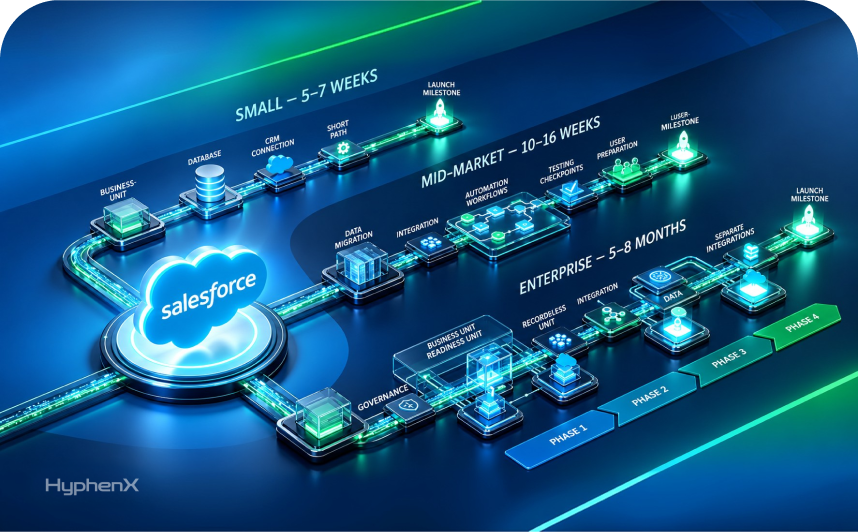
Salesforce implementation consulting focuses on setting up the platform around business requirements rather than generic templates. This includes configuring objects, fields, page layouts, user roles, permission structures, automation flows, approval processes, dashboards, and reporting environments. A structured implementation approach also defines rollout timelines, testing plans, and phased launches to reduce operational disruption. Many businesses work with consulting partners like HyphenX to avoid overbuilding Salesforce too early in the implementation cycle.
Salesforce Customization and Development
Some businesses require workflows that standard Salesforce features cannot fully support. Salesforce customization services help build tailored experiences through custom objects, Lightning components, advanced flow logic, approval structures, and role-specific dashboards. Good customization should simplify operations, not complicate them. Experienced Salesforce consultants know when custom development is necessary and when standard Salesforce functionality can achieve the same result with lower maintenance risk.
Salesforce Integration Consulting
Most organizations use multiple business systems alongside Salesforce, including ERP software, finance tools, support platforms, marketing automation systems, and internal databases. Without proper integration, teams often work with disconnected customer data across different platforms. Salesforce integration consulting focuses on creating reliable connections between systems so information moves accurately between teams. This improves reporting visibility, reduces duplicate work, and gives users a more complete customer view inside Salesforce.
Salesforce Data Migration and Data Quality Consulting
Data migration consulting involves more than transferring records from one platform to another. Consultants review existing data quality, map fields correctly, remove duplicates, validate structures, and plan migration sequencing before records move into Salesforce. Poor migration planning usually creates long-term CRM issues, including inaccurate reporting, broken automation, and low trust in the platform. A structured migration approach helps businesses maintain cleaner and more reliable Salesforce data from the beginning.
Salesforce Support, Maintenance, and Optimization
Salesforce consulting often continues after implementation through ongoing support and optimization services. Businesses regularly need help with troubleshooting, reporting updates, user requests, release management, automation changes, and administrative maintenance. Optimization consulting focuses on improving Salesforce as business requirements evolve. This may include simplifying automation logic, redesigning page layouts, cleaning outdated fields, improving dashboards, or restructuring workflows that no longer support current operations effectively.
Salesforce AI, Agentforce, Data Cloud, and Data 360 Readiness
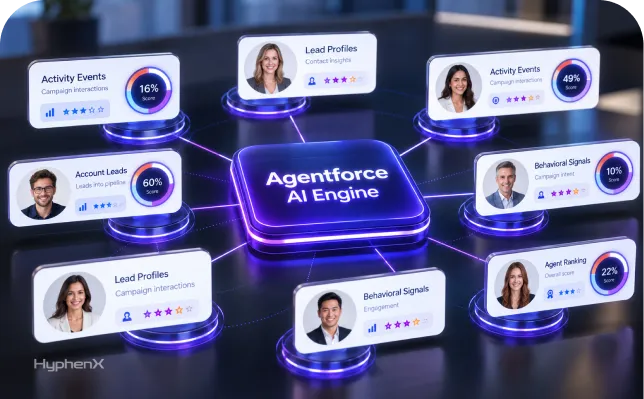
Modern Salesforce consulting increasingly focuses on AI readiness and connected customer data. Agentforce, Data Cloud, and Data 360 rely on clean records, structured automation, connected systems, and strong governance to deliver meaningful CRM intelligence. Consultants help businesses evaluate whether their Salesforce environment is prepared for AI-powered workflows, predictive insights, and unified customer experiences. As Salesforce continues expanding its AI ecosystem in 2026, many businesses are reassessing CRM structure, integrations, and data quality to support future growth properly..
Salesforce Consulting Services at a Glance
| Consulting Area | What It Covers | Business Value |
|---|---|---|
| Strategy and roadmap | Process review, CRM planning, priorities | Clearer Salesforce direction |
| Implementation | Setup, configuration, roles, workflows | Faster and cleaner launch |
| Customization | Tailored objects, flows, dashboards | Better fit for business workflows |
| Integration | ERP, marketing, finance, support systems | Connected data across teams |
| Data migration | Cleansing, mapping, deduplication | More reliable CRM records |
| Support and optimization | Fixes, improvements, release updates | Better long-term performance |
| AI and Data readiness | Data quality, governance, Agentforce planning | Stronger foundation for AI CRM |
Why Businesses Need Salesforce Consulting Services

As Salesforce environments grow, businesses often face challenges related to data quality, reporting accuracy, automation complexity, integrations, and user adoption. Salesforce consulting services help organizations manage these challenges with clearer CRM strategy, stronger governance, and better operational alignment across teams.
Salesforce Becomes Complex as the Business Grows
A Salesforce setup that works for a small team may become difficult to manage as the business expands. More users, departments, workflows, reports, and automation requirements can quickly increase CRM complexity and reduce system flexibility. Growth also brings additional Salesforce products and integrations. Expanding into Service Cloud, Marketing Cloud, Revenue Cloud, Data Cloud, or AI-powered workflows requires planning and coordination that many internal teams struggle to manage without dedicated Salesforce consulting expertise.
Poor Planning Can Create Long-Term CRM Problems
Many Salesforce issues begin with rushed implementation decisions and unclear CRM planning. Problems such as duplicate records, broken automation, inaccurate dashboards, inconsistent permissions, and disconnected integrations usually appear gradually as the system grows. These challenges affect more than technology. Poor CRM structure impacts forecasting accuracy, customer service visibility, marketing segmentation, operational reporting, and leadership decision-making. Without proper governance, Salesforce can become harder to trust and maintain over time.
Consultants Connect Salesforce With Real Business Outcomes
A Salesforce consultant helps connect CRM decisions with measurable business outcomes. Instead of focusing only on technical setup, consulting aligns Salesforce with revenue visibility, service efficiency, reporting clarity, automation improvement, and customer lifecycle management. This business-first approach helps teams avoid common situations where Salesforce works technically but still fails to improve productivity, collaboration, or operational performance across departments.
When Hiring a Salesforce Consultant Makes More Sense Than Handling Everything Internally
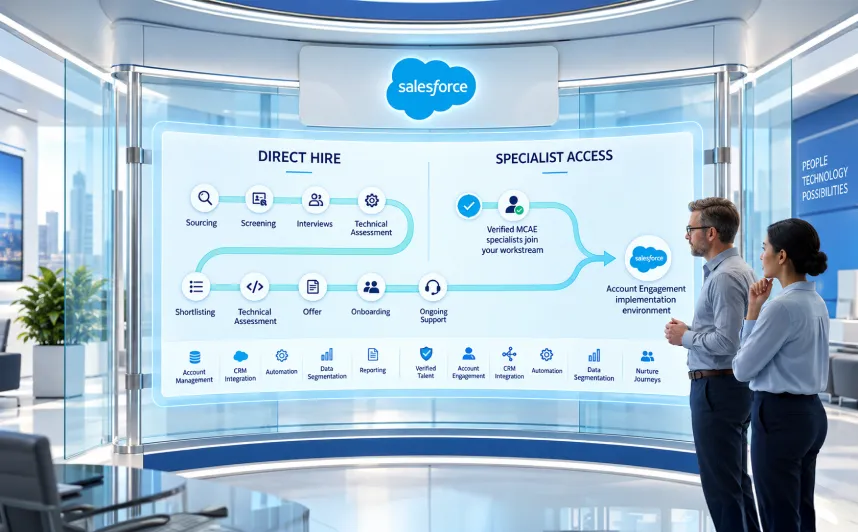
Internal Salesforce management works best when businesses have experienced admins, developers, architects, and CRM leaders with enough bandwidth to support ongoing improvements. Many growing companies do not have those resources available internally. In these situations, working with a Hire Salesforce consultant provider like HyphenX can help businesses bring structure, scalability, implementation guidance, optimization support, and long-term CRM accountability under a more organized consulting approach.
| Consulting Area | What It Covers | Business Value |
|---|---|---|
| Strategy and roadmap | Process review, CRM planning, priorities | Clearer Salesforce direction |
| Implementation | Setup, configuration, roles, workflows | Faster and cleaner launch |
| Customization | Tailored objects, flows, dashboards | Better fit for business workflows |
| Integration | ERP, marketing, finance, support systems | Connected data across teams |
| Data migration | Cleansing, mapping, deduplication | More reliable CRM records |
| Support and optimization | Fixes, improvements, release updates | Better long-term performance |
| AI and Data readiness | Data quality, governance, Agentforce planning | Stronger foundation for AI CRM |
Key Benefits of Working With a Salesforce Consulting Partner
Salesforce consulting services help businesses improve CRM performance beyond basic implementation. The right consulting approach supports cleaner architecture, stronger adoption, better reporting, improved automation, and long-term scalability while reducing the operational problems that often grow inside unmanaged Salesforce environments.
Better CRM Architecture From the Start
Early Salesforce decisions affect how easy the platform will be to manage later. Poor object structures, unnecessary customization, and weak permission planning often create technical debt that becomes expensive to fix as the business grows. A Salesforce consulting partner helps design cleaner architecture from the beginning. This includes building the right data model, automation structure, reporting framework, security controls, and workflow logic to support long-term CRM stability and flexibility.
Higher User Adoption Across Teams
Low adoption is one of the most common Salesforce challenges businesses face. Teams often avoid using the platform when workflows feel complicated, data entry takes too long, or the system does not match real operational processes. Salesforce consultants improve adoption by simplifying user experiences, reducing unnecessary steps, improving page layouts, and aligning Salesforce with how teams actually work. Training and change management also help users understand the value behind the CRM process.
Cleaner Data and More Reliable Reporting
Reporting quality depends entirely on data quality. Duplicate records, inconsistent fields, missing ownership, and disconnected systems can quickly reduce trust in dashboards and forecasting visibility. Salesforce consulting helps businesses improve validation rules, governance standards, duplicate management, reporting structures, and CRM data consistency. Cleaner Salesforce data supports stronger reporting accuracy, better automation performance, and more reliable operational decisions.
Better Automation Without Creating Process Confusion
Automation should simplify work, not create confusion. Poorly designed flows, approval paths, or alerts can frustrate users and make Salesforce harder to trust and maintain over time. Consultants help businesses design automation that reduces repetitive work while keeping workflows manageable, scalable, and easier to troubleshoot as business requirements evolve.
Stronger Integration Across Sales, Service, Marketing, and Operations
Salesforce becomes more valuable when connected with marketing platforms, ERP systems, support software, finance tools, and operational systems. Integration consulting helps teams work with more complete and synchronized customer information across departments.
| Consulting Benefit | Business Impact |
|---|---|
| Better planning | Reduces rebuilds and implementation risk |
| Cleaner data | Improves reporting accuracy and visibility |
| Higher adoption | Increases consistent CRM usage |
| Stronger automation | Reduces manual operational work |
| Better integration | Creates connected customer visibility |
| Ongoing optimization | Keeps Salesforce aligned with business growth |
| AI readiness | Supports Agentforce, Data Cloud, and AI CRM initiatives |
Salesforce Consulting vs Implementation vs Support: What Is the Difference?
Many businesses use these terms together, but each one solves a different Salesforce need. Understanding the difference helps you choose the right type of support instead of paying for the wrong service at the wrong stage.
When You Need Salesforce Consulting
Salesforce consulting is useful when the business needs strategic direction before making CRM decisions. It helps with process alignment, architecture planning, roadmap creation, org cleanup, AI readiness, and deciding how Salesforce should support sales, service, marketing, and operations.
When You Need Salesforce Implementation
Salesforce implementation is the hands-on setup and launch process. It includes configuring objects, fields, roles, permissions, automation, dashboards, reports, integrations, and user access for a new Salesforce environment or a new Salesforce Cloud rollout.
When You Need Salesforce Support and Maintenance
Salesforce support and maintenance help after the platform is live. This includes fixing issues, updating reports, adjusting automation, managing users, improving permissions, handling admin tasks, and keeping the org ready for Salesforce release changes.
When Salesforce Managed Services Make Sense
Salesforce managed services are best when a business needs ongoing CRM ownership, not just occasional fixes. This model supports continuous optimization, governance, reporting improvements, automation updates, admin coverage, and long-term Salesforce health.
Salesforce Service Types Compared
| Service Type | Main Focus | Best For |
|---|---|---|
| Salesforce Consulting | Strategy, roadmap, process alignment | Businesses needing direction before or after setup |
| Salesforce Implementation | Configuration, launch, cloud setup | New Salesforce users or new Cloud rollouts |
| Salesforce Customization | Tailored features and workflows | Businesses with unique processes |
| Salesforce Integration | Connecting systems and data | Companies using multiple business platforms |
| Salesforce Support | Fixes, admin help, release updates | Existing Salesforce users needing regular help |
| Salesforce Managed Services | Continuous improvement | Growing teams needing long-term CRM support |
How to Choose the Right Salesforce Consulting Partner

Choosing the right Salesforce consulting partner affects how well your CRM is planned, built, adopted, and improved after launch. The right partner should understand your business model first, then recommend Salesforce decisions that support real workflows and long-term growth.
Look for Business Process Understanding, Not Just Technical Skills
Technical Salesforce skills matter, but they are not enough. A strong Salesforce consultant should understand how your teams sell, serve customers, manage data, track performance, and handle daily operations before suggesting configuration or customization.
Check Experience With Implementation, Integration, Data, and Optimization
Salesforce works as a connected CRM ecosystem. Look for a partner with experience across:
- Salesforce implementation services
- Salesforce customization services
- Salesforce integration consulting
- Salesforce data migration
- Salesforce support and maintenance
- Salesforce CRM optimization
This reduces gaps between setup, adoption, reporting, and long-term platform performance.
Ask How They Handle Data Quality and Governance
Data quality should never be treated as a side task. A capable consulting partner should explain how they manage field structure, duplicate control, migration planning, validation rules, permissions, reporting logic, and long-term CRM governance.
Review Their Training and Adoption Approach
Salesforce only creates value when teams use it correctly. Ask how the partner handles user training, change management, role-based workflows, adoption tracking, and post-launch support. Good adoption planning starts before go-live, not after problems appear.
Make Sure They Can Support AI, Agentforce, and Data Readiness
Modern Salesforce consulting should also prepare businesses for AI CRM. Agentforce, Data Cloud, Data 360, and Einstein features need clean data, connected systems, structured automation, and clear governance to work effectively.
Choose a Partner That Can Support Long-Term Improvement
Salesforce is not a one-time setup. Businesses looking to hire a Salesforce consultant should choose a partner that supports planning, implementation, optimization, and ongoing guidance. HyphenX can fit this need for companies that want consistent Salesforce expertise across the full CRM journey.
Conclusion
Salesforce consulting services help businesses turn Salesforce into a cleaner, more connected, and more useful CRM system. The right partner brings strategy, process understanding, data planning, integration expertise, adoption support, and long-term optimization together. Whether the goal is implementation, migration, automation, reporting improvement, or AI readiness through Agentforce and Data Cloud, consulting quality directly affects CRM value. For businesses looking to hire a Salesforce consultant, HyphenX can support the full Salesforce journey with practical guidance built around real business needs.