
No, it does not. As of September 2026, Agentforce does not calculate, adjust or override lead scoring in Marketing Cloud Account Engagement. Scoring stays exactly where it has always been: your rules-based Prospect Score, your grading profiles, and Einstein Behavior Scoring if you have it switched on. We’re being this blunt because there’s a lot of published content suggesting otherwise. You’ll find articles claiming that AI agents dynamically adjust scores in account engagement based on real-time engagement. We went looking for the documentation behind that claim and could not find any.
What does exist is real and useful, and it’s worth understanding properly. Salesforce shipped six Account Engagement actions for Agentforce, and every one of them is a read or write action on prospects and lists. None of them touch scoring logic.
This article walks through what actually ships today, how Marketing Cloud Account Engagement lead scoring genuinely works, where the confusion comes from, and what your marketing operations team should be preparing for. We’ve labelled every capability as current, announced or speculative so you can tell them apart.
TL;DR
Six Actions, Zero Scoring Changes
Salesforce ships six documented Agentforce actions for Marketing Cloud Account Engagement. They read prospects, update records, and manage list membership. Your Prospect Score, grading profiles and Einstein Behavior Scoring stay exactly as configured, because no shipped action modifies scoring logic in any way.
Why the Answers You Find Online Contradict Each Other
Search this topic and you’ll meet confident claims that AI agents adjust Pardot scores automatically. Three things cause that: confusing Salesforce Lead records with Account Engagement prospects, reading roadmap vision as shipped product, and stretching Agentforce Campaign Creation well beyond what it covers.
Fix the Scoring Model, Then Add the Agent
Every capability here is labelled current, announced or speculative, so you can plan against facts. The practical priority stays unchanged: validate scoring against real conversions, clean prospect data, secure your sync, and settle agent governance before anything touches your production marketing database.
What Agentforce Actually Does With Account Engagement Today
Six Actions, Zero Scoring Changes
Salesforce publishes a Help article titled Use Account Engagement Actions in Agentforce. It describes creating a dedicated Account Engagement Lead Management Agent, letting users view and update prospect records and add them to nurture campaigns from anywhere in Salesforce.
The article lists the exact Apex classes an admin needs access to in order to deploy these actions. That list tells you precisely what the agent can do.
- getB2BEngagementStudioProgram
- getB2BMarketingListMemberships
- getB2BMarketingLists
- signUpProspectB2BMarketingLists
- upsertB2BProspect
- viewB2BProspect
Read those again. Retrieve an Engagement Studio programme. Retrieve list memberships. Retrieve lists. Sign a prospect up to lists. Create or update a prospect. View a prospect.
There is no scoring action. No recalculation action. Nothing that modifies a grading profile or adjusts a scoring category. The agent can read what your scoring produced and it can update prospect fields, but the scoring engine itself is untouched.
The distinction that matters: An agent that can read a score and act on it is a workflow tool. An agent that recalculates the score is a scoring engine. Salesforce has shipped the first and not the second.
What You Need in Place to Use Them
The requirements are worth knowing before anyone promises your team an agent by Friday.
The actions are available across all Account Engagement editions, provided your Salesforce org is Enterprise, Performance or Unlimited. You need the latest Account Engagement AppExchange package installed, Agentforce enabled, and an External Client App with a Named Credential created.
Deployment happens from Account Engagement Settings under Agentforce Actions for Account Engagement. After deploying, you add the actions to an Agentforce Topic in Salesforce Setup.
Two practical details from the documentation that catch people out. An action can take up to an hour to deploy, and once deployed it cannot be deleted. Every time an agent uses an action, standard credits are consumed, so agent usage carries a running cost tied to your credit balance.
What This Looks Like in Practice
Abstract action names are hard to picture, so here’s a realistic scenario from a B2B sales floor.
A rep is about to call a prospect who came through last week’s webinar. Normally that means opening the Lead record, switching to the Account Engagement Lightning app, checking engagement history, looking at which emails were opened, and deciding whether the prospect is warm enough to justify a call.
With a Lead Management Agent configured, the rep asks the agent for the prospect’s recent engagement and current score. The agent invokes viewB2BProspect, retrieves the record including the score your model produced, and returns it in the conversation. The rep asks it to add the prospect to the enterprise nurture track, and the agent calls getB2BMarketingLists to find the right list, then signUpProspectB2BMarketingLists to enrol them.
Notice what happened and what did not. The agent read a score. It did not calculate one, adjust one, or decide the scoring model was wrong. Your scoring rules produced the number, and the agent surfaced it and acted on your instruction.
That is a genuine productivity gain, and it is worth building. It is also a narrower thing than the phrase agentic lead qualification tends to suggest, which is exactly why we think teams should understand the boundary before planning around it.
What You Can Instruct It to Do, and What You Cannot
|
Possible today with the six actions |
Not possible today |
|
Retrieve a prospect record including score and grade |
Recalculate the Prospect Score using different logic |
|
Update prospect fields conversationally |
Change scoring category point values |
|
Look up which lists a prospect belongs to |
Modify a grading profile |
|
Add a prospect to one or more marketing lists |
Override an Einstein Behavior Score |
|
Create a prospect that does not yet exist |
Generate an independent qualification score inside Account Engagement |
|
Retrieve details of an Engagement Studio programme |
Build or edit an Engagement Studio programme |
|
Combine the above into a multi-step task |
Act on prospect data the connector has not synced |
The right-hand column is not a criticism. It is a scope boundary, and knowing where it sits is what separates a plan that works from one that assumes a feature into existence.
Why the Answers You Find Online Contradict Each Other
Search this topic and you’ll meet confident claims that AI agents adjust Pardot scores automatically. Three things cause that: confusing Salesforce Lead records with Account Engagement prospects, reading roadmap vision as shipped product, and stretching Agentforce Campaign Creation well beyond what it covers.
Fix the Scoring Model, Then Add the Agent
Every capability here is labelled current, announced or speculative, so you can plan against facts. The practical priority stays unchanged: validate scoring against real conversions, clean prospect data, secure your sync, and settle agent governance before anything touches your production marketing database.
How Lead Scoring in Marketing Cloud Account Engagement Actually Works
To understand what Agentforce does and does not change, you need the baseline clear. MCAE has more scoring mechanisms than most teams realise, and they do different jobs.
Prospect Score, the Rules-Based Original
This is classic Pardot scoring and it’s still the default. You assign point values to actions. A form submission earns 50 points, an email click earns 3, a pricing page visit earns whatever you decide. Points accumulate, and the total is the prospect’s score.
It measures engagement, meaning how interested someone appears to be. It is entirely deterministic, which is its strength and its weakness. You know exactly why a score is what it is, and it never adapts on its own.
Scoring categories let you run separate scores for different product lines, so a prospect can score highly on one offering and barely register on another.
Grading, Which Measures Something Different
Grading is the other half and teams routinely conflate the two. Where scoring measures engagement, grading measures fit against your ideal customer profile using a grading profile built on criteria like industry, company size, job title and location.
A prospect graded A with a score of 10 is exactly the right kind of company doing nothing. A prospect graded D with a score of 200 is highly engaged and wrong for you. Sales needs both numbers to prioritise properly.
Einstein Behavior Scoring, the Predictive Layer
Einstein Behavior Scoring works differently again. According to Salesforce Trailhead, Einstein uses Engagement History data to determine which prospects are most likely to become customers, analysing behavioural signals and recency of engagement to assign a score from 0 to 100.
The important difference is that prospects are ranked against each other rather than scored on an absolute scale. Einstein also surfaces Top Positive and Top Negative Predictive Factors, telling you which behaviours moved a particular score in either direction.
It also decays. Where a rules-based Prospect Score keeps whatever points it accumulated regardless of how long ago, behaviour scoring responds to prospects going quiet. That solves a genuine problem with the classic model, where somebody who downloaded three whitepapers in 2023 still looks hot today.
Einstein Lead Scoring, and Why It Causes Confusion
Here’s the one that generates most of the misunderstanding in this whole topic.
Einstein Lead Scoring is not unique to Account Engagement. Organisations with Sales Cloud Einstein have access to it independently, and it operates on Salesforce Lead records rather than Account Engagement Prospect records.
So you can have Einstein Lead Scoring running on Leads in your CRM and Account Engagement Prospect Score running on Prospects in your marketing database, describing overlapping but different populations with different logic.
Keep that separation in mind, because it explains most of the confusion about what Agentforce changes.
Four Mechanisms, Side by Side
Here’s how the pieces compare, including where Agentforce sits relative to them. This is the table we draw on a whiteboard in most discovery sessions about Agentforce and Marketing Cloud Account Engagement lead scoring.
|
|
Prospect Score |
Grading |
Einstein Behavior Scoring |
Agentforce |
|
What it measures |
Engagement through accumulated points |
Fit against your ideal customer profile |
Likelihood of conversion, ranked against other prospects |
Nothing. It acts on data rather than producing a score |
|
How it works |
Rules you configure manually |
Grading profile criteria you define |
Machine learning over Engagement History data |
Reasoning over available actions |
|
Where it lives |
Account Engagement Prospect record |
Account Engagement Prospect record |
Account Engagement Prospect record |
Salesforce, calling Account Engagement through actions |
|
Scale |
Unbounded points total |
Letter grade A to F |
0 to 100, relative |
Not applicable |
|
Adapts over time |
No |
No |
Yes, including decay when engagement stops |
Depends entirely on your instructions |
|
Explains itself |
Fully, since you wrote the rules |
Fully |
Partly, through Top Positive and Negative Predictive Factors |
Through agent reasoning logs, if you configure them |
|
Changed by Agentforce |
No |
No |
No |
Not applicable |
The bottom row is the answer to the question in this article’s title. Whatever else Agentforce does for your marketing operation, it leaves all three scoring mechanisms in Marketing Cloud Account Engagement exactly as you configured them.
Where the Agentforce and Pardot Scoring Confusion Comes From
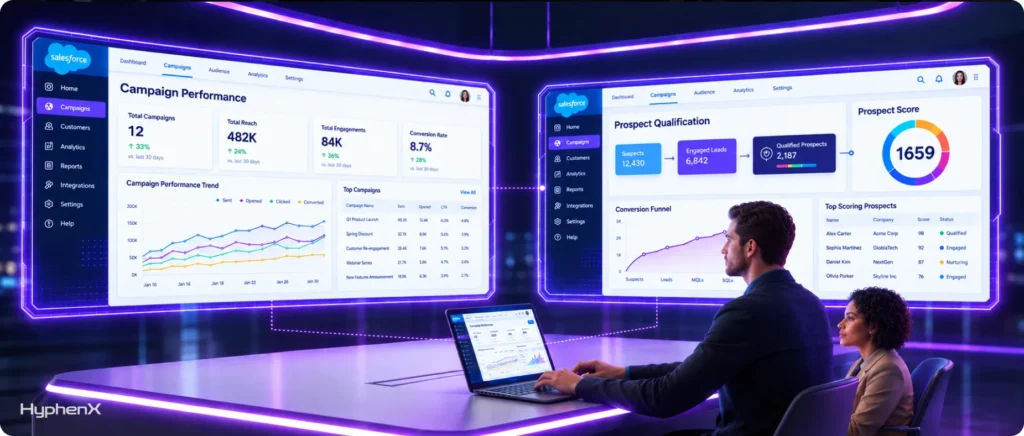
Search for whether Agentforce affects Pardot scoring and you’ll find confident claims that AI agents dynamically adjust scores in Account Engagement. We think three things produce that impression, and none of them are quite what they appear.
Confusing Salesforce Lead Scoring With MCAE Prospect Scoring
Agentforce genuinely can work with lead prioritisation on the Salesforce CRM side, alongside Einstein Lead Scoring on Lead records. That is a real capability and worth exploring.
It is not the same thing as changing your Account Engagement Prospect Score. Different object, different scoring engine, different database. An article describing the first that gets read as describing the second creates exactly this confusion.
Reading Roadmap Vision as Shipped Product
Salesforce talks a great deal about agentic marketing, and the direction of travel is not subtle. Announcements about where a product is heading get summarised as descriptions of what it does, particularly by content produced quickly after a keynote.
Agentforce Campaign Creation Being Read Too Broadly
The official Account Engagement pricing page lists Agentforce Campaign Creation as included across all four editions, and Account Engagement+ gives customers access to Marketing Cloud Next capabilities through permission set licences. Both are real.
Campaign creation is generative work, meaning an agent helping you build a campaign. It sits some distance from an agent recalculating how prospects are qualified.
Current, Announced and Speculative: An Honest Split
Here’s our reading of where each capability sits across Agentforce, the Atlas Reasoning Engine and Marketing Cloud Account Engagement lead scoring. We’ve been deliberately conservative, and where we could not verify something in Salesforce documentation we’ve said so rather than filling the gap.
|
Capability |
Status |
What We Can Verify |
|
Six Account Engagement actions in Agentforce |
Current |
Documented in Salesforce Help with named Apex classes. Read prospects, update prospects, manage list membership, retrieve Engagement Studio programmes |
|
Account Engagement Lead Management Agent |
Current |
Documented. A custom agent built from those six actions plus your own topics |
|
Agentforce Campaign Creation |
Current |
Listed on the official pricing page across all Account Engagement editions |
|
Einstein Behavior Scoring |
Current |
Long-established, documented, 0 to 100 relative ranking with predictive factors |
|
Einstein Lead Scoring |
Current |
Documented, operates on Salesforce Lead records |
|
Account Engagement data flowing into Data 360 |
Current |
Salesforce documents ingesting prospect, asset and activity data from Account Engagement into Data 360 |
|
Agentforce reading a prospect score to decide an action |
Current, with configuration |
The viewB2BProspect action can retrieve prospect data. What the agent then does with it is your topic and instruction design |
|
Agentforce recalculating MCAE Prospect Score |
Not found in documentation |
No action, setting or documented capability that modifies scoring logic |
|
Agentforce overriding grading profiles |
Not found in documentation |
Grading remains profile-driven and manually configured |
|
Agents autonomously requalifying prospects end to end |
Speculative |
Consistent with the agentic direction Salesforce describes, without a shipped capability we could verify |
|
Unified agent-driven scoring across CRM and MCAE |
Speculative |
A reasonable expectation given Data 360 convergence, and not something to plan a 2026 budget around |
If Salesforce ships something that moves a row up this table, we’ll update the article. Until then we’d rather under-promise than have a client build an architecture around a capability that turns out not to exist.
What the Atlas Reasoning Engine Does, and What It Doesn't
Any serious discussion of Agentforce eventually reaches the Atlas Reasoning Engine, so it’s worth being precise about its role here. Atlas is the reasoning layer underneath Agentforce. It interprets a request, works out what information it needs, decides which actions to take in what order, and executes them. It’s what separates an agent from a chatbot with a script.
Applied to Account Engagement, that reasoning operates over the six actions available to it. Ask an agent to bring you engagement detail on a prospect and add them to a nurture track, and Atlas works out that it needs viewB2BProspect, then getB2BMarketingLists, then signUpProspectB2BMarketingLists, and sequences them.
That’s genuinely useful. It is orchestration rather than scoring. Atlas reasons about which actions to invoke, and it does not reason its way into recalculating a Prospect Score, because no action exposes that capability.
The distinction matters for planning. A more capable reasoning engine makes agents better at using the actions they have. It does not grant them actions they were never given.
Subagents and Where This Could Go
Salesforce describes architectures where agents delegate to specialised subagents, each handling a defined domain. It’s a sensible pattern, and you can see the shape of what a marketing implementation might eventually look like.
A qualification subagent handling prospect triage, handing off to a nurture subagent for programme enrolment, escalating to a human for anything above a confidence threshold. That is a coherent design, and we would place it firmly in the speculative column for Account Engagement specifically.
What you can build today is a single Lead Management Agent with well-designed topics. Start there, learn how instruction design affects behaviour in practice, and you’ll be considerably better prepared for a multi-agent architecture than a team who spent the same period reading announcements.
The Data 360 Connection and Why It Matters More Than the Agent
The genuinely interesting development here is less about Agentforce actions and more about data.
Salesforce documents connecting Account Engagement to Data 360, formerly Data Cloud, including configuring the Data 360 connector, ingesting prospect data, and ingesting asset and activity data. There is also documented functionality for automatically matching email consent between Account Engagement and Data 360.
That matters because agents reason over the data available to them. An agent working only from Account Engagement prospect records sees marketing engagement. An agent working from a unified profile in Data 360 can see marketing engagement, service history, purchase behaviour and everything else your organisation has unified.
So the honest way to think about the future here is not that Agentforce will replace your scoring model. It’s that agents with access to richer unified context may eventually make better qualification decisions than any scoring model reading marketing signals alone.
Our practical read: the data foundation is where preparation pays off. Whatever agentic qualification eventually looks like, it will run on unified, governed, trustworthy data. That work is useful today regardless of what ships next.
What Marketing Operations Teams Should Actually Do Now
Nothing here is speculative. All of it improves your setup today and positions you for whatever arrives.
Fix Your Scoring Model First
The most common thing we find in an MCAE audit is a scoring model nobody has revisited since implementation. Point values assigned by whoever set it up, thresholds never validated against actual conversions, and a sales team quietly ignoring the results.
No AI layer fixes that. Agents reason over the data and signals available to them, and a scoring model that misrepresents intent gives an agent bad inputs to reason from.
Go back to your closed-won opportunities from the last year and check whether your scoring actually predicted them. If it did not, that is your project.
How to Audit Your Scoring Model Properly
Since we keep saying the scoring model matters more than the agent, here is how we actually run that review. It takes a couple of days and it is the highest-value work available to most marketing operations teams right now.
|
Check |
What to Look For |
|
Conversion correlation |
Pull closed-won opportunities from the last 12 months and check what the prospect score was at the point sales engaged. If high scorers did not convert at a meaningfully better rate, your model is not predictive |
|
Threshold validity |
Find the score at which prospects actually start converting. Compare it to the threshold you currently use to route leads to sales. These two numbers are frequently far apart |
|
Point value drift |
Review each scoring rule and ask whether that action still signals what it did when the rule was written. A webinar registration meant something different in 2022 |
|
Score inflation |
Check whether long-tenured prospects have accumulated scores that no longer reflect current interest. Rules-based scoring never decays on its own |
|
Category coverage |
If you sell multiple products, confirm scoring categories exist and are used. A single blended score across product lines hides more than it reveals |
|
Grading accuracy |
Test your grading profile against a sample of ideal and poor-fit accounts. Grading drifts as your ICP evolves and nobody updates the profile |
|
Sales trust |
Ask three reps whether they use the score. If they say no, find out why before you automate anything on top of it |
|
Field completeness |
Check what percentage of prospects have the fields your grading profile depends on. Grading on missing data produces confident nonsense |
The sales trust check is the one people skip and the one that tells you most. A scoring model your sales team ignores is not a scoring problem, it is an alignment problem, and layering AI agents on top of it will not fix that.
Run this audit before anyone starts a conversation about Agentforce and Marketing Cloud Account Engagement lead scoring. If your model is sound, agentic capability will eventually make it more useful. If it is not, you have found the actual project.
Sort Out Prospect Data Quality
Duplicate prospects, inconsistent field structures, incomplete records and stale data all degrade agent output exactly as they degrade scoring output.
This is the point we make constantly, and we made it in our guide to setting up AI in Salesforce with Agentforce, Data Cloud and Einstein. AI reflects what the system already knows, so messy foundations produce weak output no matter how capable the model is.
Get Your Sync Architecture Right
If Agentforce agents operate across Salesforce and Account Engagement, sync integrity stops being a hygiene issue and becomes a correctness issue. An agent reading a stale or wrongly-mapped field acts on it.
Review your connector configuration, field mappings, sync behaviour settings and error queue before you deploy anything agentic.
Try the Six Actions on Something Low-Risk
The actions that exist today are genuinely useful for productivity. A rep pulling prospect engagement detail without leaving the record, or adding someone to a nurture programme conversationally, saves real time.
Start there. Build a small Lead Management Agent, watch what it does, learn how topic and instruction design affects behaviour. That experience is worth more than any prediction about what ships next year.
Watch Your Credit Consumption
Since every action invocation consumes standard credits, agent usage has a cost curve that scales with adoption. Model it before you roll an agent out across a large sales team, because the pilot economics and the production economics look different.
What Not to Over-Invest In Yet
Being direct about this is more useful than being enthusiastic.
- Do not rebuild your scoring model in anticipation of agents replacing it. Build one that works for the humans using it now
- Do not buy Data 360 solely to enable agentic scoring, since the capability is not documented as shipping. Buy it for unification benefits you can name today
- Do not architect around unreleased functionality, because roadmap timing moves and you cannot build against a keynote
- Do not delay fixing genuine scoring problems while waiting for AI to solve them
- Do not assume competitor content is verified, since a good deal of what circulates on this topic describes intent rather than product
We’ve watched organisations defer a needed scoring rebuild for two quarters while waiting to see whether Agentforce would change Pardot scoring for them. The scoring problem stayed exactly where it was, and the capability that eventually shipped solved a different problem.
Your Agentforce and Account Engagement Readiness Checklist
Everything on this list is worth doing whether or not agentic qualification ever arrives in Marketing Cloud Account Engagement. That is deliberate. We do not recommend work that only pays off if a roadmap lands.
Data Foundation
- Run a duplicate analysis on your prospect database and fix what you find
- Check field completeness on every field your grading profile depends on
- Confirm your Salesforce connector sync error queue is empty and stays that way
- Verify field mappings between Salesforce and Account Engagement still match current CRM structure
- Document where prospect data goes after it leaves Account Engagement
Scoring and Qualification
- Validate your scoring model against 12 months of closed-won opportunities
- Recalibrate thresholds against the score at which conversion actually improves
- Review grading profile criteria against your current ideal customer profile
- Enable Einstein Behavior Scoring if your edition supports it and you have sufficient engagement data
- Confirm with sales that they use and trust the scores you produce
Technical Prerequisites
- Install the latest Account Engagement AppExchange package
- Confirm your Salesforce edition is Enterprise, Performance or Unlimited
- Enable Agentforce and create your External Client App and Named Credential
- Model expected credit consumption before rolling agents out broadly
- Set up a sandbox to test agent behaviour before touching production prospect data
Governance
- Name an owner for agent behaviour and an owner for the outcome when it goes wrong
- Define which actions require human review and which do not
- Configure logging so you can reconstruct what an agent did and why
- Check agent actions against the consent purposes your prospects agreed to
- Agree a rollback path and who is authorised to use it
Work through that list and you will have a better marketing operation regardless of what Salesforce ships next. That is the test we apply to any AI readiness recommendation we make.
How to Track Whether This Changes
Since this is a fast-moving product area, the useful skill is knowing where to look rather than reading every announcement.
Salesforce release notes are the primary source, published for each seasonal release. Look specifically for the Marketing Cloud Account Engagement section rather than general Agentforce coverage, since capability often lands in one product before another.
Salesforce Help documentation for Account Engagement is the confirmation. A capability with a documentation page, configuration steps and stated permission requirements is shipped. A capability described only in a press release or a keynote is a direction.
The specific thing to watch for on this topic is a new Agentforce action appearing in the Account Engagement action list, or an addition to the Apex classes required for deployment. That list is the boundary of what an agent can do with your prospect database, and it is the clearest signal available of whether Agentforce and Marketing Cloud Account Engagement lead scoring have genuinely converged.
We review this quarterly for clients running MCAE, and we will update this article when the documentation changes rather than when the marketing does.
The Governance Question Nobody Asks Early Enough
Suppose the speculative row does become real, and agents reasoning through Atlas start influencing which prospects sales sees first. Who owns that decision?
It’s worth answering now, because the same question already applies to the actions available today. An agent that can upsert a prospect record is changing your marketing database, and that needs oversight regardless of whether scoring is involved.
Ownership, Audit and Review
Four questions we work through with clients before any agent goes near a production marketing database.
Who owns agent behaviour? Marketing operations owns the qualification logic, the Salesforce admin owns the technical configuration, and somebody senior has to own the outcome when an agent does something unexpected.
How do you audit what happened? If an agent updated a prospect or added someone to a nurture programme, you need a record of which agent, on what basis, and when. Configure that before deployment rather than after an incident.
Where is the human handoff? Define which decisions an agent can make alone and which need review. Anything affecting how a person is contacted deserves a higher bar than anything purely informational.
What happens when it’s wrong? Agents will occasionally act on bad data or misread intent. A rollback path and a monitoring routine are part of the design, not an afterthought.
Who Owns What
We find it helps to write this down before deployment rather than discovering the gaps afterwards.
|
Area |
Owner |
What They Decide |
|
Qualification logic |
Marketing operations |
What scoring and grading mean, what thresholds route to sales, what an agent may act on |
|
Agent topics and instructions |
Marketing operations with Salesforce admin |
What the agent is permitted to do, how instructions are phrased, what falls outside scope |
|
Technical configuration |
Salesforce administrator |
Action deployment, External Client App, Named Credential, permission sets, credit monitoring |
|
Data quality |
RevOps |
Prospect completeness, deduplication, sync integrity, field mapping accuracy |
|
Audit and monitoring |
Salesforce admin with marketing operations |
What gets logged, who reviews it, how often, what triggers an escalation |
|
Consent and lawful basis |
Privacy or legal |
Whether an agent action is within the purpose a person consented to |
|
Escalation and rollback |
Named individual, agreed in advance |
What happens when an agent acts on bad data, and who can switch it off |
The last row is the one organisations most often leave blank. Agents will occasionally get something wrong, and the moment to decide who can pull the handle is before that happens rather than during.
The India Compliance Angle
For Indian organizations there’s an additional layer. The Digital Personal Data Protection Rules bring consent, notice, purpose limitation and rights obligations into force around May 2027, and marketing automation databases sit squarely in scope.
An agent that reads prospect data is processing personal data. An agent that updates a prospect record or adds someone to a nurture program is processing personal data in a way that affects how that person is contacted.
Purpose limitation is the specific pressure point. If someone consented to receive product updates, an agent adding them to an unrelated nurture track raises a question your legal team should have answered in advance rather than during an investigation.
We treat agent governance as a data, process and oversight project before it is a configuration exercise, which is the same approach behind our Salesforce Agentforce services. The Einstein Trust Layer gives you technical controls, and the operational governance around who reviews what is still yours to build.
Questions Marketing Ops Teams Bring Us
These come up in nearly every conversation we have about AI agents and Marketing Cloud Account Engagement, so they are worth answering properly rather than in a single FAQ line.
Our Salesforce rep said Agentforce Will Handle Lead Qualification. Were They Wrong?
Probably not wrong, and possibly describing a different thing than you heard.
Agentforce genuinely supports lead qualification workflows on the Salesforce CRM side, where agents can work with Lead records, engage inbound enquiries and support routing. That is real and it is meaningful.
What it does not currently mean is that Agentforce takes over scoring inside Account Engagement. If the qualification you care about happens through your Prospect Score and grading profile, that stays yours. Ask your rep specifically which object the capability operates on, and the answer usually clarifies everything.
We Are Buying Data 360. Will That Enable Agentic Scoring?
Not on its own, and we would not buy it for that reason today.
Data 360 gives you unified profiles and lets Account Engagement data flow into a broader customer picture. That is valuable in its own right, and it is plausibly the foundation for richer agentic qualification later. Plausibly is doing real work in that sentence.
Buy Data 360 for the unification, segmentation and consent-matching benefits you can name today. If agentic scoring arrives on top of it, you will be well positioned. If it does not arrive on your timeline, you still bought something useful.
Should We Delay Our MCAE Implementation Until This Settles?
No. This is the question we push back on hardest.
Every foundation an agentic future needs is a foundation you need now. Clean prospect data. A scoring model that predicts conversion. Reliable sync. Documented consent. Governance around automation. None of that becomes less useful if agentic qualification arrives, and all of it takes months to build.
Teams waiting for clarity end up with the same problems they had, minus a year of compounding value from a working platform.
How Will We Know When Something Actually Changes?
Watch Salesforce release notes rather than announcements, and watch the Help documentation for Account Engagement specifically. A capability is real when it appears in the product documentation with configuration steps and required permissions attached.
Keynote demos show direction. Documented actions with named Apex classes and permission requirements show shipped product. The gap between them is usually several quarters and occasionally much longer.
Where We Help
We sit at an unusual intersection on this topic, working across Marketing Cloud Account Engagement marketing operations and Agentforce implementation. Most teams we meet have expertise in one or the other, which is part of why questions about Agentforce and Marketing Cloud Account Engagement lead scoring get answered inconsistently.
The work that matters most right now is unglamorous. Scoring model review against actual conversion data. Prospect data cleanup and deduplication. Sync architecture and field mapping. Data 360 readiness assessment where it earns its place. Agent design with governance built in. Testing before anything reaches a production database.
Some organizations want this as a scoped engagement, which runs through our Salesforce consulting services and Marketing Cloud services. Others have the plan and need capacity, which is where Salesforce staff augmentation fits better, since you keep ownership of priorities and add certified people to the specific gaps.
The gaps we’re most often asked to fill on this kind of work are MCAE administration, scoring and qualification strategy, Salesforce architecture and sync remediation, Data 360 integration, agent design and testing, and ongoing optimisation once something is live.
Where an agent touches multiple systems, the work becomes integration work, which usually runs through our Salesforce integration services team. And once agents are in production, they need the same continuous attention as any other automation, which is what our Salesforce managed services engagements cover.
The thing we do that clients tell us they value most is the boring one. We verify capabilities against documentation before recommending anything built on them. On a topic moving as fast as this, that discipline is the difference between an architecture that works and one that assumed a feature into existence.
If you want the broader picture of how Salesforce AI capabilities fit together across sales and marketing, we covered that separately in our guide to automating sales with Salesforce AI, and the CRM-side view of AI-assisted prioritization in our piece on AI-driven lead scoring with Agentforce. Read that one alongside this article, since it covers the Salesforce Lead side rather than the Account Engagement Prospect side.
AI-powered lead scoring, backed by certified marketing and Agentforce expertise
Agentforce brings new intelligence to Account Engagement scoring. We hold 250+ Salesforce certifications across our delivery and consulting roles, and the ones that matter here are Pardot/Marketing Cloud Consultant, Pardot Consultant, Pardot Specialist, Pardot/Marketing Cloud Specialist and Agentforce Specialist. Want them working alongside your people? Hire certified Salesforce experts from that same bench and skip the months-long hiring cycle. Sales gets only buyers ready to talk. Learn more about HyphenX and the people behind every certification.
Frequently Asked Questions
- Which Salesforce edition do I need for Agentforce actions in Account Engagement?
Salesforce Enterprise, Performance or Unlimited edition. The actions work across all Account Engagement editions, so your MCAE tier does not restrict access. The constraint sits on the CRM side rather than the marketing platform side. - Do Agentforce actions cost extra to run?
Yes. Salesforce documentation confirms every action invocation consumes standard credits. Costs scale with adoption, so pilot economics and production economics differ. Model consumption before rolling an agent out across a large sales team. - Can I delete an Agentforce action after deploying it?
No. Salesforce documentation states an Agentforce action cannot be deleted once deployed. Test in a sandbox first, since this is a one-way decision that stays in your org permanently. - How long does it take to deploy Account Engagement actions?
Allow up to an hour for an action to deploy after you trigger it from Account Engagement Settings. Plan accordingly if you are demonstrating to stakeholders, since it does not appear instantly. - What is an External Client App and why do I need one?
It is the authentication component connecting Agentforce to Account Engagement. Salesforce requires an External Client App plus a Named Credential before deployment. Your Salesforce administrator configures both, and it is a prerequisite rather than an optional step. - Can Agentforce create Engagement Studio programmes?
No. The available action retrieves programme details only. Building or editing Engagement Studio programmes remains manual work inside Account Engagement. An agent can enrol prospects into existing programmes, not design new ones. - Does Agentforce work with Account Engagement Business Units?
The actions deploy per business unit through Account Engagement Settings. Multi-business-unit environments need configuration in each unit separately, and governance across units becomes considerably more involved than a single-unit setup. - Will Agentforce update prospect records without asking me?
That depends entirely on your topic and instruction design. The upsertB2BProspect action permits record updates, so define which changes require human confirmation before deployment rather than discovering the behaviour afterwards. - Can Agentforce read Einstein Behavior Scores?
It can retrieve prospect data through the viewB2BProspect action, which includes score fields on the record. Reading a score is different from influencing how Einstein calculates it, and only the first is possible. - Does connecting Account Engagement to Data 360 change scoring?
No. Salesforce documents ingesting prospect, asset and activity data into Data 360 for unification and segmentation. Your Prospect Score, grading profiles and Einstein Behavior Scoring continue calculating inside Account Engagement unchanged. - Is Piper the same as Agentforce for Account Engagement?
No. Piper is an AI SDR agent for inbound buyer engagement, positioned differently from the six Account Engagement actions covered here. Evaluate them separately, since they solve different problems in the funnel. - Should our Salesforce admin or marketing ops team own the agent?
Split it. Marketing operations should own qualification logic and instruction design, while the Salesforce administrator owns action deployment, authentication and credit monitoring. Name a single person accountable for outcomes when an agent behaves unexpectedly. - Can we test Agentforce actions in a sandbox first?
Yes, and we would strongly recommend it given actions cannot be deleted after deployment. Account Engagement sandboxes are available on Advanced and Premium editions, which affects how thoroughly lower editions can test. - Does Agentforce respect prospect opt-out status?
The actions operate on prospect records where opt-out status lives, though enforcement depends on your configuration and instruction design. Test explicitly that agent-driven list enrolment honours suppression before deploying to production. - How often should we review our agent configuration?
Quarterly at minimum, aligned to Salesforce seasonal releases. New actions may appear, existing behaviour may change, and your own scoring model evolves. Review agent logs monthly during the first quarter after deployment.