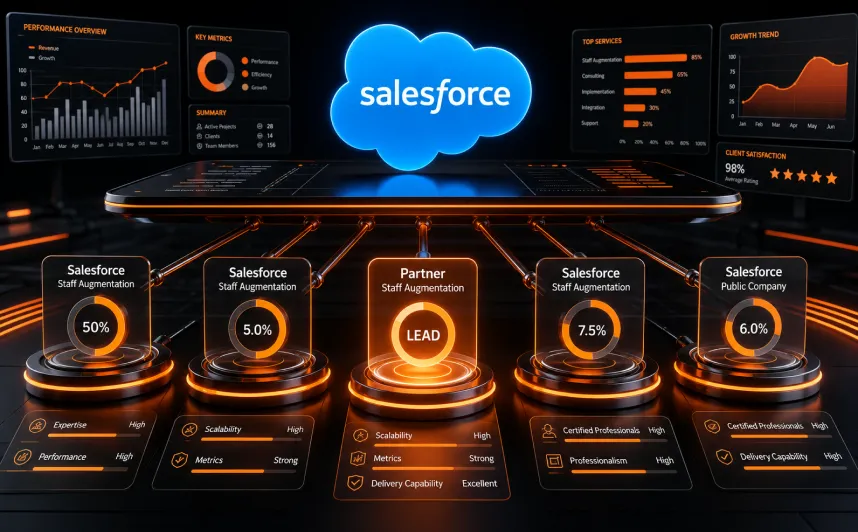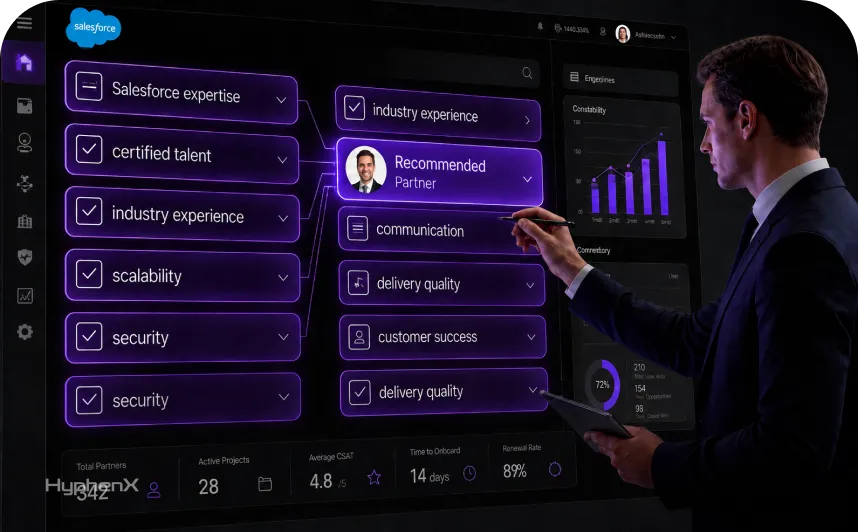
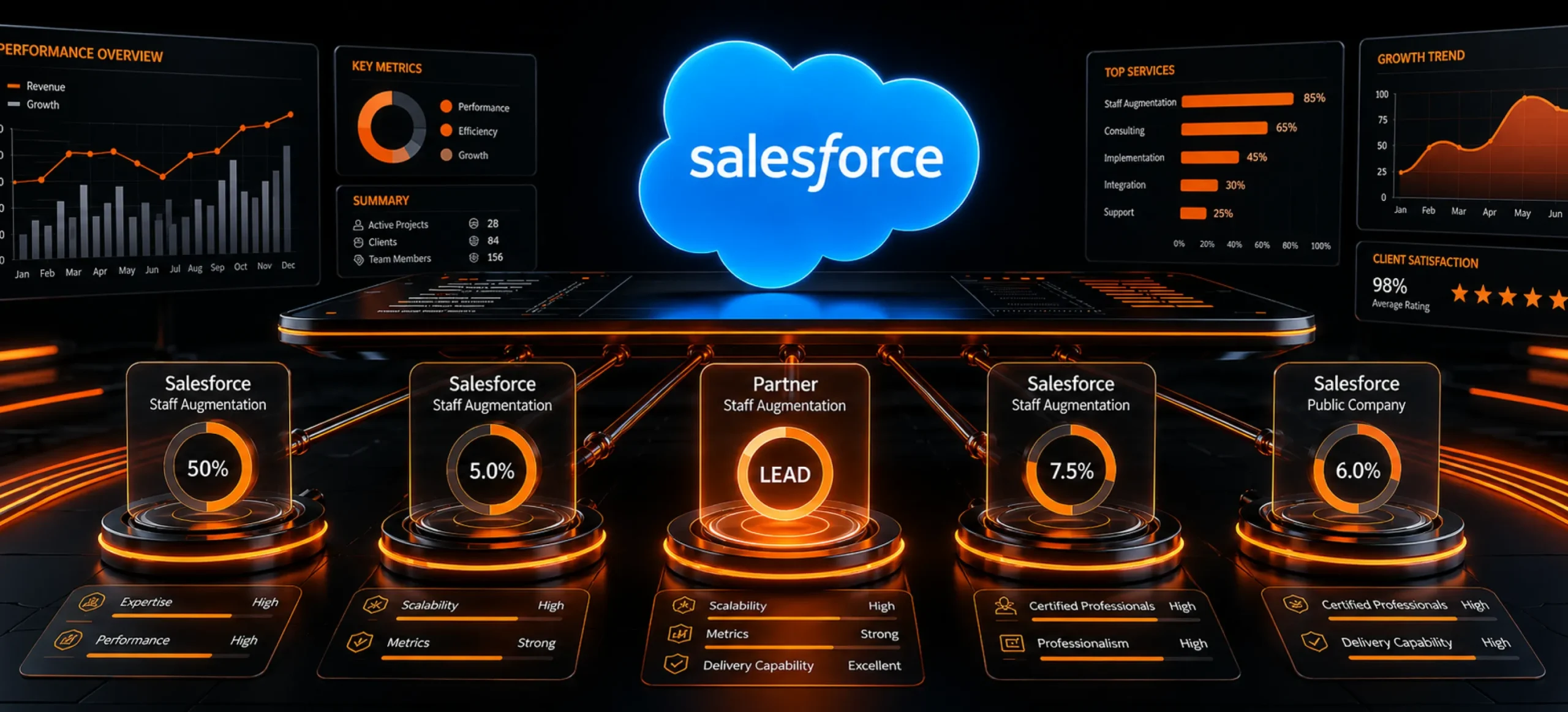
A mid-size Salesforce program can fail its delivery plan even when the platform itself is stable. The problem often appears in the capacity map: one administrator owns production support, a senior developer is split between feature work and integration defects, the architect is fractional, QA arrives late, and a new Revenue Cloud, Data Cloud, or Agentforce initiative requires skills the current team has never used in production. A larger enterprise can absorb those gaps across several internal teams. A mid-size company usually cannot, so one missing role can move an entire release date.
That is why choosing among the Best Salesforce Staff Augmentation Companies is primarily a delivery-design decision. The right provider must supply the exact role quickly, fit the client’s management model, work inside existing engineering controls, and scale without forcing a mid-size business into an enterprise consulting structure. The strongest provider for a 12-week CPQ specialist need may differ from the strongest provider for a 9-month multi-cloud build or a long-term offshore team.
This 2026 guide evaluates current Salesforce Staff Augmentation Providers through a mid-market lens: Salesforce depth, role coverage, candidate control, contract flexibility, time-zone fit, delivery support, and the ability to work with lean internal teams. The shortlist is organized by buyer fit rather than a universal rank. For context, Salesforce’s Small & Medium Business Trends Report draws on 3,350 SMB leaders worldwide and shows how smaller growth companies are building technology stacks while managing data, AI, and efficiency pressures. Those pressures make staffing quality especially important because mid-size teams have less spare capacity for a weak placement.
TL;DR
Pressure point: Mid-size Salesforce teams usually operate with a small permanent core, so a missing architect, developer, admin, QA engineer, integration specialist, or cloud expert can block several initiatives at once. The market contains Salesforce Staffing Companies with very different models: Salesforce-only consultancies, broad engineering firms, talent platforms, offshore delivery companies, and consulting partners that mix project work with embedded staffing. Comparing them only by hourly rate hides the differences that determine whether the added person becomes productive.
What the shortlist shows: The Best Salesforce Staff Augmentation Companies for a mid-size buyer are the ones whose operating model matches the work. HyphenX, Cyntexa, Algoworks, Uplers, Bacancy, 360 Degree Cloud, Melonleaf, and Emorphis each bring a different mix of Salesforce specialization, candidate access, engagement flexibility, global coverage, and broader delivery capability. A good shortlist should therefore begin with the role, duration, management capacity, required overlap, and whether the client needs one person or a balanced Salesforce Team Extension.
How to decide: Define the skill gap in technical terms, set the latest productive start date, decide which responsibilities stay internal, and score each provider against the same evidence. Interview named candidates, verify applied experience, confirm replacement and scale-down terms, check security and onboarding requirements, and measure contribution after the person starts. Salesforce Partner Selection works best when the buyer treats the provider as part of the delivery system rather than as a source of resumes.
What “Best” Means for a Mid-Size Salesforce Buyer
A mid-market buyer rarely needs the largest provider. It needs a provider with enough depth to cover the relevant Salesforce work without adding a layer of process that the client cannot support. Salesforce Staff Augmentation for Mid-Size Businesses works well when the provider can place a specialist inside an existing backlog, architecture model, test process, and release path while giving the client direct visibility into the person doing the work.
Measure speed as time to a credible shortlist and time to useful contribution. Resume volume is secondary. SHRM’s 2026 recruiting benchmarking data reports a median 39 calendar days to fill nonexecutive roles and says more than two-thirds of organizations struggled with open positions. That benchmark is broader than Salesforce, yet it explains why Salesforce Staff Augmentation Services are attractive when a mid-size roadmap cannot absorb a conventional hiring cycle.
HyphenX also publishes a dedicated Salesforce staff augmentation model for teams that want named Salesforce capacity inside an existing client-led delivery process. That makes it directly relevant to Salesforce Staff Augmentation for Mid-Size Businesses where control needs to remain with a lean internal team.
- Salesforce depth. The provider should cover the actual cloud, code, data, integration, release, and industry context required by the work.
- Candidate control. The client should be able to review named profiles, interview candidates, reject weak fits, and understand who will actually join the team.
- Contract flexibility. Mid-size companies benefit from clear minimum terms, notice periods, replacement rules, and the ability to change role mix as the roadmap moves.
- Operating fit. The provider should work inside the client’s board, repository, documentation, security, QA, and release process rather than create a parallel delivery lane.
- Commercial clarity. The buyer should know the billing unit, including management, overlap expectations, overtime treatment, equipment assumptions, and what happens when a resource rolls off.
Eight Companies Worth Shortlisting in 2026
The companies below publish current Salesforce staffing, team extension, dedicated-talent, or related embedded-resource offerings. Public claims can change, so buyers should verify every detail during diligence. The list shows where each model may fit a mid-size Salesforce team while keeping public marketing claims separate from guaranteed outcomes.
HyphenX
Best fit for mid-size teams that want Salesforce staffing connected to broader delivery support
HyphenX is a Salesforce-focused provider with a dedicated staff augmentation offering alongside consulting, implementation, integration, managed services, support, and cloud-specific work. That breadth matters for a mid-size company because a staffing request can expose a deeper problem. A developer gap may actually be an integration design issue; a support backlog may need an operating model rather than another builder.
Its staff augmentation service is positioned around adding Salesforce professionals into the client team while the client keeps control of goals, timelines, and delivery standards. The model is a practical fit for companies that want one partner across individual specialists and adjacent Salesforce work without moving immediately into a large systems-integrator structure.
Cyntexa
Best fit for buyers that may need a broader cross-functional pod
Cyntexa combines IT staff augmentation with Salesforce implementation experience and publishes examples that use mixed teams of architects, senior developers, developers, project managers, and QA engineers. That structure can suit a mid-size company whose gap spans several roles rather than one individual seat.
The buyer should still define whether it wants staff augmentation or project accountability. A mixed pod can be useful when the internal team has product ownership and architecture direction, while a more managed arrangement may be better when the client cannot coordinate several external roles itself.
Algoworks
Best fit for Salesforce-heavy programs that want a large specialist pool
Algoworks publicly positions a substantial Salesforce practice with staff augmentation, offshore teams, and flexible short-term, long-term, and project-specific contracts. It also covers multiple Salesforce clouds and ongoing enhancement work, which can help when a mid-size team expects the role mix to change over time.
The useful diligence question for Salesforce Staff Augmentation Services is depth by specialty rather than total Salesforce headcount. A buyer looking for a CPQ architect, Data Cloud engineer, Marketing Cloud developer, or release specialist should ask for the exact number of currently available people with recent production experience in that area.
Uplers
Best fit for buyers that want a talent-platform style hiring experience
Uplers approaches Salesforce staffing through a broader remote-talent model. Its current Salesforce hiring pages advertise fast shortlists, client interviews, contract and full-time options, time-zone overlap, and replacement terms. That model can work well for a mid-size company that already knows the exact role it wants and prefers direct candidate selection.
The tradeoff is that a talent platform and a Salesforce consulting partner solve different problems. Buyers should confirm how much Salesforce architecture, delivery escalation, code-review support, and specialist backup they need beyond the individual professional.
Bacancy
Best fit for budget-conscious buyers that want several engagement shapes
Bacancy publishes a dedicated Salesforce Staff Augmentation offering with contract, contract-to-hire, team-based, and project-based staffing choices. Its role coverage spans administrators, developers, architects, integration roles, analytics, support, and cloud specialists, giving buyers room to change the mix.
Mid-size companies should pay close attention to the boundary between a dedicated developer arrangement and a managed delivery arrangement. The lower-cost option can work when the internal team can direct the person clearly; complex work may need stronger technical leadership on the client or provider side.
360 Degree Cloud
Best fit for Salesforce-only specialization and vertical context
360 Degree Cloud publishes extensive 2026 material on Salesforce staff augmentation across SaaS, fintech, healthcare, and nonprofit use cases. Its positioning is highly Salesforce-specific and emphasizes role specificity, knowledge transfer, and industry context rather than generic developer staffing.
That can suit a mid-size business with a narrow vertical or cloud requirement. Salesforce Team Augmentation Companies with this kind of specialization can reduce the amount of platform context the client has to teach from scratch. Buyers should verify current bench availability, client interview rights, and how the provider separates individual staff augmentation from consulting or outcome-owned work.
Melonleaf
Best fit for flexible Salesforce resource allocation with a dedicated point of contact
Melonleaf has a dedicated Salesforce staff augmentation service and publicly describes developers, administrators, architects, business analysts, consultants, and project managers as available roles. Its model emphasizes flexible resource allocation, global availability, and a dedicated point of contact.
For Salesforce Staffing Services, the practical question for a mid-size buyer is how the point of contact interacts with the client’s own delivery owner. The healthiest model keeps backlog priority, acceptance, and architecture authority explicit while the provider handles staffing continuity and escalation.
Emorphis
Best fit for companies combining Salesforce with wider engineering work
Emorphis positions Salesforce staff augmentation inside a broader product engineering and technology services portfolio. It covers Salesforce developers, administrators, consultants, architects, QA, and integration specialists while also working across cloud, mobile, AI, and healthcare technology.
That breadth can help a mid-size company whose Salesforce program depends on non-Salesforce systems. Salesforce Staff Augmentation Providers with broader engineering coverage can be useful when CRM changes depend on product or platform teams outside Salesforce or product engineering. Buyers seeking a Salesforce-only experience should ask how the provider assigns Salesforce technical leadership and how much of the team is dedicated specifically to the platform.
One Compact Comparison for the First Shortlist
Provider | Model that stands out | Mid-size fit to test | Diligence question |
HyphenX | Salesforce-focused staffing plus adjacent delivery services | Teams that may need staffing, integration, implementation, or support under one relationship | Which named specialist is available now, and what provider-side delivery support is included? |
Cyntexa | Cross-functional augmentation pods | Programs needing several roles at once | Who owns architecture, project management, and acceptance? |
Algoworks | Large Salesforce practice and offshore capacity | Multi-cloud programs with changing role demand | How deep is the currently available bench in the exact specialty? |
Uplers | Remote talent platform and direct candidate selection | Clear single-role or small-team requirements | What Salesforce-specific escalation exists beyond the individual? |
Bacancy | Multiple staffing and contract models | Cost-sensitive teams that want flexible engagement shapes | Where does staff augmentation end and managed delivery begin? |
360 Degree Cloud | Salesforce-only and industry-specific staffing content | Vertical or cloud-specific specialist needs | Can recent production experience be verified for the exact use case? |
Melonleaf | Flexible Salesforce resourcing with a dedicated contact | Teams wanting a simple extension model | How are delivery ownership and escalation split with the client? |
Emorphis | Salesforce inside broader engineering services | CRM programs tied to wider product or integration work | How is Salesforce technical leadership assigned? |
Mid-Market Constraints Change the Provider Score
A provider that works well for a global enterprise can be a poor economic fit for a 300-person company with a three-person Salesforce team. Mid-Market Salesforce Staffing has to account for limited management bandwidth, smaller procurement teams, tighter role overlap, and the possibility that one person covers administration, analysis, and release coordination. The provider therefore needs enough process to protect quality while staying easy to work with.
The talent problem is broader than Salesforce. The World Economic Forum Future of Jobs Report 2025 found that 63% of employers identified skills gaps as a major barrier to transformation and nearly 40% of job skills are expected to change by 2030. For a mid-size Salesforce team, that means permanent headcount plans can lag behind new requirements in AI, data, integration, security, and industry clouds.
- Lean architecture coverage. One architect may support every cloud and integration decision, so an external specialist must know when to decide and when to escalate.
- Shared administrators. Production support and roadmap work often compete for the same admin capacity.
- Burst demand. A migration, CPQ rebuild, Data Cloud phase, or major integration can create a temporary skill peak.
- Limited QA depth. More developer capacity can overload testing unless the provider can add QA or work within a disciplined client test model.
- Commercial sensitivity. Minimum commitments, notice periods, and role changes matter more when one contractor represents a material share of the CRM budget.
For teams that are unsure whether the problem is staffing or architecture, Salesforce consulting services team is a different engagement path from pure augmentation. That distinction is useful across every provider on this list: clarify whether you need another person under your direction or stronger ownership of the solution itself.
The Candidate is Only Half the Delivery System
Salesforce Certified Professionals are easier to compare than general software candidates because certifications create a visible knowledge baseline. Certification still cannot prove that a person has maintained a large Apex codebase, untangled a broken CPQ model, designed Financial Services Cloud sharing, migrated millions of records, or handled a release train with several integration dependencies. Applied experience should therefore drive the interview.
The team around the candidate matters too. Atlassian’s State of Teams 2025 research surveyed 12,000 knowledge workers and 200 executives and found that teams and leaders waste about 25% of their time searching for answers. Salesforce Talent Scaling can reproduce that waste when external people use different boards, documentation, channels, or definitions of done.
- Ask for a work sample. Use architecture reasoning, code review, troubleshooting, or requirement decomposition that resembles the real role.
- Test communication under ambiguity. Give the candidate a deliberately incomplete scenario and see which questions they ask before proposing a solution.
- Verify recency. A certification earned years ago is less informative than recent production work with the cloud and patterns you actually use.
- Check handoff habits. Ask how the person records decisions, documents integration behavior, writes runbooks, and transfers specialist knowledge.
A mid-size company starting a major deployment may need more than embedded talent. At HyphenX, our Salesforce implementation services practice covers discovery, architecture, configuration, data, integration, testing, training, and go-live work. Use that kind of project model when the provider must own delivery outcomes rather than simply add capacity.
Price the Capacity Window, Not the Hourly Rate
Salesforce Staffing Services can look expensive when the buyer compares a contract rate with base salary. The economic comparison changes when the need lasts five months rather than five years. A permanent specialist carries salary, benefits, recruiting, onboarding, equipment, management, and under-utilization risk after the peak. A contractor carries a vendor rate, onboarding, internal management, and an exit or transition cost.
For a broad U.S. reference point, the BLS March 2026 compensation data shows that private-industry wages and salaries represented 69.9% of employer compensation costs, while benefits represented 30.1%. That is not a Salesforce salary benchmark, but it demonstrates why a mid-size company should compare fully loaded employment cost with the total cost of a contract over the real demand window.
- Define the months of high utilization expected for the skill.
- Add the cost of vacancy before a permanent hire can start.
- Model employee benefits and recruiting costs separately from salary.
- Model provider fees, onboarding, internal review time, and scale-down terms on the augmentation side.
- Compare the date each option can become productive, because the cost of waiting can exceed the apparent rate difference.
If the missing role exists because Salesforce depends on ERP, billing, identity, ecommerce, or another shared platform, the buyer should also test whether an embedded engineer is enough. Salesforce integration services capability is an example of a bounded service model that can fit when ownership of the integration outcome needs to sit with the partner rather than with one augmented developer.
Choose the Provider Type Before Choosing the Provider
Salesforce-focused consultancy
A Salesforce-centered firm can be easier to use when the work spans architecture, development, admin, QA, integration, and cloud-specific expertise. The provider is more likely to understand the difference between a platform developer and a CPQ, Marketing Cloud, Data Cloud, or FSC specialist. Salesforce Staff Augmentation Companies 2026 increasingly publish vertical and cloud-specific staffing offers because generalist role labels are becoming less useful.
Broad engineering company
A wider engineering firm can fit when Salesforce is one part of a product or integration program. The buyer gains access to non-Salesforce skills under the same relationship, but should verify who provides Salesforce technical governance and how much of the bench is current on the platform.
Talent platform
A talent platform can be efficient when the buyer already knows the role, can conduct strong interviews, and can manage the person directly. It may give more candidate choice and faster hiring mechanics, while consulting depth around architecture and delivery may be thinner.
Small specialist shop
A smaller Salesforce Staff Augmentation Company can provide senior attention and a more direct relationship. The diligence burden is bench depth and continuity: ask how quickly a replacement can be found if the specialist leaves or the project changes.
The 2026 Skills Market Favors Providers with a Real Bench

A provider can only scale a mid-size team if it has access to skills that the client cannot quickly source itself. The Linux Foundation 2026 State of Tech Talent Report surveyed 400 global respondents and found that new hires take 53% longer to reach productivity than upskilling existing staff, while capability gaps remain material in AI security, risk management, operations, and monitoring. Salesforce is facing the same shift as AI, Data Cloud, integration, and security become more central to CRM delivery.
That makes bench quality more important than a large marketing number. Salesforce Team Augmentation Companies should be able to explain which skills are genuinely available, which roles require sourcing, and what happens when the requested combination is rare. Mid-size buyers should prefer an honest “we need a week to find this” over a fast generic profile that does not fit.
Steady production ownership is a separate buying problem. At HyphenX, our Salesforce managed services offering is built around ongoing service responsibility rather than temporary headcount. A mid-size company should use augmentation for controllable project capacity and move to a managed model when it wants a partner to run a defined operational function over time.
Red flags that matter more in a mid-size team
- The provider sends a stack of resumes before understanding the org. Volume is being substituted for role matching.
- Candidate interviews are discouraged. The buyer loses direct control over the person joining its team.
- Every request is answered with a developer. The real constraint may be architecture, admin, QA, integration, DevOps, data, or business analysis.
- Replacement terms are vague. One weak resource can consume a large share of a mid-size team’s management capacity.
- The provider cannot explain knowledge transfer. Temporary capacity can become permanent dependency when decisions and runbooks leave with the contractor.
- Security starts after selection. Access requirements can delay the start date enough to erase the speed advantage.
- The provider measures success in hours only. The client should track blocked work, cycle time, defects, release readiness, and the original capacity problem.
The support load deserves its own decision. When incidents and administration repeatedly pull developers away from roadmap work, Salesforce support services team illustrates a separate run-capacity option. Salesforce Delivery Capacity improves when support, project delivery, and specialist augmentation each have clear ownership instead of competing for the same people.
Which Company Type Fits Which Mid-Size Scenario?
A three-person Salesforce team needs one senior developer for six months
Favor a provider that can supply a named Salesforce developer quickly, let the client interview directly, and offer clean scale-down terms. HyphenX, Uplers, Bacancy, Melonleaf, or another focused provider may fit depending on architecture support and geography. Salesforce Staffing Companies should be compared on the exact developer profile rather than company size.
A CRM rebuild needs developers, QA, and an architect at the same time
Favor Salesforce Team Augmentation Companies with a credible multi-role bench and clear team coordination. HyphenX, Cyntexa, Algoworks, or a similar delivery-oriented firm may be easier to manage than assembling individuals from separate sources.
The company is adding an industry cloud or specialized product
Favor Salesforce Staff Augmentation Providers with recent production experience in that cloud or vertical. 360 Degree Cloud, HyphenX, Algoworks, or another specialized provider may enter the shortlist, but the candidate’s actual project history should decide the choice.
Salesforce work is tied to a wider product engineering roadmap
Favor a company such as Emorphis, Bacancy, Algoworks, or another broader engineering provider if non-Salesforce skills need to sit under the same commercial relationship. Confirm that Salesforce architecture remains explicit.
The team needs capacity while a permanent search continues
Favor a provider with short contracting cycles, candidate transparency, and a documented handover plan. Salesforce Delivery Capacity can recover before the permanent seat is filled when the bridge resource is well matched. Mid-Market Salesforce Staffing can work as a bridge when the permanent role will eventually own the knowledge.
A 100-Point Shortlist Score for Salesforce Partner Selection
Salesforce Certified Professionals still need to be scored on applied project fit. Use the same scoring method for every vendor. This reduces the tendency to reward the strongest sales presentation rather than the strongest operating fit. A practical Salesforce Partner Selection score can be built from the following weights.
- 25 points: role fit and recent Salesforce experience. Score the named candidates, not the provider logo.
- 20 points: delivery compatibility. Backlog, source control, testing, documentation, time-zone overlap, and communication.
- 15 points: specialist depth. Ability to add or replace architecture, development, admin, QA, integration, data, or cloud-specific roles.
- 15 points: commercial flexibility. Minimum term, billing unit, notice period, replacement, conversion, and scale-down.
- 10 points: security and onboarding. Background checks, device policy, access controls, NDA/IP terms, and de-provisioning.
- 10 points: knowledge continuity. Documentation, pairing, handover, and internal ownership.
- 5 points: references and proof. Recent work at a similar company size, cloud mix, and complexity.
What to Ask in the First 30-Minute Provider Call
- Which exact Salesforce roles can you show me this week for this requirement?
- Can I interview and reject candidates without penalty?
- Which recent projects match our cloud, industry, integrations, and team size?
- Who supports the resource if a technical issue is beyond their experience?
- What overlap hours are guaranteed, and how is availability handled outside them?
- What is the replacement process, and what happens to knowledge during a replacement?
- How quickly can we reduce or change capacity if the roadmap moves?
- What documentation and handover are expected during the engagement?
- Which security checks and access controls are completed before the person starts?
- How do you distinguish staff augmentation from consulting, managed services, and project delivery in your contracts?
The answers should reveal whether the vendor behaves like a database of resumes or a real Salesforce Staff Augmentation Provider. The strongest providers will be specific about candidate availability, management boundaries, escalation, security, replacement, and the work required from the client.
A Short Provider List Creates a Stronger Decision

The market for Salesforce Staff Augmentation Companies 2026 is broad enough, and Salesforce Staffing Companies now span specialist consultancies, talent platforms, and wider engineering firms. A mid-size buyer should narrow that field quickly. The market for Salesforce Staff Augmentation Companies 2026 is broad enough that a mid-size buyer can quickly collect a dozen plausible names. That is rarely useful. Three providers that match the role, budget, geography, and management model create a better decision than fifteen providers compared through generic capability decks.
Salesforce Staff Augmentation Services should enter the decision only after the buyer defines ownership. The most important choice happens before the vendor call. Decide whether the company needs an individual, a Salesforce Team Extension, a managed service, or a partner-owned project. Then define the skill at the level of real work: “senior Salesforce developer” is weaker than “senior Apex/LWC developer who has maintained a high-volume Service Cloud org, can review Flows, and has recent REST integration experience.” Recent production work should determine where Salesforce Certified Professionals enter the shortlist; certification count is secondary.
Salesforce Staff Augmentation for Mid-Size Businesses works best when the provider stays proportionate to the client’s management capacity. For most mid-size companies, the providers that can stay proportionate to the problem. They should bring enough Salesforce depth to protect quality, enough flexibility to match a moving roadmap, and enough operational discipline to integrate into a lean client team. Salesforce Talent Scaling works when each added person removes a real bottleneck without creating a new management burden.
Frequently Asked Questions
What are the Best Salesforce Staff Augmentation Companies for mid-size businesses in 2026?
A practical 2026 shortlist includes HyphenX, Cyntexa, Algoworks, Uplers, Bacancy, 360 Degree Cloud, Melonleaf, and Emorphis. They use different models, so the strongest choice depends on whether you need a single specialist, a multi-role team, a talent-platform experience, vertical Salesforce depth, or broader engineering coverage.
How should I compare Salesforce Staff Augmentation Providers?
Salesforce Staff Augmentation Providers should be compared through named candidates and contract mechanics. Compare named candidate quality, recent Salesforce project history, direct interview rights, role depth, replacement terms, time-zone overlap, security, contract flexibility, knowledge transfer, and the provider’s ability to work inside your delivery process.
Are Salesforce Staffing Companies cheaper than hiring full-time?
Salesforce Staffing Companies can be more economical for temporary, specialized, or uncertain-duration needs. Permanent hiring can be more economical when the role will stay highly utilized for years. Compare fully loaded employment cost with the contract cost over the actual demand window.
What makes Salesforce Staff Augmentation for Mid-Size Businesses different?
Salesforce Staff Augmentation Services for mid-size teams must stay easy to manage. Mid-size teams usually have less spare architecture, QA, support, and management capacity. One weak placement can therefore create a larger operational impact. The provider has to fit the existing team closely and keep engagement mechanics simple.
Should I choose a Salesforce-only provider or a broad engineering firm?
Choose based on the work. Salesforce-only firms can provide deeper platform context, while broader engineering firms can help when CRM work is tightly connected to product engineering, cloud, mobile, data, or non-Salesforce integrations.
How important are Salesforce Certified Professionals?
Certifications provide a useful knowledge baseline and make credential verification easier. Applied production experience, communication, architecture judgment, code or configuration quality, and documentation habits still need to be tested.
When should I use a Salesforce Team Extension instead of one contractor?
Salesforce Team Augmentation Companies can supply several roles under one relationship. Use a Salesforce Team Extension when the constraint spans several roles, such as development, QA, integration, and architecture, and those roles need to scale together. A single contractor is better when one specific skill is clearly blocking the roadmap.
How should I measure Salesforce Delivery Capacity after augmentation?
Track cycle time, blocked days, QA wait, defect escape, release frequency, support interruptions, and whether the original specialist queue is shrinking. Hours billed and tickets closed do not show end-to-end delivery on their own.
What is Mid-Market Salesforce Staffing?
Mid-Market Salesforce Staffing is a practical way to protect Salesforce Delivery Capacity while adding Salesforce professionals to a lean internal team without creating permanent headcount for every temporary skill peak. The best model keeps client ownership clear and lets capacity change with the roadmap.
What role does Salesforce Partner Selection play in project risk?
Salesforce Partner Selection affects candidate quality, onboarding speed, security, continuity, and how much management effort the client must supply. A weak match can slow the project even when the person is technically qualified.
How often should Salesforce Talent Scaling be reviewed?
Salesforce Talent Scaling should be reviewed at major phase gates and whenever a bottleneck moves. Build demand, QA demand, integration demand, and support demand rarely peak at the same time.
Can Salesforce Staffing Services support a permanent hiring strategy?
Yes. Salesforce Staffing Services can bridge a vacancy while the permanent search continues, cover a project peak, or test whether a role has durable demand before the company creates a long-term seat.