
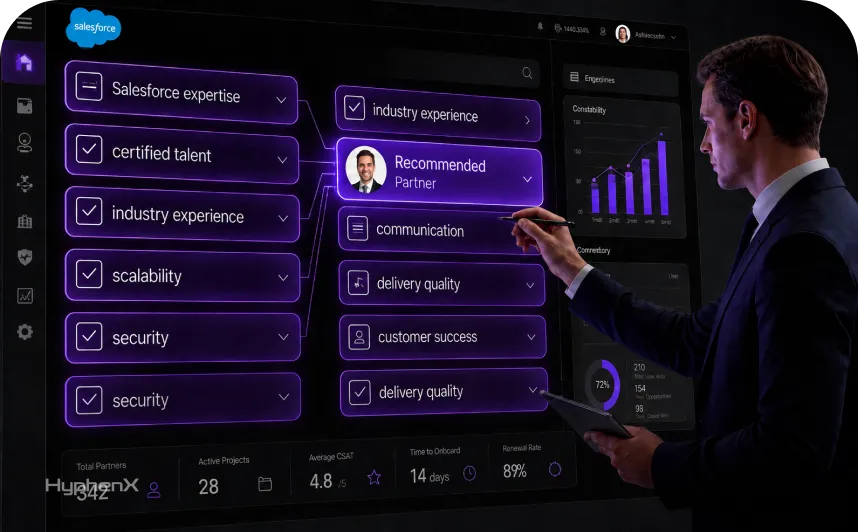
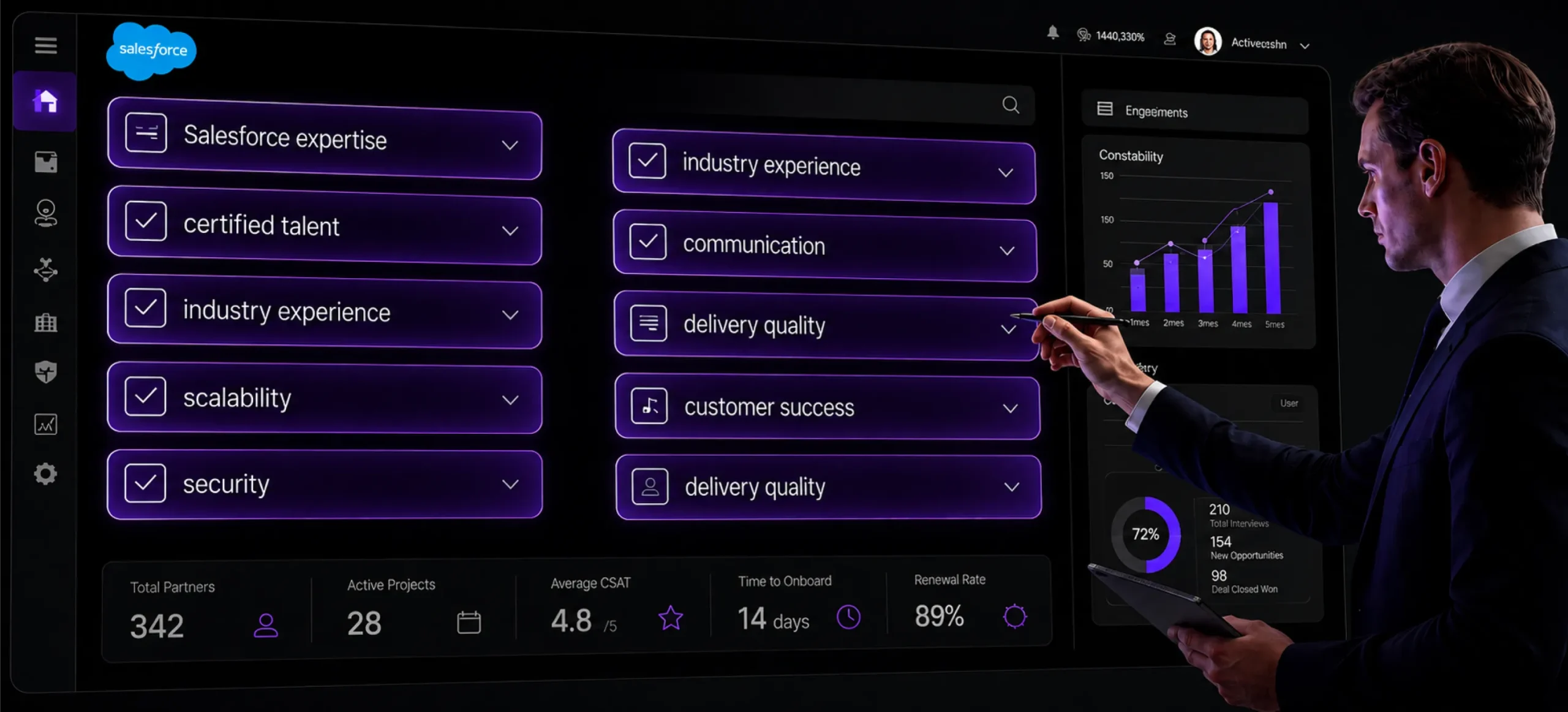
A Salesforce staff augmentation decision becomes technical before it becomes commercial. The partner will touch source control, sandboxes, metadata, APIs, deployment pipelines, security models, release calendars, and business processes that may have accumulated years of local rules. A weak selection process can place an impressive résumé inside a delivery system the person cannot navigate. A strong selection process tests whether the provider can supply people who understand the work, enter the team quickly, follow the same engineering controls as employees, and leave behind enough documentation for the platform to remain supportable after the contract ends.
That makes the choice of a Salesforce Staff Augmentation Partner a due-diligence exercise rather than a vendor-comparison exercise. The right Salesforce Staff Augmentation Partner should be able to explain how candidates are screened, what evidence supports claimed experience, how replacement works, who owns delivery escalation, how access is controlled, and how the engagement changes when the role mix changes. Those questions matter more than the size of a CV database.
This guide gives enterprise buyers a complete evaluation method. It covers Salesforce Talent Vetting, Salesforce Technical Screening, commercial terms, security, onboarding, replacement policy, time-zone coverage, documentation, knowledge transfer, proof of experience, governance, and the signals that separate a dependable Salesforce Staffing Partner from a provider that mainly moves résumés. The goal is a repeatable Salesforce Partner Selection process that procurement, delivery, security, and platform leaders can all use.
TL;DR
The concern: a staffing provider can look credible during procurement and still create delivery risk after onboarding. Certifications may be real but unrelated to the work, candidate screening may stop at résumé review, replacement terms may be vague, security controls may be delegated to the client, and communication may depend on informal availability. The result is lost ramp time, repeated re-explanation of the org, weak documentation, and a Salesforce Team Extension that behaves like a separate vendor team.
The overview: a reliable Salesforce Staff Augmentation Company proves quality at several layers. It can show role-specific Salesforce Technical Screening, let the client interview candidates, verify Salesforce Certified Professionals, explain how it handles background checks and access, define overlap hours, provide named escalation ownership, document replacement timing, and work inside the client’s backlog and release process. Pricing matters, but the operating model decides whether the added capacity becomes productive capacity.
The approach: use a scored Salesforce Staff Augmentation Checklist before signing. Test technical depth against real work, inspect security and delivery controls, review sample candidate evidence, interview references, verify how the provider handles weak fit, and read the commercial terms for scale-down, conversion, notice, IP, and replacement. Then start with a bounded role or workstream, measure ramp time and delivery quality, and expand only after the partner has proved it can operate inside your standards.
Start with the Work the Partner Must Actually Cover
A provider cannot be evaluated well from a generic requirement such as “senior Salesforce developer.” The evaluation has to start with the work surface. A Service Cloud program with Omni-Channel, entitlement logic, telephony, and external knowledge has a different risk profile from a CPQ backlog with price rules, product rules, quote calculation, and ERP dependencies. An integration-heavy role should be tested on API contracts, failure handling, authentication, idempotency, and monitoring. A Data Cloud role should be tested on source mapping, identity resolution, segmentation, consent, and downstream activation.
This is where Salesforce Resource Augmentation frequently goes wrong. Buyers ask for years of experience and certifications when they should ask for evidence of relevant delivery. A person can have eight years on Salesforce and still have little exposure to the exact cloud, scale, or integration pattern the project requires. The provider should translate the brief into specific technical competencies, decision boundaries, expected outputs, and the level of independence required during the first thirty days.
HyphenX separates role capacity from broader advisory work. When the need is architecture or solution direction rather than embedded staffing, Salesforce consulting services are the more suitable engagement. That distinction is useful during Salesforce Partner Selection because a provider should be willing to tell the buyer when staffing alone will not solve the problem.
The First Filter: Can the Provider Find the Skill You Cannot?
The talent problem is broader than Salesforce. SHRM’s 2025 Talent Trends research reported that 4 in 5 organizations requiring new skills had difficulty finding qualified candidates. That matters because a Salesforce Staffing Partner is being hired partly to solve a search problem the client could not solve quickly on its own. A provider that sends many loosely matched profiles has not solved that problem. It has transferred the search burden back to the client.
A useful first filter is specificity. Ask how many people the provider has screened recently for the exact role, how many of those people have worked on comparable orgs, what evidence the provider verified, and what would disqualify a candidate before the client ever sees the profile. Strong Salesforce Talent Vetting removes weak fits early. Weak vetting produces a large shortlist and forces the client to perform the agency’s job.
Eight Proof Points to Request Before You Review a Single Résumé
- Role scorecard: A written competency map for the requested role, including clouds, integrations, tools, level of independence, and expected outputs.
- Screening record: A summary of technical questions or practical exercises used during Salesforce Technical Screening.
- Certification verification: Trailblazer or credential evidence for Salesforce Certified Professionals when certification is relevant to the role.
- Comparable project history: Specific work completed in a similar Salesforce domain, with enough detail to distinguish participation from ownership.
- Availability confirmation: Real start date, weekly commitment, time-zone overlap, and other client obligations that could affect delivery.
- Communication sample: Evidence that the person can explain trade-offs, document decisions, and escalate blockers without waiting for a meeting.
- Replacement terms: Written timing, process, and commercial treatment if the person leaves or fails to meet the agreed role standard.
- Security readiness: Background-check status, device policy, confidentiality terms, access expectations, and de-provisioning responsibilities.
These proof points turn Salesforce Staff Augmentation Services into an evidence review. They also reveal whether the provider has a real delivery process behind sales. A Salesforce Staff Augmentation Provider should be able to produce this material without improvising it after the contract is signed.
Technical Screening Should Change by Role
Administrator or consultant
Test configuration judgement, Flow design, permission models, reporting, data quality, and the ability to identify when declarative work is becoming difficult to maintain. A strong candidate should explain trade-offs, not simply name features.
Developer
Review Apex and LWC experience, bulkification, asynchronous processing, testing, deployment practice, integration patterns, and code review habits. Ask about production incidents caused by code and what changed afterward.
Architect
Test design reasoning through a real scenario. The person should be able to explain data-model choices, integration boundaries, security implications, technical debt, and what they would deliberately keep simple.
QA or release specialist
Review regression strategy, test data, environment coordination, release readiness, CI/CD, rollback planning, and how quality gates change for high-risk metadata or integrations.
Cloud specialist
Use domain-specific scenarios for CPQ, Service Cloud, Data Cloud, Marketing Cloud, Revenue Cloud, or an industry cloud. General Salesforce experience should not substitute for the specialty the roadmap requires.
This role-specific approach is the center of a useful Salesforce Staff Augmentation Checklist. The buyer should be able to trace each interview question back to the work. Salesforce Technical Screening is strongest when it tests judgement under the same constraints the person will meet after onboarding.
For development-heavy roles, we also use a dedicated developer hiring model where the client can evaluate the developer before the person joins the delivery process. Whatever provider you choose, direct client evaluation should remain part of the model rather than being replaced by an internal vendor score alone.
Do Not Confuse Individual Speed with Team Performance
A partner can present fast coders and still weaken delivery if the operating system around them is poor. The 2025 DORA software development report drew on survey responses from nearly 5,000 technology professionals and described AI as an amplifier of existing organizational strengths and weaknesses. The same principle applies to added Salesforce capacity. New people magnify the standards, review habits, documentation quality, and release discipline they enter.
During Salesforce Partner Selection, ask how the provider works inside an existing engineering model. Will the person use the client’s repository and branching rules? Are pull requests reviewed by the same standards? Does the provider accept the client’s definition of done? Can it support documentation and knowledge-transfer requirements that may reduce short-term ticket volume but protect maintainability? These answers reveal whether a Salesforce Staff Augmentation Company is selling throughput or dependable delivery.
A Practical Partner Scorecard
Evaluation area | Weight | What good looks like | Automatic concern |
Role fit | 20% | Evidence from comparable Salesforce work | Generic profiles matched mainly by title |
Technical screening | 20% | Role-specific assessment and client interview | Certification treated as the full technical test |
Delivery model | 15% | One backlog, shared standards, clear escalation | Separate vendor process or opaque ownership |
Security | 15% | Named access, device, background and offboarding controls | Security left undefined until onboarding |
Continuity | 10% | Replacement window and backup process in writing | Replacement discussed only after a problem |
Communication | 10% | Defined overlap and decision path | “Flexible hours” with no committed window |
Commercials | 10% | Clear rates, notice, conversion and scale-down terms | Low headline rate with unclear conditions |
The score is less important than the discussion it forces. A buyer can change the weights, but every Salesforce Staff Augmentation Provider should be tested on quality, control, security, continuity, communication, and commercial clarity. The scorecard also gives procurement and delivery leaders a shared language for the decision.
Governance Starts Before the First Person Joins
Partner quality depends partly on the governance the buyer establishes. Gartner research on IT outsourcing governance notes that weak formal governance can lead to ineffective provider management and failed deals, and it recommends governance across relationship, operations, demand, value, and innovation. Staff augmentation is a different commercial model, but the governance lesson still applies: responsibilities have to be explicit before delivery pressure exposes gaps.
Ask who owns the account, who owns delivery escalation, who resolves attendance or performance issues, and who approves a replacement. Define which decisions belong to the augmented professional and which must stay with the client’s product owner, architect, security lead, or release manager. A Salesforce Engagement Model that leaves those boundaries vague creates meetings and delays because every exception becomes a negotiation.
Security Review: Treat External Access as a Design Decision
The security review deserves its own track. Verizon’s 2025 Data Breach Investigations Report analyzed more than 22,000 security incidents and 12,195 confirmed breaches, and reported that third-party involvement doubled to 30%. An external Salesforce specialist may receive access to customer records, source repositories, sandboxes, integration secrets, ticket systems, and documentation. That access should never be treated as an administrative afterthought.
- Named accounts for every external person, with no shared credentials.
- Least-privilege permissions by environment and task.
- Client-approved device, endpoint protection, and remote-access requirements.
- Background checks proportionate to the data and systems involved.
- NDA and IP assignment that clearly covers produced code, configuration, documents, and test assets.
- Production access is limited to the smallest group that needs it.
- Credential rotation and de-provisioning on role change or exit.
- Incident reporting time and escalation path written into the operating process.
A credible Salesforce Staffing Partner should be comfortable with these controls and should explain how it supports them. Resistance to named access, background checks, offboarding, or audit evidence is a reason to slow the selection process.
Integration work needs an additional review because external specialists may handle credentials, middleware, API endpoints, and production data flows. At HyphenX, our Salesforce integration services show the breadth of enterprise systems that can sit behind Salesforce. A partner supplying integration talent should be screened against the security and failure modes of those connected systems, not Salesforce alone.
The Replacement Clause Is a Quality Signal
Every staffing relationship eventually encounters absence, attrition, changing project needs, or a weak fit. The question is how the provider handles it. Ask what qualifies for a no-fault replacement, how quickly a replacement profile is produced, whether overlap is provided for handover, and whether the client pays twice during the transition. Ask what happens when the problem is performance rather than availability. The answer should exist before the first person starts.
A mature Salesforce Staff Augmentation Company treats replacement as a continuity process. It keeps role documentation current, knows the client’s working standards, and can brief the next person from recorded context instead of asking the client to restart onboarding from zero. A Salesforce Staffing Partner that cannot describe this process is relying on the individual rather than on a repeatable service model.
Certifications Help, but Skills Depth Still Needs Proof
Certification should be one input rather than the final decision. The 2025 ISC2 Cybersecurity Workforce Study surveyed 16,029 cybersecurity practitioners and decision-makers and found that critical skills needs outweighed simple headcount concerns. The study also reported that 59% of respondents had critical or significant skills needs. That finding translates well to Salesforce Talent Vetting: the buyer needs the right capability for the task, not simply another technically credentialed person.
For Salesforce Certified Professionals, verify the credential, then test the experience behind it. Ask which parts of a previous implementation the person owned, what decisions they made, what broke, what they would do differently, and how they documented the work. The technical assessment should expose the depth behind the badge.
Reference Checks Should Reconstruct the Engagement
Reference calls often fail because the buyer asks whether the provider was good and whether the client would use it again. Those questions invite polite answers. A stronger reference check reconstructs how the engagement actually worked. Ask how quickly the first person became useful, how often candidates were rejected, whether the named person stayed for the expected duration, how replacement was handled, what the provider did when work was blocked, and what documentation remained after roll-off.
Request one reference from an engagement that has ended, not only a current happy client. Finished engagements reveal handover quality, final invoicing, access removal, knowledge retention, and whether the provider respected scale-down. These details say more about a Salesforce Staff Augmentation Provider than a general testimonial.
The reference should also match the accountability model you are buying. If the client wanted ongoing operational ownership rather than people working under internal direction, Salesforce managed services would be the closer comparison. A provider should be able to explain the boundary between a Salesforce Engagement Model based on embedded capacity and one based on transferred service ownership.
Onboarding Speed Has to Be Designed, not Promised
Fast staffing has little value if the person spends two weeks waiting for access and context. The Linux Foundation 2025 State of Tech Talent Report found that hiring managers viewed onboarding new hires as more costly and reported that onboarding took 62% longer than upskilling. The exact timing will differ for a Salesforce Team Extension, but the point is relevant: time-to-start and time-to-productivity are different measures.
Ask the provider for its onboarding template before contracting. It should cover client access, architecture orientation, repository setup, coding or configuration standards, environment model, test process, release method, security expectations, documentation locations, escalation contacts, and the first controlled work item. A provider that depends on the client to invent this process after day one is not offering a complete staffing service.
A five-step onboarding test
- Before start: verify contract, background checks, named accounts, hardware requirements, and calendar access.
- Day 1: review business process, architecture, org boundaries, integrations, data sensitivity, and active risks.
- Days 2 to 3: set up repositories, environments, deployment tooling, documentation, and communication channels.
- Week 1: complete a small real ticket through analysis, build, review, test, and release to prove the path works.
- Week 2: review contribution quality, blocked time, communication, and documentation before expanding scope.
Time-Zone Coverage Needs a Contracted Window
Distributed delivery can work extremely well, but “flexible hours” is too vague for a serious Salesforce Engagement Model. Ask for the exact overlap window by role, the escalation route outside that window, and the process for releases that occur after normal hours. An architect may need fewer overlap hours than a business analyst working through daily requirements. A release engineer supporting a cutover may need a temporary schedule that differs from the normal contract.
Also ask how the provider handles local holidays, planned leave, and sudden absence. The Salesforce Staff Augmentation Checklist should treat availability as an operating control because a technically excellent person who is unreachable during the client’s decision window can still become a bottleneck.
Commercial Terms That Deserve More Attention than the Hourly Rate
- Minimum commitment: Hours per week, minimum months, and whether unused capacity can be moved to another qualified role.
- Notice to scale down: The exact notice period and whether it changes by role or engagement length.
- Rate changes: When rates can rise, how much notice is required, and whether renewals reset pricing.
- Conversion: The fee and conditions if the client wants to hire the person directly.
- Replacement: Whether replacement onboarding or overlap is billed and how quickly the provider must act.
- Bench or backup: Whether the provider can actually provide continuity for scarce roles or simply restart sourcing.
- IP and work product: Ownership of code, configuration, documentation, test assets, and other artifacts.
- Termination and access: The operational steps for final handover, credential removal, asset return, and invoice closure.
A Salesforce Staff Augmentation Provider with a low rate can still be expensive when notice, replacement, conversion, or idle commitment terms are poor. Compare the full commercial structure rather than the hourly number alone.
If the buyer’s need is continuous administration, monitoring, incident response, and maintenance rather than temporary role capacity, Salesforce support services may fit the work better. Good partner selection includes choosing the right service model before negotiating the price of the wrong one.
Check Whether the Provider Can Change Shape with the Work
A partner may perform well with one developer and still struggle when the engagement expands into architecture, QA, release support, or cloud-specific work. Salesforce Staff Augmentation Services should have a clear method for changing the role mix without resetting the relationship. Ask how new roles are briefed, whether the same screening standard applies, and how the provider keeps one delivery owner across a broader team.
Salesforce Staffing Services also need a sensible scale-down path. A six-month build surge may end with only a part-time administrator or release specialist still required. The provider should be able to reduce capacity without forcing the client to retain people whose work has ended. This is where Salesforce Team Extension becomes useful as an operating concept: the external layer grows and contracts around the internal team while the client keeps the roadmap, architecture authority, and release controls.
Ask for one example where Salesforce Staff Augmentation Services expanded across several roles and another where the provider reduced the team after a milestone. Salesforce Staffing Services are easier to trust when the provider can explain both directions. Mature Salesforce Staffing Services should support controlled expansion and reduction without changing the client’s delivery ownership. A Salesforce Team Extension that can only grow is effectively a long-term staffing commitment, even if the contract describes it as flexible.
The Complete Salesforce Staff Augmentation Checklist
☐ Have we defined the work, cloud, integration surface, expected outputs, and level of independence?
☐ Has the provider converted the brief into a written role scorecard?
☐ Can the provider show how Salesforce Talent Vetting removes weak profiles before client review?
☐ Can we interview and reject candidates without commercial pressure?
☐ Are Salesforce Certified Professionals verified where certification matters?
☐ Does Salesforce Technical Screening test the exact work rather than generic platform trivia?
☐ Are availability, time-zone overlap, and other client obligations confirmed?
☐ Are security, device, access, background check, NDA, and IP requirements explicit?
☐ Does the provider support our backlog, source control, review, QA, and release process?
☐ Is there one named escalation owner on the provider side?
☐ Are replacement timing and transition costs written into the contract?
☐ Can the provider explain how knowledge is captured before a person rolls off?
☐ Do references include comparable work and at least one completed engagement?
☐ Are rates, minimums, notice, conversion fees, renewal terms, and scale-down rules clear?
☐ Does the Salesforce Engagement Model match the accountability we actually need?
☐ Can the provider explain when consulting, managed services, or project delivery would fit better than augmentation?
☐ Do we have success measures for ramp time, blocked work, review quality, defects, delivery, and documentation?
☐ Will we start with a bounded role or workstream before expanding the relationship?
This checklist gives Salesforce Partner Selection a practical stop/go mechanism. If several answers remain unclear, the decision is not ready. If the provider can answer each item with evidence, the buyer has a stronger basis for comparing quality, continuity, and operating fit.
The Best Partner Makes the Client’s Delivery System Easier to Run
A strong Salesforce Staff Augmentation Partner should reduce management friction after the initial onboarding period. The client should spend less time searching for candidates, less time correcting role mismatch, less time resolving basic availability questions, and less time rebuilding context after turnover. The provider’s process should make added capacity easier to govern, not create another management layer.
That is why Salesforce Staffing Services should be evaluated beyond sourcing speed. Salesforce Resource Augmentation works when the provider can repeatedly place the right skill, prove technical fit, support the client’s controls, and handle change without disruption. A Salesforce Staff Augmentation Company that performs well in those areas becomes useful across several roadmap phases because the buyer trusts the operating model as much as the individual profiles.
Use the first engagement as evidence. Measure ramp time, acceptance of client standards, review quality, documentation, blocked work, attendance, and replacement responsiveness if a change occurs. Expand the relationship after the provider has proved it can deliver those basics. That is the simplest way to turn Salesforce Partner Selection from a procurement decision into a controlled delivery decision.
Frequently Asked Questions
What should I look for in a Salesforce Staff Augmentation Partner?
Look for role-specific technical vetting, direct client interviews, verifiable experience, clear security controls, committed overlap hours, named escalation ownership, written replacement terms, and evidence that augmented people work inside the client’s existing delivery process.
How should Salesforce Talent Vetting work?
Salesforce Talent Vetting should begin with a role scorecard, then verify relevant project history, certifications where needed, availability, communication, and role-specific technical competence before the client receives a profile.
Are Salesforce certifications enough to select a candidate?
Certifications alone are insufficient. Salesforce Certified Professionals provide evidence of platform knowledge, while the buyer should still test applied experience, judgement, documentation habits, communication, and the exact cloud or integration pattern required by the role.
What should Salesforce Technical Screening include?
Salesforce Technical Screening should use practical scenarios tied to the role. Developers need code and integration judgement, admins need configuration and security judgement, architects need design reasoning, and specialists need evidence in the exact cloud or product area.
How many candidates should a provider send?
The useful number is a small set of genuinely matched profiles. A large stack of résumés usually shifts the screening burden back to the client. Quality of fit matters more than shortlist volume.
What replacement policy should I expect?
The contract should define what triggers replacement, how quickly new profiles appear, whether transition overlap is provided, and how billing works during the change. The process should be written before onboarding.
How is a Salesforce Staffing Partner different from a consulting partner?
A Salesforce Staffing Partner adds professionals who work inside the client’s backlog and management model. Consulting typically adds advisory, architecture, or solution ownership. Some providers offer both, but the accountability model should be explicit.
What security checks matter for staff augmentation?
Use named accounts, least privilege, client-approved devices and remote access, background checks where appropriate, NDA and IP terms, production-access limits, credential rotation, and formal offboarding.
Should time-zone overlap be written into the contract?
Yes. Define the exact overlap window, holiday coverage, escalation path, and any release-specific schedule. Vague promises of flexibility are difficult to manage once delivery pressure increases.
How do I measure whether Salesforce Staff Augmentation Services are working?
Track ramp time, blocked work, cycle time, review quality, defect escape, documentation, release reliability, stakeholder feedback, and whether the original capacity or skill constraint is actually improving.
When should I choose Salesforce Resource Augmentation instead of permanent hiring?
Use Salesforce Resource Augmentation when the need is temporary, specialized, uncertain in duration, or too urgent for a normal hiring cycle. Use permanent hiring when the role is durable, consistently utilized, and central to long-term business ownership.
What is the most important question in Salesforce Partner Selection?
Ask the provider to show how it knows a candidate can perform the exact work you need. That question forces evidence across screening, project history, technical depth, communication, and role fit.


