

A Salesforce implementation can pass user acceptance testing and still leave the buyer unable to operate the org safely. The weakness often appears after the partner exits. An admin opens a Flow and cannot tell which business rule it implements. A developer finds Apex with no decision record explaining why code was chosen over configuration. An integration fails and the support team has no current mapping, retry rule, owner, or reconciliation procedure. A deployment needs to be rolled back, but the release record does not state which metadata, data changes, or external dependencies moved together. The org may be live, yet the operating knowledge still sits in people rather than in the delivery package.
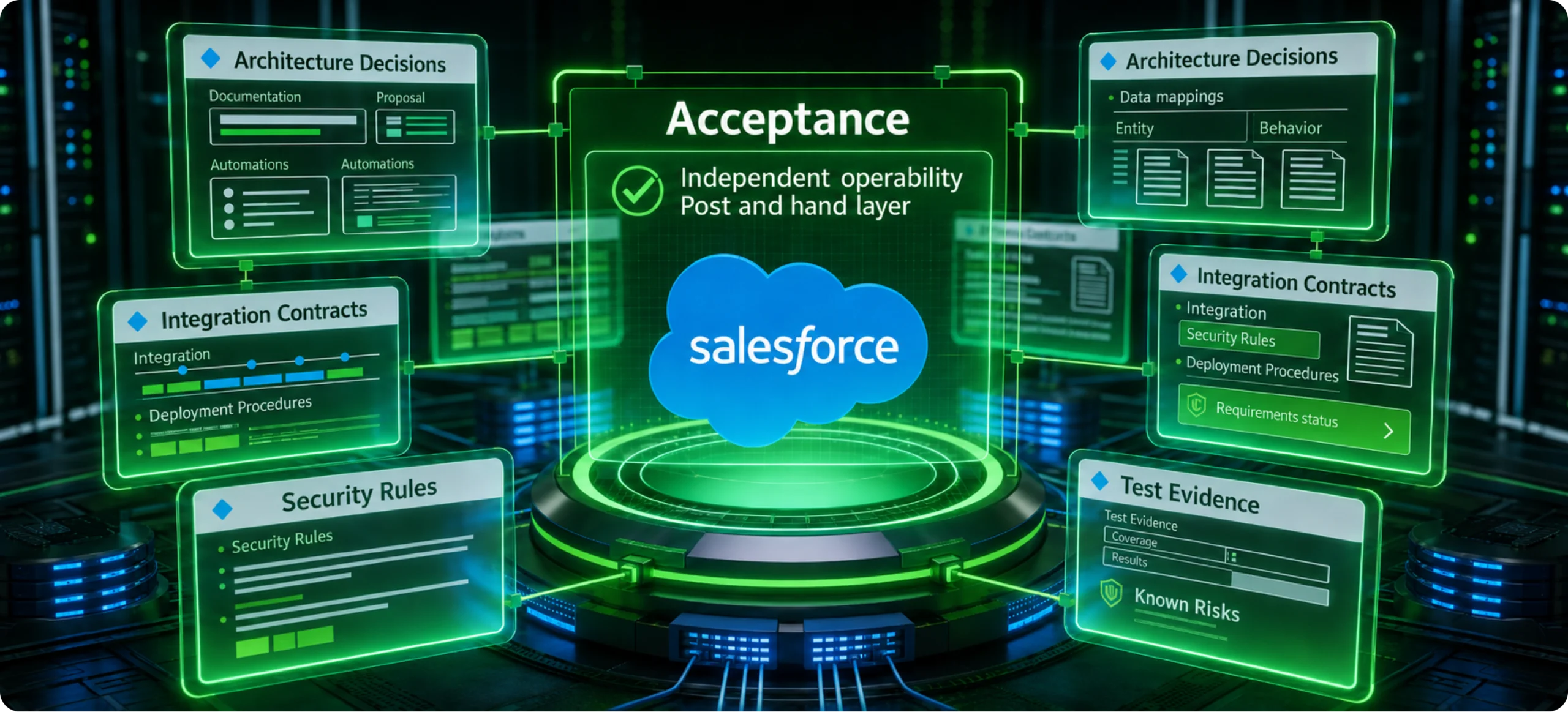
Good Salesforce Implementation Documentation should make the system understandable without requiring the original project team to reconstruct its intent from meetings, ticket history, or memory. That means documenting architecture decisions, data ownership, automation behavior, integration contracts, security rules, environments, deployment procedures, test evidence, open risks, known debt, support ownership, and the business assumptions that shaped the build. The standard is practical: a qualified internal team should be able to maintain, troubleshoot, release, and extend the org with the handover package in front of them.
That is also why Salesforce implementation services should be judged on the quality of the final operating package as well as the configuration that goes live. A buyer is purchasing a maintainable system, not only a completed backlog. The documentation standard below treats handover as a technical acceptance condition and gives buyers a way to test whether project knowledge has actually moved into their control.
TL;DR
The ownership test: A finished Salesforce project should leave the buyer with enough technical and operational evidence to run the org without depending on the original partner for routine explanation. The handover needs current architecture, data, automation, integration, security, test, release, support, and decision records. A folder full of screenshots and workshop decks does not meet that standard if the permanent team still has to ask how the system behaves.
The documentation package: Salesforce Implementation Handover should combine reference material with operational material. Reference documents explain what exists and why. Operational documents explain how to deploy, monitor, recover, support, train, and change it. The buyer should also receive source control, environment records, known technical debt, unresolved risks, ownership lists, access records, and the final acceptance evidence for critical business paths.
The acceptance method: Do not approve documentation by counting files. Test it. Give the package to an administrator, developer, support lead, security reviewer, and business owner who were not responsible for writing it. Ask them to trace a transaction, explain an automation decision, identify an integration owner, run a release, locate test evidence, and find the rollback path. Any answer that still depends on a departing consultant becomes a handover gap that must be closed before final acceptance.
The Buyer Does Not Own the Org Until the Buyer Can Explain It
Salesforce Project Documentation has one job after go-live: preserve enough system knowledge that the next person can make a safe decision. That standard is more demanding than producing a project archive. A requirements document can prove what stakeholders asked for six months ago. It does not tell an administrator which requirement changed, which Flow now enforces it, what exception was approved, or what another system expects when Salesforce updates the record. Handover documentation has to describe the implemented state, including the decisions that changed during delivery.
The same distinction applies to Salesforce Technical Documentation. The permanent team does not need commentary on every field. It needs the relationships and rules that would otherwise require investigation: why an object exists, which process owns it, which automations can alter it, where data originates, what integrations depend on it, which permission grants access, what tests protect the behavior, and what failure looks like. The more expensive the consequence of a wrong change, the more precise that record should be.
The 2025 Stack Overflow Developer Survey found that technical documentation was the most-used resource for learning among respondents who learned coding skills during the year, with nearly 68% using it. That finding is broader than Salesforce, but it supports a practical handover principle: technical teams repeatedly return to written reference material when they need to understand unfamiliar systems. A buyer should expect its Salesforce Project Handover to support that same learning path.
The Minimum Handover Package
A useful Salesforce Implementation Checklist should specify artifacts by operating need rather than by document type. The following table is the minimum package for a material implementation. Smaller projects can combine documents, but they should not omit the information simply because fewer files are used.
|
Handover area |
Minimum artifact |
What it must answer |
Primary owner after go-live |
|
Solution architecture |
Current-state architecture pack |
What components exist, how they interact, and which design decisions constrain future change |
Salesforce architect / platform owner |
|
Data |
Data model and ownership record |
Which objects and fields matter, where data originates, and which system owns each shared concept |
Data owner + Salesforce admin |
|
Automation |
Automation inventory |
What Flows, Apex, approvals, jobs, and rules run, in what order, and for which business purpose |
Admin / development lead |
|
Integrations |
Interface catalog and contracts |
Endpoints, authentication, mappings, retries, errors, limits, reconciliation, and support ownership |
Integration owner |
|
Security |
Access and security design |
Profiles, permission sets, sharing, privileged access, integration identities, and review responsibilities |
Security owner + admin |
|
ALM and deployment |
Environment and release runbook |
How work moves from source control to production, including approvals, tests, rollback, and hotfix handling |
Release manager / DevOps |
|
Testing |
Test pack and traceability |
Which business paths are protected, how tests map to requirements, and what evidence proves acceptance |
QA lead / product owner |
|
Operations |
Support and incident runbook |
How incidents are detected, triaged, escalated, repaired, and communicated |
Support lead |
|
Training |
Role-based operating guides |
How users and admins complete important tasks and where support boundaries sit |
Business owner / enablement lead |
|
Open items |
Debt, risks, decisions, and deferred scope |
What remains unresolved, why it was deferred, and when it should be revisited |
Platform owner / steering group |
Architecture Documentation Should Explain Decisions, Not Redraw Setup Screens
Start with the business capability map
Salesforce Architecture Documentation should begin one level above metadata. Show which business capabilities the implementation supports, which Salesforce clouds or products carry them, which external systems participate, and where major ownership boundaries sit. A diagram that starts and ends with Salesforce objects can miss the real system. Order management may involve Sales Cloud, middleware, ERP, finance, tax, identity, and data services. Service may depend on telephony, knowledge, entitlements, customer portals, and downstream analytics.
Record the decisions that future teams could reasonably question
The architecture pack should state why the team chose standard functionality, Flow, Apex, middleware, a managed package, or another pattern when the choice affects maintainability. Capture the rejected alternatives when the trade-off matters. A future architect should not have to repeat discovery simply to learn that a direct integration was rejected because of rate limits, or that a custom object exists because the standard model could not support a regulatory requirement. Decision records are part of Salesforce Solution Architecture because they preserve intent, not just structure.
Show dependencies and failure boundaries
Each critical business path should have a dependency view. If quote approval depends on pricing data, an external tax service, a finance interface, and a scheduled job, document that chain. Mark the failure points, retry behavior, manual recovery, and owner. This is where Salesforce consulting services can differ from pure configuration work: the design record must connect technical choices to process ownership and long-term operating responsibility.
Data Documentation Needs an Owner Beside Every Important Definition
Salesforce Data Model Documentation should do more than list objects and fields. The buyer needs a business definition, source of truth, creation path, update path, retention rule where relevant, sensitivity classification, and downstream use for important data. Shared concepts deserve special attention. Customer, product, contract, consent, territory, entitlement, and revenue fields often exist across several systems. Handover should make clear which platform has authority when values disagree.
- For each critical object, identify the business owner, technical owner, and system of record.
- Document external IDs, matching rules, duplicate controls, merge behavior, and record survivorship rules.
- List fields populated by integrations, formulas, automation, imports, users, or data products so future teams know where a value actually comes from.
- Capture picklist translations, defaults, null handling, date and time-zone assumptions, and any business definitions that reports depend on.
- Record migration transformations and rejected records, including how the final migrated totals were reconciled.
PwC’s 2026 Global Digital Trust Insights surveyed 3,887 business and technology executives across 72 countries and found that only 6% had fully implemented all surveyed data-risk measures. The report is a cybersecurity study, not a Salesforce documentation benchmark, but it shows why data ownership, access, and risk controls cannot remain informal after a partner exits. The handover should make those controls inspectable by the people who inherit them.
Automation Needs a Map Before it Needs More Comments
Salesforce Org Documentation is weak when automation can be understood only by opening components one at a time. The buyer needs an inventory that groups automation by business transaction. For an opportunity, case, order, contract, or custom object, show which record-triggered Flows, scheduled Flows, Apex triggers, approval processes, platform events, queues, validation rules, formulas, and external calls can change state. The inventory should state purpose, entry conditions, owner, dependencies, failure behavior, and tests.
Comments inside Apex still matter, but comments are not a substitute for design records. Code comments can explain a local decision. They usually cannot show why the organization accepted a cross-system trade-off, which business owner approved it, or which downstream process depends on the behavior. Salesforce Documentation Best Practices should keep local explanations close to code while preserving system-level decisions in a place that survives refactoring and staff changes.
Integration Handover Must Work During an Incident
The best test of Salesforce Integration Documentation is whether an on-call team can use it while a transaction is failing. Every production interface should have a record for the business purpose, source and target systems, endpoint or event, authentication, data contract, mappings, transformations, limits, timeout behavior, retries, duplicate handling, monitoring, reconciliation, release dependencies, and escalation contacts. If middleware owns part of the behavior, the document should point to that logic rather than pretending the interface ends at the Salesforce boundary.
Skillsoft’s IT Skills and Salary Report, based on more than 5,100 technology professionals and decision-makers, reported that 65% of IT decision-makers saw skill gaps across their teams. Documentation cannot replace specialist skill, but it can reduce the amount of hidden system knowledge a replacement engineer must rediscover. A strong Salesforce Implementation Handover makes the inherited environment learnable enough that new specialists can become useful without depending on one former project member for every interface decision.
For interface-heavy programs, Salesforce integration services provide a useful example of the operating boundary buyers should document: APIs, middleware, data movement, monitoring, error handling, and connected-system ownership all need to remain visible after delivery. The implementation partner should not be the only place where those relationships are understood.
A Handover Document is Accepted only when another person can use it

Buyers should test handover quality through tasks, not file counts. The following acceptance exercise can be run during the last two weeks of implementation. Choose reviewers who were not the principal authors of the documents. Give them the package and normal system access, then observe where they have to ask the partner for information that should already exist.
- Trace one critical business transaction from user action through Salesforce automation, integrations, and final system state.
- Identify the owner and source of truth for five business-critical data fields, then explain what happens when connected systems disagree.
- Change one bounded configuration item in a sandbox and follow the documented release path through review, testing, deployment, and verification.
- Locate the access model for a privileged user and an integration identity, including who approves changes and how access is removed.
- Reproduce one known integration failure, find the monitoring evidence, and follow the recovery or escalation instructions.
- Find the test evidence for one high-value process and map it back to the requirement or acceptance condition it protects.
- Locate three known technical-debt items and explain their consequence, owner, and recommended treatment window.
- Run the support process for a simulated production incident and confirm that the right owners, logs, and escalation contacts are available.
Weak, Acceptable, and Strong Handovers Look Different
|
Area |
Weak handover |
Acceptable handover |
Strong handover |
|
Architecture |
Screenshots and old design deck |
Current component and dependency diagrams |
Current diagrams plus decision records, owners, risks, and operating assumptions |
|
Data |
Field list exported from Setup |
Object model, key definitions, source systems, migration notes |
Ownership, lineage, transformations, reconciliation, sensitivity, and prevention controls |
|
Automation |
List of Flows and classes |
Purpose and owner for active automation |
Transaction-level map with order, dependencies, failure behavior, tests, and retirement notes |
|
Integrations |
Endpoint list |
Interface catalog with mappings and credentials process |
Contracts, failure states, retries, monitoring, reconciliation, release dependencies, and support model |
|
Security |
Profiles and permission exports |
Access model and privileged-role list |
Access rationale, approval path, integration identities, review cadence, exceptions, and offboarding |
|
Testing |
UAT sign-off only |
Test cases and final results |
Requirement traceability, regression assets, known gaps, test data rules, and ownership |
|
Release |
Deployment checklist |
Environment map and normal release steps |
Source control, approvals, rollback, hotfix, dependency, and post-release verification rules |
|
Operations |
Support contact list |
Runbook and escalation path |
Runbook plus monitoring, incident examples, ownership boundaries, service expectations, and review cadence |
Security Handover should Remove the Partner as a Hidden Control Point
A Salesforce Project Handover is incomplete when privileged access, integration credentials, certificate ownership, connected apps, external users, or emergency admin processes still depend on the implementation partner. The security package should show who can access what, why the access exists, who approves changes, where secrets are stored, how credentials rotate, which external systems trust Salesforce, and how access is removed when a person or vendor leaves.
GitLab’s 2026 AI Accountability Report surveyed 1,528 developers and technology buyers and found that 80% said their organizations adopted AI tools faster than they developed policies to govern them. Salesforce programs now face similar pressure when teams add AI agents, external data, automation, and new integrations quickly. The documentation lesson is broader than AI: governance has to keep pace with implementation. A handover should include current decision rights and control records for new technical capabilities, not leave policy to catch up later.
Release Documentation Should Make the Next Deployment Boring
Salesforce Deployment Documentation should explain one normal path from approved work to production. Name the source-control repository, branch or package model, environments, scratch-org or sandbox use, metadata ownership, automated checks, review requirements, test gates, deployment tooling, production approvals, rollback conditions, hotfix path, and post-release verification. If data changes or external deployments must occur in sequence, the release record should show that dependency.
A common handover failure is documenting the happy path while leaving exceptions in the heads of the delivery team. Buyers should demand the exception path too. What happens when a validation rule blocks migration? How is a partial deployment handled? Which changes require a destructive deployment? How is a failed permission update restored? Who can authorize an emergency production fix? Salesforce Technical Documentation becomes operational when it answers those questions before an incident.
For implementations that move into recurring support, Salesforce support services sit on the other side of this handover boundary. Support teams can only maintain the org consistently when release, incident, ownership, and escalation information is current enough to use. The implementation package should therefore be written for the people who will operate the system next, not only for project closure.
Testing Evidence Needs Traceability, not a Folder Called UAT
The test handover should state what was tested, against which requirement or business path, with what data, in which environment, and with what result. Critical paths should include negative cases and failure behavior, especially for integrations, permissions, pricing, approvals, and high-volume automation. Known test gaps should be recorded rather than hidden behind a single acceptance signature. The permanent team needs to know what is protected before it changes the org.
IBM’s 2025 Data Breach Report analyzed 600 breached organizations across 17 industries. Its focus is security rather than Salesforce testing, but it reinforces the cost of weak governance and incomplete controls around data. A buyer inheriting an implementation should know which security, access, data, and failure scenarios were actually tested. Test evidence is part of the control record, particularly where Salesforce handles customer, financial, employee, or regulated information.
Training Material Should Describe the Operating Model Users Actually Received
Training decks age quickly when they are built before configuration settles. Final Salesforce Project Documentation should include role-based operating guides that reflect the production process, not the demo environment. A sales user needs the stages, required information, exception path, and ownership rules for opportunity work. A service user needs routing, escalation, entitlement, and knowledge behavior. An administrator needs to set up ownership, support boundaries, and change rules. These are different documents because the decisions each audience must make are different.
Atlassian’s State of Teams 2026 research collected survey data from more than 12,000 knowledge workers and 173 Fortune 1000 executives. Its broader work on team information flow shows how costly fragmented knowledge can become. A Salesforce handover should therefore have a named home, a clear indexing model, version ownership, and a rule for retiring stale material. Documentation that cannot be found quickly is operationally close to documentation that does not exist.
The Known-Debt Register is Part of the Product You Bought
Good implementations still finish with compromises. A deadline may defer a refactor. A temporary integration may remain until ERP modernization. A permission exception may stay open while a business role is redesigned. A migration may carry historical data that is valid but messy. Salesforce Documentation Best Practices require those compromises to be named. A buyer should never discover six months later that the partner already knew a component was temporary or difficult to maintain.
- Describe the debt or risk in plain technical terms.
- Name the affected business path and components.
- State why the issue was accepted or deferred.
- Record the consequence of leaving it unchanged.
- Give a recommended treatment window or trigger condition.
- Name the owner who will decide whether and when to address it.
This register turns Salesforce Implementation Documentation into a forward-looking operating tool. It also prevents the next partner or internal team from treating every unusual design choice as accidental. Some decisions are debt. Others are deliberate trade-offs. The handover should make that distinction visible.
Who Owns Each Document After the Project Closes?
Handover fails when documentation is treated as frozen project output. Salesforce Org Documentation has to change as the org changes. Buyers should assign ownership before final acceptance and set a review trigger for each document. Some records should change with every release; others only when architecture, security, or process ownership changes.
|
Document |
Operational owner |
Update trigger |
Review cadence |
|
Architecture and decision records |
Platform architect |
Material design or dependency change |
At major release or quarterly |
|
Data model and ownership |
Data owner + admin |
New field/object, source change, migration, governance change |
Quarterly |
|
Automation inventory |
Admin / development lead |
Flow, Apex, approval, event, or scheduled-job change |
Every release |
|
Integration catalog |
Integration owner |
Contract, endpoint, credential, mapping, retry, or owner change |
Every interface release |
|
Security model |
Security owner + admin |
Role, permission, sharing, connected app, or identity change |
Monthly/quarterly by risk |
|
Release runbook |
Release manager |
Tooling, environment, approval, rollback, or pipeline change |
Every process change |
|
Support runbook |
Support lead |
New incident pattern, monitor, escalation, or ownership change |
Monthly during early operations |
|
Training guides |
Business process owner |
Process, UI, policy, or role change |
Each material user-facing release |
The Final Acceptance Meeting Should be a Transfer of Control
The final documentation review should not be a presentation where the partner scrolls through folders. It should be a transfer-of-control session where internal owners demonstrate that they can use the materials. Ask the platform owner to navigate the Salesforce Solution Architecture. Ask the admin to locate data ownership and automation rules. Ask the integration owner to trace a failed message. Ask security to review privileged access. Ask the release manager to walk through a rollback. Ask support to handle a simulated incident.
Where the buyer wants another team to assume ongoing administration, release, and improvement ownership, Salesforce managed services require the same discipline. A new operating team should receive the same evidence an internal team would need. Changing the support model does not remove the requirement for a current, usable handover package.
The acceptance decision should record gaps explicitly. Missing documents, stale diagrams, uncertain owners, undocumented credentials, absent test evidence, and unresolved deployment steps should become closure items with dates and owners. Final payment or formal project acceptance is the buyer’s strongest point of control over handover quality. Documentation should therefore be a contractual deliverable with observable acceptance conditions, not a polite request made after the project team has already rolled off.
A Practical Buyer Checklist Before Signing Off
- Current-state architecture diagrams match the production org and connected systems.
- Major architecture decisions include rationale, alternatives, and owner.
- Critical objects and fields have business definitions and source-of-truth ownership.
- Automation is mapped by transaction, with dependencies, owners, failure behavior, and tests.
- Every production integration has a contract, mapping, authentication process, monitoring path, reconciliation rule, and escalation owner.
- Privileged access, connected apps, integration identities, certificates, and vendor accounts are documented and under buyer control.
- Source control, environments, deployment gates, rollback, hotfix handling, and post-release verification are documented.
- Test cases and results can be traced to critical requirements and business paths.
- Support runbooks include monitoring, logs, escalation, incident ownership, and recovery steps.
- Role-based user and admin guides match the production process.
- Known technical debt, deferred scope, open risks, and temporary designs are visible with owners and treatment guidance.
- Every living document has an operational owner and an update trigger after project close.
- Internal reviewers can complete the handover acceptance exercise without depending on undocumented partner knowledge.
Documentation Quality Changes the Economics of the Implementation

Salesforce Knowledge Transfer is often discussed as a series of final workshops. Workshops help, but they decay quickly if the information is not tied to maintained records and repeatable operating procedures. The economic value of documentation appears months later, when a new admin can understand why a Flow exists, a developer can change an integration without breaking a hidden consumer, or a support lead can recover a failed transaction without finding the consultant who built it.
The same logic affects partner transitions. A buyer with complete Salesforce Implementation Documentation can change vendors with less discovery, fewer duplicated assessments, and a lower probability that the new team misreads deliberate design choices as defects. A buyer with weak records effectively pays a knowledge-reconstruction tax each time the operating team changes. That cost rarely appears in the original implementation quote, but it becomes visible in slower releases, repeated workshops, rework, and dependence on specific individuals.
For projects with custom code or extensions, Salesforce development services add another documentation obligation: source structure, coding standards, component responsibilities, test strategy, packaging, dependencies, and support ownership need to remain understandable to the next development team. Custom work increases the need for precise technical records because the platform cannot explain the business intent on its own.
What Buyers Should Demand at Handover?
A good Salesforce Implementation Handover leaves the buyer with control over the system’s meaning, not simply access to the org. Salesforce Implementation Documentation should explain the architecture, data, automation, integrations, security, environments, releases, tests, support model, user process, debt, and decisions that define the production system. The package should be current enough to use, detailed enough to support change, and owned by people who will keep it current.
The standard can be tested without inventing a documentation score. Hand the materials to people who did not write them and ask them to perform real operating tasks. If they can trace a transaction, find the source of truth, understand a design decision, release a bounded change, recover a failure, identify an access owner, and find known debt without calling the original partner, the documentation is doing its job. If they cannot, the project still has knowledge trapped inside the delivery team.
The strongest buyer position is to define that test before implementation starts. Put Salesforce Project Handover artifacts, owners, update expectations, and acceptance exercises into the delivery plan from the beginning. Documentation written alongside decisions is more accurate than documentation reconstructed during the final week. It also gives the project team a shared record while the implementation is still moving, which reduces ambiguity before handover even begins.
Frequently Asked Questions
What should Salesforce Implementation Documentation include?
It should include current architecture, data ownership, automation, integrations, security, environments, release procedures, testing, support, role-based operating guidance, known debt, open risks, deferred decisions, and ownership for maintaining those records after go-live. The exact number of files can vary. The information required to operate the org should not.
What is a Salesforce Implementation Handover?
Salesforce Implementation Handover is the transfer of system knowledge, access, operating procedures, technical records, open risks, and decision ownership from the delivery team to the people who will run the org. It is complete when the receiving team can perform normal maintenance, support, release, and troubleshooting work without depending on undocumented partner knowledge.
How is Salesforce Project Documentation different from handover documentation?
Salesforce Project Documentation can include discovery notes, requirements, plans, workshop outputs, and project governance records. Handover documentation focuses on the implemented production state and the information required to operate it. Some project records remain useful, but buyers should not assume the project archive automatically explains the final system.
What belongs in Salesforce Architecture Documentation?
Salesforce Architecture Documentation should show business capabilities, Salesforce products, major components, connected systems, data movement, security boundaries, dependencies, failure points, and material design decisions. Decision records should explain why important patterns or customizations were chosen when that rationale affects future maintenance.
What should Salesforce Data Model Documentation contain?
It should contain critical objects and fields, business definitions, system-of-record ownership, external IDs, relationships, creation and update paths, integration mappings, retention or sensitivity rules where relevant, duplicate controls, migration transformations, and reconciliation logic for important shared data.
What is required in Salesforce Integration Documentation?
Each production interface should document its purpose, source and target, API or event contract, authentication, mappings, transformations, limits, retries, duplicate handling, errors, monitoring, reconciliation, release dependencies, support owner, and recovery or escalation path.
What should Salesforce Deployment Documentation explain?
It should explain source control, environments, branching or packaging, automated checks, approvals, test gates, deployment tooling, production steps, rollback, hotfix handling, data or external-system dependencies, post-release verification, and who can authorize exceptions.
How should buyers test Salesforce Knowledge Transfer?
Use task-based acceptance. Ask internal reviewers who did not write the documents to trace a critical transaction, identify data ownership, review an automation decision, follow an integration failure, run a bounded release, locate test evidence, review privileged access, and use the support runbook. Record every point where undocumented explanation is still required.
How often should Salesforce Org Documentation be updated?
Update frequency should follow the document. Automation inventories and release records may change every release. Integration records should change whenever contracts, mappings, credentials, or owners change. Security documentation should follow access changes and review cycles. Architecture, data ownership, and training materials should change when the underlying design or process changes.
Should known technical debt be included in the final handover?
Yes. Known technical debt, temporary designs, deferred scope, open risks, and unresolved decisions should be recorded with affected components, business consequence, reason for deferral, owner, and suggested treatment window. Hiding known debt creates avoidable rediscovery and can cause future teams to make unsafe assumptions.
Who should own Salesforce Project Handover documents after go-live?
Ownership should sit with the operating role closest to the information: platform architecture with the architect or platform owner, automation with the admin or development lead, integrations with the integration owner, security with the security owner and admin, releases with DevOps or release management, and process guides with business owners.
Can a small Salesforce implementation use a lighter documentation set?
Yes. Small projects can combine artifacts into fewer documents, but the same operating questions still need answers. A compact implementation may use one architecture and operations pack instead of several files. What matters is whether the buyer can understand, maintain, support, release, and extend the production solution after the partner leaves.