top benifits outsourcing
Salesforce Marketing Cloud

Top Benefits of Outsourcing Marketing Cloud Account Engagement for B2B Teams in 2026

user
By user
September 23, 2026
cloud engagement b2b

Marketing Cloud Account Engagement has become a much bigger operational responsibility than “the tool that sends B2B emails.” In a mature Salesforce environment, it touches lead capture, scoring and grading, Engagement Studio, campaign attribution, consent, CRM synchronization, data quality, reporting, and the handoff between marketing and sales. That breadth is useful, but it also creates a staffing problem: few B2B marketing teams have every skill needed to operate the platform well every week of the year.

That is why Marketing Cloud Account Engagement outsourcing is increasingly an operating-model decision rather than an emergency fix. A B2B team may outsource campaign production, platform administration, scoring optimization, integration troubleshooting, analytics, or complete day-to-day ownership. The value is not simply “cheaper labor.” It is access to specialized capacity at the point where the work appears, without building every capability into permanent headcount.

The timing matters in 2026. Marketing teams are being asked to do more with automation, AI, cleaner data, stronger attribution, and tighter sales alignment while hiring remains difficult for specialist roles. For teams deciding what to keep in-house and what to externalize, Marketing Cloud Account Engagement services sit in the middle of that decision: the platform still needs internal business ownership, but specialist execution can be brought in around the work that requires deeper Salesforce and marketing automation expertise.

This guide explains where outsourcing creates real value, which delivery models B2B teams can use, what ten providers in the market emphasize, and what actual Pardot and Account Engagement case studies reveal about the economics of outside expertise.

TL;DR

Marketing Cloud Account Engagement outsourcing gives B2B teams access to specialized skills without forcing every capability into a permanent role. That matters because the platform now sits across campaign operations, CRM data, scoring, reporting, integrations, compliance, and increasingly AI-ready data foundations. Outsourcing works best when the team keeps ownership of strategy, brand, sales definitions, and priorities while an external specialist handles configuration, optimization, troubleshooting, and repeatable execution.

The biggest benefits are speed, flexibility, continuity, and depth. Teams can add senior expertise for architecture or complex Salesforce work, then use lower-cost operational capacity for campaign builds and administration. The model can also reduce the recruiting delay attached to niche skills. The SHRM 2026 recruiting benchmark reports a 39-day median time-to-fill for non-executive positions and says more than two in three organizations struggled with hiring for open roles in 2026. For a campaign or CRM backlog, that delay can matter as much as salary.

The model is not automatically better than hiring. B2B marketing automation outsourcing becomes valuable when workload changes over time, specialist skills are needed only part time, the internal team is overloaded, or the platform needs a broader mix of Salesforce expertise than one employee can reasonably provide. If workload is stable, strategic ownership is weak, or no one internally can set priorities, outsourcing can become expensive context switching. The right goal is not to outsource Account Engagement completely; it is to externalize the work where an outside team creates measurable leverage.

Why Outsourcing Account Engagement Matters More for B2B Teams in 2026

B2B marketing operations have become more technical without becoming less commercial. Marketing still has to generate a pipeline, but the work underneath that goal now includes lifecycle logic, CRM field governance, scoring models, consent, attribution, automation, integration monitoring, and data readiness for AI. A marketer who can write an email is not necessarily the person who should diagnose a Salesforce connector conflict, and a Salesforce administrator is not automatically the person who should design a nurture strategy.

That skills overlap is part of a wider workforce problem. The World Economic Forum skills report found that 63% of employers identified skill gaps as a major barrier to transformation for 2025-2030. At the same time, the 2026 B2B market is leaning harder into automation. The Sagefrog 2026 B2B report says Salesforce is used by 42% of surveyed marketers and Pardot by 38%, while data and analytics rank as a leading investment area.

Those two trends meet inside Salesforce Account Engagement. Companies want more automation, better lead quality, and better reporting, but they do not always have a dedicated platform specialist sitting between marketing operations and Salesforce. For many teams, Salesforce marketing automation services become a way to add that missing execution layer without redesigning the entire org chart.

What Does Outsourcing Account Engagement Actually Cover?

Outsourcing Account Engagement can mean very different things depending on who retains ownership. A company may outsource a few technical tasks, a fixed implementation, recurring campaign execution, or the entire operational service. Before comparing providers, define which layer is leaving the internal team.

Outsourced layer

Typical work

Internal owner should still control

Best-fit model

Campaign operations

Emails, forms, landing pages, lists, QA, campaign setup

Messaging, audience, approval

Retainer or staff augmentation

Platform administration

Users, folders, automation rules, settings, asset governance

Priorities and risk policy

Managed services

Marketing operations

Scoring, grading, lifecycle, attribution, reporting

Sales definitions and funnel strategy

Consulting + ongoing support

Salesforce integration

Connector health, field mapping, campaign sync, API dependencies

Data ownership and architecture decisions

Specialist project or managed support

Optimization

Audits, technical debt, deliverability, database cleanup

Business goals and acceptance criteria

Fixed project or quarterly advisory

Strategic architecture

Business units, data model, governance, migration

Executive decisions and operating model

Senior consulting

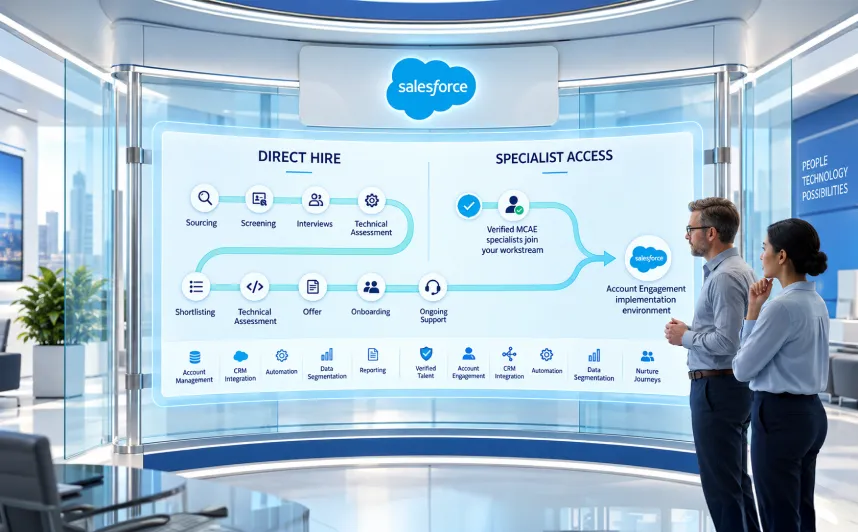
This is why Account Engagement managed services and Salesforce staff augmentation are not interchangeable. Managed services transfer more responsibility to the provider; augmentation adds people under the client’s direction. Pardot outsourcing services can also sit between the two, with a retained specialist or small pod owning a clearly defined part of marketing operations.

The Business Benefits of Outsourcing Account Engagement

Faster Access to Specialist Platform Knowledge

You can buy expertise at the moment the problem appears. One month you may need an Engagement Studio specialist, the next a Salesforce admin who understands connector behavior, and later someone who can redesign attribution. One permanent hire rarely covers all three equally well.

With Marketing Cloud Account Engagement services, a provider can mix skills across a bench instead of forcing every problem through one job description. This is especially useful when the work is narrow but consequential, such as repairing scoring categories, resolving a sync queue, or restructuring connected campaigns before a major launch.

For B2B teams trying to outsource Pardot specialists, the key advantage is role matching: reserve senior consulting for decisions and architecture, then use specialist capacity for routine configuration.

Shorter Time From Backlog to Production

Internal marketing teams often know what they want but cannot get it into production. Campaigns wait for Salesforce capacity, QA, or approval while higher-priority CRM work keeps moving ahead. Outsourcing creates a dedicated execution path.

The opportunity cost of delay is easy to miss in a vendor comparison. Account Engagement support services reduce that queue when the provider has clear access, acceptance criteria, and an agreed release process.

For teams that want outside capacity while retaining backlog control, Salesforce staff augmentation services can place a specialist inside the existing delivery rhythm rather than moving the whole function outside the business.

More Flexible Cost Than Permanent Headcount

A permanent hire is economical when there is stable, full-time work for years. B2B marketing automation outsourcing is more flexible when workload rises and falls. A company can use heavier capacity during implementation, migration, event season, or a nurture rebuild, then reduce it after the backlog normalizes.

This flexibility changes the cost structure from fixed headcount to variable capacity. It also avoids paying senior rates for weeks when the work is mostly campaign administration. The benefits of outsourcing Account Engagement become strongest when the demand curve is uneven: strategy and architecture in bursts, execution every week, and complex troubleshooting only occasionally.

Outside support is not automatically cheaper. A poorly scoped retainer can waste money just as easily as an underused employee; the advantage is that capacity can be resized more easily when the commercial model is designed well.

Better Continuity Than Depending on One Internal Specialist

Many Account Engagement environments depend on one person who knows why every list, field, and automation rule exists. When that person leaves, the platform becomes a documentation exercise under pressure.

Pardot managed services reduce that single-person dependency by spreading knowledge across a small delivery team, using runbooks, peer review, and service ownership. The benefit is resilience rather than raw capacity. Campaign execution continues, troubleshooting has a backup route, and platform knowledge is less likely to disappear with one resignation.

This is why Salesforce managed services support differs from hiring a freelancer for tickets: the service should preserve context, documentation, and continuity across releases and staff changes.

Stronger Sales and Marketing Alignment

Account Engagement only creates value when marketing activity becomes useful to sales. That requires agreement on what qualifies a lead, what score means, what grade means, when ownership changes, which fields sales must maintain, and what feedback returns to marketing.

Sagefrog’s 2026 B2B research, based on nearly 500 marketers, also emphasizes sales-marketing alignment as a central priority. An external marketing automation consultant can help because they are not protecting either team’s historical process. They can map the lifecycle, show where the handoff breaks, and translate the agreed logic into Salesforce Account Engagement.

This is where Pardot consulting services can be more valuable than generic campaign production. The deliverable is not another nurture program; it is a qualification system that sales actually trusts and marketing can measure.

Cleaner CRM Data and More Reliable Integrations

Most mature Account Engagement problems are partly Salesforce problems. A scoring rule can be correct while the underlying field is stale. A form can work while a duplicate rule blocks sync. A nurture program can be perfect while an integration writes the wrong lifecycle value back into CRM.

A provider that understands both systems can treat the connector as architecture rather than a black box. For complex environments, a Salesforce integration services framework helps define source-of-truth fields, sync behavior, error ownership, third-party dependencies, and testing before changes reach production.

That cross-system depth is one of the strongest benefits of outsourcing Account Engagement for B2B teams. It is difficult to maintain inside a small marketing department because integration problems are irregular: not enough to justify a full-time integration specialist, but expensive when they appear.

More Consistent Campaign Governance and QA

As campaign volume rises, small inconsistencies become operational debt. Naming conventions drift, duplicate lists appear, old automation rules keep firing, UTMs are captured differently, and reporting becomes harder to reconcile. The platform still works, but every new request takes longer because nobody knows which assets are authoritative.

Account Engagement managed services can impose a repeatable build-and-release process: intake, build, peer review, QA, approval, deployment, documentation, and post-send checks. That makes campaign delivery less dependent on individual habits.

The benefit is repeatability. Pardot support services become more valuable when the provider reduces errors and makes future work cheaper instead of merely closing tickets faster.

Better Use of Advanced Features You Already Pay For

Many B2B teams use only a fraction of their Salesforce marketing automation platform. They send emails and capture forms but never revisit scoring, grading, dynamic lists, or campaign influence.

The Act-On marketing automation trends report, based on more than 100 marketers, highlights continuing challenges around reporting, attribution, integration, and proving ROI even as teams use automation to accomplish more with limited resources. Outside specialists can accelerate feature adoption because they have seen multiple implementations rather than one internal setup.

B2B marketing automation services create leverage by making existing capabilities usable enough that teams stop solving platform problems with spreadsheets and manual workarounds.

Stronger Reporting, Attribution, and Decision Support

Marketing leaders increasingly need to answer commercial questions: which campaigns influenced the pipeline, which sources create sales-accepted leads, and where prospects stall.

Salesforce Account Engagement can support those answers only when campaign structure, UTMs, lifecycle fields, connected campaigns, and opportunity relationships are consistent. For Salesforce Account Engagement teams, the measurement layer is part of the operating model, not an afterthought. External specialists can rebuild that measurement layer.

That is especially relevant in 2026 because the Salesforce 2026 marketing report found that 75% of marketers had adopted AI, while 84% still reported running generic campaigns and many remained constrained by fragmented or irrelevant data. Better reporting starts with better data structure, not another dashboard.

Easier Scaling Without Rebuilding the Team

A B2B company can move from two campaigns a month to ten after a funding round, geographic expansion, or acquisition. Internal headcount rarely scales at the same speed.

Salesforce marketing automation outsourcing gives teams a way to increase delivery capacity without immediately changing permanent staffing. A provider can add campaign operations, QA, integration support, or senior oversight around a growth period, then reduce capacity once processes stabilize.

This is one of the practical benefits of outsourcing Account Engagement that finance teams tend to understand quickly: capacity can follow the roadmap rather than the org chart.

More Time for Internal Teams to Work on Strategy and Content

Every hour a demand-generation manager spends troubleshooting sync is time not spent on audience strategy, positioning, content, or sales feedback.

Outsourcing does not remove internal responsibility. It changes where internal attention goes. Pardot managed services can absorb recurring administration; Account Engagement support services can take technical requests; marketing leaders retain the work that depends on company knowledge and customer understanding.

That division of labor is durable because the vendor owns platform work, not the company’s marketing judgment.

Outsourcing vs Hiring vs Staff Augmentation: Which Model Fits the Benefit You Need?

Decision factor

Full-time hire

Project outsourcing

Staff augmentation

Managed services

Best for

Stable, permanent ownership

Defined outcome

Extra capacity under internal direction

Ongoing operational ownership

Speed to add capacity

Slowest

Medium

Fast

Medium

Internal management required

High

Medium

High

Lower

Flexibility to scale

Low

Medium

High

Medium

Access to multiple specialists

Low unless team is large

High for project

Depends on provider

Usually high

Knowledge retention

Highest

Requires handover

Good with stable resource

Good with documentation

Typical risk

Vacancy or underutilization

Scope creep

Weak internal direction

Buying more service than needed

The choice depends on what is actually blocking the team. If the roadmap is clear but there are not enough hands, Salesforce staff augmentation is usually the cleaner model. If the platform needs continuous monitoring, prioritization, and optimization, Account Engagement managed services are more natural. If the need is a scoring redesign or implementation, a fixed project can be more efficient.

Companies sometimes jump to outsourcing because hiring has stalled. That can be rational, but the cause should be understood first. HyphenX’s guide on how to hire Account Engagement specialists explains why the talent pool is narrower than a generic “Salesforce Marketing Cloud” search suggests and why the old Pardot name still affects candidate discovery.

10 Companies B2B Teams May Compare for Account Engagement Outsourcing in 2026

This is not a ranking. These companies represent different delivery styles a B2B buyer may encounter when comparing Pardot outsourcing services, consulting, implementation, or managed support. The useful exercise is to compare fit: who owns strategy, who builds, who manages Salesforce dependencies, and how much ongoing responsibility transfers to the provider.

1. HyphenX

HyphenX combines Marketing Cloud Account Engagement services with Salesforce integration, staff augmentation, and managed services. It fits B2B teams whose marketing automation work crosses into CRM data or Salesforce administration, and it can support both embedded specialists and broader service ownership when companies outsource Pardot specialists.

2. VALiNTRY360

VALiNTRY360 covers implementation, CRM synchronization, lead scoring, Engagement Studio, reporting, training, journey optimization, and ongoing support. Its broader Salesforce practice is relevant when Account Engagement support services must coexist with other CRM workstreams.

3. Sercante

Sercante specializes in Account Engagement and marketing operations, covering implementation, migration, scoring and grading, reporting, audits, integrations, training, and managed services. For teams prioritizing deep Pardot consulting services, that specialization is the main differentiator.

4. MarCloud Consulting

MarCloud works across Account Engagement and related marketing operations, with case studies covering Pardot optimization, lead handoff, automation, and CRM-connected campaigns. It is a useful comparison for teams seeking strategy plus hands-on platform delivery.

5. KVP Business Solutions

KVP publishes Account Engagement implementation and optimization examples across several industries. Its delivery combines configuration, templates, scoring, forms, attribution, and Salesforce alignment, making it relevant where B2B marketing automation services sit inside a larger Salesforce program.

6. Grazitti Interactive

Grazitti offers Account Engagement implementation, integration, migration, onboarding, audits, training, and technical support. Its wider marketing automation practice also spans other platforms, which can suit companies operating a mixed martech stack.

7. Cyntexa

Cyntexa is a broad Salesforce implementation partner whose portfolio includes Marketing Cloud Account Engagement. It is relevant for buyers treating Salesforce Account Engagement as part of a multi-cloud implementation or modernization program.

8. Algoworks

Algoworks is a broad Salesforce consulting and managed-services provider covering Marketing Cloud, Pardot, integration, support, and custom development. It is a useful comparison when Salesforce marketing automation outsourcing must sit beside development or enterprise integration capacity.

9. Mphasis Silverline

Mphasis Silverline has a dedicated Marketing Cloud Account Engagement offering and a long Salesforce consulting history. It is relevant for larger organizations placing Account Engagement work inside a wider transformation, integration, or managed-services relationship.

10. GravityLab

GravityLab’s published work includes B2B Pardot automation within connected sales, finance, and marketing programs. That model suits companies treating Account Engagement as part of a broader revenue architecture rather than an isolated campaign tool.

When comparing any of these providers, the name matters less than the delivery model. Ask who will actually perform the work, how often senior specialists review it, how Salesforce-side changes are handled, what documentation is produced, and whether the provider can scale down when the backlog shrinks.

Where Outsourcing Creates the Most Value Across the Account Engagement Lifecycle

B2B marketing automation outsourcing tends to deliver the strongest value in work that is important but uneven. These are common examples:

  • Implementation and reimplementation: platform setup, Salesforce connector, campaign architecture, scoring, grading, forms, governance, and training.
  • Backlog reduction: campaigns, templates, landing pages, dynamic lists, reporting, and QA that internal teams cannot get through quickly enough.
  • Scoring and lifecycle redesign: aligning MQL definitions with sales, updating grading criteria, and removing years of score inflation.
  • Connector and data remediation: field mapping, duplicate handling, sync errors, campaign membership, and cross-system troubleshooting.
  • Engagement Studio optimization: rebuilding nurture around actual buyer stages instead of adding more one-off emails.
  • Reporting and attribution: Connected Campaigns, UTMs, funnel reporting, opportunity influence, and executive dashboards.
  • Release and governance support: regression checks, documentation, naming standards, user access, and technical debt reduction.
  • Temporary specialist cover: parental leave, resignation, hiring gaps, acquisitions, product launches, or major event periods.

For companies planning a new deployment, the Account Engagement implementation cost guide is useful because implementation economics and outsourcing economics overlap. A platform may need intense specialist capacity during setup and far less once governance and repeatable campaign processes are established.

Case Studies: What Real Outsourced Account Engagement Work Shows

Case studies show where outside expertise changed an operating result. HyphenX maintains its own HyphenX Salesforce case studies across CRM transformation, automation, and integration. The three external examples below focus directly on Pardot or Marketing Cloud Account Engagement and illustrate different benefits of outsourcing.

Case Study 1: Pieta – More Output Without Expanding a Small Internal Team

Pieta’s annual Darkness Into Light fundraising campaign had a small internal team and a large communication workload. MarCloud’s Pieta Account Engagement case study describes an optimization program covering audience segmentation, automation workflows, dynamic lists, dashboards, and team enablement.

The published outcome was fundraising performance 97% above target and a EUR57,000 uplift on the previous year. The important outsourcing lesson is not that a partner “ran email.” The partner improved the operating system around the campaign so a small team could execute a larger program without proportionally increasing manual workload.

This is a clear example of the benefits of outsourcing Account Engagement when the constraint is specialist capacity rather than marketing ideas. The internal team still owned the campaign and supporter context; outside expertise improved how the platform executed it.

Case Study 2: Kirkpatrick Price – Turning a Cold Database Into Qualified Opportunities

MarCloud’s Kirkpatrick Price Pardot case study documents work for an information-security services company that used Pardot to promote remote services. The consultancy configured scoring and grading, built an automated campaign, and set up Salesforce tasks so warm leads moved directly to sales users.

The published results included a 26% email open rate, 36 marketing-qualified opportunities, two long-term contracts, and $78,000 in attributed revenue. The value came from combining strategy, automation, qualification, and sales handoff rather than treating campaign production as a standalone task.

For B2B teams considering Pardot managed services or Pardot consulting services, this case shows why platform expertise can affect revenue quality. A better nurture program matters, but so does what happens when a prospect crosses the threshold and sales needs to act.

Case Study 3: Retail Technology – Building Qualification, Forms, and Attribution Together

KVP’s retail technology Pardot case study describes a company that already had the Salesforce Sales Cloud but was using Pardot mainly for basic email sends. The outsourced engagement introduced scoring and grading, progressive profiling, dynamic country and region forms, UTM tracking, and custom reporting.

The published outcomes included consistent MQL standards, geo-targeted forms, and full UTM attribution from campaign touch through Salesforce. This is a good example of Salesforce marketing automation outsourcing creating value by connecting several disciplines at once. The company did not need ten separate point solutions; it needed someone to design the marketing automation system as one connected process.

Across all three cases, outside teams add the most value when they remove friction, establish reusable systems, and leave behind better data and clearer processes.

What B2B Teams Should Keep In-House?

Outsourcing works best when the company does not outsource its own judgment. Keep these responsibilities internal even when Account Engagement managed services handles most day-to-day platform work:

  • Business goals, market positioning, and campaign priorities
  • Ideal customer profile and account strategy
  • Sales definitions for MQL, SQL, opportunity, and disqualification
  • Brand voice, offers, and final content approval
  • Legal and privacy decisions
  • Data ownership and system-of-record decisions
  • Budget authority and roadmap prioritization
  • Final acceptance of major architecture changes

Everything else can be evaluated for external support. This distinction prevents B2B marketing automation outsourcing from becoming vendor dependent. A provider should increase internal clarity and documentation over time, not make the client less capable of understanding its own platform.

Risks to Manage Before You Outsource Pardot Specialists

The benefits are real, but the operating model has failure modes. The most common ones are straightforward:

  • No internal owner: a provider receives tickets but nobody can prioritize them or resolve stakeholder disagreements.
  • Vague scope: “manage Pardot” means different things to finance, marketing, sales, and the vendor.
  • Too many handoffs: campaign work, Salesforce work, integration work, and reporting sit with different suppliers that blame each other when data breaks.
  • Weak documentation: the service completes work but does not leave runbooks, field maps, naming standards, or decision history.
  • Senior rates for junior work: every request is handled by the most expensive consultant regardless of complexity.
  • No QA gate: changes move directly into production without peer review, testing, or acceptance criteria.
  • No exit plan: knowledge transfer is discussed only after the contract is being terminated.

A strong Account Engagement support services agreement should therefore define ownership, SLA, access controls, testing, documentation, escalation, and knowledge transfer before the first campaign is built.

How to Measure Whether Outsourcing Is Actually Working?

Do not evaluate Salesforce marketing automation outsourcing only by hours consumed or tickets closed. The measures should connect the service to throughput, quality, and pipeline operations.

Measurement area

Useful metric

What improvement should look like

Delivery speed

Request-to-production cycle time

Faster without more defects

Campaign quality

QA defects / rework rate

Fewer repeat mistakes

Lead management

MQL acceptance and rejection reasons

More consistent sales trust

Platform health

Sync errors, automation failures, stale assets

Lower technical debt

Reporting

% campaigns with complete source/UTM/CRM attribution

More complete pipeline visibility

Team capacity

Internal hours spent on platform administration

More time returned to strategy

Continuity

Work blocked by one person’s absence

Lower single-person dependency

Knowledge

Documentation coverage and handover readiness

Easier internal ownership and vendor switching

If the service is producing more activity but the same bottlenecks remain, the model needs to change. If Account Engagement managed services reduce recurring incidents, improves handoff quality, and gives the internal team more time for customer and campaign strategy, the outsourcing model is doing what it should.

A Practical 2026 Outsourcing Checklist for B2B Teams

a practical outstanding

Before signing a contract for Pardot outsourcing services, work through these questions:

  1. What work are we actually outsourcing: execution, expertise, ownership, or all three?
  2. Which decisions must remain with marketing, sales, RevOps, IT, and legal?
  3. What Salesforce-side skills are required beyond Account Engagement?
  4. Which tasks need senior consulting and which can be handled by an administrator?
  5. How much campaign and support volume do we expect each month?
  6. Do we need fixed deliverables, flexible hours, an embedded resource, or an SLA-backed service?
  7. Who owns QA, production release, and rollback?
  8. How will the provider document changes and transfer knowledge?
  9. What happens when the named consultant is unavailable?
  10. Which outcomes will prove the engagement is working after 90 days?

The best answer may be a blended model. A B2B team can use Pardot consulting services for quarterly architecture and optimization, Account Engagement support services for ongoing execution, and Salesforce staff augmentation for temporary spikes. The operating model should follow the work rather than force every requirement into one contract type.

Final Thoughts

The top benefits of outsourcing Marketing Cloud Account Engagement in 2026 are not simply lower cost or access to more people. The real advantages are speed to specialist capability, flexible capacity, stronger continuity, better Salesforce integration, more disciplined governance, and the ability to use advanced marketing automation without turning every requirement into a permanent hire.

For B2B teams, the strongest model keeps commercial ownership internal and externalizes the work that benefits from repeatable platform expertise. Marketing Cloud Account Engagement outsourcing is especially effective when demand fluctuates, the Salesforce environment is complex, or the business needs several specialist skills but only a fraction of each one.

The final test is operational. If the Salesforce marketing automation platform becomes easier to trust, campaigns move faster, sales accepts more qualified leads, reporting becomes clearer, and internal marketers recover time for strategy, the provider is creating leverage. If the service only moves tickets from one queue to another, outsourcing has changed the location of the work without improving the system.

Frequently Asked Questions

1. What are the biggest benefits of outsourcing Account Engagement?

The biggest benefits of outsourcing Account Engagement are faster access to specialists, flexible capacity, lower dependence on one internal expert, stronger governance, and access to Salesforce-side skills when CRM or integration issues affect marketing. The model is most valuable when the workload is variable or the team needs senior expertise only part time rather than as a permanent role.

2. What does Marketing Cloud Account Engagement outsourcing usually include?

Marketing Cloud Account Engagement outsourcing can include campaign setup, forms, landing pages, Engagement Studio, scoring and grading, platform administration, Salesforce connector troubleshooting, reporting, data cleanup, deliverability, release testing, documentation, and strategic optimization. Scope varies widely, so buyers should define whether they are purchasing execution, expert advice, or ongoing service ownership.

3. Are Pardot outsourcing services the same as Account Engagement services?

Yes. Pardot is the former name of Marketing Cloud Account Engagement, so Pardot outsourcing services generally refer to external implementation, administration, campaign operations, optimization, or support for the same Salesforce B2B marketing automation product. The exact service still depends on whether the provider handles only the marketing platform or also works across Salesforce CRM and integrations.

4. When should a B2B team use Account Engagement managed services?

Account Engagement managed services are a strong fit when the platform needs ongoing administration, monitoring, optimization, ticket handling, release support, and governance rather than a single defined project. They are especially useful when continuity matters and the internal team wants a provider to assume more operational responsibility than a freelancer or staff augmentation resource would.

5. Is Salesforce marketing automation outsourcing cheaper than hiring?

Salesforce marketing automation outsourcing can be cheaper when the workload is part time, seasonal, specialist-heavy, or uncertain. A permanent employee may be more economical when the role is stable and fully utilized for years. The comparison should include recruiting delay, benefits, management time, underutilization, continuity, and the cost of accessing multiple specialists, not salary or hourly rate alone.

6. Can we outsource Pardot specialists but keep strategy in-house?

Yes, and this is often the healthiest model. Companies can outsource Pardot specialists for configuration, campaign production, QA, data work, troubleshooting, and optimization while internal marketing leaders retain audience strategy, messaging, campaign priorities, and sales definitions. That split keeps business context inside the company while external specialists handle technical and operational work.

7. What are B2B marketing automation services supposed to improve?

B2B marketing automation services should improve lead capture, nurture, qualification, campaign execution, sales handoff, CRM data quality, attribution, reporting, and platform governance. These B2B marketing automation services should ultimately make the revenue process more reliable. If it only increases the number of emails or automation rules without improving lead quality or operational efficiency, the engagement is too activity-focused.

8. How do Pardot managed services differ from staff augmentation?

Pardot managed services transfer more ongoing operational ownership to a provider, typically with defined service levels, monitoring, prioritization, and continuity. Salesforce staff augmentation adds external specialists to the client’s team, but the client usually owns the backlog, management, and delivery decisions. Managed services buy an operating service; augmentation buys additional skilled capacity.

9. What should Account Engagement support services include in 2026?

Account Engagement support services should cover more than reactive troubleshooting. A mature service can include campaign support, platform administration, connector monitoring, scoring reviews, data-quality checks, reporting, release testing, documentation, governance, deliverability support, and scheduled optimization. The exact mix should match campaign volume and the Salesforce complexity surrounding the marketing platform.

10. How do we choose between Pardot consulting services and managed support?

Use Pardot consulting services when the main need is expertise around architecture, lifecycle design, scoring, reporting, implementation, or a defined optimization problem. Use managed support when the need is continuous administration and operational ownership. Many B2B teams combine the two: Marketing Cloud Account Engagement services provide recurring execution while senior consultants make periodic design decisions.

11. Does outsourcing improve the Salesforce marketing automation platform itself?

Outsourcing does not change the Salesforce marketing automation platform, but it can improve how the organization uses it. Specialists can clean data, simplify automation, rebuild scoring, repair integrations, establish governance, and improve reporting. Those changes make the existing Salesforce marketing automation platform more reliable and can unlock features the internal team has not had time or expertise to use effectively.

12. What should we measure after starting Marketing Cloud Account Engagement outsourcing?

After starting Marketing Cloud Account Engagement outsourcing, track request-to-production time, defects, sync errors, campaign attribution completeness, internal hours saved, sales acceptance of MQLs, documentation coverage, and recurring incidents. The goal is not simply to consume contracted hours. The engagement should reduce friction and improve the quality and speed of marketing operations.

13. Can Salesforce staff augmentation work for Account Engagement?

Yes. Salesforce staff augmentation works well when a company already has marketing operations leadership and a clear backlog but lacks enough delivery capacity. An external Account Engagement specialist can join existing ceremonies, work in the client’s tools, and follow internal release standards. It is less effective when nobody internally can prioritize work or make platform decisions.

14. What risks should we consider with B2B marketing automation outsourcing?

The main risks in B2B marketing automation outsourcing are vendor dependence, poor documentation, unclear ownership, weak QA, fragmented responsibility across suppliers, and paying senior rates for routine work. These risks can be managed through named internal ownership, explicit scope, sandbox-first change control, documentation requirements, knowledge transfer, access governance, and measurable service outcomes.

15. Is outsourcing still useful if we already have an internal Salesforce team?

Yes. An internal Salesforce team may be strong in Sales Cloud, Service Cloud, Apex, or platform administration but still lack deep Account Engagement expertise or campaign bandwidth. External Marketing Cloud Account Engagement services can complement the internal team for scoring, Engagement Studio, reporting, or temporary workload spikes without replacing core Salesforce ownership.

Like what you see? Share with a friend.

Best CRM Software for Businesses: Why Companies Are Choosing Salesforce

Share with your community!

What's trending

Most Related Blogs

How to hire a Salesforce Lightning developer: LWC skills scorecard and hiring checklist
Salesforce Marketing Cloud    23 September 2026

How to Hire a Salesforce Lightning Developer: Skills, LWC Expertise, Cost and Interview Questions

For most of your team, Salesforce isn’t a database. It’s the set of screens they work in every…

Read More...
top benifits outsourcing
Salesforce Marketing Cloud    23 September 2026

Top Benefits of Outsourcing Marketing Cloud Account Engagement for B2B Teams in 2026

Marketing Cloud Account Engagement has become a much bigger operational responsibility than “the tool that sends B2B emails.”…

Read More...
Marketing Cloud Account Engagement Outsourcing Cost_ A Complete Cost Guide
Salesforce Marketing Cloud    22 September 2026

Marketing Cloud Account Engagement Outsourcing Cost: A Complete Cost Guide

Marketing Cloud Account Engagement can be straightforward to license and surprisingly difficult to operate well as a Salesforce…

Read More...
Pardot Vs Marketing Cloud Account Engagement_ Is It the Same Thing_
Salesforce Marketing Cloud    22 September 2026

Pardot Vs Marketing Cloud Account Engagement: Is It the Same Thing?

If you have worked in Salesforce marketing for more than a few years, you have probably heard one…

Read More...
Why It's Hard to Hire a Marketing Cloud Account Engagement Specialist in India (and What to Do Instead)
Uncategorized    10 September 2026

Why It’s Hard to Hire a Marketing Cloud Account Engagement Specialist in India (and What to Do Instead)

If you’ve spent the last few weeks trying to hire a Marketing Cloud Account Engagement specialist in India,…

Read More...
agentforce lead change featured img
Uncategorized    10 September 2026

Does Agentforce Change Lead Scoring in Marketing Cloud Account Engagement?

No, it does not. As of September 2026, Agentforce does not calculate, adjust or override lead scoring in…

Read More...
top benifits outsourcing
Salesforce Marketing Cloud

Top Benefits of Outsourcing Marketing Cloud Account Engagement for B2B Teams in 2026

user
By user
September 23, 2026
cloud engagement b2b

Marketing Cloud Account Engagement has become a much bigger operational responsibility than “the tool that sends B2B emails.” In a mature Salesforce environment, it touches lead capture, scoring and grading, Engagement Studio, campaign attribution, consent, CRM synchronization, data quality, reporting, and the handoff between marketing and sales. That breadth is useful, but it also creates a staffing problem: few B2B marketing teams have every skill needed to operate the platform well every week of the year.

That is why Marketing Cloud Account Engagement outsourcing is increasingly an operating-model decision rather than an emergency fix. A B2B team may outsource campaign production, platform administration, scoring optimization, integration troubleshooting, analytics, or complete day-to-day ownership. The value is not simply “cheaper labor.” It is access to specialized capacity at the point where the work appears, without building every capability into permanent headcount.

The timing matters in 2026. Marketing teams are being asked to do more with automation, AI, cleaner data, stronger attribution, and tighter sales alignment while hiring remains difficult for specialist roles. For teams deciding what to keep in-house and what to externalize, Marketing Cloud Account Engagement services sit in the middle of that decision: the platform still needs internal business ownership, but specialist execution can be brought in around the work that requires deeper Salesforce and marketing automation expertise.

This guide explains where outsourcing creates real value, which delivery models B2B teams can use, what ten providers in the market emphasize, and what actual Pardot and Account Engagement case studies reveal about the economics of outside expertise.

TL;DR

Marketing Cloud Account Engagement outsourcing gives B2B teams access to specialized skills without forcing every capability into a permanent role. That matters because the platform now sits across campaign operations, CRM data, scoring, reporting, integrations, compliance, and increasingly AI-ready data foundations. Outsourcing works best when the team keeps ownership of strategy, brand, sales definitions, and priorities while an external specialist handles configuration, optimization, troubleshooting, and repeatable execution.

The biggest benefits are speed, flexibility, continuity, and depth. Teams can add senior expertise for architecture or complex Salesforce work, then use lower-cost operational capacity for campaign builds and administration. The model can also reduce the recruiting delay attached to niche skills. The SHRM 2026 recruiting benchmark reports a 39-day median time-to-fill for non-executive positions and says more than two in three organizations struggled with hiring for open roles in 2026. For a campaign or CRM backlog, that delay can matter as much as salary.

The model is not automatically better than hiring. B2B marketing automation outsourcing becomes valuable when workload changes over time, specialist skills are needed only part time, the internal team is overloaded, or the platform needs a broader mix of Salesforce expertise than one employee can reasonably provide. If workload is stable, strategic ownership is weak, or no one internally can set priorities, outsourcing can become expensive context switching. The right goal is not to outsource Account Engagement completely; it is to externalize the work where an outside team creates measurable leverage.

Why Outsourcing Account Engagement Matters More for B2B Teams in 2026

B2B marketing operations have become more technical without becoming less commercial. Marketing still has to generate a pipeline, but the work underneath that goal now includes lifecycle logic, CRM field governance, scoring models, consent, attribution, automation, integration monitoring, and data readiness for AI. A marketer who can write an email is not necessarily the person who should diagnose a Salesforce connector conflict, and a Salesforce administrator is not automatically the person who should design a nurture strategy.

That skills overlap is part of a wider workforce problem. The World Economic Forum skills report found that 63% of employers identified skill gaps as a major barrier to transformation for 2025-2030. At the same time, the 2026 B2B market is leaning harder into automation. The Sagefrog 2026 B2B report says Salesforce is used by 42% of surveyed marketers and Pardot by 38%, while data and analytics rank as a leading investment area.

Those two trends meet inside Salesforce Account Engagement. Companies want more automation, better lead quality, and better reporting, but they do not always have a dedicated platform specialist sitting between marketing operations and Salesforce. For many teams, Salesforce marketing automation services become a way to add that missing execution layer without redesigning the entire org chart.

What Does Outsourcing Account Engagement Actually Cover?

Outsourcing Account Engagement can mean very different things depending on who retains ownership. A company may outsource a few technical tasks, a fixed implementation, recurring campaign execution, or the entire operational service. Before comparing providers, define which layer is leaving the internal team.

Outsourced layer

Typical work

Internal owner should still control

Best-fit model

Campaign operations

Emails, forms, landing pages, lists, QA, campaign setup

Messaging, audience, approval

Retainer or staff augmentation

Platform administration

Users, folders, automation rules, settings, asset governance

Priorities and risk policy

Managed services

Marketing operations

Scoring, grading, lifecycle, attribution, reporting

Sales definitions and funnel strategy

Consulting + ongoing support

Salesforce integration

Connector health, field mapping, campaign sync, API dependencies

Data ownership and architecture decisions

Specialist project or managed support

Optimization

Audits, technical debt, deliverability, database cleanup

Business goals and acceptance criteria

Fixed project or quarterly advisory

Strategic architecture

Business units, data model, governance, migration

Executive decisions and operating model

Senior consulting

This is why Account Engagement managed services and Salesforce staff augmentation are not interchangeable. Managed services transfer more responsibility to the provider; augmentation adds people under the client’s direction. Pardot outsourcing services can also sit between the two, with a retained specialist or small pod owning a clearly defined part of marketing operations.

The Business Benefits of Outsourcing Account Engagement

Faster Access to Specialist Platform Knowledge

You can buy expertise at the moment the problem appears. One month you may need an Engagement Studio specialist, the next a Salesforce admin who understands connector behavior, and later someone who can redesign attribution. One permanent hire rarely covers all three equally well.

With Marketing Cloud Account Engagement services, a provider can mix skills across a bench instead of forcing every problem through one job description. This is especially useful when the work is narrow but consequential, such as repairing scoring categories, resolving a sync queue, or restructuring connected campaigns before a major launch.

For B2B teams trying to outsource Pardot specialists, the key advantage is role matching: reserve senior consulting for decisions and architecture, then use specialist capacity for routine configuration.

Shorter Time From Backlog to Production

Internal marketing teams often know what they want but cannot get it into production. Campaigns wait for Salesforce capacity, QA, or approval while higher-priority CRM work keeps moving ahead. Outsourcing creates a dedicated execution path.

The opportunity cost of delay is easy to miss in a vendor comparison. Account Engagement support services reduce that queue when the provider has clear access, acceptance criteria, and an agreed release process.

For teams that want outside capacity while retaining backlog control, Salesforce staff augmentation services can place a specialist inside the existing delivery rhythm rather than moving the whole function outside the business.

More Flexible Cost Than Permanent Headcount

A permanent hire is economical when there is stable, full-time work for years. B2B marketing automation outsourcing is more flexible when workload rises and falls. A company can use heavier capacity during implementation, migration, event season, or a nurture rebuild, then reduce it after the backlog normalizes.

This flexibility changes the cost structure from fixed headcount to variable capacity. It also avoids paying senior rates for weeks when the work is mostly campaign administration. The benefits of outsourcing Account Engagement become strongest when the demand curve is uneven: strategy and architecture in bursts, execution every week, and complex troubleshooting only occasionally.

Outside support is not automatically cheaper. A poorly scoped retainer can waste money just as easily as an underused employee; the advantage is that capacity can be resized more easily when the commercial model is designed well.

Better Continuity Than Depending on One Internal Specialist

Many Account Engagement environments depend on one person who knows why every list, field, and automation rule exists. When that person leaves, the platform becomes a documentation exercise under pressure.

Pardot managed services reduce that single-person dependency by spreading knowledge across a small delivery team, using runbooks, peer review, and service ownership. The benefit is resilience rather than raw capacity. Campaign execution continues, troubleshooting has a backup route, and platform knowledge is less likely to disappear with one resignation.

This is why Salesforce managed services support differs from hiring a freelancer for tickets: the service should preserve context, documentation, and continuity across releases and staff changes.

Stronger Sales and Marketing Alignment

Account Engagement only creates value when marketing activity becomes useful to sales. That requires agreement on what qualifies a lead, what score means, what grade means, when ownership changes, which fields sales must maintain, and what feedback returns to marketing.

Sagefrog’s 2026 B2B research, based on nearly 500 marketers, also emphasizes sales-marketing alignment as a central priority. An external marketing automation consultant can help because they are not protecting either team’s historical process. They can map the lifecycle, show where the handoff breaks, and translate the agreed logic into Salesforce Account Engagement.

This is where Pardot consulting services can be more valuable than generic campaign production. The deliverable is not another nurture program; it is a qualification system that sales actually trusts and marketing can measure.

Cleaner CRM Data and More Reliable Integrations

Most mature Account Engagement problems are partly Salesforce problems. A scoring rule can be correct while the underlying field is stale. A form can work while a duplicate rule blocks sync. A nurture program can be perfect while an integration writes the wrong lifecycle value back into CRM.

A provider that understands both systems can treat the connector as architecture rather than a black box. For complex environments, a Salesforce integration services framework helps define source-of-truth fields, sync behavior, error ownership, third-party dependencies, and testing before changes reach production.

That cross-system depth is one of the strongest benefits of outsourcing Account Engagement for B2B teams. It is difficult to maintain inside a small marketing department because integration problems are irregular: not enough to justify a full-time integration specialist, but expensive when they appear.

More Consistent Campaign Governance and QA

As campaign volume rises, small inconsistencies become operational debt. Naming conventions drift, duplicate lists appear, old automation rules keep firing, UTMs are captured differently, and reporting becomes harder to reconcile. The platform still works, but every new request takes longer because nobody knows which assets are authoritative.

Account Engagement managed services can impose a repeatable build-and-release process: intake, build, peer review, QA, approval, deployment, documentation, and post-send checks. That makes campaign delivery less dependent on individual habits.

The benefit is repeatability. Pardot support services become more valuable when the provider reduces errors and makes future work cheaper instead of merely closing tickets faster.

Better Use of Advanced Features You Already Pay For

Many B2B teams use only a fraction of their Salesforce marketing automation platform. They send emails and capture forms but never revisit scoring, grading, dynamic lists, or campaign influence.

The Act-On marketing automation trends report, based on more than 100 marketers, highlights continuing challenges around reporting, attribution, integration, and proving ROI even as teams use automation to accomplish more with limited resources. Outside specialists can accelerate feature adoption because they have seen multiple implementations rather than one internal setup.

B2B marketing automation services create leverage by making existing capabilities usable enough that teams stop solving platform problems with spreadsheets and manual workarounds.

Stronger Reporting, Attribution, and Decision Support

Marketing leaders increasingly need to answer commercial questions: which campaigns influenced the pipeline, which sources create sales-accepted leads, and where prospects stall.

Salesforce Account Engagement can support those answers only when campaign structure, UTMs, lifecycle fields, connected campaigns, and opportunity relationships are consistent. For Salesforce Account Engagement teams, the measurement layer is part of the operating model, not an afterthought. External specialists can rebuild that measurement layer.

That is especially relevant in 2026 because the Salesforce 2026 marketing report found that 75% of marketers had adopted AI, while 84% still reported running generic campaigns and many remained constrained by fragmented or irrelevant data. Better reporting starts with better data structure, not another dashboard.

Easier Scaling Without Rebuilding the Team

A B2B company can move from two campaigns a month to ten after a funding round, geographic expansion, or acquisition. Internal headcount rarely scales at the same speed.

Salesforce marketing automation outsourcing gives teams a way to increase delivery capacity without immediately changing permanent staffing. A provider can add campaign operations, QA, integration support, or senior oversight around a growth period, then reduce capacity once processes stabilize.

This is one of the practical benefits of outsourcing Account Engagement that finance teams tend to understand quickly: capacity can follow the roadmap rather than the org chart.

More Time for Internal Teams to Work on Strategy and Content

Every hour a demand-generation manager spends troubleshooting sync is time not spent on audience strategy, positioning, content, or sales feedback.

Outsourcing does not remove internal responsibility. It changes where internal attention goes. Pardot managed services can absorb recurring administration; Account Engagement support services can take technical requests; marketing leaders retain the work that depends on company knowledge and customer understanding.

That division of labor is durable because the vendor owns platform work, not the company’s marketing judgment.

Outsourcing vs Hiring vs Staff Augmentation: Which Model Fits the Benefit You Need?

Decision factor

Full-time hire

Project outsourcing

Staff augmentation

Managed services

Best for

Stable, permanent ownership

Defined outcome

Extra capacity under internal direction

Ongoing operational ownership

Speed to add capacity

Slowest

Medium

Fast

Medium

Internal management required

High

Medium

High

Lower

Flexibility to scale

Low

Medium

High

Medium

Access to multiple specialists

Low unless team is large

High for project

Depends on provider

Usually high

Knowledge retention

Highest

Requires handover

Good with stable resource

Good with documentation

Typical risk

Vacancy or underutilization

Scope creep

Weak internal direction

Buying more service than needed

The choice depends on what is actually blocking the team. If the roadmap is clear but there are not enough hands, Salesforce staff augmentation is usually the cleaner model. If the platform needs continuous monitoring, prioritization, and optimization, Account Engagement managed services are more natural. If the need is a scoring redesign or implementation, a fixed project can be more efficient.

Companies sometimes jump to outsourcing because hiring has stalled. That can be rational, but the cause should be understood first. HyphenX’s guide on how to hire Account Engagement specialists explains why the talent pool is narrower than a generic “Salesforce Marketing Cloud” search suggests and why the old Pardot name still affects candidate discovery.

10 Companies B2B Teams May Compare for Account Engagement Outsourcing in 2026

This is not a ranking. These companies represent different delivery styles a B2B buyer may encounter when comparing Pardot outsourcing services, consulting, implementation, or managed support. The useful exercise is to compare fit: who owns strategy, who builds, who manages Salesforce dependencies, and how much ongoing responsibility transfers to the provider.

1. HyphenX

HyphenX combines Marketing Cloud Account Engagement services with Salesforce integration, staff augmentation, and managed services. It fits B2B teams whose marketing automation work crosses into CRM data or Salesforce administration, and it can support both embedded specialists and broader service ownership when companies outsource Pardot specialists.

2. VALiNTRY360

VALiNTRY360 covers implementation, CRM synchronization, lead scoring, Engagement Studio, reporting, training, journey optimization, and ongoing support. Its broader Salesforce practice is relevant when Account Engagement support services must coexist with other CRM workstreams.

3. Sercante

Sercante specializes in Account Engagement and marketing operations, covering implementation, migration, scoring and grading, reporting, audits, integrations, training, and managed services. For teams prioritizing deep Pardot consulting services, that specialization is the main differentiator.

4. MarCloud Consulting

MarCloud works across Account Engagement and related marketing operations, with case studies covering Pardot optimization, lead handoff, automation, and CRM-connected campaigns. It is a useful comparison for teams seeking strategy plus hands-on platform delivery.

5. KVP Business Solutions

KVP publishes Account Engagement implementation and optimization examples across several industries. Its delivery combines configuration, templates, scoring, forms, attribution, and Salesforce alignment, making it relevant where B2B marketing automation services sit inside a larger Salesforce program.

6. Grazitti Interactive

Grazitti offers Account Engagement implementation, integration, migration, onboarding, audits, training, and technical support. Its wider marketing automation practice also spans other platforms, which can suit companies operating a mixed martech stack.

7. Cyntexa

Cyntexa is a broad Salesforce implementation partner whose portfolio includes Marketing Cloud Account Engagement. It is relevant for buyers treating Salesforce Account Engagement as part of a multi-cloud implementation or modernization program.

8. Algoworks

Algoworks is a broad Salesforce consulting and managed-services provider covering Marketing Cloud, Pardot, integration, support, and custom development. It is a useful comparison when Salesforce marketing automation outsourcing must sit beside development or enterprise integration capacity.

9. Mphasis Silverline

Mphasis Silverline has a dedicated Marketing Cloud Account Engagement offering and a long Salesforce consulting history. It is relevant for larger organizations placing Account Engagement work inside a wider transformation, integration, or managed-services relationship.

10. GravityLab

GravityLab’s published work includes B2B Pardot automation within connected sales, finance, and marketing programs. That model suits companies treating Account Engagement as part of a broader revenue architecture rather than an isolated campaign tool.

When comparing any of these providers, the name matters less than the delivery model. Ask who will actually perform the work, how often senior specialists review it, how Salesforce-side changes are handled, what documentation is produced, and whether the provider can scale down when the backlog shrinks.

Where Outsourcing Creates the Most Value Across the Account Engagement Lifecycle

B2B marketing automation outsourcing tends to deliver the strongest value in work that is important but uneven. These are common examples:

  • Implementation and reimplementation: platform setup, Salesforce connector, campaign architecture, scoring, grading, forms, governance, and training.
  • Backlog reduction: campaigns, templates, landing pages, dynamic lists, reporting, and QA that internal teams cannot get through quickly enough.
  • Scoring and lifecycle redesign: aligning MQL definitions with sales, updating grading criteria, and removing years of score inflation.
  • Connector and data remediation: field mapping, duplicate handling, sync errors, campaign membership, and cross-system troubleshooting.
  • Engagement Studio optimization: rebuilding nurture around actual buyer stages instead of adding more one-off emails.
  • Reporting and attribution: Connected Campaigns, UTMs, funnel reporting, opportunity influence, and executive dashboards.
  • Release and governance support: regression checks, documentation, naming standards, user access, and technical debt reduction.
  • Temporary specialist cover: parental leave, resignation, hiring gaps, acquisitions, product launches, or major event periods.

For companies planning a new deployment, the Account Engagement implementation cost guide is useful because implementation economics and outsourcing economics overlap. A platform may need intense specialist capacity during setup and far less once governance and repeatable campaign processes are established.

Case Studies: What Real Outsourced Account Engagement Work Shows

Case studies show where outside expertise changed an operating result. HyphenX maintains its own HyphenX Salesforce case studies across CRM transformation, automation, and integration. The three external examples below focus directly on Pardot or Marketing Cloud Account Engagement and illustrate different benefits of outsourcing.

Case Study 1: Pieta – More Output Without Expanding a Small Internal Team

Pieta’s annual Darkness Into Light fundraising campaign had a small internal team and a large communication workload. MarCloud’s Pieta Account Engagement case study describes an optimization program covering audience segmentation, automation workflows, dynamic lists, dashboards, and team enablement.

The published outcome was fundraising performance 97% above target and a EUR57,000 uplift on the previous year. The important outsourcing lesson is not that a partner “ran email.” The partner improved the operating system around the campaign so a small team could execute a larger program without proportionally increasing manual workload.

This is a clear example of the benefits of outsourcing Account Engagement when the constraint is specialist capacity rather than marketing ideas. The internal team still owned the campaign and supporter context; outside expertise improved how the platform executed it.

Case Study 2: Kirkpatrick Price – Turning a Cold Database Into Qualified Opportunities

MarCloud’s Kirkpatrick Price Pardot case study documents work for an information-security services company that used Pardot to promote remote services. The consultancy configured scoring and grading, built an automated campaign, and set up Salesforce tasks so warm leads moved directly to sales users.

The published results included a 26% email open rate, 36 marketing-qualified opportunities, two long-term contracts, and $78,000 in attributed revenue. The value came from combining strategy, automation, qualification, and sales handoff rather than treating campaign production as a standalone task.

For B2B teams considering Pardot managed services or Pardot consulting services, this case shows why platform expertise can affect revenue quality. A better nurture program matters, but so does what happens when a prospect crosses the threshold and sales needs to act.

Case Study 3: Retail Technology – Building Qualification, Forms, and Attribution Together

KVP’s retail technology Pardot case study describes a company that already had the Salesforce Sales Cloud but was using Pardot mainly for basic email sends. The outsourced engagement introduced scoring and grading, progressive profiling, dynamic country and region forms, UTM tracking, and custom reporting.

The published outcomes included consistent MQL standards, geo-targeted forms, and full UTM attribution from campaign touch through Salesforce. This is a good example of Salesforce marketing automation outsourcing creating value by connecting several disciplines at once. The company did not need ten separate point solutions; it needed someone to design the marketing automation system as one connected process.

Across all three cases, outside teams add the most value when they remove friction, establish reusable systems, and leave behind better data and clearer processes.

What B2B Teams Should Keep In-House?

Outsourcing works best when the company does not outsource its own judgment. Keep these responsibilities internal even when Account Engagement managed services handles most day-to-day platform work:

  • Business goals, market positioning, and campaign priorities
  • Ideal customer profile and account strategy
  • Sales definitions for MQL, SQL, opportunity, and disqualification
  • Brand voice, offers, and final content approval
  • Legal and privacy decisions
  • Data ownership and system-of-record decisions
  • Budget authority and roadmap prioritization
  • Final acceptance of major architecture changes

Everything else can be evaluated for external support. This distinction prevents B2B marketing automation outsourcing from becoming vendor dependent. A provider should increase internal clarity and documentation over time, not make the client less capable of understanding its own platform.

Risks to Manage Before You Outsource Pardot Specialists

The benefits are real, but the operating model has failure modes. The most common ones are straightforward:

  • No internal owner: a provider receives tickets but nobody can prioritize them or resolve stakeholder disagreements.
  • Vague scope: “manage Pardot” means different things to finance, marketing, sales, and the vendor.
  • Too many handoffs: campaign work, Salesforce work, integration work, and reporting sit with different suppliers that blame each other when data breaks.
  • Weak documentation: the service completes work but does not leave runbooks, field maps, naming standards, or decision history.
  • Senior rates for junior work: every request is handled by the most expensive consultant regardless of complexity.
  • No QA gate: changes move directly into production without peer review, testing, or acceptance criteria.
  • No exit plan: knowledge transfer is discussed only after the contract is being terminated.

A strong Account Engagement support services agreement should therefore define ownership, SLA, access controls, testing, documentation, escalation, and knowledge transfer before the first campaign is built.

How to Measure Whether Outsourcing Is Actually Working?

Do not evaluate Salesforce marketing automation outsourcing only by hours consumed or tickets closed. The measures should connect the service to throughput, quality, and pipeline operations.

Measurement area

Useful metric

What improvement should look like

Delivery speed

Request-to-production cycle time

Faster without more defects

Campaign quality

QA defects / rework rate

Fewer repeat mistakes

Lead management

MQL acceptance and rejection reasons

More consistent sales trust

Platform health

Sync errors, automation failures, stale assets

Lower technical debt

Reporting

% campaigns with complete source/UTM/CRM attribution

More complete pipeline visibility

Team capacity

Internal hours spent on platform administration

More time returned to strategy

Continuity

Work blocked by one person’s absence

Lower single-person dependency

Knowledge

Documentation coverage and handover readiness

Easier internal ownership and vendor switching

If the service is producing more activity but the same bottlenecks remain, the model needs to change. If Account Engagement managed services reduce recurring incidents, improves handoff quality, and gives the internal team more time for customer and campaign strategy, the outsourcing model is doing what it should.

A Practical 2026 Outsourcing Checklist for B2B Teams

a practical outstanding

Before signing a contract for Pardot outsourcing services, work through these questions:

  1. What work are we actually outsourcing: execution, expertise, ownership, or all three?
  2. Which decisions must remain with marketing, sales, RevOps, IT, and legal?
  3. What Salesforce-side skills are required beyond Account Engagement?
  4. Which tasks need senior consulting and which can be handled by an administrator?
  5. How much campaign and support volume do we expect each month?
  6. Do we need fixed deliverables, flexible hours, an embedded resource, or an SLA-backed service?
  7. Who owns QA, production release, and rollback?
  8. How will the provider document changes and transfer knowledge?
  9. What happens when the named consultant is unavailable?
  10. Which outcomes will prove the engagement is working after 90 days?

The best answer may be a blended model. A B2B team can use Pardot consulting services for quarterly architecture and optimization, Account Engagement support services for ongoing execution, and Salesforce staff augmentation for temporary spikes. The operating model should follow the work rather than force every requirement into one contract type.

Final Thoughts

The top benefits of outsourcing Marketing Cloud Account Engagement in 2026 are not simply lower cost or access to more people. The real advantages are speed to specialist capability, flexible capacity, stronger continuity, better Salesforce integration, more disciplined governance, and the ability to use advanced marketing automation without turning every requirement into a permanent hire.

For B2B teams, the strongest model keeps commercial ownership internal and externalizes the work that benefits from repeatable platform expertise. Marketing Cloud Account Engagement outsourcing is especially effective when demand fluctuates, the Salesforce environment is complex, or the business needs several specialist skills but only a fraction of each one.

The final test is operational. If the Salesforce marketing automation platform becomes easier to trust, campaigns move faster, sales accepts more qualified leads, reporting becomes clearer, and internal marketers recover time for strategy, the provider is creating leverage. If the service only moves tickets from one queue to another, outsourcing has changed the location of the work without improving the system.

Frequently Asked Questions

1. What are the biggest benefits of outsourcing Account Engagement?

The biggest benefits of outsourcing Account Engagement are faster access to specialists, flexible capacity, lower dependence on one internal expert, stronger governance, and access to Salesforce-side skills when CRM or integration issues affect marketing. The model is most valuable when the workload is variable or the team needs senior expertise only part time rather than as a permanent role.

2. What does Marketing Cloud Account Engagement outsourcing usually include?

Marketing Cloud Account Engagement outsourcing can include campaign setup, forms, landing pages, Engagement Studio, scoring and grading, platform administration, Salesforce connector troubleshooting, reporting, data cleanup, deliverability, release testing, documentation, and strategic optimization. Scope varies widely, so buyers should define whether they are purchasing execution, expert advice, or ongoing service ownership.

3. Are Pardot outsourcing services the same as Account Engagement services?

Yes. Pardot is the former name of Marketing Cloud Account Engagement, so Pardot outsourcing services generally refer to external implementation, administration, campaign operations, optimization, or support for the same Salesforce B2B marketing automation product. The exact service still depends on whether the provider handles only the marketing platform or also works across Salesforce CRM and integrations.

4. When should a B2B team use Account Engagement managed services?

Account Engagement managed services are a strong fit when the platform needs ongoing administration, monitoring, optimization, ticket handling, release support, and governance rather than a single defined project. They are especially useful when continuity matters and the internal team wants a provider to assume more operational responsibility than a freelancer or staff augmentation resource would.

5. Is Salesforce marketing automation outsourcing cheaper than hiring?

Salesforce marketing automation outsourcing can be cheaper when the workload is part time, seasonal, specialist-heavy, or uncertain. A permanent employee may be more economical when the role is stable and fully utilized for years. The comparison should include recruiting delay, benefits, management time, underutilization, continuity, and the cost of accessing multiple specialists, not salary or hourly rate alone.

6. Can we outsource Pardot specialists but keep strategy in-house?

Yes, and this is often the healthiest model. Companies can outsource Pardot specialists for configuration, campaign production, QA, data work, troubleshooting, and optimization while internal marketing leaders retain audience strategy, messaging, campaign priorities, and sales definitions. That split keeps business context inside the company while external specialists handle technical and operational work.

7. What are B2B marketing automation services supposed to improve?

B2B marketing automation services should improve lead capture, nurture, qualification, campaign execution, sales handoff, CRM data quality, attribution, reporting, and platform governance. These B2B marketing automation services should ultimately make the revenue process more reliable. If it only increases the number of emails or automation rules without improving lead quality or operational efficiency, the engagement is too activity-focused.

8. How do Pardot managed services differ from staff augmentation?

Pardot managed services transfer more ongoing operational ownership to a provider, typically with defined service levels, monitoring, prioritization, and continuity. Salesforce staff augmentation adds external specialists to the client’s team, but the client usually owns the backlog, management, and delivery decisions. Managed services buy an operating service; augmentation buys additional skilled capacity.

9. What should Account Engagement support services include in 2026?

Account Engagement support services should cover more than reactive troubleshooting. A mature service can include campaign support, platform administration, connector monitoring, scoring reviews, data-quality checks, reporting, release testing, documentation, governance, deliverability support, and scheduled optimization. The exact mix should match campaign volume and the Salesforce complexity surrounding the marketing platform.

10. How do we choose between Pardot consulting services and managed support?

Use Pardot consulting services when the main need is expertise around architecture, lifecycle design, scoring, reporting, implementation, or a defined optimization problem. Use managed support when the need is continuous administration and operational ownership. Many B2B teams combine the two: Marketing Cloud Account Engagement services provide recurring execution while senior consultants make periodic design decisions.

11. Does outsourcing improve the Salesforce marketing automation platform itself?

Outsourcing does not change the Salesforce marketing automation platform, but it can improve how the organization uses it. Specialists can clean data, simplify automation, rebuild scoring, repair integrations, establish governance, and improve reporting. Those changes make the existing Salesforce marketing automation platform more reliable and can unlock features the internal team has not had time or expertise to use effectively.

12. What should we measure after starting Marketing Cloud Account Engagement outsourcing?

After starting Marketing Cloud Account Engagement outsourcing, track request-to-production time, defects, sync errors, campaign attribution completeness, internal hours saved, sales acceptance of MQLs, documentation coverage, and recurring incidents. The goal is not simply to consume contracted hours. The engagement should reduce friction and improve the quality and speed of marketing operations.

13. Can Salesforce staff augmentation work for Account Engagement?

Yes. Salesforce staff augmentation works well when a company already has marketing operations leadership and a clear backlog but lacks enough delivery capacity. An external Account Engagement specialist can join existing ceremonies, work in the client’s tools, and follow internal release standards. It is less effective when nobody internally can prioritize work or make platform decisions.

14. What risks should we consider with B2B marketing automation outsourcing?

The main risks in B2B marketing automation outsourcing are vendor dependence, poor documentation, unclear ownership, weak QA, fragmented responsibility across suppliers, and paying senior rates for routine work. These risks can be managed through named internal ownership, explicit scope, sandbox-first change control, documentation requirements, knowledge transfer, access governance, and measurable service outcomes.

15. Is outsourcing still useful if we already have an internal Salesforce team?

Yes. An internal Salesforce team may be strong in Sales Cloud, Service Cloud, Apex, or platform administration but still lack deep Account Engagement expertise or campaign bandwidth. External Marketing Cloud Account Engagement services can complement the internal team for scoring, Engagement Studio, reporting, or temporary workload spikes without replacing core Salesforce ownership.

Like what you see? Share with a friend.

Most Related Blogs

How to hire a Salesforce Lightning developer: LWC skills scorecard and hiring checklist
Salesforce Marketing Cloud    23 September 2026

How to Hire a Salesforce Lightning Developer: Skills, LWC Expertise, Cost and Interview Questions

For most of your team, Salesforce isn’t a database. It’s the set of screens they work in every…

Read More...
top benifits outsourcing
Salesforce Marketing Cloud    23 September 2026

Top Benefits of Outsourcing Marketing Cloud Account Engagement for B2B Teams in 2026

Marketing Cloud Account Engagement has become a much bigger operational responsibility than “the tool that sends B2B emails.”…

Read More...
Marketing Cloud Account Engagement Outsourcing Cost_ A Complete Cost Guide
Salesforce Marketing Cloud    22 September 2026

Marketing Cloud Account Engagement Outsourcing Cost: A Complete Cost Guide

Marketing Cloud Account Engagement can be straightforward to license and surprisingly difficult to operate well as a Salesforce…

Read More...
Pardot Vs Marketing Cloud Account Engagement_ Is It the Same Thing_
Salesforce Marketing Cloud    22 September 2026

Pardot Vs Marketing Cloud Account Engagement: Is It the Same Thing?

If you have worked in Salesforce marketing for more than a few years, you have probably heard one…

Read More...
Why It's Hard to Hire a Marketing Cloud Account Engagement Specialist in India (and What to Do Instead)
Uncategorized    10 September 2026

Why It’s Hard to Hire a Marketing Cloud Account Engagement Specialist in India (and What to Do Instead)

If you’ve spent the last few weeks trying to hire a Marketing Cloud Account Engagement specialist in India,…

Read More...
agentforce lead change featured img
Uncategorized    10 September 2026

Does Agentforce Change Lead Scoring in Marketing Cloud Account Engagement?

No, it does not. As of September 2026, Agentforce does not calculate, adjust or override lead scoring in…

Read More...

Get in Touch

Ready to launch your next project? Fill out the form below.