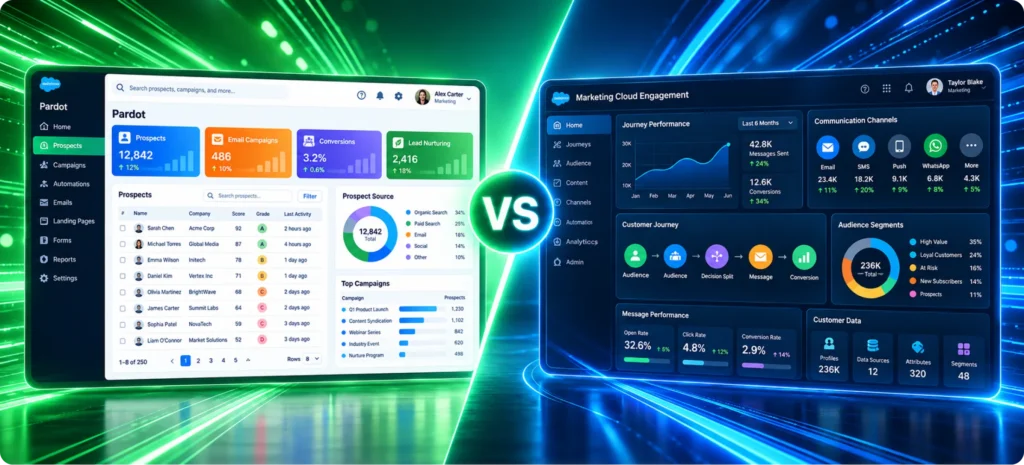

Pardot Vs Marketing Cloud Account Engagement_ Is It the Same Thing_
Salesforce Marketing Cloud

Pardot Vs Marketing Cloud Account Engagement: Is It the Same Thing?

user
By user
September 22, 2026
Why Its Hard to Hire a Marketing Cloud Account Engagement Specialist in India (and What to Do Instead)

If you have worked in Salesforce marketing for more than a few years, you have probably heard one team say “Pardot,” another say “Account Engagement,” and a third say “Marketing Cloud Account Engagement.” That can make a straightforward platform conversation sound like three separate products. The short answer is much simpler: Pardot and Marketing Cloud Account Engagement are the same core Salesforce B2B marketing automation product. Salesforce renamed Pardot in 2022 as part of a wider Marketing Cloud naming change.

The confusion did not disappear with the rename. In fact, it became easier to mix up Pardot with Marketing Cloud Engagement, which is a separate Salesforce product family used for broader B2C and multi-channel messaging. That is why this naming question still matters in 2026. People are not only asking whether the product was renamed; they are trying to understand whether features, licenses, architecture, integrations, terminology, and implementation skills changed with it.

This guide answers Pardot the same as Marketing Cloud Account Engagement without treating the rebrand as a trivial footnote. We will look at the naming timeline, what stayed the same, what evolved after 2022, how Salesforce Account Engagement vs Marketing Cloud should be understood, and why the old Pardot name still appears in search, hiring, documentation, and implementation conversations. If you are evaluating the platform today, Marketing Cloud Account Engagement services show how the modern product is typically configured around scoring, nurturing, Salesforce CRM sync, and revenue attribution rather than around the label printed on the menu.

TL;DR

  • Pardot and Marketing Cloud Account Engagement are the same product lineage. The Pardot name change to Account Engagement was a rebrand announced in April 2022, not a forced migration to a new marketing automation system.
  • The old name still matters. Customers, consultants, job listings, search queries, historical documentation, and integrations still use “Pardot,” so the old-versus-new naming debate often describes a terminology problem rather than a platform decision.
  • Marketing Cloud Engagement is different. When comparing Salesforce Account Engagement vs Marketing Cloud, Account Engagement is primarily a B2B lead-nurturing and sales-alignment platform, while Marketing Cloud Engagement is a separate platform centered on large-scale journeys, subscribers, channels, and data extensions.
  • The product has continued to evolve since the rebrand. The modern feature set includes the familiar foundation of scoring, grading, forms, automation rules, connected campaigns, and Engagement Studio, plus newer integrations and AI-related capabilities. The rename did not freeze the product in 2022.
  • The practical question is not “Should we migrate from Pardot to Account Engagement?” If you already use Pardot, you are already in the Account Engagement product family. The better question is whether your implementation, data model, lead qualification rules, and Salesforce connection are still fit for purpose.

So, Is Pardot the Same as Marketing Cloud Account Engagement?

Yes. If someone asks what happened to Salesforce Pardot, the core answer is that Salesforce renamed it Marketing Cloud Account Engagement. The company did not create a second product and ask every Pardot customer to migrate into it. Existing customers continued using the same B2B marketing automation lineage, while Salesforce progressively changed product language across interfaces, documentation, certifications, release notes, and partner conversations.

That distinction matters because Salesforce Pardot vs Account Engagement can sound like a product comparison when there is no clean “old platform versus new platform” split to evaluate. It is closer to comparing an earlier brand name with the current brand name of a product that has continued to receive releases over time. A 2021 Pardot environment and a 2026 Account Engagement environment may differ because Salesforce has shipped years of updates, not because the rebrand itself replaced the underlying product.

The easiest way to explain Marketing Cloud Account Engagement is to start with its job: it is Salesforce’s B2B marketing automation platform for managing prospects, forms, email nurture, scoring, grading, campaign influence, and marketing-to-sales handoff. HyphenX covers the wider operating model through its Salesforce marketing automation services because the value comes from how the automation supports the pipeline, not from whether a team still says Pardot in meetings.

The naming question matters in the market, though. The Sagefrog B2B Marketing Mix Report continues to show Pardot as a recognizable marketing automation label alongside Salesforce and other platforms, illustrating why the older name still has commercial visibility years after the rename.

The Naming Timeline: From Pardot to Account Engagement

The history becomes easier to follow when the brand changes are separated from actual product changes.

Period

Name most people used

What was happening

What it means now

2007-2012

Pardot

Pardot developed as a B2B marketing automation platform.

This is the origin of the product, terminology, and practitioner community.

2012-2013

Pardot under ExactTarget/Salesforce

ExactTarget acquired Pardot, then Salesforce acquired ExactTarget.

Pardot became part of the Salesforce marketing ecosystem without losing its identity.

2014-2021

Pardot

Salesforce deepened CRM integration and expanded B2B marketing capabilities.

Most legacy documentation, skills, job titles, and community content still use this name.

April 2022

Marketing Cloud Account Engagement

Salesforce announced a broader Marketing Cloud naming strategy.

The Pardot rebranding formally placed the product inside the Marketing Cloud naming family.

2022-2025

Account Engagement / Pardot

Old and new language coexisted across customers, partners, search, and documentation.

This mixed terminology is the main reason the question persists.

2026

Marketing Cloud Account Engagement, often shortened to Account Engagement or MCAE

Salesforce now distinguishes Account Engagement, MCE, and newer Marketing Cloud offerings more explicitly.

Teams should use the current name in formal architecture and procurement documents while retaining “Pardot” where it aids clarity and searchability.

The Pardot name change to Account Engagement therefore sits inside a longer product history. It changed the vocabulary, but it did not erase years of customer configuration, automation rules, prospect records, or Pardot features. That is why teams frequently use both names in the same sentence.

What Changed With the Pardot Rebranding, and What Did Not?

The Pardot rebranding changed how Salesforce positioned the product. “Marketing Cloud Account Engagement” makes the intended audience clearer: B2B teams working around accounts, leads, prospects, and sales alignment. It also brought the product into a common naming family with other Salesforce marketing tools.

What did not change overnight was the operating logic marketers already knew. Prospect records, lead scoring, grading, automation rules, forms, completion actions, lists, connected campaigns, and Engagement Studio remained recognizable parts of the product. Teams did not wake up after the announcement and needed to rebuild every nurture program from scratch.

There is an important nuance. Saying “same product” does not mean “nothing has changed since 2022.” Salesforce has continued adding and retiring capabilities, improving Lightning experiences, expanding integrations, and connecting Account Engagement with newer data and AI services. The Salesforce State of Marketing report found that marketers are increasingly constrained by fragmented data even as AI adoption expands, which reinforces why modern Account Engagement projects increasingly involve data quality and cross-cloud architecture rather than email automation alone.

For teams trying to understand modern Account Engagement features, this is the right mental model: the product identity continued, the name changed, and the feature set kept evolving through normal releases. If your organization still treats its environment as “the Pardot setup we built five years ago,” the bigger risk is outdated configuration rather than outdated naming.

Pardot, Account Engagement, and Marketing Cloud Engagement: The Comparison That Actually Matters

A more useful comparison than the naming debate is Account Engagement versus MCE. The names look similar, but the products solve different problems.

Dimension

Pardot / Marketing Cloud Account Engagement

MCE

Core market

Primarily B2B marketing and sales alignment

Primarily B2C and high-volume lifecycle engagement

Person model

Prospects synchronized with Salesforce leads, contacts, and person accounts

Subscribers and data-extension-based audiences

Main automation experience

Engagement Studio, automation rules, completion actions

Journey Builder and Automation Studio

Qualification model

Scoring, grading, scoring categories, sales handoff

Segmentation and journey orchestration rather than classic Pardot grading

Common channels

Email, forms, landing pages, website activity, nurture

Email, SMS, mobile, advertising, and broader journey channels

CRM relationship

Designed around close alignment with Salesforce CRM

Can integrate deeply with Salesforce but uses a distinct data and execution model

Typical buying motion

Longer B2B sales cycles, MQL/SQL handoff, account-based nurture

Large consumer audiences, transactional and lifecycle communications

Historical name

Pardot

Salesforce Marketing Cloud / ExactTarget lineage

This is where Salesforce Account Engagement vs Marketing Cloud becomes a real platform decision. Salesforce Marketing Cloud services cover the Engagement side of that equation, where Journey Builder, data extensions, multi-channel communication, and high-volume customer journeys are the center of gravity.

The current marketing technology environment also explains why buyers care about that distinction. The HubSpot State of Marketing report describes a market where AI, automation, data, and personalization are converging, while platform complexity is increasing. Choosing the right Salesforce marketing automation platform therefore depends less on brand familiarity and more on your audience model, channel mix, sales cycle, data architecture, and ownership model.

12 Things to Know About Pardot vs Marketing Cloud Account Engagement

The fastest way to remove the remaining ambiguity is to separate twelve common assumptions from what actually happens in practice.

1. The Rename Did Not Create a New Database

A discussion of the two names sometimes assumes customer data moved to a new database in 2022. That is not what the naming change meant. Your prospects, lists, forms, automation, and CRM connection belonged to the continuing product lineage. Normal upgrades and connector changes may affect architecture, but the rebrand itself was not a database migration.

2. Existing Pardot Skills Still Transfer

When companies ask about Salesforce Pardot vs Account Engagement skills, the underlying practitioner knowledge still maps strongly. Someone experienced with scoring, grading, automation rules, Engagement Studio, forms, and Salesforce synchronization is working with the same functional family. Modern projects may require newer capabilities, but the historical skill base did not suddenly become irrelevant.

3. The Word “Pardot” Still Appears for Practical Reasons

If you search Pardot Marketing Cloud Account Engagement, you will still find consultants, training content, legacy URLs, community discussions, and job descriptions using both names. That is partly search behavior and partly habit. The old name is short, distinctive, and embedded in years of technical vocabulary.

4. Formal Documentation Should Prefer the Current Name

Architecture diagrams, statements of work, procurement documents, governance standards, and new training material should generally say Marketing Cloud Account Engagement, with “formerly Pardot” added when helpful. That prevents confusion when the same document also discusses the separate Engagement product.

5. MCE Is Not the New Pardot

This is the most important distinction in the article. The Engagement product is a separate Salesforce platform lineage. It did not replace Pardot. If someone tells you the Pardot name change to Account Engagement means all Pardot customers moved into Journey Builder and Data Extensions, they are combining two products that remain operationally distinct.

6. The Rename Did Not Remove Classic B2B Qualification

Core Pardot features such as prospect scoring and grading still define how many teams use Account Engagement. Those mechanisms are especially useful when marketing needs to separate “interested” from “good fit” before routing records to sales.

7. Account Engagement Features Have Continued to Evolve

Modern Account Engagement features should not be judged only by a screenshot from the Pardot Classic era. Lightning-based experiences, connected campaign workflows, analytics, integrations, and AI-related capabilities have evolved. The Act-On marketing automation trends report also shows how B2B teams increasingly evaluate automation platforms around usability, integration, attribution, and ROI rather than email capability alone.

8. Salesforce Engagement Studio Is Still a Key Clue

If a team describes building branching B2B nurture logic in Salesforce Engagement Studio, it is talking about Account Engagement. By contrast, Journey Builder is the better clue that the conversation is about MCE. This simple vocabulary test prevents a surprising amount of project confusion.

9. Licensing Questions Need Current Answers

The fact that Pardot and Account Engagement are the same product lineage does not mean commercial packaging has stayed static. Editions, entitlements, add-ons, AI capabilities, and Salesforce dependencies can change. Treat old pricing decks as historical artifacts and validate current licensing before planning an implementation.

10. Integration Is More Important Than the Name

A weak Salesforce connector, duplicate records, poor field mapping, or inconsistent campaign structure will hurt performance whether your team calls the product Pardot or MCAE. The Salesforce consulting services team typically treats those architecture questions as part of the operating model because marketing automation is only as reliable as the data moving through it.

11. Search and Hiring Should Use Both Terms

If you are recruiting, researching, or sourcing help, use both names. A search for what is Marketing Cloud Account Engagement may surface current product language, while a search for Pardot consultants may surface practitioners with years of relevant implementation depth. HyphenX’s guide on how to hire Account Engagement specialists explains why the split vocabulary can narrow the candidate pool if you search only one term.

12. The Real Decision Is Whether the Platform Fits Your Motion

The useful strategic question is not which side wins in Pardot vs Marketing Cloud Account Engagement. They are the same product family. The real question is whether a Salesforce B2B marketing automation approach built around lead qualification, CRM alignment, nurture, and account-level sales collaboration fits the way your business buys and sells.

What Is Marketing Cloud Account Engagement Used For Today?

What Is Marketing Cloud Account Engagement Used For Today_

For modern teams asking about Marketing Cloud Account Engagement, the product is best understood as a bridge between B2B demand generation and Salesforce sales execution. It helps marketers capture prospects, interpret engagement, automate nurture, and pass useful context to sales without forcing the sales team to work in a separate marketing database.

Typical uses include:

  •             Building lead-scoring models that add weight to high-intent behaviors such as pricing-page visits, form submissions, webinar registrations, or repeated content engagement.
  •             Using grading to compare prospect attributes with an ideal customer profile so sales can distinguish high activity from genuine fit.
  •             Creating Salesforce Engagement Studio nurture programs for new leads, dormant prospects, trial users, event attendees, or long-cycle buying groups.
  •             Running forms and landing pages that update prospect data and trigger completion actions immediately.
  •             Connecting marketing activity with Salesforce campaigns, opportunities, and sales follow-up so attribution is closer to pipeline than vanity metrics.
  •             Segmenting prospects into dynamic lists that change automatically as behavior, profile data, or lifecycle stage changes.
  •             Supporting a broader Salesforce marketing automation platform strategy where CRM data, marketing engagement, analytics, and AI services work from a governed data foundation.

The global B2B automation usage data published by Statista shows how deeply automation is embedded in B2B marketing activities. That context is useful because Salesforce B2B marketing automation is no longer an isolated email tool decision; it is part of a wider revenue-operations stack.

Which Name Should Your Team Use in 2026?

There is no need to police every use of the old word. The better approach is to use terminology intentionally.

Marketing Teams

Use “Marketing Cloud Account Engagement” or “Account Engagement” in current campaign documentation, training, and governance. When discussing older Pardot features, it is fine to say “formerly Pardot” once so long-tenured users immediately know what product is meant. This makes the old-versus-new terminology less of a vocabulary debate and more of a shared language standard.

Salesforce Administrators and Architects

Use the current name in architecture diagrams and integration inventories. This is especially important when MCE or Marketing Cloud Next also exists in the same enterprise. A connector diagram labeled only “Marketing Cloud” is too ambiguous for support, security, and data-governance teams.

Procurement and Leadership

Use the exact commercial product and edition names appearing in your current Salesforce agreement. If leadership asks what happened to Salesforce Pardot, explain the rebrand separately from any later licensing or capability changes. That prevents stakeholders from assuming the organization bought a new product simply because the name changed.

Recruiters and Hiring Managers

Use both “Pardot” and “Marketing Cloud Account Engagement” in job descriptions. The Salesforce Pardot vs Account Engagement skill distinction is usually artificial, and experienced practitioners may still brand themselves around Pardot because that was the product name during much of their career.

SEO, Content, and Knowledge Teams

Keep both terms in searchable content where they genuinely help users. Phrases such as Pardot Marketing Cloud Account Engagement may be awkward as prose, but they reflect how users combine names when they are unsure what changed. Use them sparingly and answer the confusion clearly instead of forcing the phrase into every heading. If your search data contains Pardot Marketing Cloud Account Engagement, treat it as evidence of naming uncertainty and route readers to a direct explanation rather than a second product comparison.

Case Studies: What Real Pardot and Account Engagement Projects Show?

The best evidence that the old and new names describe a continuous product lineage is not a branding slide; it is the way real implementations refer to the same capabilities across years. HyphenX maintains a library of HyphenX Salesforce case studies covering integration, automation, and CRM transformation patterns. The three external examples below focus directly on Pardot or Account Engagement and show how practitioners use both names around the same core B2B automation work.

Case Study 1: Pieta — Pardot Optimization Under the Account Engagement Name

MarCloud’s Pieta Pardot optimization case study describes an organization improving Salesforce Account Engagement (Pardot) through automation workflows, segmentation, dynamic lists, reporting dashboards, and team training. The published result was a fundraising performance 97% above target and a €57,000 uplift versus the previous year.

The naming lesson is useful: the case study uses “Salesforce Account Engagement (Pardot)” because the project capabilities are recognizable under both labels. The commercial value did not come from the Pardot rebranding; it came from applying the platform more effectively to audience segmentation, automation, and measurement.

Case Study 2: Retail Technology — Building a Pardot Foundation From the Ground Up

A KVP case study on Pardot enablement for retail describes a retail technology company that already had Sales Cloud but was using Pardot mainly for basic email sends. The project expanded that setup into lead scoring, qualification, geo-targeted forms, segmentation, and attribution.

This is a practical illustration of Marketing Cloud Account Engagement in delivery terms. Whether the project team says Pardot or Account Engagement, the system is doing the same category of work: identifying behavior, qualifying B2B prospects, connecting activity to Salesforce, and helping sales prioritize follow-up. It also shows why Salesforce Pardot vs Account Engagement is less useful than “basic configuration versus mature revenue automation.”

Case Study 3: STAAH — Pardot as Part of a Connected Revenue Architecture

GravityLab’s STAAH Pardot automation case study describes a software company using Salesforce across sales, financial integration, and Pardot. The marketing work introduced segmented nurture journeys designed to identify, qualify, and engage prospects while the wider program connected Salesforce with multiple Xero environments.

That matters because Salesforce B2B marketing automation rarely succeeds in isolation. In a connected architecture, the platform’s name is less important than data movement, ownership, qualification logic, and reporting. A modern Salesforce implementation services framework should therefore document where Account Engagement begins and ends, what Salesforce owns, and how connected systems behave when data conflicts.

When the Naming Confusion Becomes a Real Business Problem

Most teams can live with colleagues using Pardot and Account Engagement interchangeably. The problem starts when ambiguous terminology changes a purchasing, hiring, or architecture decision.

Situation

Naming mistake

Practical risk

Better approach

Buying marketing technology

Treating MCE as the renamed Pardot

Wrong platform, budget, skills, and implementation plan

Define B2B vs B2C motion, channels, objects, and automation model before selecting a product

Hiring

Requiring only “MCAE” experience

Missing experienced Pardot practitioners

Search both Pardot and Account Engagement terminology

Architecture

Labeling every product “Marketing Cloud”

Unclear data ownership and support responsibility

Name Account Engagement and MCE separately

Migration planning

Assuming Pardot customers must migrate to Account Engagement

Unnecessary project scope and stakeholder anxiety

Audit the existing environment; treat rebranding separately from technical modernization

Training

Replacing every old term without context

Users cannot reconcile old documentation with new screens

Teach the naming history once, then standardize on current terminology

SEO and support content

Using only one name

Users fail to find relevant material

Include both where search intent warrants it

This is why the Salesforce Account Engagement vs Marketing Cloud distinction deserves explicit governance. Sagefrog’s marketing automation findings show automation remains a foundational B2B technology category, with multiple platforms competing for attention. When the stack is already complex, unclear product names create avoidable operational mistakes.

Do Existing Pardot Customers Need to Migrate?

Do Existing Pardot Customers Need to Migrate_

No migration is required simply because the product is now called Marketing Cloud Account Engagement. If your team asks what happened to Salesforce Pardot, separate the branding event from any technical work your specific org may need.

What you should do instead is audit the environment:

  •             Confirm the Salesforce connector is healthy and field mappings still match your CRM data model.
  •             Review scoring and grading against current conversion behavior rather than historical assumptions.
  •             Inspect Pardot features that were configured years ago but are no longer used or understood.
  •             Review Account Engagement features your team may not have adopted because the environment has been maintained on autopilot.
  •             Check forms, automation rules, dynamic lists, suppression logic, and Engagement Studio programs for technical debt.
  •             Validate campaign influence and reporting so marketing activity connects to revenue outcomes.
  •             Document where MCE or other marketing systems coexist so users do not confuse audience ownership.

MarCloud’s Account Engagement case studies repeatedly show that mature environments accumulate sync errors, unused assets, and handoff problems over time. The lesson is not that Account Engagement replaced Pardot; it is that any long-running Salesforce marketing automation platform needs periodic governance and optimization.

For organizations that do not have enough internal capacity for that maintenance, Salesforce managed services support can be more relevant than a reimplementation because the goal is to keep the existing environment reliable while improving it incrementally.

A Practical Way to Explain Pardot vs Marketing Cloud Account Engagement Internally

If you need a one-minute explanation for a stakeholder meeting, use this sequence:

  1. Pardot was renamed. The Pardot name change to Account Engagement happened in 2022 as part of Salesforce’s wider marketing-product naming strategy.
  2. It is the same product lineage. Pardot vs Marketing Cloud Account Engagement is mainly old name versus current name, not a choice between two independent B2B automation platforms.
  3. Do not confuse it with MCE. That is a separate Salesforce marketing platform with a different audience model, data model, and automation tooling.
  4. The product kept evolving. New releases mean a 2026 environment can do more than older Pardot implementations even though the lineage is continuous.
  5. Focus on your implementation quality. Data quality, CRM sync, scoring, nurture, governance, and reporting determine results far more than the label your team uses.

This framing answer is Pardot the same as Marketing Cloud Account Engagement without oversimplifying the ecosystem. It also makes Salesforce Account Engagement vs Marketing Cloud a separate conversation, which is exactly where it belongs.

Conclusion

So, this is not a traditional “which platform is better?” comparison. Pardot is the former name of Marketing Cloud Account Engagement, and the 2022 rename did not require customers to move into an entirely different B2B marketing system. The product continued evolving under a new name.

The confusion becomes important when the Engagement product enters the conversation. That platform is different, with its own architecture, data model, automation tools, and typical use cases. For B2B teams, the better question is whether Salesforce B2B marketing automation through Account Engagement fits the sales cycle and whether the implementation is healthy enough to support it.

If you remember one rule, make it this: use “Account Engagement” for current formal language, keep “Pardot” where it helps people find or understand legacy knowledge, and never use the two names as if they represent competing products.

Frequently Asked Questions

1. Is Pardot the same as Marketing Cloud Account Engagement?

Yes. Is Pardot the same as Marketing Cloud Account Engagement is primarily a naming question. Salesforce renamed Pardot to Marketing Cloud Account Engagement in 2022. Existing customers did not have to migrate to a completely separate B2B marketing automation platform because of that rebrand.

2. What happened to Salesforce Pardot?

If you are asking what happened to Salesforce Pardot, it was renamed Marketing Cloud Account Engagement as part of a broader Salesforce Marketing Cloud naming strategy. The Pardot brand became less prominent in official product language, but the underlying B2B marketing automation lineage continued.

3. Why did Salesforce rename Pardot?

The Pardot rebranding was intended to place Salesforce marketing products under a clearer shared vocabulary. Pardot became “Marketing Cloud Account Engagement,” emphasizing B2B account and sales engagement while aligning the name with the wider Marketing Cloud portfolio.

4. Is Pardot vs Account Engagement a real product comparison?

Not in the normal sense. The comparison is mostly former name versus current name. You may see differences between an old Pardot implementation and a modern Account Engagement environment because the product has evolved through releases, not because Salesforce replaced Pardot with an unrelated system.

5. What is Marketing Cloud Account Engagement best used for?

For teams asking what is Marketing Cloud Account Engagement, it is a B2B automation platform for lead capture, scoring, grading, forms, nurture, campaign tracking, and sales handoff. It works especially well when marketing and sales share Salesforce CRM as the operational source of truth.

6. Is Marketing Cloud Engagement the same thing as Account Engagement?

No. Marketing Cloud Engagement is a separate Salesforce product. It is generally associated with high-volume and multi-channel customer journeys, while Account Engagement is built around B2B prospects, lead qualification, CRM synchronization, and nurture.

7. What is the difference in Salesforce Account Engagement vs Marketing Cloud?

In Salesforce Account Engagement vs Marketing Cloud, Account Engagement is usually the B2B choice for prospects, scoring, grading, forms, and sales alignment. MCE is typically used for subscriber-based segmentation, Journey Builder, data extensions, and large-scale multi-channel communication.

8. Did the Pardot name change to Account Engagement change my data?

No. The Pardot name change to Account Engagement did not itself move customer data into a brand-new platform. Separate product upgrades, connector changes, or implementation projects may affect data, but the rename was fundamentally a branding and product-positioning change.

9. Do Pardot features still exist in Account Engagement?

Many familiar Pardot features remain central to Account Engagement, including scoring, grading, forms, automation rules, completion actions, lists, campaign connections, and nurture automation. Some interfaces and capabilities have evolved, so old training material should still be checked against current releases.

10. What Account Engagement features should existing users review?

Important Account Engagement features to review include scoring and grading models, Engagement Studio, connected campaigns, forms, dynamic lists, automation rules, reporting, Salesforce sync, and newer data or AI integrations. Long-running instances often benefit from an audit before adding more automation.

11. Is Salesforce Engagement Studio part of Pardot or Account Engagement?

Salesforce Engagement Studio is the visual nurture-program builder associated with Account Engagement, formerly Pardot. If your historical documentation calls it a Pardot Engagement Studio program, it is referring to the same functional product lineage.

12. Should job descriptions say Pardot or Marketing Cloud Account Engagement?

Use both. A job description can say “Marketing Cloud Account Engagement (Pardot)” because many experienced specialists still use the old term. Searching only one side of Salesforce Pardot vs Account Engagement can unnecessarily reduce the candidate pool.

13. Why do people search Pardot Marketing Cloud Account Engagement together?

The phrase Pardot Marketing Cloud Account Engagement reflects ongoing naming confusion. Users often know the word Pardot but see the newer name in Salesforce interfaces or documentation, so they combine the terms to confirm whether they refer to the same tool.

14. Is Account Engagement still a Salesforce marketing automation platform?

Yes. Account Engagement remains a Salesforce marketing automation platform focused on B2B demand generation and marketing-sales alignment. It captures engagement, automates nurture, qualifies prospects, and shares useful context with Salesforce sales users.

15. Who is the best fit for Salesforce B2B marketing automation with Account Engagement?

Salesforce B2B marketing automation with Account Engagement is usually a strong fit for organizations with longer buying cycles, lead qualification requirements, sales-assisted conversion, and a need to connect marketing engagement directly with Salesforce CRM records and opportunities.


Like what you see? Share with a friend.

Best CRM Software for Businesses: Why Companies Are Choosing Salesforce

Share with your community!

What's trending

Most Related Blogs

Marketing Cloud Account Engagement Outsourcing Cost_ A Complete Cost Guide
Salesforce Marketing Cloud    22 September 2026

Marketing Cloud Account Engagement Outsourcing Cost: A Complete Cost Guide

Marketing Cloud Account Engagement can be straightforward to license and surprisingly difficult to operate well as a Salesforce…

Read More...
Pardot Vs Marketing Cloud Account Engagement_ Is It the Same Thing_
Salesforce Marketing Cloud    22 September 2026

Pardot Vs Marketing Cloud Account Engagement: Is It the Same Thing?

If you have worked in Salesforce marketing for more than a few years, you have probably heard one…

Read More...
Why It's Hard to Hire a Marketing Cloud Account Engagement Specialist in India (and What to Do Instead)
Uncategorized    10 September 2026

Why It’s Hard to Hire a Marketing Cloud Account Engagement Specialist in India (and What to Do Instead)

If you’ve spent the last few weeks trying to hire a Marketing Cloud Account Engagement specialist in India,…

Read More...
agentforce lead change featured img
Uncategorized    10 September 2026

Does Agentforce Change Lead Scoring in Marketing Cloud Account Engagement?

No, it does not. As of September 2026, Agentforce does not calculate, adjust or override lead scoring in…

Read More...
How Long Does a Marketing Cloud Account Engagement Implementation Actually Take_ A 2026 Timeline by Company Size
Uncategorized    10 September 2026

How Long Does a Marketing Cloud Account Engagement Implementation Actually Take? A 2026 Timeline by Company Size

A small B2B company with one business unit and clean data can be live on Marketing Cloud Account…

Read More...
Marketing Cloud Account Engagement and the DPDP Act_ What Indian B2B Marketers Actually Need to Fix
Uncategorized    10 September 2026

Marketing Cloud Account Engagement and the DPDP Act: What Indian B2B Marketers Actually Need to Fix

Yes, the DPDP Act applies to Marketing Cloud Account Engagement. If your prospect database holds people in India,…

Read More...
Pardot Vs Marketing Cloud Account Engagement_ Is It the Same Thing_
Salesforce Marketing Cloud

Pardot Vs Marketing Cloud Account Engagement: Is It the Same Thing?

user
By user
September 22, 2026
Why Its Hard to Hire a Marketing Cloud Account Engagement Specialist in India (and What to Do Instead)

If you have worked in Salesforce marketing for more than a few years, you have probably heard one team say “Pardot,” another say “Account Engagement,” and a third say “Marketing Cloud Account Engagement.” That can make a straightforward platform conversation sound like three separate products. The short answer is much simpler: Pardot and Marketing Cloud Account Engagement are the same core Salesforce B2B marketing automation product. Salesforce renamed Pardot in 2022 as part of a wider Marketing Cloud naming change.

The confusion did not disappear with the rename. In fact, it became easier to mix up Pardot with Marketing Cloud Engagement, which is a separate Salesforce product family used for broader B2C and multi-channel messaging. That is why this naming question still matters in 2026. People are not only asking whether the product was renamed; they are trying to understand whether features, licenses, architecture, integrations, terminology, and implementation skills changed with it.

This guide answers Pardot the same as Marketing Cloud Account Engagement without treating the rebrand as a trivial footnote. We will look at the naming timeline, what stayed the same, what evolved after 2022, how Salesforce Account Engagement vs Marketing Cloud should be understood, and why the old Pardot name still appears in search, hiring, documentation, and implementation conversations. If you are evaluating the platform today, Marketing Cloud Account Engagement services show how the modern product is typically configured around scoring, nurturing, Salesforce CRM sync, and revenue attribution rather than around the label printed on the menu.

TL;DR

  • Pardot and Marketing Cloud Account Engagement are the same product lineage. The Pardot name change to Account Engagement was a rebrand announced in April 2022, not a forced migration to a new marketing automation system.
  • The old name still matters. Customers, consultants, job listings, search queries, historical documentation, and integrations still use “Pardot,” so the old-versus-new naming debate often describes a terminology problem rather than a platform decision.
  • Marketing Cloud Engagement is different. When comparing Salesforce Account Engagement vs Marketing Cloud, Account Engagement is primarily a B2B lead-nurturing and sales-alignment platform, while Marketing Cloud Engagement is a separate platform centered on large-scale journeys, subscribers, channels, and data extensions.
  • The product has continued to evolve since the rebrand. The modern feature set includes the familiar foundation of scoring, grading, forms, automation rules, connected campaigns, and Engagement Studio, plus newer integrations and AI-related capabilities. The rename did not freeze the product in 2022.
  • The practical question is not “Should we migrate from Pardot to Account Engagement?” If you already use Pardot, you are already in the Account Engagement product family. The better question is whether your implementation, data model, lead qualification rules, and Salesforce connection are still fit for purpose.

So, Is Pardot the Same as Marketing Cloud Account Engagement?

Yes. If someone asks what happened to Salesforce Pardot, the core answer is that Salesforce renamed it Marketing Cloud Account Engagement. The company did not create a second product and ask every Pardot customer to migrate into it. Existing customers continued using the same B2B marketing automation lineage, while Salesforce progressively changed product language across interfaces, documentation, certifications, release notes, and partner conversations.

That distinction matters because Salesforce Pardot vs Account Engagement can sound like a product comparison when there is no clean “old platform versus new platform” split to evaluate. It is closer to comparing an earlier brand name with the current brand name of a product that has continued to receive releases over time. A 2021 Pardot environment and a 2026 Account Engagement environment may differ because Salesforce has shipped years of updates, not because the rebrand itself replaced the underlying product.

The easiest way to explain Marketing Cloud Account Engagement is to start with its job: it is Salesforce’s B2B marketing automation platform for managing prospects, forms, email nurture, scoring, grading, campaign influence, and marketing-to-sales handoff. HyphenX covers the wider operating model through its Salesforce marketing automation services because the value comes from how the automation supports the pipeline, not from whether a team still says Pardot in meetings.

The naming question matters in the market, though. The Sagefrog B2B Marketing Mix Report continues to show Pardot as a recognizable marketing automation label alongside Salesforce and other platforms, illustrating why the older name still has commercial visibility years after the rename.

The Naming Timeline: From Pardot to Account Engagement

The history becomes easier to follow when the brand changes are separated from actual product changes.

Period

Name most people used

What was happening

What it means now

2007-2012

Pardot

Pardot developed as a B2B marketing automation platform.

This is the origin of the product, terminology, and practitioner community.

2012-2013

Pardot under ExactTarget/Salesforce

ExactTarget acquired Pardot, then Salesforce acquired ExactTarget.

Pardot became part of the Salesforce marketing ecosystem without losing its identity.

2014-2021

Pardot

Salesforce deepened CRM integration and expanded B2B marketing capabilities.

Most legacy documentation, skills, job titles, and community content still use this name.

April 2022

Marketing Cloud Account Engagement

Salesforce announced a broader Marketing Cloud naming strategy.

The Pardot rebranding formally placed the product inside the Marketing Cloud naming family.

2022-2025

Account Engagement / Pardot

Old and new language coexisted across customers, partners, search, and documentation.

This mixed terminology is the main reason the question persists.

2026

Marketing Cloud Account Engagement, often shortened to Account Engagement or MCAE

Salesforce now distinguishes Account Engagement, MCE, and newer Marketing Cloud offerings more explicitly.

Teams should use the current name in formal architecture and procurement documents while retaining “Pardot” where it aids clarity and searchability.

The Pardot name change to Account Engagement therefore sits inside a longer product history. It changed the vocabulary, but it did not erase years of customer configuration, automation rules, prospect records, or Pardot features. That is why teams frequently use both names in the same sentence.

What Changed With the Pardot Rebranding, and What Did Not?

The Pardot rebranding changed how Salesforce positioned the product. “Marketing Cloud Account Engagement” makes the intended audience clearer: B2B teams working around accounts, leads, prospects, and sales alignment. It also brought the product into a common naming family with other Salesforce marketing tools.

What did not change overnight was the operating logic marketers already knew. Prospect records, lead scoring, grading, automation rules, forms, completion actions, lists, connected campaigns, and Engagement Studio remained recognizable parts of the product. Teams did not wake up after the announcement and needed to rebuild every nurture program from scratch.

There is an important nuance. Saying “same product” does not mean “nothing has changed since 2022.” Salesforce has continued adding and retiring capabilities, improving Lightning experiences, expanding integrations, and connecting Account Engagement with newer data and AI services. The Salesforce State of Marketing report found that marketers are increasingly constrained by fragmented data even as AI adoption expands, which reinforces why modern Account Engagement projects increasingly involve data quality and cross-cloud architecture rather than email automation alone.

For teams trying to understand modern Account Engagement features, this is the right mental model: the product identity continued, the name changed, and the feature set kept evolving through normal releases. If your organization still treats its environment as “the Pardot setup we built five years ago,” the bigger risk is outdated configuration rather than outdated naming.

Pardot, Account Engagement, and Marketing Cloud Engagement: The Comparison That Actually Matters

A more useful comparison than the naming debate is Account Engagement versus MCE. The names look similar, but the products solve different problems.

Dimension

Pardot / Marketing Cloud Account Engagement

MCE

Core market

Primarily B2B marketing and sales alignment

Primarily B2C and high-volume lifecycle engagement

Person model

Prospects synchronized with Salesforce leads, contacts, and person accounts

Subscribers and data-extension-based audiences

Main automation experience

Engagement Studio, automation rules, completion actions

Journey Builder and Automation Studio

Qualification model

Scoring, grading, scoring categories, sales handoff

Segmentation and journey orchestration rather than classic Pardot grading

Common channels

Email, forms, landing pages, website activity, nurture

Email, SMS, mobile, advertising, and broader journey channels

CRM relationship

Designed around close alignment with Salesforce CRM

Can integrate deeply with Salesforce but uses a distinct data and execution model

Typical buying motion

Longer B2B sales cycles, MQL/SQL handoff, account-based nurture

Large consumer audiences, transactional and lifecycle communications

Historical name

Pardot

Salesforce Marketing Cloud / ExactTarget lineage

This is where Salesforce Account Engagement vs Marketing Cloud becomes a real platform decision. Salesforce Marketing Cloud services cover the Engagement side of that equation, where Journey Builder, data extensions, multi-channel communication, and high-volume customer journeys are the center of gravity.

The current marketing technology environment also explains why buyers care about that distinction. The HubSpot State of Marketing report describes a market where AI, automation, data, and personalization are converging, while platform complexity is increasing. Choosing the right Salesforce marketing automation platform therefore depends less on brand familiarity and more on your audience model, channel mix, sales cycle, data architecture, and ownership model.

12 Things to Know About Pardot vs Marketing Cloud Account Engagement

The fastest way to remove the remaining ambiguity is to separate twelve common assumptions from what actually happens in practice.

1. The Rename Did Not Create a New Database

A discussion of the two names sometimes assumes customer data moved to a new database in 2022. That is not what the naming change meant. Your prospects, lists, forms, automation, and CRM connection belonged to the continuing product lineage. Normal upgrades and connector changes may affect architecture, but the rebrand itself was not a database migration.

2. Existing Pardot Skills Still Transfer

When companies ask about Salesforce Pardot vs Account Engagement skills, the underlying practitioner knowledge still maps strongly. Someone experienced with scoring, grading, automation rules, Engagement Studio, forms, and Salesforce synchronization is working with the same functional family. Modern projects may require newer capabilities, but the historical skill base did not suddenly become irrelevant.

3. The Word “Pardot” Still Appears for Practical Reasons

If you search Pardot Marketing Cloud Account Engagement, you will still find consultants, training content, legacy URLs, community discussions, and job descriptions using both names. That is partly search behavior and partly habit. The old name is short, distinctive, and embedded in years of technical vocabulary.

4. Formal Documentation Should Prefer the Current Name

Architecture diagrams, statements of work, procurement documents, governance standards, and new training material should generally say Marketing Cloud Account Engagement, with “formerly Pardot” added when helpful. That prevents confusion when the same document also discusses the separate Engagement product.

5. MCE Is Not the New Pardot

This is the most important distinction in the article. The Engagement product is a separate Salesforce platform lineage. It did not replace Pardot. If someone tells you the Pardot name change to Account Engagement means all Pardot customers moved into Journey Builder and Data Extensions, they are combining two products that remain operationally distinct.

6. The Rename Did Not Remove Classic B2B Qualification

Core Pardot features such as prospect scoring and grading still define how many teams use Account Engagement. Those mechanisms are especially useful when marketing needs to separate “interested” from “good fit” before routing records to sales.

7. Account Engagement Features Have Continued to Evolve

Modern Account Engagement features should not be judged only by a screenshot from the Pardot Classic era. Lightning-based experiences, connected campaign workflows, analytics, integrations, and AI-related capabilities have evolved. The Act-On marketing automation trends report also shows how B2B teams increasingly evaluate automation platforms around usability, integration, attribution, and ROI rather than email capability alone.

8. Salesforce Engagement Studio Is Still a Key Clue

If a team describes building branching B2B nurture logic in Salesforce Engagement Studio, it is talking about Account Engagement. By contrast, Journey Builder is the better clue that the conversation is about MCE. This simple vocabulary test prevents a surprising amount of project confusion.

9. Licensing Questions Need Current Answers

The fact that Pardot and Account Engagement are the same product lineage does not mean commercial packaging has stayed static. Editions, entitlements, add-ons, AI capabilities, and Salesforce dependencies can change. Treat old pricing decks as historical artifacts and validate current licensing before planning an implementation.

10. Integration Is More Important Than the Name

A weak Salesforce connector, duplicate records, poor field mapping, or inconsistent campaign structure will hurt performance whether your team calls the product Pardot or MCAE. The Salesforce consulting services team typically treats those architecture questions as part of the operating model because marketing automation is only as reliable as the data moving through it.

11. Search and Hiring Should Use Both Terms

If you are recruiting, researching, or sourcing help, use both names. A search for what is Marketing Cloud Account Engagement may surface current product language, while a search for Pardot consultants may surface practitioners with years of relevant implementation depth. HyphenX’s guide on how to hire Account Engagement specialists explains why the split vocabulary can narrow the candidate pool if you search only one term.

12. The Real Decision Is Whether the Platform Fits Your Motion

The useful strategic question is not which side wins in Pardot vs Marketing Cloud Account Engagement. They are the same product family. The real question is whether a Salesforce B2B marketing automation approach built around lead qualification, CRM alignment, nurture, and account-level sales collaboration fits the way your business buys and sells.

What Is Marketing Cloud Account Engagement Used For Today?

What Is Marketing Cloud Account Engagement Used For Today_

For modern teams asking about Marketing Cloud Account Engagement, the product is best understood as a bridge between B2B demand generation and Salesforce sales execution. It helps marketers capture prospects, interpret engagement, automate nurture, and pass useful context to sales without forcing the sales team to work in a separate marketing database.

Typical uses include:

  •             Building lead-scoring models that add weight to high-intent behaviors such as pricing-page visits, form submissions, webinar registrations, or repeated content engagement.
  •             Using grading to compare prospect attributes with an ideal customer profile so sales can distinguish high activity from genuine fit.
  •             Creating Salesforce Engagement Studio nurture programs for new leads, dormant prospects, trial users, event attendees, or long-cycle buying groups.
  •             Running forms and landing pages that update prospect data and trigger completion actions immediately.
  •             Connecting marketing activity with Salesforce campaigns, opportunities, and sales follow-up so attribution is closer to pipeline than vanity metrics.
  •             Segmenting prospects into dynamic lists that change automatically as behavior, profile data, or lifecycle stage changes.
  •             Supporting a broader Salesforce marketing automation platform strategy where CRM data, marketing engagement, analytics, and AI services work from a governed data foundation.

The global B2B automation usage data published by Statista shows how deeply automation is embedded in B2B marketing activities. That context is useful because Salesforce B2B marketing automation is no longer an isolated email tool decision; it is part of a wider revenue-operations stack.

Which Name Should Your Team Use in 2026?

There is no need to police every use of the old word. The better approach is to use terminology intentionally.

Marketing Teams

Use “Marketing Cloud Account Engagement” or “Account Engagement” in current campaign documentation, training, and governance. When discussing older Pardot features, it is fine to say “formerly Pardot” once so long-tenured users immediately know what product is meant. This makes the old-versus-new terminology less of a vocabulary debate and more of a shared language standard.

Salesforce Administrators and Architects

Use the current name in architecture diagrams and integration inventories. This is especially important when MCE or Marketing Cloud Next also exists in the same enterprise. A connector diagram labeled only “Marketing Cloud” is too ambiguous for support, security, and data-governance teams.

Procurement and Leadership

Use the exact commercial product and edition names appearing in your current Salesforce agreement. If leadership asks what happened to Salesforce Pardot, explain the rebrand separately from any later licensing or capability changes. That prevents stakeholders from assuming the organization bought a new product simply because the name changed.

Recruiters and Hiring Managers

Use both “Pardot” and “Marketing Cloud Account Engagement” in job descriptions. The Salesforce Pardot vs Account Engagement skill distinction is usually artificial, and experienced practitioners may still brand themselves around Pardot because that was the product name during much of their career.

SEO, Content, and Knowledge Teams

Keep both terms in searchable content where they genuinely help users. Phrases such as Pardot Marketing Cloud Account Engagement may be awkward as prose, but they reflect how users combine names when they are unsure what changed. Use them sparingly and answer the confusion clearly instead of forcing the phrase into every heading. If your search data contains Pardot Marketing Cloud Account Engagement, treat it as evidence of naming uncertainty and route readers to a direct explanation rather than a second product comparison.

Case Studies: What Real Pardot and Account Engagement Projects Show?

The best evidence that the old and new names describe a continuous product lineage is not a branding slide; it is the way real implementations refer to the same capabilities across years. HyphenX maintains a library of HyphenX Salesforce case studies covering integration, automation, and CRM transformation patterns. The three external examples below focus directly on Pardot or Account Engagement and show how practitioners use both names around the same core B2B automation work.

Case Study 1: Pieta — Pardot Optimization Under the Account Engagement Name

MarCloud’s Pieta Pardot optimization case study describes an organization improving Salesforce Account Engagement (Pardot) through automation workflows, segmentation, dynamic lists, reporting dashboards, and team training. The published result was a fundraising performance 97% above target and a €57,000 uplift versus the previous year.

The naming lesson is useful: the case study uses “Salesforce Account Engagement (Pardot)” because the project capabilities are recognizable under both labels. The commercial value did not come from the Pardot rebranding; it came from applying the platform more effectively to audience segmentation, automation, and measurement.

Case Study 2: Retail Technology — Building a Pardot Foundation From the Ground Up

A KVP case study on Pardot enablement for retail describes a retail technology company that already had Sales Cloud but was using Pardot mainly for basic email sends. The project expanded that setup into lead scoring, qualification, geo-targeted forms, segmentation, and attribution.

This is a practical illustration of Marketing Cloud Account Engagement in delivery terms. Whether the project team says Pardot or Account Engagement, the system is doing the same category of work: identifying behavior, qualifying B2B prospects, connecting activity to Salesforce, and helping sales prioritize follow-up. It also shows why Salesforce Pardot vs Account Engagement is less useful than “basic configuration versus mature revenue automation.”

Case Study 3: STAAH — Pardot as Part of a Connected Revenue Architecture

GravityLab’s STAAH Pardot automation case study describes a software company using Salesforce across sales, financial integration, and Pardot. The marketing work introduced segmented nurture journeys designed to identify, qualify, and engage prospects while the wider program connected Salesforce with multiple Xero environments.

That matters because Salesforce B2B marketing automation rarely succeeds in isolation. In a connected architecture, the platform’s name is less important than data movement, ownership, qualification logic, and reporting. A modern Salesforce implementation services framework should therefore document where Account Engagement begins and ends, what Salesforce owns, and how connected systems behave when data conflicts.

When the Naming Confusion Becomes a Real Business Problem

Most teams can live with colleagues using Pardot and Account Engagement interchangeably. The problem starts when ambiguous terminology changes a purchasing, hiring, or architecture decision.

Situation

Naming mistake

Practical risk

Better approach

Buying marketing technology

Treating MCE as the renamed Pardot

Wrong platform, budget, skills, and implementation plan

Define B2B vs B2C motion, channels, objects, and automation model before selecting a product

Hiring

Requiring only “MCAE” experience

Missing experienced Pardot practitioners

Search both Pardot and Account Engagement terminology

Architecture

Labeling every product “Marketing Cloud”

Unclear data ownership and support responsibility

Name Account Engagement and MCE separately

Migration planning

Assuming Pardot customers must migrate to Account Engagement

Unnecessary project scope and stakeholder anxiety

Audit the existing environment; treat rebranding separately from technical modernization

Training

Replacing every old term without context

Users cannot reconcile old documentation with new screens

Teach the naming history once, then standardize on current terminology

SEO and support content

Using only one name

Users fail to find relevant material

Include both where search intent warrants it

This is why the Salesforce Account Engagement vs Marketing Cloud distinction deserves explicit governance. Sagefrog’s marketing automation findings show automation remains a foundational B2B technology category, with multiple platforms competing for attention. When the stack is already complex, unclear product names create avoidable operational mistakes.

Do Existing Pardot Customers Need to Migrate?

Do Existing Pardot Customers Need to Migrate_

No migration is required simply because the product is now called Marketing Cloud Account Engagement. If your team asks what happened to Salesforce Pardot, separate the branding event from any technical work your specific org may need.

What you should do instead is audit the environment:

  •             Confirm the Salesforce connector is healthy and field mappings still match your CRM data model.
  •             Review scoring and grading against current conversion behavior rather than historical assumptions.
  •             Inspect Pardot features that were configured years ago but are no longer used or understood.
  •             Review Account Engagement features your team may not have adopted because the environment has been maintained on autopilot.
  •             Check forms, automation rules, dynamic lists, suppression logic, and Engagement Studio programs for technical debt.
  •             Validate campaign influence and reporting so marketing activity connects to revenue outcomes.
  •             Document where MCE or other marketing systems coexist so users do not confuse audience ownership.

MarCloud’s Account Engagement case studies repeatedly show that mature environments accumulate sync errors, unused assets, and handoff problems over time. The lesson is not that Account Engagement replaced Pardot; it is that any long-running Salesforce marketing automation platform needs periodic governance and optimization.

For organizations that do not have enough internal capacity for that maintenance, Salesforce managed services support can be more relevant than a reimplementation because the goal is to keep the existing environment reliable while improving it incrementally.

A Practical Way to Explain Pardot vs Marketing Cloud Account Engagement Internally

If you need a one-minute explanation for a stakeholder meeting, use this sequence:

  1. Pardot was renamed. The Pardot name change to Account Engagement happened in 2022 as part of Salesforce’s wider marketing-product naming strategy.
  2. It is the same product lineage. Pardot vs Marketing Cloud Account Engagement is mainly old name versus current name, not a choice between two independent B2B automation platforms.
  3. Do not confuse it with MCE. That is a separate Salesforce marketing platform with a different audience model, data model, and automation tooling.
  4. The product kept evolving. New releases mean a 2026 environment can do more than older Pardot implementations even though the lineage is continuous.
  5. Focus on your implementation quality. Data quality, CRM sync, scoring, nurture, governance, and reporting determine results far more than the label your team uses.

This framing answer is Pardot the same as Marketing Cloud Account Engagement without oversimplifying the ecosystem. It also makes Salesforce Account Engagement vs Marketing Cloud a separate conversation, which is exactly where it belongs.

Conclusion

So, this is not a traditional “which platform is better?” comparison. Pardot is the former name of Marketing Cloud Account Engagement, and the 2022 rename did not require customers to move into an entirely different B2B marketing system. The product continued evolving under a new name.

The confusion becomes important when the Engagement product enters the conversation. That platform is different, with its own architecture, data model, automation tools, and typical use cases. For B2B teams, the better question is whether Salesforce B2B marketing automation through Account Engagement fits the sales cycle and whether the implementation is healthy enough to support it.

If you remember one rule, make it this: use “Account Engagement” for current formal language, keep “Pardot” where it helps people find or understand legacy knowledge, and never use the two names as if they represent competing products.

Frequently Asked Questions

1. Is Pardot the same as Marketing Cloud Account Engagement?

Yes. Is Pardot the same as Marketing Cloud Account Engagement is primarily a naming question. Salesforce renamed Pardot to Marketing Cloud Account Engagement in 2022. Existing customers did not have to migrate to a completely separate B2B marketing automation platform because of that rebrand.

2. What happened to Salesforce Pardot?

If you are asking what happened to Salesforce Pardot, it was renamed Marketing Cloud Account Engagement as part of a broader Salesforce Marketing Cloud naming strategy. The Pardot brand became less prominent in official product language, but the underlying B2B marketing automation lineage continued.

3. Why did Salesforce rename Pardot?

The Pardot rebranding was intended to place Salesforce marketing products under a clearer shared vocabulary. Pardot became “Marketing Cloud Account Engagement,” emphasizing B2B account and sales engagement while aligning the name with the wider Marketing Cloud portfolio.

4. Is Pardot vs Account Engagement a real product comparison?

Not in the normal sense. The comparison is mostly former name versus current name. You may see differences between an old Pardot implementation and a modern Account Engagement environment because the product has evolved through releases, not because Salesforce replaced Pardot with an unrelated system.

5. What is Marketing Cloud Account Engagement best used for?

For teams asking what is Marketing Cloud Account Engagement, it is a B2B automation platform for lead capture, scoring, grading, forms, nurture, campaign tracking, and sales handoff. It works especially well when marketing and sales share Salesforce CRM as the operational source of truth.

6. Is Marketing Cloud Engagement the same thing as Account Engagement?

No. Marketing Cloud Engagement is a separate Salesforce product. It is generally associated with high-volume and multi-channel customer journeys, while Account Engagement is built around B2B prospects, lead qualification, CRM synchronization, and nurture.

7. What is the difference in Salesforce Account Engagement vs Marketing Cloud?

In Salesforce Account Engagement vs Marketing Cloud, Account Engagement is usually the B2B choice for prospects, scoring, grading, forms, and sales alignment. MCE is typically used for subscriber-based segmentation, Journey Builder, data extensions, and large-scale multi-channel communication.

8. Did the Pardot name change to Account Engagement change my data?

No. The Pardot name change to Account Engagement did not itself move customer data into a brand-new platform. Separate product upgrades, connector changes, or implementation projects may affect data, but the rename was fundamentally a branding and product-positioning change.

9. Do Pardot features still exist in Account Engagement?

Many familiar Pardot features remain central to Account Engagement, including scoring, grading, forms, automation rules, completion actions, lists, campaign connections, and nurture automation. Some interfaces and capabilities have evolved, so old training material should still be checked against current releases.

10. What Account Engagement features should existing users review?

Important Account Engagement features to review include scoring and grading models, Engagement Studio, connected campaigns, forms, dynamic lists, automation rules, reporting, Salesforce sync, and newer data or AI integrations. Long-running instances often benefit from an audit before adding more automation.

11. Is Salesforce Engagement Studio part of Pardot or Account Engagement?

Salesforce Engagement Studio is the visual nurture-program builder associated with Account Engagement, formerly Pardot. If your historical documentation calls it a Pardot Engagement Studio program, it is referring to the same functional product lineage.

12. Should job descriptions say Pardot or Marketing Cloud Account Engagement?

Use both. A job description can say “Marketing Cloud Account Engagement (Pardot)” because many experienced specialists still use the old term. Searching only one side of Salesforce Pardot vs Account Engagement can unnecessarily reduce the candidate pool.

13. Why do people search Pardot Marketing Cloud Account Engagement together?

The phrase Pardot Marketing Cloud Account Engagement reflects ongoing naming confusion. Users often know the word Pardot but see the newer name in Salesforce interfaces or documentation, so they combine the terms to confirm whether they refer to the same tool.

14. Is Account Engagement still a Salesforce marketing automation platform?

Yes. Account Engagement remains a Salesforce marketing automation platform focused on B2B demand generation and marketing-sales alignment. It captures engagement, automates nurture, qualifies prospects, and shares useful context with Salesforce sales users.

15. Who is the best fit for Salesforce B2B marketing automation with Account Engagement?

Salesforce B2B marketing automation with Account Engagement is usually a strong fit for organizations with longer buying cycles, lead qualification requirements, sales-assisted conversion, and a need to connect marketing engagement directly with Salesforce CRM records and opportunities.

Like what you see? Share with a friend.

Most Related Blogs

Marketing Cloud Account Engagement Outsourcing Cost_ A Complete Cost Guide
Salesforce Marketing Cloud    22 September 2026

Marketing Cloud Account Engagement Outsourcing Cost: A Complete Cost Guide

Marketing Cloud Account Engagement can be straightforward to license and surprisingly difficult to operate well as a Salesforce…

Read More...
Pardot Vs Marketing Cloud Account Engagement_ Is It the Same Thing_
Salesforce Marketing Cloud    22 September 2026

Pardot Vs Marketing Cloud Account Engagement: Is It the Same Thing?

If you have worked in Salesforce marketing for more than a few years, you have probably heard one…

Read More...
Why It's Hard to Hire a Marketing Cloud Account Engagement Specialist in India (and What to Do Instead)
Uncategorized    10 September 2026

Why It’s Hard to Hire a Marketing Cloud Account Engagement Specialist in India (and What to Do Instead)

If you’ve spent the last few weeks trying to hire a Marketing Cloud Account Engagement specialist in India,…

Read More...
agentforce lead change featured img
Uncategorized    10 September 2026

Does Agentforce Change Lead Scoring in Marketing Cloud Account Engagement?

No, it does not. As of September 2026, Agentforce does not calculate, adjust or override lead scoring in…

Read More...
How Long Does a Marketing Cloud Account Engagement Implementation Actually Take_ A 2026 Timeline by Company Size
Uncategorized    10 September 2026

How Long Does a Marketing Cloud Account Engagement Implementation Actually Take? A 2026 Timeline by Company Size

A small B2B company with one business unit and clean data can be live on Marketing Cloud Account…

Read More...
Marketing Cloud Account Engagement and the DPDP Act_ What Indian B2B Marketers Actually Need to Fix
Uncategorized    10 September 2026

Marketing Cloud Account Engagement and the DPDP Act: What Indian B2B Marketers Actually Need to Fix

Yes, the DPDP Act applies to Marketing Cloud Account Engagement. If your prospect database holds people in India,…

Read More...

Get in Touch

Ready to launch your next project? Fill out the form below.