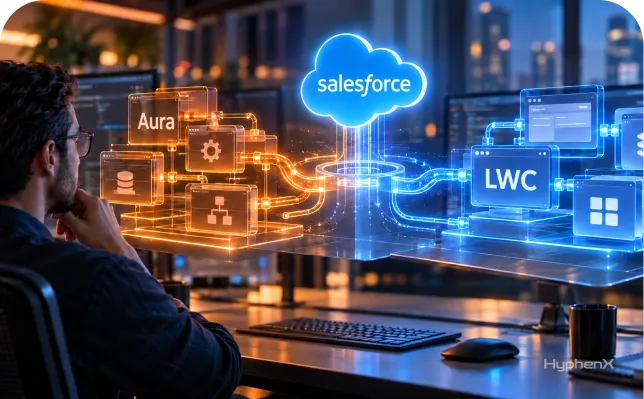
lwc aura
Salesforce Marketing Cloud

LWC vs Aura: What’s the Difference and Which Salesforce Developer Do You Need to Hire?

user
By user
September 24, 2026

If your Salesforce org has been customized for more than a few years, there is a good chance your front end is not built with one technology. You may have Aura Components created during an earlier Lightning rollout, newer Lightning Web Components added later, Visualforce still supporting a few workflows, and Apex sitting underneath all of them. That makes the LWC-Aura decision more than a framework comparison. It becomes a hiring question: which Salesforce developer can safely work in the architecture you already have while moving it in the direction Salesforce now recommends?

For new custom UI work, LWC is the modern default. LWC uses standards-based HTML, JavaScript, CSS, custom elements, ES modules, and browser-native capabilities much more directly than Aura. Aura still matters because thousands of production Salesforce orgs contain it, some capabilities and legacy patterns still depend on them, and an Aura parent can host LWC children during phased modernization. A company that hires only for greenfield LWC knowledge can therefore struggle inside a mature org with years of Aura dependencies.

The hiring decision depends on the work, not the framework name alone. Understanding the Lightning Component Framework helps teams distinguish legacy compatibility needs from modern build requirements. A new Experience Cloud interface may call for a strong Salesforce frontend developer with deep LWC skills. A heavily customized Service Cloud console may require somebody who can read Aura, trace application events, work with Apex, and gradually modernize components without breaking production behavior. HyphenX approaches this through Salesforce custom development services that combine LWC, Aura, Apex, integrations, and platform architecture so the developer profile is matched to the actual codebase rather than to a generic “Salesforce Developer” title.

This guide explains Salesforce LWC vs Aura from both the technical and hiring sides. We will compare architecture, performance, events, testing, interoperability, migration, and maintenance, then map those differences to the type of developer you need for new builds, legacy support, mixed-framework orgs, and Aura to LWC migration programs.

TL;DR

LWC is the default choice for new Salesforce UI development. LWC use modern web standards and a simpler component model, and Salesforce continues moving its own user-interface implementation toward LWC. Aura is not suddenly unusable or unsupported across every scenario, but it is the older framework. When the requirement is a new component, new application experience, or modern Salesforce Lightning development project, the developer you hire should normally be strongest in LWC, JavaScript, Apex integration, Lightning Data Service, testing, and Salesforce security.

Aura expertise still has real value in existing Salesforce estates. A mature org can contain hundreds of Aura, custom events, interfaces, utility-bar behavior, console integrations, and wrappers around newer LWC. An Aura component can contain an LWC, while an LWC cannot simply contain an Aura component, so dependency direction matters during modernization. For a legacy-heavy org, the useful comparison is not just LWC developer vs Aura developer. You need somebody who can understand both frameworks well enough to keep production stable while deciding what should remain, what should be wrapped, and what should be migrated.

Hire against the project stage. For greenfield development, hire Salesforce LWC developer talent first. For maintenance of a large existing Aura estate, hire a Salesforce Lightning developer who can debug both Aura and LWC. For modernization, prioritize a Salesforce JavaScript developer with hands-on Aura to LWC migration experience, Apex depth, regression-testing discipline, and component dependency analysis. If you are unsure which profile fits, the safest requirement is usually “strong LWC plus proven Aura maintenance and migration experience,” not “Aura-only developer.”

LWC and Aura: What Is the Core Difference?

LWC and Aura are both programming models for creating custom user interfaces on Salesforce, but they come from different generations of frontend architecture.

Aura was Salesforce’s original component framework for Lightning Experience. The Lightning Component Framework established the component model that many mature Salesforce orgs still carry today. It introduced reusable components, attributes, client-side controllers, helpers, custom events, interfaces, and a framework-managed component lifecycle. It solved an important problem when modern browser component standards were not yet mature enough to support the model Salesforce wanted.

LWC arrived later and is built much closer to the web platform itself. A Lightning web component normally has an HTML template, an ES6 JavaScript module, CSS, and a metadata configuration file. Instead of relying on a proprietary component programming model for every interaction, the framework uses standard JavaScript concepts, DOM events, modules, promises, classes, and browser APIs wherever Salesforce security and platform abstractions allow them.

This architectural direction also affects hiring. Lightning Web Components vs Aura Components is therefore a staffing distinction as much as a technical one. A developer coming from modern JavaScript can understand LWC concepts more quickly than Aura’s proprietary patterns, although Salesforce platform knowledge is still essential. The broad developer market reinforces why this matters: the Stack Overflow Developer Survey covers more than 49,000 respondents across 177 countries and continues to show the scale of mainstream web-development skills, which gives LWC teams a larger conceptual talent bridge from general JavaScript development than Aura typically provides.

LWC and Aura Technical Comparison

Dimension

LWC (LWC)

Aura

Hiring implication

Programming model

Modern web standards and ES6 modules

Salesforce-specific Aura framework

LWC benefits from stronger modern JavaScript skills

Markup

HTML templates

`.cmp` markup with Aura syntax

LWC syntax is closer to standard frontend development

JavaScript structure

Component logic in ES6 modules

Controller, helper, and optional renderer patterns

Aura developers need framework-specific debugging experience

Communication

Properties, methods, DOM/custom events, Lightning Message Service

Attributes, component events, application events, methods

Migration requires event-model redesign, not syntax replacement

Data access

Lightning Data Service, wire adapters, imperative Apex, UI APIs

Lightning Data Service and Apex with Aura patterns

Both need Salesforce data/security knowledge

Performance model

More browser-native and generally lighter

More framework abstraction and overhead

Performance-sensitive builds normally favor LWC

Testing

Jest-based unit testing plus Salesforce test strategy

Aura-specific tooling and broader integration testing

LWC aligns more closely with mainstream JavaScript testing

Composition

LWC can contain LWC; Aura can contain LWC

Aura can contain Aura and LWC

Mixed-org migration often proceeds from child components upward

New development

Preferred default

Used for legacy needs or remaining gaps

New hires should normally be LWC-first

Legacy maintenance

Increasingly common in mixed estates

Still widely present in long-running orgs

Mature orgs may need dual-framework expertise

Why Is Salesforce Moving Toward LWC?

The direction is now unambiguous. Salesforce recommends LWC for new development and continues a multi-phase transition of internal standard components from Aura toward LWC. The reasons are practical: standards-based development, better browser alignment, reduced framework overhead, more conventional JavaScript patterns, and a development experience that fits modern frontend engineering.

Performance is one of the most visible reasons. LWC can do more work using browser-native capabilities instead of routing every behavior through a proprietary framework layer. That does not mean every Aura component will become dramatically faster when rewritten; poorly designed LWC can still be slow. It means the architecture gives developers a cleaner foundation for efficient rendering, component composition, data access, and JavaScript execution.

The other reason is maintainability. A modern Salesforce frontend developer can work with concepts that resemble the rest of the web ecosystem: modules, classes, events, promises, templates, Jest tests, and standard JavaScript tooling. This matters for companies trying to reduce platform-specific technical debt. The World Economic Forum report found skills gaps to be a major barrier to business transformation across surveyed employers, and using development models that align more closely with widely taught web skills can reduce the gap between Salesforce specialization and general frontend engineering.

For organizations planning new applications, framework choice should follow the wider solution architecture rather than lead it. At that stage, a Salesforce consulting services team can help separate component decisions from security, data access, Apex, integration boundaries, packaging, release management, and user experience across the wider Salesforce Lightning development roadmap.

Lightning Web Components vs Aura Components: What Changes for the Developer?

The biggest difference is the mental model. Lightning Web Components vs Aura Components changes how developers structure code, state, and communication. Lightning Web Components vs Aura Components is not only a change in file extensions or tag syntax; it changes how developers structure code, manage state, communicate between components, and reason about the browser.

JavaScript Becomes More Standard

Aura client-side code commonly separates controller and helper logic, while LWC consolidates behavior into an ES6 module. Developers use standard imports and exports, classes, async patterns, decorators supplied by Salesforce, and familiar JavaScript testing approaches.

That makes a Salesforce JavaScript developer particularly valuable in LWC-heavy projects. Strong general JavaScript fundamentals often improve code quality because the developer understands scope, event propagation, asynchronous behavior, modules, immutable patterns, and browser performance rather than learning only Salesforce-specific recipes.

Events Become More Web-Like

Aura uses framework events, including component and application events. LWC primarily uses DOM-style events and public APIs, with Lightning Message Service available for communication across otherwise unrelated components and technology boundaries.

During Aura-to-LWC modernization, event design is one of the areas that requires actual redesign. A developer who tries to reproduce every Aura application event mechanically can create an unnecessarily coupled LWC architecture.

Component Composition Has Direction

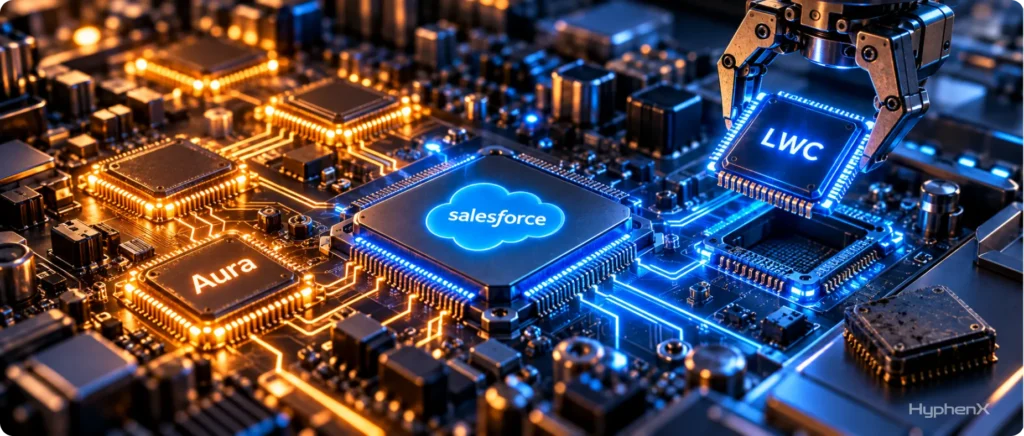
Aura can host LWC children. LWC cannot host an Aura child component. That asymmetry strongly influences migration order. Teams usually get safer results by migrating low-level children first and working upward through the hierarchy.

Testing Expectations Rise

LWC fits naturally with Jest-style unit testing, while migration also requires Salesforce-side Apex tests, integration tests, permissions validation, regression checks, and user-acceptance testing. A developer who can write LWC but cannot design a safe test strategy is not enough for a production migration.

Which Salesforce Developer Do You Need to Hire?

Do not start with the job title. Start with the codebase and the next twelve months of work. LWC developer vs Aura developer is useful only after you know which framework mix the roadmap actually contains.

A greenfield project, a maintenance backlog, and a migration program need different profiles even if all three job descriptions say “Salesforce Developer.” If you need to hire dedicated Salesforce developers for an existing org, the first screening step should be an inventory of LWC, Aura, Visualforce, Apex, Flow, integrations, Experience Cloud, packages, and the release pipeline so the interview tests match the work.

Your situation

Developer profile to prioritize

Skills that matter most

What not to overvalue

New custom Lightning UI

LWC-first developer

LWC, JavaScript, Apex, LDS/UI API, Jest, SLDS

Deep Aura specialization

Existing mixed Aura/LWC org

Dual-framework Salesforce developer

LWC, Aura, Apex, events, debugging, regression testing

Framework purity

Large Aura modernization

Migration specialist

Dependency analysis, Aura, LWC, Apex, test strategy, phased releases

Fast code conversion claims

Experience Cloud rebuild

LWC/Experience Cloud developer

LWC, Experience Cloud, security, responsive UI, Apex

Generic Sales Cloud admin skills

Console/utility-heavy Service Cloud

Senior Lightning developer

Aura legacy APIs, LWC, workspace patterns, Apex, integrations

LWC-only portfolio

Managed package modernization

Senior product developer

LWC, Aura compatibility, packaging, versioning, security review

Project-only implementation experience

Small backlog of UI enhancements

Salesforce frontend developer

LWC, JavaScript, Apex basics, design system

Architect-level seniority

Broader Salesforce transformation

Full Salesforce developer

LWC, Apex, Flow, integration, DevOps, data model

Frontend skills alone

12 Hiring Scenarios: LWC Developer, Aura Developer, or Both?

12 hiring

The fastest way to make the hiring decision is to match the developer profile to the situation. These twelve scenarios cover the most common patterns we see in Salesforce teams.

1. You Are Building a New Salesforce Application

Choose an LWC-first developer. New Salesforce component development should normally start with LWC unless a specific unsupported capability creates a genuine reason to use Aura. Look for modern JavaScript, component design, Apex integration, Lightning Data Service, accessibility, SLDS, and testing.

2. Your Org Has Hundreds of Existing Aura

Hire someone who is comfortable in both frameworks. An LWC-only engineer may build new features well but struggle to debug an older event architecture or understand why a nested Aura hierarchy behaves the way it does.

3. You Want to Start an Aura to LWC Migration

Hire for migration experience, not merely LWC development. Aura to LWC migration is an architecture and regression problem. The developer should know how to inventory dependencies, choose a migration sequence, redesign event communication, replace Aura interfaces where possible, verify Apex behavior, and preserve user-facing functionality through staged releases.

Migration programs need more than a developer converting individual component files. For that reason, a structured Salesforce implementation services framework is useful because the work touches discovery, design, build, testing, release planning, user acceptance, documentation, and post-release support rather than only code conversion.

4. Your Aura Application Works Fine and Rarely Changes

Do not create a migration project simply to make the technology stack look modern. If the component is stable, secure, supported for the use case, and rarely changed, the migration benefit may be lower than the regression cost.

5. Your Salesforce Pages Feel Slow

Hire someone with performance-diagnostic skills, not somebody who promises that replacing Aura with LWC will automatically fix speed. Component framework matters, but page performance can also be affected by Apex queries, repeated server calls, excessive data, render patterns, integrations, browser work, and page composition.

6. You Are Rebuilding an Experience Cloud Site

Prioritize an LWC developer with Experience Cloud depth. Modern digital experiences need responsive layouts, accessibility, security, reusable components, data access, performance awareness, and familiarity with the runtime and template being used.

7. Your Components Depend on Complex Aura Events

Hire a migration-capable Salesforce JavaScript developer who can redesign communication rather than reproduce it blindly. Aura application events can create broad dependencies, while LWC encourages clearer parent-child APIs, DOM events, and message-based patterns.

8. Your UI Is Simple but Apex Is Complex

Do not over-hire for frontend specialization. If most complexity sits in Apex services, transaction logic, integrations, sharing, or asynchronous processing, you need a strong Salesforce developer who can build LWC but is primarily excellent at platform/backend engineering.

9. You Need a Developer Temporarily for a Modernization Sprint

A permanent hire may be unnecessary. If your internal technical lead already owns the architecture and backlog, temporary delivery capacity can be added without creating a permanent role. A Salesforce staff augmentation model can add LWC migration capacity for a defined period while your existing team retains architectural ownership and code-review control.

This works best when your team already knows what to migrate and mainly lacks delivery capacity. If nobody can define migration order or judge the architecture, staff augmentation alone does not solve the leadership gap.

10. You Are Modernizing a Managed AppExchange Package

Hire a senior developer who understands backward compatibility, packaging, version behavior, security review expectations, subscriber-org risk, and mixed Aura/LWC operation. A managed package migration is not equivalent to rewriting a private internal component.

11. You Need One Developer to Cover LWC, Aura, Apex, Integrations, and DevOps

That role exists, but seniority matters. A genuinely broad Salesforce developer will cost more than a frontend specialist because the role crosses UI, platform logic, integration, testing, deployment, and operational troubleshooting.

Current ecosystem compensation data illustrates how variable developer value is. The Salesforce developer salary guide shows meaningful differences by geography, experience, and market conditions, so “Salesforce Developer” should not be treated as one interchangeable salary band when you are hiring for specialized architecture skills.

12. You Are Not Sure What Framework Your Org Actually Uses

Start with a technical inventory before recruiting. Identify custom components, framework types, component hierarchies, Apex controllers, integrations, managed packages, Experience Cloud dependencies, and test coverage. Then define the role.

The same principle applies before a role reaches a recruiter or staffing partner. HyphenX’s guide on how to hire the right Salesforce developer takes the broader view that hiring should follow architecture, delivery risk, and roadmap rather than a generic list of platform keywords.

Skills to Screen for in an LWC-First Salesforce Developer

An LWC-first role should still be a Salesforce role, not a generic JavaScript position with CRM access. Modern Salesforce component development still depends on platform data, security, Apex, and release discipline. Strong candidates should demonstrate:

  1. LWC fundamentals: lifecycle, reactive state, public APIs, slots, events, composition, wire service, Lightning Data Service, and base components.
  2. Modern JavaScript: ES modules, promises, asynchronous behavior, classes, error handling, and modular design.
  3. HTML, CSS, SLDS, accessibility, responsive layout, and browser debugging.
  4. Apex integration with awareness of cacheability, governor limits, bulk safety, and secure data exposure.
  5. Jest, Apex tests, Git, Salesforce CLI, code review, CI/CD, and controlled deployment.
  6. Enough Aura knowledge to understand interoperability and legacy code in a mixed org.

This is why Salesforce LWC vs Aura should influence the interview, and why Salesforce component development should be tested as an end-to-end platform skill: production readiness depends on data access, security, testability, and architecture as much as component syntax.

Skills to Screen for in an Aura-Heavy Salesforce Developer

An Aura-heavy role is increasingly a maintenance-and-modernization profile. Screen for Aura bundles, attributes, controllers, helpers, interfaces, component and application events, strong Apex knowledge, LWC interoperability, and regression testing across nested component trees.

The best candidate is usually not an Aura-only specialist. It is a Salesforce Lightning developer who can stabilize existing Aura, introduce LWC safely, document legacy behavior, and decide when maintenance is cheaper than migration.

How to Evaluate LWC and Aura Experience in an Interview

Framework trivia is easy to memorize. Ask for decisions instead. A strong LWC developer vs Aura developer comparison should surface architecture judgment, not syntax recall.

Interview prompt

What a strong answer should reveal

Warning sign

An Aura parent has five nested Aura children. How would you migrate it?

Dependency inventory, child-first strategy, regression plan, interoperability

“Rewrite the parent first” with no dependency discussion

An LWC page is slow. What do you inspect?

Network/server/browser split, Apex, renders, data volume, caching, component tree

“LWC is fast, so it must be Salesforce”

How would you replace an Aura application event?

Scope analysis, CustomEvent/public APIs/LMS as appropriate

One universal replacement pattern

When would you keep Aura?

Stable value, unsupported capability, migration risk/cost

“Never” or “always”

How do you secure Apex used by LWC?

Sharing, CRUD/FLS, user context, exposure minimization

Only mentions unit tests

How do you test a migration?

Jest, Apex, integration, permissions, UAT, regression, performance baseline

Only compiles and clicks through UI

How do LWC and Aura compose?

Aura can contain LWC; dependency direction affects migration

Claims they can nest freely both ways

What belongs in Apex vs LWC?

Server-side data/business logic vs client interaction, LDS/UI API first where appropriate

Puts all logic in one side by preference

When You Need More Than a Frontend Developer

Some projects look like LWC work until a component calls complex Apex, triggers Flow, depends on an external API, or runs inside Experience Cloud under different sharing rules. At that point, Salesforce component development is only one layer of the solution.

When UI work crosses system boundaries, the component team needs explicit ownership of the data and API behavior around it. In that situation, a Salesforce integration services approach helps define authentication, contracts, retries, error visibility, and performance expectations before a Salesforce JavaScript developer embeds integration assumptions in the component. Senior projects may therefore need a frontend specialist plus platform or integration expertise rather than one overloaded “unicorn” role.

Should You Migrate Every Aura Component to LWC?
should you migrate

No. A useful Aura-to-LWC modernization program is selective and value-driven.

Start by inventorying the component estate. For each Aura component, record where it is used, how often users touch it, its dependencies, its business criticality, current defects, performance concerns, test coverage, and whether a clean LWC equivalent exists. Then prioritize.

A practical sequence is:

  1. Retire unused components first. Do not migrate code that should disappear.
  2. Start with low-dependency children. This teaches the team the migration patterns with limited blast radius.
  3. Move high-value performance hotspots. Use before-and-after measurements rather than assumptions.
  4. Replace framework-specific events deliberately. Redesign communication instead of copying it.
  5. Keep necessary Aura wrappers temporarily. Mixed-framework operation is a valid migration state.
  6. Move up the hierarchy. Parent components become easier to replace after children are modernized.
  7. Regression-test business behavior. The objective is functional continuity plus maintainability, not simply an LWC file count.
  8. Document what remains. A future developer should understand why specific Aura were retained.

This staged model is generally safer than a big-bang rewrite. For complex estates, LWC migration services should also include dependency mapping, test baselines, and release-wave planning. LWC migration services should therefore be scoped around dependencies, tests, release waves, and measurable outcomes, not priced by multiplying an Aura component count by a fixed conversion rate.

Case Studies: What Real Aura and LWC Modernization Projects Show?

Real projects are useful because they expose the migration problems that framework comparisons tend to hide. HyphenX maintains Salesforce case studies across Salesforce delivery and transformation, while the external examples below show several concrete Aura/LWC modernization patterns.

Case Study 1: Xavor – Phased Aura-to-LWC Modernization Without Customer Disruption

A SaaS provider had an AppExchange application used by multiple customer organizations and built primarily on Aura. Performance issues, technical debt, and maintainability problems were growing, but a complete rewrite would have created risk for production subscribers. The Xavor Salesforce modernization case study describes a hybrid strategy where Aura remained as an outer shell while new functionality and migrated components were built in LWC.

The published outcomes included 30%-40% improved page performance, 25%-35% lower client-side processing overhead, reduced technical debt, and zero disruption across existing customer organizations. The hiring lesson is important: this was not a job for a junior LWC developer working from a conversion checklist. It required a developer or team comfortable with both frameworks, managed-package constraints, Apex, Salesforce DX, REST integrations, backwards compatibility, and phased release design.

Case Study 2: RAZOR – Lower Complexity in a Large Federal Salesforce Program

A large federal program used Aura inside a Salesforce application and found that new capabilities were becoming more difficult to implement while each Salesforce release introduced additional risk. In the RAZOR Aura conversion case study, the delivery team converted the application from Aura to LWC while maintaining the user experience.

RAZOR reports a more consistent user experience, lower application complexity, reduced upgrade impact, improved testing flexibility, reusable architecture, and lower total cost of ownership. This is a classic LWC developer vs Aura developer hiring scenario: the project needs both. The developer must understand the old framework deeply enough to preserve behavior and the new framework well enough to avoid carrying unnecessary legacy patterns forward.

Case Study 3: Hyniva – Aura-Based Experience Cloud to LWR

A large U.S. credit union was running an Aura-based Experience Cloud member portal with slow page loads, navigation delays, and inconsistent mobile responsiveness. The Hyniva LWR modernization case study describes a phased migration to Lightning Web Runtime, including 77 service pages and the refactoring of 20 Aura into reusable LWC.

The published results include two-times faster page loads, a 55% performance gain, full mobile responsiveness, and a 25% SEO improvement. The key hiring point is that Experience Cloud modernization is not generic Salesforce Lightning development. It requires LWC, portal architecture, performance optimization, responsive UI, caching, Apex interaction design, release governance, and user-experience skills.

Case Study 4: Application House – Classic UI Consolidated Into LWC

A nonprofit-facing Salesforce program had heavily customized Classic screens and growing technical debt. The Application House Lightning migration describes moving more than 50 Visualforce pages to Lightning pages and using a single configurable LWC component to reduce custom code.

The case is broader than Aura alone, but it shows the same modernization principle: the best Salesforce frontend developer is not measured by how much code they write. The useful outcome can be fewer components, more configurability, less custom maintenance, and better use of platform capabilities.

Case Study 5: Nixopix – Mixed Aura/LWC Modernization During Lightning Adoption

A Classic Salesforce environment needed a phased Lightning migration without disrupting established workflows. The Nixopix Lightning modernization case study describes rebuilding legacy UI with a combination of Aura and LWC, remapping record pages to Flexipages, and sequencing rollout by business unit.

This is a reminder that “LWC and Aura” is not always a winner-takes-all architectural decision during transition. A mixed state can be deliberately correct while an organization protects productivity and retires technical debt in stages.

A Practical Hiring Checklist for LWC and Aura Developers

Before publishing the role, confirm:

  • What percentage of your custom UI is LWC, Aura, and Visualforce?
  • Are you hiring for new development, maintenance, migration, or a mix?
  • Does the developer need Experience Cloud, Service Console, or managed-package experience?
  • Which Apex and integration dependencies sit behind the components?
  • Is modern JavaScript architecture a core requirement?
  • Do you expect the developer to design the Aura to LWC migration sequence?
  • Who owns architecture, code review, and release approval internally?
  • What automated and manual test coverage exists today?
  • Does the role include Git, Salesforce CLI, CI/CD, or packaging?
  • Are you assessing candidates with real component scenarios rather than certification trivia?

Use a short code-review or architecture exercise. Ask candidates to explain an existing Aura component and propose a safe migration, or give them an LWC with unnecessary server calls and ask how they would diagnose it. The goal is to reveal engineering judgment rather than memorized syntax.

Conclusion

The practical answer to LWC and Aura is straightforward for new development and more nuanced for existing orgs. Lightning Web Components vs Aura Components is ultimately a choice about current architecture and future maintainability. LWC is the modern default. They align with web standards, mainstream JavaScript, current Salesforce platform direction, and a cleaner long-term development model. Aura remains relevant wherever legacy applications, framework-specific behavior, mixed component trees, or migration sequencing make them part of the production reality.

That means the developer you hire should match the estate you have and the estate you want. For a new build, hire Salesforce LWC developer talent with strong JavaScript, Apex, Salesforce data access, testing, and security knowledge. For a mixed org, hire a Salesforce Lightning developer who can work comfortably across LWC and Aura. For modernization, prioritize proven Aura to LWC migration experience, dependency analysis, regression testing, and phased release design.

The hiring mistake is treating Salesforce LWC vs Aura as a simple keyword filter. The best candidate is the person who understands where the frontend framework ends and the broader Salesforce system begins. They can build modern components, respect legacy dependencies, improve architecture rather than copy it, and leave the org easier to maintain after the project is finished.

FAQs

  1. What is the main difference between LWC and Aura?

The main difference in LWC and Aura is the programming model. LWC use modern web standards, ES6 JavaScript modules, HTML templates, and browser-native concepts, while Aura use Salesforce’s older proprietary component framework with attributes, controllers, helpers, interfaces, and framework events. LWC is the preferred model for new development.

  1. Is Aura deprecated in Salesforce?

Aura is treated as the legacy Lightning component model, but existing Aura can continue to operate and remain common in mature orgs. Salesforce recommends LWC for new development. Teams should evaluate existing Aura based on business value, dependencies, supportability, and migration benefit rather than assuming every component needs an immediate rewrite.

  1. Should I hire an LWC developer or Aura developer?

For new development, prioritize an LWC-first Salesforce frontend developer. If your org contains significant legacy Aura, choose a developer with both LWC and Aura experience. For a modernization program, LWC developer vs Aura developer is too narrow; you need a migration specialist who can understand both frameworks and redesign dependencies safely.

  1. What skills should I look for when I hire Salesforce LWC developer talent?

When you hire Salesforce LWC developer talent, look for LWC fundamentals, modern JavaScript, HTML/CSS, SLDS, Apex, Lightning Data Service, wire adapters, Salesforce security, Jest, Git, Salesforce CLI, and deployment experience. For enterprise orgs, add Aura interoperability, integrations, Experience Cloud, or managed-package experience as required.

  1. What is involved in Aura-to-LWC modernization?

Aura-to-LWC modernization starts with an inventory of components and dependencies. Developers then choose migration order, map markup and data access, redesign events and public APIs, replace or retain interfaces, migrate JavaScript patterns, test Apex interactions, and run regression and performance checks. It is not normally a line-by-line conversion.

  1. Can Aura and LWC work together?

Yes. Aura and LWC can coexist in the same Salesforce application. An Aura component can contain an LWC child, which makes phased migration practical. Composition is not symmetrical, so the hierarchy matters when planning Salesforce Lightning development and modernization.

  1. Are LWC faster than Aura?

LWC generally has a performance advantage because it uses more browser-native standards and less framework abstraction. However, actual page speed also depends on Apex, server calls, data volume, caching, render behavior, page composition, and integrations. A strong developer measures the bottleneck before promising that framework migration alone will solve it.

  1. Do I need a Salesforce JavaScript developer for LWC?

Strong JavaScript is increasingly important. A Salesforce JavaScript developer working with LWC should understand ES modules, classes, events, asynchronous behavior, promises, state, browser debugging, and testing in addition to Salesforce-specific data access and security. General JavaScript depth often separates maintainable LWC from code that only works in a narrow scenario.

  1. What is the Lightning Component Framework?

The Lightning Component Framework broadly refers to Salesforce’s component-based UI development environment, historically centered on Aura and now primarily on LWC for modern development. Understanding both models helps developers maintain older applications while designing new Salesforce component development around current standards.

  1. What does a Salesforce Lightning developer do?

A Salesforce Lightning developer builds and maintains Salesforce user experiences using LWC, Aura where required, Apex, Lightning Data Service, SLDS, Flow integrations, and platform APIs. Senior developers may also handle migration architecture, performance, Experience Cloud, testing, integrations, DevOps, and technical governance.

  1. Are LWC migration services worth it for every org?

No. LWC migration services are most valuable where Aura creates active maintenance, performance, development, or roadmap constraints. Stable low-change components may remain in Aura temporarily. The right migration program prioritizes high-value components, retires obsolete custom code, and avoids rewriting functionality that standard Salesforce features can replace.

  1. Can a normal frontend developer become a Salesforce frontend developer?

Yes, especially because LWC uses familiar web standards. However, a Salesforce frontend developer also needs Salesforce-specific knowledge: Apex integration, Lightning Data Service, permissions, sharing, governor limits, metadata, deployment, and platform security. JavaScript skill accelerates the transition but does not replace Salesforce architecture knowledge.

  1. How do I test Salesforce LWC vs Aura experience in an interview?

Use scenario-based questions. Ask the candidate to plan an Aura-to-LWC modernization, trace an event dependency, diagnose a slow LWC, explain LWC/Aura composition, secure an Apex method, or design a regression plan. Strong candidates discuss tradeoffs, dependencies, test strategy, and platform constraints rather than only syntax.

  1. Is Aura knowledge still useful for Salesforce developers in 2026?

Yes. Aura knowledge remains valuable in long-running Salesforce orgs, Experience Cloud sites, managed packages, console customizations, and mixed-framework applications. The most useful profile is usually a Salesforce Lightning developer who can maintain Aura but uses LWC as the default for new Salesforce Lightning development.

  1. What type of developer should lead a large Aura modernization?

A large modernization should be led by a senior Salesforce developer or technical lead with deep Aura and LWC experience, strong Apex knowledge, migration architecture skills, testing and DevOps discipline, and the ability to map component dependencies. For complex estates, the lead should also understand integrations, security, Experience Cloud or console requirements, and release governance.
Like what you see? Share with a friend.

Best CRM Software for Businesses: Why Companies Are Choosing Salesforce

Share with your community!

What's trending

Most Related Blogs

lwc aura
Salesforce Marketing Cloud    24 September 2026

LWC vs Aura: What’s the Difference and Which Salesforce Developer Do You Need to Hire?

If your Salesforce org has been customized for more than a few years, there is a good chance…

Read More...
How to hire a Salesforce Lightning developer: LWC skills scorecard and hiring checklist
Salesforce Marketing Cloud    23 September 2026

How to Hire a Salesforce Lightning Developer: Skills, LWC Expertise, Cost and Interview Questions

For most of your team, Salesforce isn’t a database. It’s the set of screens they work in every…

Read More...
top benifits outsourcing
Salesforce Marketing Cloud    23 September 2026

Top Benefits of Outsourcing Marketing Cloud Account Engagement for B2B Teams in 2026

Marketing Cloud Account Engagement has become a much bigger operational responsibility than “the tool that sends B2B emails.”…

Read More...
Marketing Cloud Account Engagement Outsourcing Cost_ A Complete Cost Guide
Salesforce Marketing Cloud    22 September 2026

Marketing Cloud Account Engagement Outsourcing Cost: A Complete Cost Guide

Marketing Cloud Account Engagement can be straightforward to license and surprisingly difficult to operate well as a Salesforce…

Read More...
Pardot Vs Marketing Cloud Account Engagement_ Is It the Same Thing_
Salesforce Marketing Cloud    22 September 2026

Pardot Vs Marketing Cloud Account Engagement: Is It the Same Thing?

If you have worked in Salesforce marketing for more than a few years, you have probably heard one…

Read More...
Why It's Hard to Hire a Marketing Cloud Account Engagement Specialist in India (and What to Do Instead)
Uncategorized    10 September 2026

Why It’s Hard to Hire a Marketing Cloud Account Engagement Specialist in India (and What to Do Instead)

If you’ve spent the last few weeks trying to hire a Marketing Cloud Account Engagement specialist in India,…

Read More...
lwc aura
Salesforce Marketing Cloud

LWC vs Aura: What’s the Difference and Which Salesforce Developer Do You Need to Hire?

user
By user
September 24, 2026

If your Salesforce org has been customized for more than a few years, there is a good chance your front end is not built with one technology. You may have Aura Components created during an earlier Lightning rollout, newer Lightning Web Components added later, Visualforce still supporting a few workflows, and Apex sitting underneath all of them. That makes the LWC-Aura decision more than a framework comparison. It becomes a hiring question: which Salesforce developer can safely work in the architecture you already have while moving it in the direction Salesforce now recommends?

For new custom UI work, LWC is the modern default. LWC uses standards-based HTML, JavaScript, CSS, custom elements, ES modules, and browser-native capabilities much more directly than Aura. Aura still matters because thousands of production Salesforce orgs contain it, some capabilities and legacy patterns still depend on them, and an Aura parent can host LWC children during phased modernization. A company that hires only for greenfield LWC knowledge can therefore struggle inside a mature org with years of Aura dependencies.

The hiring decision depends on the work, not the framework name alone. Understanding the Lightning Component Framework helps teams distinguish legacy compatibility needs from modern build requirements. A new Experience Cloud interface may call for a strong Salesforce frontend developer with deep LWC skills. A heavily customized Service Cloud console may require somebody who can read Aura, trace application events, work with Apex, and gradually modernize components without breaking production behavior. HyphenX approaches this through Salesforce custom development services that combine LWC, Aura, Apex, integrations, and platform architecture so the developer profile is matched to the actual codebase rather than to a generic “Salesforce Developer” title.

This guide explains Salesforce LWC vs Aura from both the technical and hiring sides. We will compare architecture, performance, events, testing, interoperability, migration, and maintenance, then map those differences to the type of developer you need for new builds, legacy support, mixed-framework orgs, and Aura to LWC migration programs.

TL;DR

LWC is the default choice for new Salesforce UI development. LWC use modern web standards and a simpler component model, and Salesforce continues moving its own user-interface implementation toward LWC. Aura is not suddenly unusable or unsupported across every scenario, but it is the older framework. When the requirement is a new component, new application experience, or modern Salesforce Lightning development project, the developer you hire should normally be strongest in LWC, JavaScript, Apex integration, Lightning Data Service, testing, and Salesforce security.

Aura expertise still has real value in existing Salesforce estates. A mature org can contain hundreds of Aura, custom events, interfaces, utility-bar behavior, console integrations, and wrappers around newer LWC. An Aura component can contain an LWC, while an LWC cannot simply contain an Aura component, so dependency direction matters during modernization. For a legacy-heavy org, the useful comparison is not just LWC developer vs Aura developer. You need somebody who can understand both frameworks well enough to keep production stable while deciding what should remain, what should be wrapped, and what should be migrated.

Hire against the project stage. For greenfield development, hire Salesforce LWC developer talent first. For maintenance of a large existing Aura estate, hire a Salesforce Lightning developer who can debug both Aura and LWC. For modernization, prioritize a Salesforce JavaScript developer with hands-on Aura to LWC migration experience, Apex depth, regression-testing discipline, and component dependency analysis. If you are unsure which profile fits, the safest requirement is usually “strong LWC plus proven Aura maintenance and migration experience,” not “Aura-only developer.”

LWC and Aura: What Is the Core Difference?

LWC and Aura are both programming models for creating custom user interfaces on Salesforce, but they come from different generations of frontend architecture.

Aura was Salesforce’s original component framework for Lightning Experience. The Lightning Component Framework established the component model that many mature Salesforce orgs still carry today. It introduced reusable components, attributes, client-side controllers, helpers, custom events, interfaces, and a framework-managed component lifecycle. It solved an important problem when modern browser component standards were not yet mature enough to support the model Salesforce wanted.

LWC arrived later and is built much closer to the web platform itself. A Lightning web component normally has an HTML template, an ES6 JavaScript module, CSS, and a metadata configuration file. Instead of relying on a proprietary component programming model for every interaction, the framework uses standard JavaScript concepts, DOM events, modules, promises, classes, and browser APIs wherever Salesforce security and platform abstractions allow them.

This architectural direction also affects hiring. Lightning Web Components vs Aura Components is therefore a staffing distinction as much as a technical one. A developer coming from modern JavaScript can understand LWC concepts more quickly than Aura’s proprietary patterns, although Salesforce platform knowledge is still essential. The broad developer market reinforces why this matters: the Stack Overflow Developer Survey covers more than 49,000 respondents across 177 countries and continues to show the scale of mainstream web-development skills, which gives LWC teams a larger conceptual talent bridge from general JavaScript development than Aura typically provides.

LWC and Aura Technical Comparison

Dimension

LWC (LWC)

Aura

Hiring implication

Programming model

Modern web standards and ES6 modules

Salesforce-specific Aura framework

LWC benefits from stronger modern JavaScript skills

Markup

HTML templates

`.cmp` markup with Aura syntax

LWC syntax is closer to standard frontend development

JavaScript structure

Component logic in ES6 modules

Controller, helper, and optional renderer patterns

Aura developers need framework-specific debugging experience

Communication

Properties, methods, DOM/custom events, Lightning Message Service

Attributes, component events, application events, methods

Migration requires event-model redesign, not syntax replacement

Data access

Lightning Data Service, wire adapters, imperative Apex, UI APIs

Lightning Data Service and Apex with Aura patterns

Both need Salesforce data/security knowledge

Performance model

More browser-native and generally lighter

More framework abstraction and overhead

Performance-sensitive builds normally favor LWC

Testing

Jest-based unit testing plus Salesforce test strategy

Aura-specific tooling and broader integration testing

LWC aligns more closely with mainstream JavaScript testing

Composition

LWC can contain LWC; Aura can contain LWC

Aura can contain Aura and LWC

Mixed-org migration often proceeds from child components upward

New development

Preferred default

Used for legacy needs or remaining gaps

New hires should normally be LWC-first

Legacy maintenance

Increasingly common in mixed estates

Still widely present in long-running orgs

Mature orgs may need dual-framework expertise

Why Is Salesforce Moving Toward LWC?

The direction is now unambiguous. Salesforce recommends LWC for new development and continues a multi-phase transition of internal standard components from Aura toward LWC. The reasons are practical: standards-based development, better browser alignment, reduced framework overhead, more conventional JavaScript patterns, and a development experience that fits modern frontend engineering.

Performance is one of the most visible reasons. LWC can do more work using browser-native capabilities instead of routing every behavior through a proprietary framework layer. That does not mean every Aura component will become dramatically faster when rewritten; poorly designed LWC can still be slow. It means the architecture gives developers a cleaner foundation for efficient rendering, component composition, data access, and JavaScript execution.

The other reason is maintainability. A modern Salesforce frontend developer can work with concepts that resemble the rest of the web ecosystem: modules, classes, events, promises, templates, Jest tests, and standard JavaScript tooling. This matters for companies trying to reduce platform-specific technical debt. The World Economic Forum report found skills gaps to be a major barrier to business transformation across surveyed employers, and using development models that align more closely with widely taught web skills can reduce the gap between Salesforce specialization and general frontend engineering.

For organizations planning new applications, framework choice should follow the wider solution architecture rather than lead it. At that stage, a Salesforce consulting services team can help separate component decisions from security, data access, Apex, integration boundaries, packaging, release management, and user experience across the wider Salesforce Lightning development roadmap.

Lightning Web Components vs Aura Components: What Changes for the Developer?

The biggest difference is the mental model. Lightning Web Components vs Aura Components changes how developers structure code, state, and communication. Lightning Web Components vs Aura Components is not only a change in file extensions or tag syntax; it changes how developers structure code, manage state, communicate between components, and reason about the browser.

JavaScript Becomes More Standard

Aura client-side code commonly separates controller and helper logic, while LWC consolidates behavior into an ES6 module. Developers use standard imports and exports, classes, async patterns, decorators supplied by Salesforce, and familiar JavaScript testing approaches.

That makes a Salesforce JavaScript developer particularly valuable in LWC-heavy projects. Strong general JavaScript fundamentals often improve code quality because the developer understands scope, event propagation, asynchronous behavior, modules, immutable patterns, and browser performance rather than learning only Salesforce-specific recipes.

Events Become More Web-Like

Aura uses framework events, including component and application events. LWC primarily uses DOM-style events and public APIs, with Lightning Message Service available for communication across otherwise unrelated components and technology boundaries.

During Aura-to-LWC modernization, event design is one of the areas that requires actual redesign. A developer who tries to reproduce every Aura application event mechanically can create an unnecessarily coupled LWC architecture.

Component Composition Has Direction

Aura can host LWC children. LWC cannot host an Aura child component. That asymmetry strongly influences migration order. Teams usually get safer results by migrating low-level children first and working upward through the hierarchy.

Testing Expectations Rise

LWC fits naturally with Jest-style unit testing, while migration also requires Salesforce-side Apex tests, integration tests, permissions validation, regression checks, and user-acceptance testing. A developer who can write LWC but cannot design a safe test strategy is not enough for a production migration.

Which Salesforce Developer Do You Need to Hire?

Do not start with the job title. Start with the codebase and the next twelve months of work. LWC developer vs Aura developer is useful only after you know which framework mix the roadmap actually contains.

A greenfield project, a maintenance backlog, and a migration program need different profiles even if all three job descriptions say “Salesforce Developer.” If you need to hire dedicated Salesforce developers for an existing org, the first screening step should be an inventory of LWC, Aura, Visualforce, Apex, Flow, integrations, Experience Cloud, packages, and the release pipeline so the interview tests match the work.

Your situation

Developer profile to prioritize

Skills that matter most

What not to overvalue

New custom Lightning UI

LWC-first developer

LWC, JavaScript, Apex, LDS/UI API, Jest, SLDS

Deep Aura specialization

Existing mixed Aura/LWC org

Dual-framework Salesforce developer

LWC, Aura, Apex, events, debugging, regression testing

Framework purity

Large Aura modernization

Migration specialist

Dependency analysis, Aura, LWC, Apex, test strategy, phased releases

Fast code conversion claims

Experience Cloud rebuild

LWC/Experience Cloud developer

LWC, Experience Cloud, security, responsive UI, Apex

Generic Sales Cloud admin skills

Console/utility-heavy Service Cloud

Senior Lightning developer

Aura legacy APIs, LWC, workspace patterns, Apex, integrations

LWC-only portfolio

Managed package modernization

Senior product developer

LWC, Aura compatibility, packaging, versioning, security review

Project-only implementation experience

Small backlog of UI enhancements

Salesforce frontend developer

LWC, JavaScript, Apex basics, design system

Architect-level seniority

Broader Salesforce transformation

Full Salesforce developer

LWC, Apex, Flow, integration, DevOps, data model

Frontend skills alone

12 Hiring Scenarios: LWC Developer, Aura Developer, or Both?

12 hiring

The fastest way to make the hiring decision is to match the developer profile to the situation. These twelve scenarios cover the most common patterns we see in Salesforce teams.

1. You Are Building a New Salesforce Application

Choose an LWC-first developer. New Salesforce component development should normally start with LWC unless a specific unsupported capability creates a genuine reason to use Aura. Look for modern JavaScript, component design, Apex integration, Lightning Data Service, accessibility, SLDS, and testing.

2. Your Org Has Hundreds of Existing Aura

Hire someone who is comfortable in both frameworks. An LWC-only engineer may build new features well but struggle to debug an older event architecture or understand why a nested Aura hierarchy behaves the way it does.

3. You Want to Start an Aura to LWC Migration

Hire for migration experience, not merely LWC development. Aura to LWC migration is an architecture and regression problem. The developer should know how to inventory dependencies, choose a migration sequence, redesign event communication, replace Aura interfaces where possible, verify Apex behavior, and preserve user-facing functionality through staged releases.

Migration programs need more than a developer converting individual component files. For that reason, a structured Salesforce implementation services framework is useful because the work touches discovery, design, build, testing, release planning, user acceptance, documentation, and post-release support rather than only code conversion.

4. Your Aura Application Works Fine and Rarely Changes

Do not create a migration project simply to make the technology stack look modern. If the component is stable, secure, supported for the use case, and rarely changed, the migration benefit may be lower than the regression cost.

5. Your Salesforce Pages Feel Slow

Hire someone with performance-diagnostic skills, not somebody who promises that replacing Aura with LWC will automatically fix speed. Component framework matters, but page performance can also be affected by Apex queries, repeated server calls, excessive data, render patterns, integrations, browser work, and page composition.

6. You Are Rebuilding an Experience Cloud Site

Prioritize an LWC developer with Experience Cloud depth. Modern digital experiences need responsive layouts, accessibility, security, reusable components, data access, performance awareness, and familiarity with the runtime and template being used.

7. Your Components Depend on Complex Aura Events

Hire a migration-capable Salesforce JavaScript developer who can redesign communication rather than reproduce it blindly. Aura application events can create broad dependencies, while LWC encourages clearer parent-child APIs, DOM events, and message-based patterns.

8. Your UI Is Simple but Apex Is Complex

Do not over-hire for frontend specialization. If most complexity sits in Apex services, transaction logic, integrations, sharing, or asynchronous processing, you need a strong Salesforce developer who can build LWC but is primarily excellent at platform/backend engineering.

9. You Need a Developer Temporarily for a Modernization Sprint

A permanent hire may be unnecessary. If your internal technical lead already owns the architecture and backlog, temporary delivery capacity can be added without creating a permanent role. A Salesforce staff augmentation model can add LWC migration capacity for a defined period while your existing team retains architectural ownership and code-review control.

This works best when your team already knows what to migrate and mainly lacks delivery capacity. If nobody can define migration order or judge the architecture, staff augmentation alone does not solve the leadership gap.

10. You Are Modernizing a Managed AppExchange Package

Hire a senior developer who understands backward compatibility, packaging, version behavior, security review expectations, subscriber-org risk, and mixed Aura/LWC operation. A managed package migration is not equivalent to rewriting a private internal component.

11. You Need One Developer to Cover LWC, Aura, Apex, Integrations, and DevOps

That role exists, but seniority matters. A genuinely broad Salesforce developer will cost more than a frontend specialist because the role crosses UI, platform logic, integration, testing, deployment, and operational troubleshooting.

Current ecosystem compensation data illustrates how variable developer value is. The Salesforce developer salary guide shows meaningful differences by geography, experience, and market conditions, so “Salesforce Developer” should not be treated as one interchangeable salary band when you are hiring for specialized architecture skills.

12. You Are Not Sure What Framework Your Org Actually Uses

Start with a technical inventory before recruiting. Identify custom components, framework types, component hierarchies, Apex controllers, integrations, managed packages, Experience Cloud dependencies, and test coverage. Then define the role.

The same principle applies before a role reaches a recruiter or staffing partner. HyphenX’s guide on how to hire the right Salesforce developer takes the broader view that hiring should follow architecture, delivery risk, and roadmap rather than a generic list of platform keywords.

Skills to Screen for in an LWC-First Salesforce Developer

An LWC-first role should still be a Salesforce role, not a generic JavaScript position with CRM access. Modern Salesforce component development still depends on platform data, security, Apex, and release discipline. Strong candidates should demonstrate:

  1. LWC fundamentals: lifecycle, reactive state, public APIs, slots, events, composition, wire service, Lightning Data Service, and base components.
  2. Modern JavaScript: ES modules, promises, asynchronous behavior, classes, error handling, and modular design.
  3. HTML, CSS, SLDS, accessibility, responsive layout, and browser debugging.
  4. Apex integration with awareness of cacheability, governor limits, bulk safety, and secure data exposure.
  5. Jest, Apex tests, Git, Salesforce CLI, code review, CI/CD, and controlled deployment.
  6. Enough Aura knowledge to understand interoperability and legacy code in a mixed org.

This is why Salesforce LWC vs Aura should influence the interview, and why Salesforce component development should be tested as an end-to-end platform skill: production readiness depends on data access, security, testability, and architecture as much as component syntax.

Skills to Screen for in an Aura-Heavy Salesforce Developer

An Aura-heavy role is increasingly a maintenance-and-modernization profile. Screen for Aura bundles, attributes, controllers, helpers, interfaces, component and application events, strong Apex knowledge, LWC interoperability, and regression testing across nested component trees.

The best candidate is usually not an Aura-only specialist. It is a Salesforce Lightning developer who can stabilize existing Aura, introduce LWC safely, document legacy behavior, and decide when maintenance is cheaper than migration.

How to Evaluate LWC and Aura Experience in an Interview

Framework trivia is easy to memorize. Ask for decisions instead. A strong LWC developer vs Aura developer comparison should surface architecture judgment, not syntax recall.

Interview prompt

What a strong answer should reveal

Warning sign

An Aura parent has five nested Aura children. How would you migrate it?

Dependency inventory, child-first strategy, regression plan, interoperability

“Rewrite the parent first” with no dependency discussion

An LWC page is slow. What do you inspect?

Network/server/browser split, Apex, renders, data volume, caching, component tree

“LWC is fast, so it must be Salesforce”

How would you replace an Aura application event?

Scope analysis, CustomEvent/public APIs/LMS as appropriate

One universal replacement pattern

When would you keep Aura?

Stable value, unsupported capability, migration risk/cost

“Never” or “always”

How do you secure Apex used by LWC?

Sharing, CRUD/FLS, user context, exposure minimization

Only mentions unit tests

How do you test a migration?

Jest, Apex, integration, permissions, UAT, regression, performance baseline

Only compiles and clicks through UI

How do LWC and Aura compose?

Aura can contain LWC; dependency direction affects migration

Claims they can nest freely both ways

What belongs in Apex vs LWC?

Server-side data/business logic vs client interaction, LDS/UI API first where appropriate

Puts all logic in one side by preference

When You Need More Than a Frontend Developer

Some projects look like LWC work until a component calls complex Apex, triggers Flow, depends on an external API, or runs inside Experience Cloud under different sharing rules. At that point, Salesforce component development is only one layer of the solution.

When UI work crosses system boundaries, the component team needs explicit ownership of the data and API behavior around it. In that situation, a Salesforce integration services approach helps define authentication, contracts, retries, error visibility, and performance expectations before a Salesforce JavaScript developer embeds integration assumptions in the component. Senior projects may therefore need a frontend specialist plus platform or integration expertise rather than one overloaded “unicorn” role.

Should You Migrate Every Aura Component to LWC?

should you migrate

No. A useful Aura-to-LWC modernization program is selective and value-driven.

Start by inventorying the component estate. For each Aura component, record where it is used, how often users touch it, its dependencies, its business criticality, current defects, performance concerns, test coverage, and whether a clean LWC equivalent exists. Then prioritize.

A practical sequence is:

  1. Retire unused components first. Do not migrate code that should disappear.
  2. Start with low-dependency children. This teaches the team the migration patterns with limited blast radius.
  3. Move high-value performance hotspots. Use before-and-after measurements rather than assumptions.
  4. Replace framework-specific events deliberately. Redesign communication instead of copying it.
  5. Keep necessary Aura wrappers temporarily. Mixed-framework operation is a valid migration state.
  6. Move up the hierarchy. Parent components become easier to replace after children are modernized.
  7. Regression-test business behavior. The objective is functional continuity plus maintainability, not simply an LWC file count.
  8. Document what remains. A future developer should understand why specific Aura were retained.

This staged model is generally safer than a big-bang rewrite. For complex estates, LWC migration services should also include dependency mapping, test baselines, and release-wave planning. LWC migration services should therefore be scoped around dependencies, tests, release waves, and measurable outcomes, not priced by multiplying an Aura component count by a fixed conversion rate.

Case Studies: What Real Aura and LWC Modernization Projects Show?

Real projects are useful because they expose the migration problems that framework comparisons tend to hide. HyphenX maintains Salesforce case studies across Salesforce delivery and transformation, while the external examples below show several concrete Aura/LWC modernization patterns.

Case Study 1: Xavor – Phased Aura-to-LWC Modernization Without Customer Disruption

A SaaS provider had an AppExchange application used by multiple customer organizations and built primarily on Aura. Performance issues, technical debt, and maintainability problems were growing, but a complete rewrite would have created risk for production subscribers. The Xavor Salesforce modernization case study describes a hybrid strategy where Aura remained as an outer shell while new functionality and migrated components were built in LWC.

The published outcomes included 30%-40% improved page performance, 25%-35% lower client-side processing overhead, reduced technical debt, and zero disruption across existing customer organizations. The hiring lesson is important: this was not a job for a junior LWC developer working from a conversion checklist. It required a developer or team comfortable with both frameworks, managed-package constraints, Apex, Salesforce DX, REST integrations, backwards compatibility, and phased release design.

Case Study 2: RAZOR – Lower Complexity in a Large Federal Salesforce Program

A large federal program used Aura inside a Salesforce application and found that new capabilities were becoming more difficult to implement while each Salesforce release introduced additional risk. In the RAZOR Aura conversion case study, the delivery team converted the application from Aura to LWC while maintaining the user experience.

RAZOR reports a more consistent user experience, lower application complexity, reduced upgrade impact, improved testing flexibility, reusable architecture, and lower total cost of ownership. This is a classic LWC developer vs Aura developer hiring scenario: the project needs both. The developer must understand the old framework deeply enough to preserve behavior and the new framework well enough to avoid carrying unnecessary legacy patterns forward.

Case Study 3: Hyniva – Aura-Based Experience Cloud to LWR

A large U.S. credit union was running an Aura-based Experience Cloud member portal with slow page loads, navigation delays, and inconsistent mobile responsiveness. The Hyniva LWR modernization case study describes a phased migration to Lightning Web Runtime, including 77 service pages and the refactoring of 20 Aura into reusable LWC.

The published results include two-times faster page loads, a 55% performance gain, full mobile responsiveness, and a 25% SEO improvement. The key hiring point is that Experience Cloud modernization is not generic Salesforce Lightning development. It requires LWC, portal architecture, performance optimization, responsive UI, caching, Apex interaction design, release governance, and user-experience skills.

Case Study 4: Application House – Classic UI Consolidated Into LWC

A nonprofit-facing Salesforce program had heavily customized Classic screens and growing technical debt. The Application House Lightning migration describes moving more than 50 Visualforce pages to Lightning pages and using a single configurable LWC component to reduce custom code.

The case is broader than Aura alone, but it shows the same modernization principle: the best Salesforce frontend developer is not measured by how much code they write. The useful outcome can be fewer components, more configurability, less custom maintenance, and better use of platform capabilities.

Case Study 5: Nixopix – Mixed Aura/LWC Modernization During Lightning Adoption

A Classic Salesforce environment needed a phased Lightning migration without disrupting established workflows. The Nixopix Lightning modernization case study describes rebuilding legacy UI with a combination of Aura and LWC, remapping record pages to Flexipages, and sequencing rollout by business unit.

This is a reminder that “LWC and Aura” is not always a winner-takes-all architectural decision during transition. A mixed state can be deliberately correct while an organization protects productivity and retires technical debt in stages.

A Practical Hiring Checklist for LWC and Aura Developers

Before publishing the role, confirm:

  • What percentage of your custom UI is LWC, Aura, and Visualforce?
  • Are you hiring for new development, maintenance, migration, or a mix?
  • Does the developer need Experience Cloud, Service Console, or managed-package experience?
  • Which Apex and integration dependencies sit behind the components?
  • Is modern JavaScript architecture a core requirement?
  • Do you expect the developer to design the Aura to LWC migration sequence?
  • Who owns architecture, code review, and release approval internally?
  • What automated and manual test coverage exists today?
  • Does the role include Git, Salesforce CLI, CI/CD, or packaging?
  • Are you assessing candidates with real component scenarios rather than certification trivia?

Use a short code-review or architecture exercise. Ask candidates to explain an existing Aura component and propose a safe migration, or give them an LWC with unnecessary server calls and ask how they would diagnose it. The goal is to reveal engineering judgment rather than memorized syntax.

Conclusion

The practical answer to LWC and Aura is straightforward for new development and more nuanced for existing orgs. Lightning Web Components vs Aura Components is ultimately a choice about current architecture and future maintainability. LWC is the modern default. They align with web standards, mainstream JavaScript, current Salesforce platform direction, and a cleaner long-term development model. Aura remains relevant wherever legacy applications, framework-specific behavior, mixed component trees, or migration sequencing make them part of the production reality.

That means the developer you hire should match the estate you have and the estate you want. For a new build, hire Salesforce LWC developer talent with strong JavaScript, Apex, Salesforce data access, testing, and security knowledge. For a mixed org, hire a Salesforce Lightning developer who can work comfortably across LWC and Aura. For modernization, prioritize proven Aura to LWC migration experience, dependency analysis, regression testing, and phased release design.

The hiring mistake is treating Salesforce LWC vs Aura as a simple keyword filter. The best candidate is the person who understands where the frontend framework ends and the broader Salesforce system begins. They can build modern components, respect legacy dependencies, improve architecture rather than copy it, and leave the org easier to maintain after the project is finished.

FAQs

  1. What is the main difference between LWC and Aura?

The main difference in LWC and Aura is the programming model. LWC use modern web standards, ES6 JavaScript modules, HTML templates, and browser-native concepts, while Aura use Salesforce’s older proprietary component framework with attributes, controllers, helpers, interfaces, and framework events. LWC is the preferred model for new development.

  1. Is Aura deprecated in Salesforce?

Aura is treated as the legacy Lightning component model, but existing Aura can continue to operate and remain common in mature orgs. Salesforce recommends LWC for new development. Teams should evaluate existing Aura based on business value, dependencies, supportability, and migration benefit rather than assuming every component needs an immediate rewrite.

  1. Should I hire an LWC developer or Aura developer?

For new development, prioritize an LWC-first Salesforce frontend developer. If your org contains significant legacy Aura, choose a developer with both LWC and Aura experience. For a modernization program, LWC developer vs Aura developer is too narrow; you need a migration specialist who can understand both frameworks and redesign dependencies safely.

  1. What skills should I look for when I hire Salesforce LWC developer talent?

When you hire Salesforce LWC developer talent, look for LWC fundamentals, modern JavaScript, HTML/CSS, SLDS, Apex, Lightning Data Service, wire adapters, Salesforce security, Jest, Git, Salesforce CLI, and deployment experience. For enterprise orgs, add Aura interoperability, integrations, Experience Cloud, or managed-package experience as required.

  1. What is involved in Aura-to-LWC modernization?

Aura-to-LWC modernization starts with an inventory of components and dependencies. Developers then choose migration order, map markup and data access, redesign events and public APIs, replace or retain interfaces, migrate JavaScript patterns, test Apex interactions, and run regression and performance checks. It is not normally a line-by-line conversion.

  1. Can Aura and LWC work together?

Yes. Aura and LWC can coexist in the same Salesforce application. An Aura component can contain an LWC child, which makes phased migration practical. Composition is not symmetrical, so the hierarchy matters when planning Salesforce Lightning development and modernization.

  1. Are LWC faster than Aura?

LWC generally has a performance advantage because it uses more browser-native standards and less framework abstraction. However, actual page speed also depends on Apex, server calls, data volume, caching, render behavior, page composition, and integrations. A strong developer measures the bottleneck before promising that framework migration alone will solve it.

  1. Do I need a Salesforce JavaScript developer for LWC?

Strong JavaScript is increasingly important. A Salesforce JavaScript developer working with LWC should understand ES modules, classes, events, asynchronous behavior, promises, state, browser debugging, and testing in addition to Salesforce-specific data access and security. General JavaScript depth often separates maintainable LWC from code that only works in a narrow scenario.

  1. What is the Lightning Component Framework?

The Lightning Component Framework broadly refers to Salesforce’s component-based UI development environment, historically centered on Aura and now primarily on LWC for modern development. Understanding both models helps developers maintain older applications while designing new Salesforce component development around current standards.

  1. What does a Salesforce Lightning developer do?

A Salesforce Lightning developer builds and maintains Salesforce user experiences using LWC, Aura where required, Apex, Lightning Data Service, SLDS, Flow integrations, and platform APIs. Senior developers may also handle migration architecture, performance, Experience Cloud, testing, integrations, DevOps, and technical governance.

  1. Are LWC migration services worth it for every org?

No. LWC migration services are most valuable where Aura creates active maintenance, performance, development, or roadmap constraints. Stable low-change components may remain in Aura temporarily. The right migration program prioritizes high-value components, retires obsolete custom code, and avoids rewriting functionality that standard Salesforce features can replace.

  1. Can a normal frontend developer become a Salesforce frontend developer?

Yes, especially because LWC uses familiar web standards. However, a Salesforce frontend developer also needs Salesforce-specific knowledge: Apex integration, Lightning Data Service, permissions, sharing, governor limits, metadata, deployment, and platform security. JavaScript skill accelerates the transition but does not replace Salesforce architecture knowledge.

  1. How do I test Salesforce LWC vs Aura experience in an interview?

Use scenario-based questions. Ask the candidate to plan an Aura-to-LWC modernization, trace an event dependency, diagnose a slow LWC, explain LWC/Aura composition, secure an Apex method, or design a regression plan. Strong candidates discuss tradeoffs, dependencies, test strategy, and platform constraints rather than only syntax.

  1. Is Aura knowledge still useful for Salesforce developers in 2026?

Yes. Aura knowledge remains valuable in long-running Salesforce orgs, Experience Cloud sites, managed packages, console customizations, and mixed-framework applications. The most useful profile is usually a Salesforce Lightning developer who can maintain Aura but uses LWC as the default for new Salesforce Lightning development.

  1. What type of developer should lead a large Aura modernization?

A large modernization should be led by a senior Salesforce developer or technical lead with deep Aura and LWC experience, strong Apex knowledge, migration architecture skills, testing and DevOps discipline, and the ability to map component dependencies. For complex estates, the lead should also understand integrations, security, Experience Cloud or console requirements, and release governance.

Like what you see? Share with a friend.

Most Related Blogs

lwc aura
Salesforce Marketing Cloud    24 September 2026

LWC vs Aura: What’s the Difference and Which Salesforce Developer Do You Need to Hire?

If your Salesforce org has been customized for more than a few years, there is a good chance…

Read More...
How to hire a Salesforce Lightning developer: LWC skills scorecard and hiring checklist
Salesforce Marketing Cloud    23 September 2026

How to Hire a Salesforce Lightning Developer: Skills, LWC Expertise, Cost and Interview Questions

For most of your team, Salesforce isn’t a database. It’s the set of screens they work in every…

Read More...
top benifits outsourcing
Salesforce Marketing Cloud    23 September 2026

Top Benefits of Outsourcing Marketing Cloud Account Engagement for B2B Teams in 2026

Marketing Cloud Account Engagement has become a much bigger operational responsibility than “the tool that sends B2B emails.”…

Read More...
Marketing Cloud Account Engagement Outsourcing Cost_ A Complete Cost Guide
Salesforce Marketing Cloud    22 September 2026

Marketing Cloud Account Engagement Outsourcing Cost: A Complete Cost Guide

Marketing Cloud Account Engagement can be straightforward to license and surprisingly difficult to operate well as a Salesforce…

Read More...
Pardot Vs Marketing Cloud Account Engagement_ Is It the Same Thing_
Salesforce Marketing Cloud    22 September 2026

Pardot Vs Marketing Cloud Account Engagement: Is It the Same Thing?

If you have worked in Salesforce marketing for more than a few years, you have probably heard one…

Read More...
Why It's Hard to Hire a Marketing Cloud Account Engagement Specialist in India (and What to Do Instead)
Uncategorized    10 September 2026

Why It’s Hard to Hire a Marketing Cloud Account Engagement Specialist in India (and What to Do Instead)

If you’ve spent the last few weeks trying to hire a Marketing Cloud Account Engagement specialist in India,…

Read More...

Get in Touch

Ready to launch your next project? Fill out the form below.