Marketing Cloud Account Engagement Outsourcing Cost_ A Complete Cost Guide
Salesforce Marketing Cloud

Marketing Cloud Account Engagement Outsourcing Cost: A Complete Cost Guide

user
By user
September 22, 2026
Why Its Hard to Hire a Marketing Cloud Account Engagement Specialist in India (and What to Do Instead)

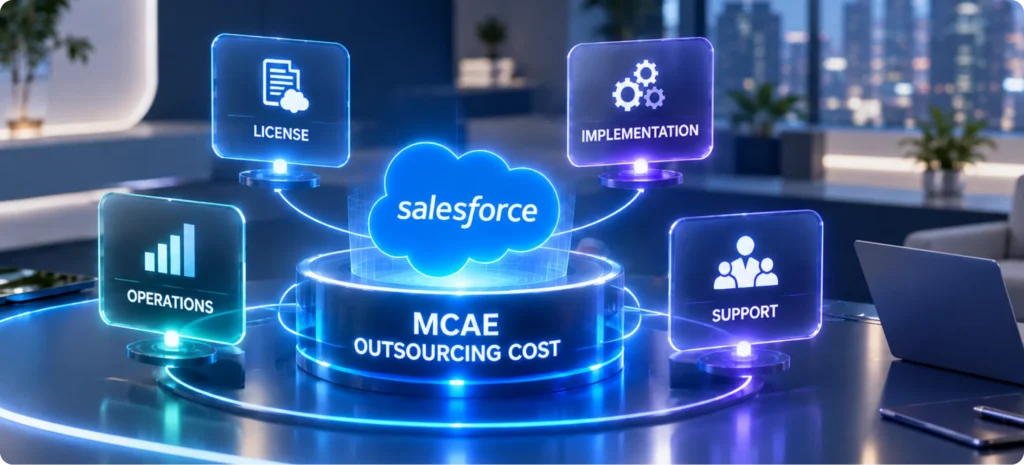
Marketing Cloud Account Engagement can be straightforward to license and surprisingly difficult to operate well as a Salesforce marketing automation platform. The platform sits between marketing operations, Salesforce administration, data management, campaign execution, lead qualification, and reporting. That means the real question for many teams is not whether they need the platform, but how much it will cost to keep it productive once it is live.

That is where outsourcing enters the budget discussion. Marketing Cloud Account Engagement outsourcing costs can range from a small cleanup project to several thousand dollars a month for administration, optimization, reporting, and strategy. Complex sync, business units, data remediation, integrations, and architecture push the price upward, so Pardot outsourcing cost cannot be reduced to one universal hourly figure.

This guide separates those layers so you can budget the Salesforce marketing automation platform without mixing licensing, implementation, production, and support. If you are still defining the operating model, our Marketing Cloud Account Engagement services address the same question: what stays internal, what gets outsourced, and what expertise is actually required?

The ranges below are planning benchmarks, not fixed quotes. Public datasets rarely isolate Account Engagement consultant cost, so we combine salary data, freelance benchmarks, recruiting costs, and project patterns. The goal is to estimate Salesforce Account Engagement services cost before proposals arrive and then test Salesforce Account Engagement services cost again at annual scale.

TL;DR

  1. Typical outsourcing spend: A focused Account Engagement task may cost roughly $1,000-$5,000, while broader optimization or implementation work can move into the $5,000-$25,000+ range. Ongoing support commonly lands in a monthly retainer or dedicated-capacity model rather than a one-off project.
  2. Hourly pricing: A practical Pardot consultant hourly rate can vary from roughly $30-$150+ depending on location, seniority, specialization, and whether the person is a freelancer, embedded resource, or consultancy lead. Public Salesforce expert benchmarks show a similarly wide band.
  3. India changes the economics: Salesforce marketing automation outsourcing to India can materially lower delivery cost, but the best comparison is not hourly rate alone. Seniority, overlap hours, QA, continuity, governance, and access to backup specialists all affect the true cost.
  4. Outsourcing models matter: Marketing Cloud Account Engagement support cost looks very different under ad hoc freelancing, a fixed project, a monthly retainer, Salesforce staff augmentation, and fully managed services. Choose the model based on ownership, workload stability, and how much direction your internal team can provide.
  5. Licensing is separate: Marketing Cloud Account Engagement pricing from Salesforce is software spend. Outsourcing is services spend. Budget them separately so a cheaper service model does not hide an expensive license tier or data-volume requirement.
  6. The cheapest quote can be expensive: Weak scoring, poor sync rules, duplicate prospects, bad suppression logic, and broken attribution can create rework that exceeds the original savings. Cost control comes from matching scope to the right skill level, not automatically selecting the lowest hourly rate.

What Does Marketing Cloud Account Engagement Outsourcing Actually Include?

Outsourcing is not one standard package. One company may outsource an Engagement Studio rebuild, another daily administration, and another only execution and troubleshooting.

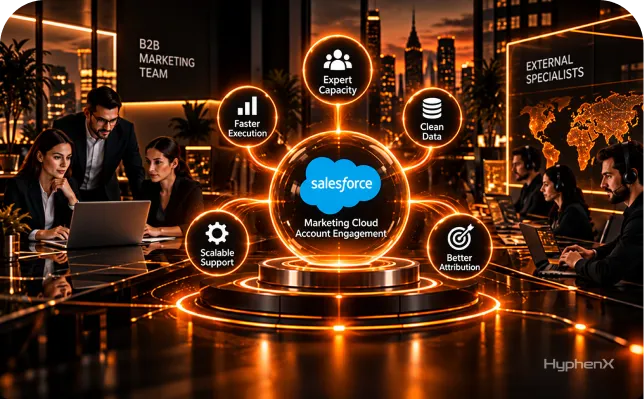
Outsourcing spend pays external people for work your team cannot cover, lacks time for, or does not need to own permanently. It usually falls into four layers.

Administration and Campaign Operations

This is the day-to-day layer of a Salesforce marketing automation platform: list creation, segmentation, forms, landing pages, email templates, campaign setup, automation rules, completion actions, user administration, and basic reporting. For many mid-market companies, this is the largest recurring workload.

Optimization and Marketing Operations

This layer covers scoring and grading, lifecycle design, nurture strategy, deliverability, campaign governance, database hygiene, attribution, and reporting. It is where marketing automation consulting starts to add strategic judgment rather than only execution. It requires more judgment than simple execution because the specialist has to decide what should change, not just build what was requested.

Salesforce and Integration Work

Account Engagement rarely operates alone. Field mappings, campaign membership, lead/contact behavior, API connections, duplicate management, consent data, and opportunity reporting can all cross into core Salesforce. Once that happens, Salesforce integration services framework becomes relevant because the issue may sit outside the marketing application itself.

Strategy and Architecture

Senior support includes solution design, business-unit architecture, governance, migration planning, multi-org considerations, data-model decisions, security, and roadmap work. This is the most expensive capacity by the hour, but it often prevents the most expensive mistakes.

The difference between these layers explains why two quotes for Pardot managed services can be several multiples apart, and why B2B marketing automation services should never be priced as one generic skill set even when both vendors describe the service as “Account Engagement support.”

Outsourcing Cost by Engagement Model

There is no useful cost conversation until the commercial model is clear. The same specialist can be inexpensive for ten hours of focused work and costly if retained indefinitely without enough backlog to justify the capacity.

Outsourcing model

Directional cost range

Best suited for

Main cost risk

Ad hoc freelancer

$30-$100+ per hour

Small fixes, audits, template work, isolated automation

Context has to be rebuilt each time

Senior specialist / consultant

$60-$150+ per hour

Scoring, architecture, troubleshooting, strategic work

Paying senior rates for routine execution

Fixed-scope project

$3,000-$25,000+

Implementation, migration, audit, major rebuild

Scope change after discovery

Monthly retainer

$2,000-$8,000+ per month

Ongoing admin, optimization, campaign support

Paying for unused capacity or unclear priorities

Staff augmentation

$25-$70+ per hour offshore; higher onshore

Embedded capacity under your management

Internal team must still manage backlog and quality

Managed services

$3,000-$12,000+ per month

Continuous ownership, SLA-driven support, multi-skill needs

Overbuying a service tier you do not need


These are planning ranges, not tariff cards. Public benchmarks for outsourced Salesforce talent vary widely; current Salesforce expert rate benchmarks show specialists spanning roughly $30-$150 per hour, with larger projects and ongoing support priced separately. That broad spread is why Account Engagement consultant cost has to be matched to the work rather than reduced to one “market rate.”

For companies that already know what needs to be done but lack bandwidth, Salesforce staff augmentation services often produce a cleaner cost model than full outsourcing because the external specialist works inside your priorities and processes while you retain functional ownership.

How Much Should You Budget by Type of Work?

A more useful budget starts with deliverables. “We need Pardot help” is too vague to price. “We need a scoring audit, connector review, three nurture programs, data cleanup, and monthly reporting” can be estimated.

Workstream

Typical effort pattern

Directional services budget

What usually changes the price

Health check / audit

20-50 hours

$1,500-$6,000

Org complexity, business units, data quality

Scoring and grading redesign

25-60 hours

$2,000-$8,000

ICP complexity, sales alignment, historical data

Engagement Studio rebuild

30-100+ hours

$2,500-$12,000+

Number of journeys, branching, content readiness

Forms and landing pages

Per asset or sprint

$500-$5,000+

Design, HTML, progressive profiling, testing

CRM sync remediation

30-120+ hours

$3,000-$15,000+

Field mapping, duplicate strategy, automation conflicts

Implementation / reimplementation

Multi-week project

$8,000-$30,000+

Migration, integrations, governance, training

Ongoing support

Monthly recurring

$2,000-$8,000+

SLA, ticket volume, campaign cadence, seniority mix

Fractional marketing ops ownership

Monthly recurring

$4,000-$12,000+

Strategy depth, analytics, stakeholder management


One reason these figures vary is that Salesforce marketing automation outsourcing bundles different disciplines. B2B marketing automation services may combine campaign execution, data work, reporting, and CRM operations in the same engagement. A form build is not the same kind of work as designing a lifecycle model. A sync error is not necessarily a Pardot issue at all. When companies use one flat rate for everything, they often overpay for simple tasks and under-resource architecture.

The talent spread underneath outsourcing prices is also visible in current India consultant salary data, where Salesforce Marketing Cloud consultant pay varies materially by experience and employer. That does not translate directly into contractor pricing, but it helps explain why senior specialists cost materially more than administrators.

The 15 Factors That Change Marketing Cloud Account Engagement Outsourcing Cost

These are the factors that most often move a proposal after discovery.

1. Scope Clarity

A clearly defined backlog is cheaper to price than “own our marketing automation.” Vendors add contingency for discovery and revisions, so the fastest way to reduce Pardot outsourcing cost is to define outcomes before negotiating rates.

2. Current Org Health

A clean environment lowers Pardot outsourcing cost. Years of abandoned automation, duplicate prospects, broken forms, and undocumented workarounds can turn the first month of Pardot support services into cleanup rather than optimization.

3. Salesforce Connector Complexity

Basic field sync is cheap, but Account Engagement consultant cost increases when troubleshooting crosses into CRM architecture. Record types, duplicate rules, assignments, campaigns, and Salesforce Flow can all expand effort, so Marketing Cloud Account Engagement support cost rises when both sides of the connector need debugging.

4. Number of Business Units

Multiple business units increase governance, permissions, segmentation, reporting, and deployment effort. One contract can behave operationally like several environments.

5. Database Size and Data Quality

Large databases increase duplicate risk, segmentation complexity, suppression checks, cleanup, and QA. Data quality then affects everything from scoring to reporting.

6. Campaign Volume

A team running four major campaigns a year has a different requirement from one launching weekly programs. Pardot managed services should scale with real campaign volume because recurring workload is usually the main pricing driver.

7. Content Readiness

External specialists move faster when copy, creative, audience rules, and approvals already exist. Adding content, design, landing pages, and stakeholder coordination expands the services scope.

8. Seniority of the Resource

Junior administrators can handle routine configuration, while senior consultants cover architecture, attribution, governance, and complex troubleshooting. Matching seniority to the task is the most reliable way to control Account Engagement consultant cost.

9. Engagement Model

Hourly support is flexible, fixed price needs stable scope, retainers reduce context switching, staff augmentation needs internal management, and managed services cost more because they transfer more ownership.

10. Geography and Time-Zone Coverage

Salesforce marketing automation outsourcing to India can lower delivery rates, although premium US or European coverage narrows the gap. A few agreed overlap hours usually preserve the cost advantage.

11. Reporting and Attribution Requirements

Basic email reporting is inexpensive. Attribution, campaign influence, executive dashboards, pipeline reporting, and Salesforce reconciliation require more advanced analytics.

12. Integration Footprint

Webinar tools, enrichment, data warehouses, consent systems, and APIs expand the test matrix. Once integrations are involved, marketing automation consulting becomes partly an integration discipline, and Pardot support services may need Salesforce-side expertise as well.

13. Governance and Compliance

Consent, suppression, access control, auditability, and regional rules add review time but reduce downstream risk. Removing governance to lower the quote is rarely a good trade.

14. SLA and Response Expectations

A two-business-day target is cheaper than same-day support. Weekend coverage, launch standby, escalation, and guaranteed availability require reserved capacity.

15. Documentation and Knowledge Transfer

Good outsourcing leaves the client more informed, not more dependent. Runbooks, automation maps, handoff notes, and training add delivery effort but lower future switching cost.

These factors are why two companies can ask for “Marketing Cloud Account Engagement support” and receive proposals that differ by 3x. The vendor is often pricing a different combination of risk, ownership, seniority, and response commitment.

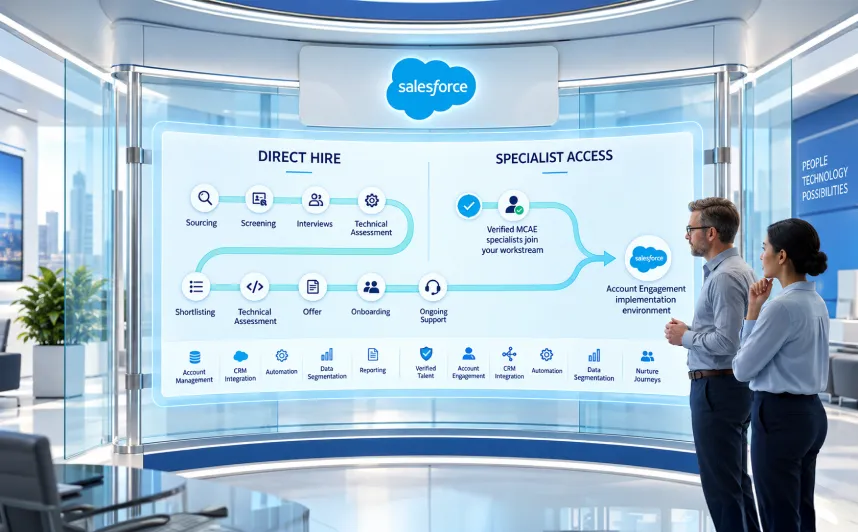
Outsourcing vs Hiring In-House: What Does the Math Look Like?
Outsourcing vs Hiring In-House_ What Does the Math Look Like_

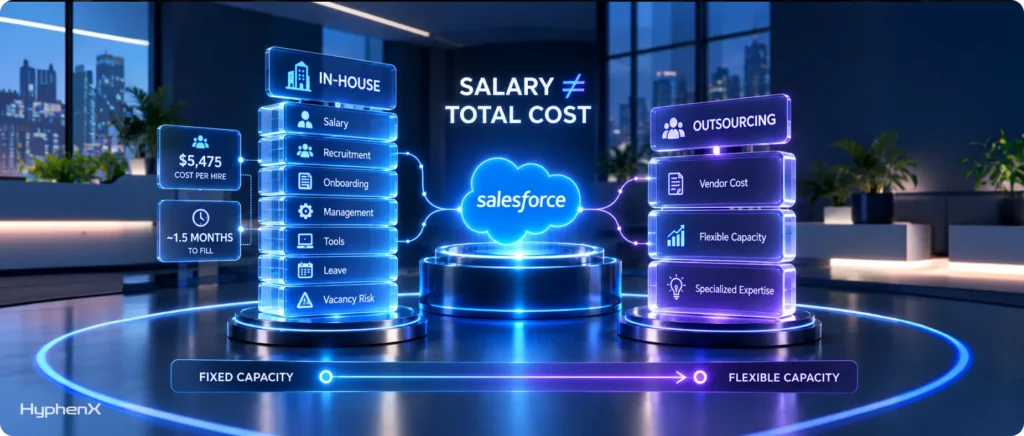
Compare full cost rather than salary alone. Employees add recruitment, onboarding, management, tools, leave, and vacancy risk; outsourcing adds vendor margin but converts part of that fixed cost into variable capacity.

Permanent hiring has its own overhead beyond salary. The 2025 SHRM recruiting benchmarks reported an average nonexecutive cost per hire of $5,475 in the US and a time-to-fill of roughly a month and a half. That is not an India-specific MCAE benchmark, but it demonstrates why a “salary only” comparison understates permanent hiring cost.

Compensation is equally variable inside the ecosystem; recent Salesforce salary survey results show meaningful differences by geography, experience, role, and specialization. A niche marketing-automation hire can therefore carry a higher sourcing burden than a general Salesforce administrator.

Cost dimension

In-house specialist

Outsourced specialist

Staff augmentation

Recruitment cost

High upfront

None to client

Usually embedded in provider rate

Time to capacity

Weeks to months

Days to weeks

Days to weeks

Fixed salary commitment

Yes

No

No

Scale up/down

Low

Medium to high

High

Institutional knowledge

High over time

Depends on documentation

High if engagement is stable

Management burden

Full employer management

Lower under managed model

Still largely internal

Access to multiple skills

Requires multiple hires

Often available through provider bench

Available if provider can rotate specialists

Best economic fit

Stable full-time workload

Variable or outcome-based workload

Predictable execution backlog


If workload fills a permanent role for years, in-house can win. If demand fluctuates or senior expertise is needed only part time, outsourcing can be cheaper even at a higher hourly rate.

Hourly Rate, Retainer, Fixed Price, or Staff Augmentation?

Each pricing model solves a different budgeting problem. There is no universally cheapest option.

Hourly Billing

Hourly billing suits a small or unpredictable backlog. It is easy to start and stop, though context switching can reduce productivity.

Judge a Pardot consultant hourly rate against specialization. Public marketplaces show lower-cost developers and much higher senior-expert rates; the cheapest profile may fit configuration but not architecture or complex troubleshooting.

Monthly Retainer

A retainer reserves monthly access for administration, campaigns, optimization, and predictable tickets. Marketing Cloud Account Engagement support cost becomes easier to forecast because some flexibility is traded for continuity.

Fixed-Price Project

Fixed price suits defined implementations, migrations, audits, and redesigns. Vendors price scope risk and contingency, so moving requirements can erase the original certainty.

Salesforce Staff Augmentation

Staff augmentation is useful when you have internal direction but need more execution capacity. The external person joins your backlog and standards rather than taking over the operating model. HyphenX explains this difference in its guide to Salesforce staff augmentation models, because staff augmentation is capacity, while managed outsourcing is ownership.

Managed Services

Managed services are appropriate when the provider is expected to monitor, prioritize, maintain, and optimize the platform continuously. Managed ownership becomes more defensible when continuity matters; HyphenX structures Salesforce managed services support around SLA, proactive maintenance, and multi-skill access rather than the lowest individual rate.

India vs US vs Europe: How Geography Changes the Cost

Geography affects labor cost, but it should not be used as a shorthand for quality. The more useful question is how geography interacts with seniority, communication, process maturity, and delivery model.

The broader offshore market gives another useful reference point: public India development pricing data shows many software and CRM service providers below $50 per hour, while specialist consultancies and highly senior resources can price above that level. The data is broader than MCAE, but it provides context for why offshore Salesforce delivery often prices below US consulting.

For Salesforce marketing automation outsourcing, a practical planning view looks like this:

  • India / offshore delivery: Often lowest for administration, campaign operations, QA, and repeatable configuration; senior architecture and extended overlap narrow the gap.
  • Eastern Europe / nearshore: Usually mid-range, with useful overlap for European buyers.
  • UK / Western Europe: Higher labor cost but easier local stakeholder access.
  • US / Canada: Often highest for senior consulting and architecture, with full North American business-hour alignment.
  • Hybrid model: Use senior overlap-friendly consulting for architecture and offshore execution for repeatable build and support.

The right comparison is cost per outcome. A $40-per-hour specialist who needs 20 hours is cheaper than a $25-per-hour generalist who needs 50 hours and creates rework.

What Should a Monthly Outsourcing Retainer Include?

A monthly retainer should be more specific than “Pardot support services.” B2B marketing automation services need explicit workload and ownership boundaries. Without defined inclusions, the client and provider can both believe they bought different things.

A strong retainer or Pardot managed services plan normally covers a mix of:

  1. Platform administration and user support
  2. Campaign setup and deployment assistance
  3. Engagement Studio maintenance
  4. Form, form handler, and landing-page support
  5. Segmentation and dynamic list management
  6. Scoring and grading adjustments
  7. Salesforce connector monitoring
  8. Data-quality checks and duplicate review
  9. Deliverability and suppression management
  10. Reporting and dashboard updates
  11. Release review and regression testing
  12. Documentation and governance upkeep
  13. Monthly optimization recommendations
  14. Defined escalation for incidents

For B2B teams that want these activities connected to a broader operating model, Salesforce marketing automation services can cover both platform execution and the process around it. The distinction matters because B2B marketing automation services should improve lead flow and sales alignment, not just keep the interface tidy.

That operating pressure is visible across the market. A 2026 marketing automation trends report highlights leaner teams alongside persistent reporting, attribution, integration, and ROI challenges. That environment is one reason companies outsource operational work: the internal team wants capacity for strategy rather than spending every week on platform maintenance.

Hidden Costs That Cheap Outsourcing Quotes Leave Out

A low quote can be valid when the scope is small. It becomes risky when important work is simply excluded.

Discovery

Inherited environments require discovery before changes are safe. Existing automation, mappings, scoring, and dependencies must be understood.

Data Cleanup

Duplicate prospects, bad email data, and stale lists are not solved by more automation. Data remediation can consume a significant share of optimization.

Testing

Forms, automation, sync changes, scoring, and Engagement Studio paths need testing. Quotes that treat QA as optional shift risk to production.

Documentation

Cheap projects can leave knowledge trapped with the consultant. Documentation costs hours now and saves more later.

Project Management

Planning, approvals, dependency tracking, and status reporting are delivery work. Some vendors include them; others charge separately.

Senior Oversight

A junior resource can handle configuration while a senior consultant reviews architecture. Blended delivery reduces cost without removing expert oversight.

Rework

Rework appears after the “cheap” project is complete. Poor mapping, scoring, suppression, or fragile automation can affect the pipeline before the configuration problem is visible.

When evaluating Marketing Cloud Account Engagement pricing, keep these services costs separate from the Salesforce subscription itself. Account Engagement implementation cost guide breaks out licensing, implementation, data, integration, and hidden project costs so buyers do not confuse software spend with delivery spend.

Case Studies: What Real Account Engagement Projects Reveal About Cost

Real projects show that consulting value comes from removing operational friction, not merely configuring screens.

For additional delivery context, HyphenX maintains a library of HyphenX Salesforce case studies covering integration, automation, and CRM transformation. The examples below come from external Account Engagement consultancies and show why scope depth affects outsourcing cost.

Case Study 1: AIMCO Global – Six-Week MCAE Implementation

AIMCO Global completed a six-week Marketing Cloud Account Engagement implementation, described in a MarTech Do implementation case study, that unified its marketing and sales technology stack through design sessions, marketing user stories, and implementation work.

The published case does not disclose a fee, but the scope is instructive. A six-week project with discovery, design, CRM alignment, QA, and handoff costs more than a Pardot consultant hourly rate multiplied only by configuration hours.

For buyers estimating Account Engagement implementation, fixed-price proposals often look higher because they price the delivery lifecycle, not only configuration.

Case Study 2: Capital Lending – Repairing a Four-Year Pardot Environment

A finance company that had run Pardot internally for years is documented in the Lime Pardot finance case study, where the client had also lost its consultant before remediation began. The inherited environment included duplicate records, fragmented processes, and event-marketing pressure. The consulting work included stakeholder discovery, customer-lifecycle mapping, data-flow redesign, business-unit work, and nurture automation.

This differs from greenfield work. Pardot outsourcing cost rises when a provider must reverse-engineer years of decisions before improving the platform.

It also shows why Pardot managed services can be attractive after remediation: ongoing support protects the stabilized environment from new technical debt.

Case Study 3: The Internal Cost of Delaying Specialist Support

Not every cost appears on an invoice. Weeks spent troubleshooting sync, rebuilding lists, or waiting for internal Salesforce capacity to create delayed campaigns and diverted staff time.

Include opportunity cost: a senior external specialist can still be cheaper than several internal people losing a week to an unfamiliar problem.

The practical takeaway across these cases is simple: marketing automation consulting is cheapest, and B2B marketing automation services are easiest to govern, when scope is clear, data is healthy, ownership is defined, and the right skill level is used for each task.

How to Build a Realistic Outsourcing Budget?

A useful Salesforce marketing automation platform budget is built in layers rather than one number.

Step 1: Separate License Cost From Services Cost

Marketing Cloud Account Engagement pricing is the Salesforce subscription. Unless a partner resells licenses, keep license, implementation, and operating budgets separate.

Step 2: Estimate Baseline Monthly Workload

Estimate recurring hours for campaigns, reporting, forms, nurture, support, data checks, and meetings. That reveals whether ad hoc support, part-time capacity, or a retainer fits.

Step 3: Identify Senior-Only Work

Reserve experienced consultants for architecture, attribution, complex sync, migration, and governance. Do not pay senior rates for routine changes or give org-wide decisions to junior resources.

Step 4: Add a Change Budget

Add 10%-20% contingency for campaign changes, cleanup, integration surprises, and Salesforce releases. Fixed projects without change budget become negotiation exercises.

Step 5: Price Continuity

If one person being unavailable would stop the program, you need continuity. A provider bench costs more because backup coverage is part of the service.

Step 6: Include Internal Time

Outsourcing still needs a client owner to prioritize, approve, provide context, and coordinate teams. Include that internal time in the comparison.

Step 7: Compare Annualized Cost

Annualize the monthly service cost and compare it with a fully loaded employee or internal team. That is the fair basis for the decision.

When Outsourcing Is Cheaper Than Hiring

Outsourcing a Salesforce marketing automation platform tends to win economically in a few recurring situations.

  • You need specialist expertise but not 40 hours a week of it.
  • Your workload fluctuates sharply between campaign-heavy and quiet periods.
  • You need immediate capacity while recruiting a permanent employee.
  • You need several skills – administrator, consultant, integration specialist, analyst – but only part-time access to each.
  • Your current team understands the business but lacks platform depth.
  • The platform has a backlog that needs to be cleared before you know the steady-state workload.
  • You need short-term help for implementation, migration, audit, or remediation.

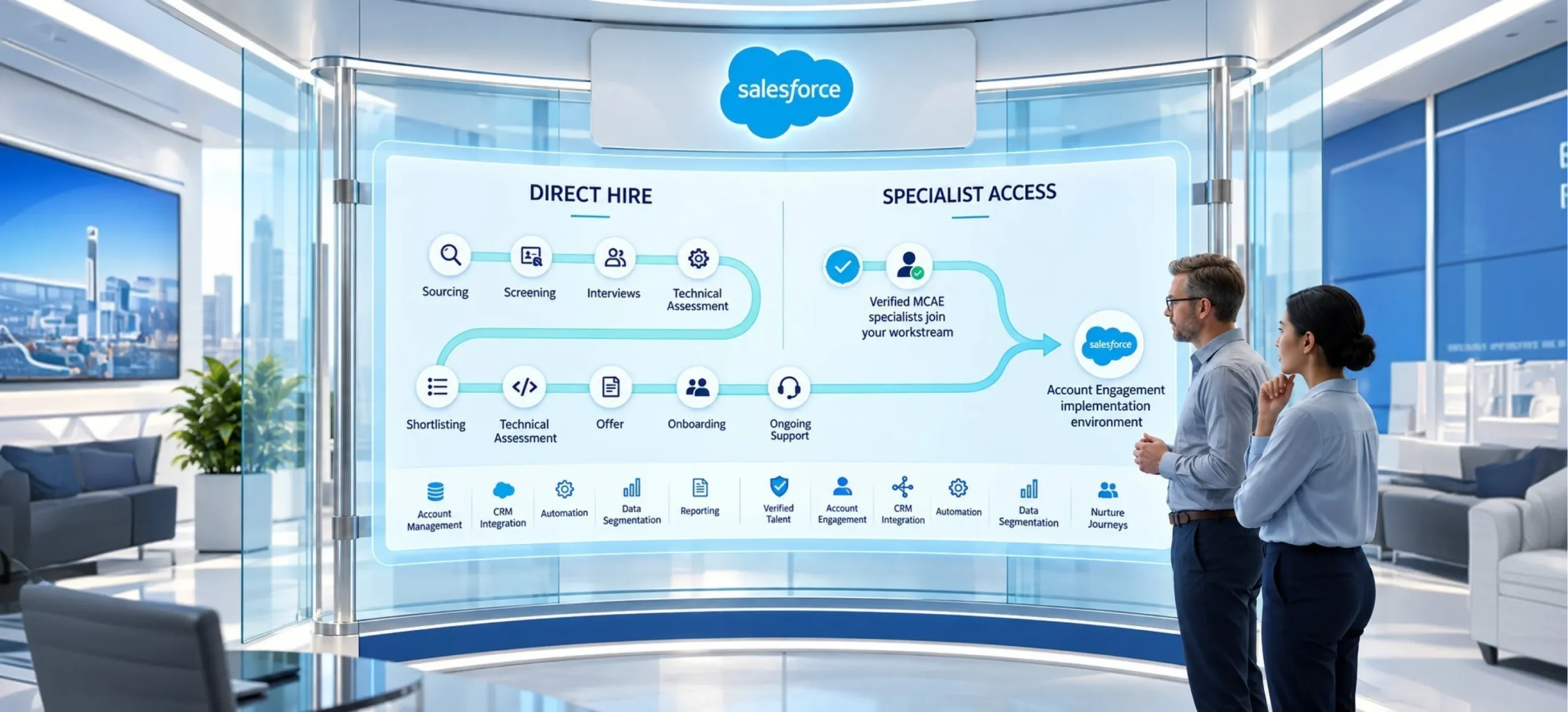
If direct hiring is still the long-term goal, HyphenX’s guide on how to hire Account Engagement specialists explains why the candidate pool is narrower than generic Salesforce hiring suggests. Outsourcing can bridge that gap without forcing the company to make a rushed permanent hire.

When Outsourcing Is More Expensive Than It Looks

Outsourcing is not automatically efficient. It becomes expensive when governance is weak.

A company can spend heavily on Salesforce Account Engagement services cost without getting proportionate value, especially when Marketing Cloud Account Engagement support cost is tied to unclear priorities if every request starts with a discovery call, priorities change weekly, stakeholders disagree about requirements, or no one internally owns acceptance criteria.

The warning signs include:

  • Repeatedly paying consultants to rediscover the same environment
  • Using senior specialists for basic campaign production
  • Keeping a large retainer with too little backlog
  • Splitting related work across multiple vendors with no architecture owner
  • Letting internal approval delays consume paid capacity
  • Treating every issue as urgent and buying premium response times
  • Failing to document configuration and creating vendor dependence
  • Measuring activity completed rather than business outcomes improved

The goal is not to minimize the monthly invoice. It is to minimize cost per reliable outcome.

How to Evaluate an Outsourcing Quote?

A strong proposal makes the economics visible. Check whether it answers:

  1. What work is included and excluded?
  2. Which tasks are handled by administrators, consultants, developers, and architects?
  3. Is project management included in the rate?
  4. How are unused retainer hours handled?
  5. What triggers a change request?
  6. What response time is guaranteed?
  7. Is senior review included for risky changes?
  8. Who owns documentation?
  9. What happens if the named specialist is unavailable?
  10. How are credentials and production access controlled?
  11. Are integrations and Salesforce-side changes included?
  12. What reporting shows how capacity was used?
  13. Can the service scale down without a long commitment?
  14. How is knowledge transferred if the engagement ends?
  15. What measurable outcomes define success?

A vendor that cannot answer these clearly may still be technically capable, but the commercial risk is higher. Marketing Cloud Account Engagement outsourcing cost is easier to control when the operating rules are explicit before the first invoice.

How HyphenX Structures Cost Around the Work?
How HyphenX Structures Cost Around the Work_

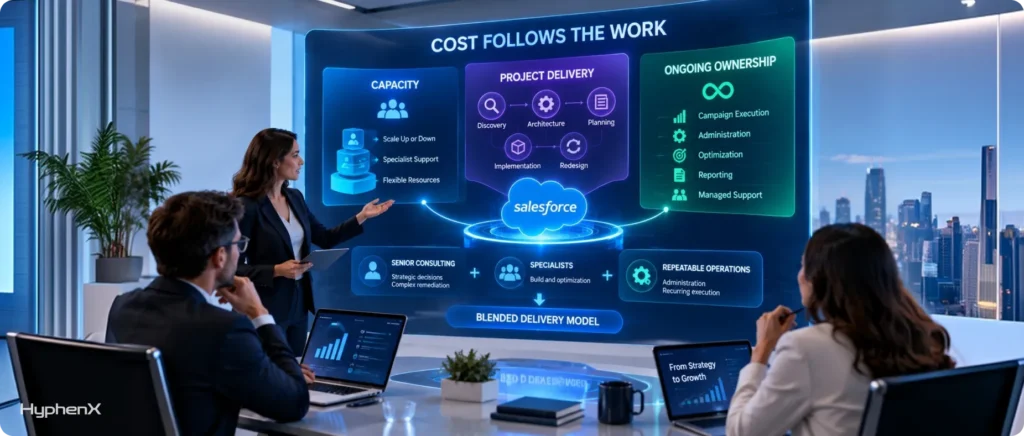
HyphenX separates Account Engagement needs into capacity, project delivery, and ongoing ownership rather than forcing one package.

For an implementation or redesign, Salesforce consulting services team can cover discovery, architecture, and planning. Recurring execution can then use staff augmentation or managed support.

This matters because Salesforce Account Engagement services cost should follow the complexity of the work. Routine campaign operations do not require an architect on every call. Complex sync remediation should not be left to an administrator who has never worked through Salesforce-side automation conflicts.

The most cost-efficient model is usually blended: senior marketing automation consulting for decisions, experienced specialists for build and optimization, and repeatable processes for ongoing administration.

A Simple Cost Planning Framework

Use this framework before requesting proposals.

Your situation

Likely model

Planning budget

Why

A few fixes each month

Hourly / small retainer

$500-$2,500/month

Avoid paying for idle capacity

Regular campaign operations

Monthly retainer

$2,000-$5,000/month

Continuity lowers context-switching cost

Heavy marketing ops ownership

Managed services

$4,000-$12,000+/month

Includes proactive ownership and senior access

Defined rebuild or optimization

Fixed project

$5,000-$20,000+

Easier to scope around deliverables

Full implementation / migration

Fixed or milestone project

$8,000-$30,000+

Discovery, build, QA, integration, training

Need one embedded specialist

Staff augmentation

$25-$70+ per hour offshore

Good when internal team controls backlog

Need architecture only

Senior consulting

$80-$150+ per hour

Buy fewer high-value hours


These ranges should be treated as a starting point. Marketing Cloud Account Engagement outsourcing cost moves above them when the environment includes extensive integrations, multiple business units, heavy data remediation, enterprise governance, or large campaign volume.

Conclusion

Marketing Cloud Account Engagement outsourcing cost is not one market price. It is the result of scope, seniority, geography, operating model, technical debt, campaign volume, and how much ownership you expect an external partner to assume.

For small tasks, a freelancer or hourly specialist can be efficient. For steady execution, a retainer or Salesforce staff augmentation model usually provides better continuity. For platforms that need proactive ownership, governance, optimization, and multi-skill support, managed services can justify a higher monthly price because the service includes more than individual labor.

The most important budgeting rule is to separate Marketing Cloud Account Engagement pricing from services around the Salesforce marketing automation platform. License cost buys the platform. Account Engagement implementation, Pardot support services, campaign execution, Salesforce integration, analytics, and optimization are separate workstreams with different skill requirements.

If you benchmark vendors only by Pardot consultant hourly rate, you will miss the larger economics. The better metric is total cost per reliable outcome: how quickly issues are solved, how much internal time is saved, how stable the Salesforce connection remains, and whether marketing automation produces measurable pipeline rather than more platform activity.

Frequently Asked Questions

1. What is the average Marketing Cloud Account Engagement outsourcing cost?

Marketing Cloud Account Engagement outsourcing cost varies by scope. Small assignments may start around $1,000-$5,000, while implementation or remediation can reach $8,000-$30,000+. Ongoing retainers often sit around $2,000-$8,000+ per month; treat these as planning ranges, not fixed prices.

2. How much does a Pardot consultant charge per hour?

A Pardot consultant hourly rate can range roughly from $30 to $150+ per hour. Geography, seniority, business-unit experience, Salesforce depth, and integration skills determine where a specialist sits in that band.

3. Is Pardot outsourcing cost lower in India?

Pardot outsourcing cost is often lower with India-based delivery, especially for administration, campaign operations, testing, and configuration. Senior architecture, heavy stakeholder management, and full US-hours coverage narrow the gap.

4. What is included in Marketing Cloud Account Engagement support cost?

Marketing Cloud Account Engagement support cost may include administration, campaigns, forms, lists, Engagement Studio, scoring, sync monitoring, reporting, data quality, deliverability, and troubleshooting. Managed plans may add optimization, architecture review, SLAs, and release management.

5. How much do Pardot managed services cost per month?

Pardot managed services commonly begin around a few thousand dollars monthly. A smaller retainer may cost $2,000-$5,000, while broader managed ownership can reach $4,000-$12,000+ as volume, SLA, integrations, and strategic responsibility increase.

6. What affects Account Engagement consultant cost the most?

Account Engagement consultant cost is driven by seniority, geography, Salesforce depth, business units, integrations, data quality, stakeholder involvement, and strategic responsibility. Scope ambiguity raises cost because providers must price more discovery and change risk.

7. Is Salesforce staff augmentation cheaper than managed services?

Salesforce staff augmentation is often cheaper when your team can manage priorities and quality. Managed services cost more because the provider assumes monitoring, continuity, escalation, and optimization responsibility.

8. How much does Account Engagement implementation cost?

Account Engagement implementation can range roughly from $8,000 to $30,000+ depending on migration, Salesforce configuration, integrations, forms, nurture, reporting, testing, training, and governance. Budget it separately from license fees.

9. What is the difference between Marketing Cloud Account Engagement pricing and outsourcing cost?

Marketing Cloud Account Engagement pricing is the Salesforce software license. Outsourcing cost covers people and services for implementation, administration, optimization, integration, and support. Budget both separately.

10. Are B2B marketing automation services usually billed hourly?

B2B marketing automation services may be hourly, fixed-price, retainer, or managed service. Hourly fits small work, fixed price fits defined projects, retainers fit recurring operations, and managed services fit ongoing ownership.

11. How do I reduce Salesforce Account Engagement services cost?

Reduce Salesforce Account Engagement services cost through clear scope, cleaner data, sensible skill mix, documentation, batched changes, and the right engagement model. Avoiding rework usually saves more than negotiating a slightly lower hourly rate.

12. When should I use Salesforce marketing automation outsourcing?

Salesforce marketing automation outsourcing works well when skills are scarce, workload fluctuates, hiring is too slow, or several Salesforce capabilities are only needed part time. Common uses include implementation, remediation, campaigns, analytics, and administration.

13. What should Pardot support services include in an SLA?

Pardot support services should define response times, severity, support hours, escalation, security, deployment, documentation, and urgent issue handling. The SLA should also state whether Salesforce-side fixes and integrations are included.

14. Is marketing automation consulting worth the cost for a small team?

Marketing automation consulting can be valuable when a few expert hours prevent months of inefficient configuration. Small teams often use senior help for architecture, scoring, reporting, and governance, then lower-cost support for recurring tasks.

15. How should I compare Pardot consultant hourly rate quotes?

Compare Pardot consultant hourly rate quotes using experience, expected hours, speed, senior oversight, documentation, continuity, and rework risk. A lower rate is not cheaper if it requires far more hours or later remediation.


Like what you see? Share with a friend.

Best CRM Software for Businesses: Why Companies Are Choosing Salesforce

Share with your community!

What's trending

Most Related Blogs

lwc aura
Salesforce Marketing Cloud    24 September 2026

LWC vs Aura: What’s the Difference and Which Salesforce Developer Do You Need to Hire?

If your Salesforce org has been customized for more than a few years, there is a good chance…

Read More...
How to hire a Salesforce Lightning developer: LWC skills scorecard and hiring checklist
Salesforce Marketing Cloud    23 September 2026

How to Hire a Salesforce Lightning Developer: Skills, LWC Expertise, Cost and Interview Questions

For most of your team, Salesforce isn’t a database. It’s the set of screens they work in every…

Read More...
top benifits outsourcing
Salesforce Marketing Cloud    23 September 2026

Top Benefits of Outsourcing Marketing Cloud Account Engagement for B2B Teams in 2026

Marketing Cloud Account Engagement has become a much bigger operational responsibility than “the tool that sends B2B emails.”…

Read More...
Marketing Cloud Account Engagement Outsourcing Cost_ A Complete Cost Guide
Salesforce Marketing Cloud    22 September 2026

Marketing Cloud Account Engagement Outsourcing Cost: A Complete Cost Guide

Marketing Cloud Account Engagement can be straightforward to license and surprisingly difficult to operate well as a Salesforce…

Read More...
Pardot Vs Marketing Cloud Account Engagement_ Is It the Same Thing_
Salesforce Marketing Cloud    22 September 2026

Pardot Vs Marketing Cloud Account Engagement: Is It the Same Thing?

If you have worked in Salesforce marketing for more than a few years, you have probably heard one…

Read More...
Why It's Hard to Hire a Marketing Cloud Account Engagement Specialist in India (and What to Do Instead)
Uncategorized    10 September 2026

Why It’s Hard to Hire a Marketing Cloud Account Engagement Specialist in India (and What to Do Instead)

If you’ve spent the last few weeks trying to hire a Marketing Cloud Account Engagement specialist in India,…

Read More...
Marketing Cloud Account Engagement Outsourcing Cost_ A Complete Cost Guide
Salesforce Marketing Cloud

Marketing Cloud Account Engagement Outsourcing Cost: A Complete Cost Guide

user
By user
September 22, 2026
Why Its Hard to Hire a Marketing Cloud Account Engagement Specialist in India (and What to Do Instead)

Marketing Cloud Account Engagement can be straightforward to license and surprisingly difficult to operate well as a Salesforce marketing automation platform. The platform sits between marketing operations, Salesforce administration, data management, campaign execution, lead qualification, and reporting. That means the real question for many teams is not whether they need the platform, but how much it will cost to keep it productive once it is live.

That is where outsourcing enters the budget discussion. Marketing Cloud Account Engagement outsourcing costs can range from a small cleanup project to several thousand dollars a month for administration, optimization, reporting, and strategy. Complex sync, business units, data remediation, integrations, and architecture push the price upward, so Pardot outsourcing cost cannot be reduced to one universal hourly figure.

This guide separates those layers so you can budget the Salesforce marketing automation platform without mixing licensing, implementation, production, and support. If you are still defining the operating model, our Marketing Cloud Account Engagement services address the same question: what stays internal, what gets outsourced, and what expertise is actually required?

The ranges below are planning benchmarks, not fixed quotes. Public datasets rarely isolate Account Engagement consultant cost, so we combine salary data, freelance benchmarks, recruiting costs, and project patterns. The goal is to estimate Salesforce Account Engagement services cost before proposals arrive and then test Salesforce Account Engagement services cost again at annual scale.

TL;DR

  1. Typical outsourcing spend: A focused Account Engagement task may cost roughly $1,000-$5,000, while broader optimization or implementation work can move into the $5,000-$25,000+ range. Ongoing support commonly lands in a monthly retainer or dedicated-capacity model rather than a one-off project.
  2. Hourly pricing: A practical Pardot consultant hourly rate can vary from roughly $30-$150+ depending on location, seniority, specialization, and whether the person is a freelancer, embedded resource, or consultancy lead. Public Salesforce expert benchmarks show a similarly wide band.
  3. India changes the economics: Salesforce marketing automation outsourcing to India can materially lower delivery cost, but the best comparison is not hourly rate alone. Seniority, overlap hours, QA, continuity, governance, and access to backup specialists all affect the true cost.
  4. Outsourcing models matter: Marketing Cloud Account Engagement support cost looks very different under ad hoc freelancing, a fixed project, a monthly retainer, Salesforce staff augmentation, and fully managed services. Choose the model based on ownership, workload stability, and how much direction your internal team can provide.
  5. Licensing is separate: Marketing Cloud Account Engagement pricing from Salesforce is software spend. Outsourcing is services spend. Budget them separately so a cheaper service model does not hide an expensive license tier or data-volume requirement.
  6. The cheapest quote can be expensive: Weak scoring, poor sync rules, duplicate prospects, bad suppression logic, and broken attribution can create rework that exceeds the original savings. Cost control comes from matching scope to the right skill level, not automatically selecting the lowest hourly rate.

What Does Marketing Cloud Account Engagement Outsourcing Actually Include?

Outsourcing is not one standard package. One company may outsource an Engagement Studio rebuild, another daily administration, and another only execution and troubleshooting.

Outsourcing spend pays external people for work your team cannot cover, lacks time for, or does not need to own permanently. It usually falls into four layers.

Administration and Campaign Operations

This is the day-to-day layer of a Salesforce marketing automation platform: list creation, segmentation, forms, landing pages, email templates, campaign setup, automation rules, completion actions, user administration, and basic reporting. For many mid-market companies, this is the largest recurring workload.

Optimization and Marketing Operations

This layer covers scoring and grading, lifecycle design, nurture strategy, deliverability, campaign governance, database hygiene, attribution, and reporting. It is where marketing automation consulting starts to add strategic judgment rather than only execution. It requires more judgment than simple execution because the specialist has to decide what should change, not just build what was requested.

Salesforce and Integration Work

Account Engagement rarely operates alone. Field mappings, campaign membership, lead/contact behavior, API connections, duplicate management, consent data, and opportunity reporting can all cross into core Salesforce. Once that happens, Salesforce integration services framework becomes relevant because the issue may sit outside the marketing application itself.

Strategy and Architecture

Senior support includes solution design, business-unit architecture, governance, migration planning, multi-org considerations, data-model decisions, security, and roadmap work. This is the most expensive capacity by the hour, but it often prevents the most expensive mistakes.

The difference between these layers explains why two quotes for Pardot managed services can be several multiples apart, and why B2B marketing automation services should never be priced as one generic skill set even when both vendors describe the service as “Account Engagement support.”

Outsourcing Cost by Engagement Model

There is no useful cost conversation until the commercial model is clear. The same specialist can be inexpensive for ten hours of focused work and costly if retained indefinitely without enough backlog to justify the capacity.

Outsourcing model

Directional cost range

Best suited for

Main cost risk

Ad hoc freelancer

$30-$100+ per hour

Small fixes, audits, template work, isolated automation

Context has to be rebuilt each time

Senior specialist / consultant

$60-$150+ per hour

Scoring, architecture, troubleshooting, strategic work

Paying senior rates for routine execution

Fixed-scope project

$3,000-$25,000+

Implementation, migration, audit, major rebuild

Scope change after discovery

Monthly retainer

$2,000-$8,000+ per month

Ongoing admin, optimization, campaign support

Paying for unused capacity or unclear priorities

Staff augmentation

$25-$70+ per hour offshore; higher onshore

Embedded capacity under your management

Internal team must still manage backlog and quality

Managed services

$3,000-$12,000+ per month

Continuous ownership, SLA-driven support, multi-skill needs

Overbuying a service tier you do not need


These are planning ranges, not tariff cards. Public benchmarks for outsourced Salesforce talent vary widely; current Salesforce expert rate benchmarks show specialists spanning roughly $30-$150 per hour, with larger projects and ongoing support priced separately. That broad spread is why Account Engagement consultant cost has to be matched to the work rather than reduced to one “market rate.”

For companies that already know what needs to be done but lack bandwidth, Salesforce staff augmentation services often produce a cleaner cost model than full outsourcing because the external specialist works inside your priorities and processes while you retain functional ownership.

How Much Should You Budget by Type of Work?

A more useful budget starts with deliverables. “We need Pardot help” is too vague to price. “We need a scoring audit, connector review, three nurture programs, data cleanup, and monthly reporting” can be estimated.

Workstream

Typical effort pattern

Directional services budget

What usually changes the price

Health check / audit

20-50 hours

$1,500-$6,000

Org complexity, business units, data quality

Scoring and grading redesign

25-60 hours

$2,000-$8,000

ICP complexity, sales alignment, historical data

Engagement Studio rebuild

30-100+ hours

$2,500-$12,000+

Number of journeys, branching, content readiness

Forms and landing pages

Per asset or sprint

$500-$5,000+

Design, HTML, progressive profiling, testing

CRM sync remediation

30-120+ hours

$3,000-$15,000+

Field mapping, duplicate strategy, automation conflicts

Implementation / reimplementation

Multi-week project

$8,000-$30,000+

Migration, integrations, governance, training

Ongoing support

Monthly recurring

$2,000-$8,000+

SLA, ticket volume, campaign cadence, seniority mix

Fractional marketing ops ownership

Monthly recurring

$4,000-$12,000+

Strategy depth, analytics, stakeholder management


One reason these figures vary is that Salesforce marketing automation outsourcing bundles different disciplines. B2B marketing automation services may combine campaign execution, data work, reporting, and CRM operations in the same engagement. A form build is not the same kind of work as designing a lifecycle model. A sync error is not necessarily a Pardot issue at all. When companies use one flat rate for everything, they often overpay for simple tasks and under-resource architecture.

The talent spread underneath outsourcing prices is also visible in current India consultant salary data, where Salesforce Marketing Cloud consultant pay varies materially by experience and employer. That does not translate directly into contractor pricing, but it helps explain why senior specialists cost materially more than administrators.

The 15 Factors That Change Marketing Cloud Account Engagement Outsourcing Cost

These are the factors that most often move a proposal after discovery.

1. Scope Clarity

A clearly defined backlog is cheaper to price than “own our marketing automation.” Vendors add contingency for discovery and revisions, so the fastest way to reduce Pardot outsourcing cost is to define outcomes before negotiating rates.

2. Current Org Health

A clean environment lowers Pardot outsourcing cost. Years of abandoned automation, duplicate prospects, broken forms, and undocumented workarounds can turn the first month of Pardot support services into cleanup rather than optimization.

3. Salesforce Connector Complexity

Basic field sync is cheap, but Account Engagement consultant cost increases when troubleshooting crosses into CRM architecture. Record types, duplicate rules, assignments, campaigns, and Salesforce Flow can all expand effort, so Marketing Cloud Account Engagement support cost rises when both sides of the connector need debugging.

4. Number of Business Units

Multiple business units increase governance, permissions, segmentation, reporting, and deployment effort. One contract can behave operationally like several environments.

5. Database Size and Data Quality

Large databases increase duplicate risk, segmentation complexity, suppression checks, cleanup, and QA. Data quality then affects everything from scoring to reporting.

6. Campaign Volume

A team running four major campaigns a year has a different requirement from one launching weekly programs. Pardot managed services should scale with real campaign volume because recurring workload is usually the main pricing driver.

7. Content Readiness

External specialists move faster when copy, creative, audience rules, and approvals already exist. Adding content, design, landing pages, and stakeholder coordination expands the services scope.

8. Seniority of the Resource

Junior administrators can handle routine configuration, while senior consultants cover architecture, attribution, governance, and complex troubleshooting. Matching seniority to the task is the most reliable way to control Account Engagement consultant cost.

9. Engagement Model

Hourly support is flexible, fixed price needs stable scope, retainers reduce context switching, staff augmentation needs internal management, and managed services cost more because they transfer more ownership.

10. Geography and Time-Zone Coverage

Salesforce marketing automation outsourcing to India can lower delivery rates, although premium US or European coverage narrows the gap. A few agreed overlap hours usually preserve the cost advantage.

11. Reporting and Attribution Requirements

Basic email reporting is inexpensive. Attribution, campaign influence, executive dashboards, pipeline reporting, and Salesforce reconciliation require more advanced analytics.

12. Integration Footprint

Webinar tools, enrichment, data warehouses, consent systems, and APIs expand the test matrix. Once integrations are involved, marketing automation consulting becomes partly an integration discipline, and Pardot support services may need Salesforce-side expertise as well.

13. Governance and Compliance

Consent, suppression, access control, auditability, and regional rules add review time but reduce downstream risk. Removing governance to lower the quote is rarely a good trade.

14. SLA and Response Expectations

A two-business-day target is cheaper than same-day support. Weekend coverage, launch standby, escalation, and guaranteed availability require reserved capacity.

15. Documentation and Knowledge Transfer

Good outsourcing leaves the client more informed, not more dependent. Runbooks, automation maps, handoff notes, and training add delivery effort but lower future switching cost.

These factors are why two companies can ask for “Marketing Cloud Account Engagement support” and receive proposals that differ by 3x. The vendor is often pricing a different combination of risk, ownership, seniority, and response commitment.

Outsourcing vs Hiring In-House: What Does the Math Look Like?

Outsourcing vs Hiring In-House_ What Does the Math Look Like_

Compare full cost rather than salary alone. Employees add recruitment, onboarding, management, tools, leave, and vacancy risk; outsourcing adds vendor margin but converts part of that fixed cost into variable capacity.

Permanent hiring has its own overhead beyond salary. The 2025 SHRM recruiting benchmarks reported an average nonexecutive cost per hire of $5,475 in the US and a time-to-fill of roughly a month and a half. That is not an India-specific MCAE benchmark, but it demonstrates why a “salary only” comparison understates permanent hiring cost.

Compensation is equally variable inside the ecosystem; recent Salesforce salary survey results show meaningful differences by geography, experience, role, and specialization. A niche marketing-automation hire can therefore carry a higher sourcing burden than a general Salesforce administrator.

Cost dimension

In-house specialist

Outsourced specialist

Staff augmentation

Recruitment cost

High upfront

None to client

Usually embedded in provider rate

Time to capacity

Weeks to months

Days to weeks

Days to weeks

Fixed salary commitment

Yes

No

No

Scale up/down

Low

Medium to high

High

Institutional knowledge

High over time

Depends on documentation

High if engagement is stable

Management burden

Full employer management

Lower under managed model

Still largely internal

Access to multiple skills

Requires multiple hires

Often available through provider bench

Available if provider can rotate specialists

Best economic fit

Stable full-time workload

Variable or outcome-based workload

Predictable execution backlog


If workload fills a permanent role for years, in-house can win. If demand fluctuates or senior expertise is needed only part time, outsourcing can be cheaper even at a higher hourly rate.

Hourly Rate, Retainer, Fixed Price, or Staff Augmentation?

Each pricing model solves a different budgeting problem. There is no universally cheapest option.

Hourly Billing

Hourly billing suits a small or unpredictable backlog. It is easy to start and stop, though context switching can reduce productivity.

Judge a Pardot consultant hourly rate against specialization. Public marketplaces show lower-cost developers and much higher senior-expert rates; the cheapest profile may fit configuration but not architecture or complex troubleshooting.

Monthly Retainer

A retainer reserves monthly access for administration, campaigns, optimization, and predictable tickets. Marketing Cloud Account Engagement support cost becomes easier to forecast because some flexibility is traded for continuity.

Fixed-Price Project

Fixed price suits defined implementations, migrations, audits, and redesigns. Vendors price scope risk and contingency, so moving requirements can erase the original certainty.

Salesforce Staff Augmentation

Staff augmentation is useful when you have internal direction but need more execution capacity. The external person joins your backlog and standards rather than taking over the operating model. HyphenX explains this difference in its guide to Salesforce staff augmentation models, because staff augmentation is capacity, while managed outsourcing is ownership.

Managed Services

Managed services are appropriate when the provider is expected to monitor, prioritize, maintain, and optimize the platform continuously. Managed ownership becomes more defensible when continuity matters; HyphenX structures Salesforce managed services support around SLA, proactive maintenance, and multi-skill access rather than the lowest individual rate.

India vs US vs Europe: How Geography Changes the Cost

Geography affects labor cost, but it should not be used as a shorthand for quality. The more useful question is how geography interacts with seniority, communication, process maturity, and delivery model.

The broader offshore market gives another useful reference point: public India development pricing data shows many software and CRM service providers below $50 per hour, while specialist consultancies and highly senior resources can price above that level. The data is broader than MCAE, but it provides context for why offshore Salesforce delivery often prices below US consulting.

For Salesforce marketing automation outsourcing, a practical planning view looks like this:

  • India / offshore delivery: Often lowest for administration, campaign operations, QA, and repeatable configuration; senior architecture and extended overlap narrow the gap.
  • Eastern Europe / nearshore: Usually mid-range, with useful overlap for European buyers.
  • UK / Western Europe: Higher labor cost but easier local stakeholder access.
  • US / Canada: Often highest for senior consulting and architecture, with full North American business-hour alignment.
  • Hybrid model: Use senior overlap-friendly consulting for architecture and offshore execution for repeatable build and support.

The right comparison is cost per outcome. A $40-per-hour specialist who needs 20 hours is cheaper than a $25-per-hour generalist who needs 50 hours and creates rework.

What Should a Monthly Outsourcing Retainer Include?

A monthly retainer should be more specific than “Pardot support services.” B2B marketing automation services need explicit workload and ownership boundaries. Without defined inclusions, the client and provider can both believe they bought different things.

A strong retainer or Pardot managed services plan normally covers a mix of:

  1. Platform administration and user support
  2. Campaign setup and deployment assistance
  3. Engagement Studio maintenance
  4. Form, form handler, and landing-page support
  5. Segmentation and dynamic list management
  6. Scoring and grading adjustments
  7. Salesforce connector monitoring
  8. Data-quality checks and duplicate review
  9. Deliverability and suppression management
  10. Reporting and dashboard updates
  11. Release review and regression testing
  12. Documentation and governance upkeep
  13. Monthly optimization recommendations
  14. Defined escalation for incidents

For B2B teams that want these activities connected to a broader operating model, Salesforce marketing automation services can cover both platform execution and the process around it. The distinction matters because B2B marketing automation services should improve lead flow and sales alignment, not just keep the interface tidy.

That operating pressure is visible across the market. A 2026 marketing automation trends report highlights leaner teams alongside persistent reporting, attribution, integration, and ROI challenges. That environment is one reason companies outsource operational work: the internal team wants capacity for strategy rather than spending every week on platform maintenance.

Hidden Costs That Cheap Outsourcing Quotes Leave Out

A low quote can be valid when the scope is small. It becomes risky when important work is simply excluded.

Discovery

Inherited environments require discovery before changes are safe. Existing automation, mappings, scoring, and dependencies must be understood.

Data Cleanup

Duplicate prospects, bad email data, and stale lists are not solved by more automation. Data remediation can consume a significant share of optimization.

Testing

Forms, automation, sync changes, scoring, and Engagement Studio paths need testing. Quotes that treat QA as optional shift risk to production.

Documentation

Cheap projects can leave knowledge trapped with the consultant. Documentation costs hours now and saves more later.

Project Management

Planning, approvals, dependency tracking, and status reporting are delivery work. Some vendors include them; others charge separately.

Senior Oversight

A junior resource can handle configuration while a senior consultant reviews architecture. Blended delivery reduces cost without removing expert oversight.

Rework

Rework appears after the “cheap” project is complete. Poor mapping, scoring, suppression, or fragile automation can affect the pipeline before the configuration problem is visible.

When evaluating Marketing Cloud Account Engagement pricing, keep these services costs separate from the Salesforce subscription itself. Account Engagement implementation cost guide breaks out licensing, implementation, data, integration, and hidden project costs so buyers do not confuse software spend with delivery spend.

Case Studies: What Real Account Engagement Projects Reveal About Cost

Real projects show that consulting value comes from removing operational friction, not merely configuring screens.

For additional delivery context, HyphenX maintains a library of HyphenX Salesforce case studies covering integration, automation, and CRM transformation. The examples below come from external Account Engagement consultancies and show why scope depth affects outsourcing cost.

Case Study 1: AIMCO Global – Six-Week MCAE Implementation

AIMCO Global completed a six-week Marketing Cloud Account Engagement implementation, described in a MarTech Do implementation case study, that unified its marketing and sales technology stack through design sessions, marketing user stories, and implementation work.

The published case does not disclose a fee, but the scope is instructive. A six-week project with discovery, design, CRM alignment, QA, and handoff costs more than a Pardot consultant hourly rate multiplied only by configuration hours.

For buyers estimating Account Engagement implementation, fixed-price proposals often look higher because they price the delivery lifecycle, not only configuration.

Case Study 2: Capital Lending – Repairing a Four-Year Pardot Environment

A finance company that had run Pardot internally for years is documented in the Lime Pardot finance case study, where the client had also lost its consultant before remediation began. The inherited environment included duplicate records, fragmented processes, and event-marketing pressure. The consulting work included stakeholder discovery, customer-lifecycle mapping, data-flow redesign, business-unit work, and nurture automation.

This differs from greenfield work. Pardot outsourcing cost rises when a provider must reverse-engineer years of decisions before improving the platform.

It also shows why Pardot managed services can be attractive after remediation: ongoing support protects the stabilized environment from new technical debt.

Case Study 3: The Internal Cost of Delaying Specialist Support

Not every cost appears on an invoice. Weeks spent troubleshooting sync, rebuilding lists, or waiting for internal Salesforce capacity to create delayed campaigns and diverted staff time.

Include opportunity cost: a senior external specialist can still be cheaper than several internal people losing a week to an unfamiliar problem.

The practical takeaway across these cases is simple: marketing automation consulting is cheapest, and B2B marketing automation services are easiest to govern, when scope is clear, data is healthy, ownership is defined, and the right skill level is used for each task.

How to Build a Realistic Outsourcing Budget?

A useful Salesforce marketing automation platform budget is built in layers rather than one number.

Step 1: Separate License Cost From Services Cost

Marketing Cloud Account Engagement pricing is the Salesforce subscription. Unless a partner resells licenses, keep license, implementation, and operating budgets separate.

Step 2: Estimate Baseline Monthly Workload

Estimate recurring hours for campaigns, reporting, forms, nurture, support, data checks, and meetings. That reveals whether ad hoc support, part-time capacity, or a retainer fits.

Step 3: Identify Senior-Only Work

Reserve experienced consultants for architecture, attribution, complex sync, migration, and governance. Do not pay senior rates for routine changes or give org-wide decisions to junior resources.

Step 4: Add a Change Budget

Add 10%-20% contingency for campaign changes, cleanup, integration surprises, and Salesforce releases. Fixed projects without change budget become negotiation exercises.

Step 5: Price Continuity

If one person being unavailable would stop the program, you need continuity. A provider bench costs more because backup coverage is part of the service.

Step 6: Include Internal Time

Outsourcing still needs a client owner to prioritize, approve, provide context, and coordinate teams. Include that internal time in the comparison.

Step 7: Compare Annualized Cost

Annualize the monthly service cost and compare it with a fully loaded employee or internal team. That is the fair basis for the decision.

When Outsourcing Is Cheaper Than Hiring

Outsourcing a Salesforce marketing automation platform tends to win economically in a few recurring situations.

  • You need specialist expertise but not 40 hours a week of it.
  • Your workload fluctuates sharply between campaign-heavy and quiet periods.
  • You need immediate capacity while recruiting a permanent employee.
  • You need several skills – administrator, consultant, integration specialist, analyst – but only part-time access to each.
  • Your current team understands the business but lacks platform depth.
  • The platform has a backlog that needs to be cleared before you know the steady-state workload.
  • You need short-term help for implementation, migration, audit, or remediation.

If direct hiring is still the long-term goal, HyphenX’s guide on how to hire Account Engagement specialists explains why the candidate pool is narrower than generic Salesforce hiring suggests. Outsourcing can bridge that gap without forcing the company to make a rushed permanent hire.

When Outsourcing Is More Expensive Than It Looks

Outsourcing is not automatically efficient. It becomes expensive when governance is weak.

A company can spend heavily on Salesforce Account Engagement services cost without getting proportionate value, especially when Marketing Cloud Account Engagement support cost is tied to unclear priorities if every request starts with a discovery call, priorities change weekly, stakeholders disagree about requirements, or no one internally owns acceptance criteria.

The warning signs include:

  • Repeatedly paying consultants to rediscover the same environment
  • Using senior specialists for basic campaign production
  • Keeping a large retainer with too little backlog
  • Splitting related work across multiple vendors with no architecture owner
  • Letting internal approval delays consume paid capacity
  • Treating every issue as urgent and buying premium response times
  • Failing to document configuration and creating vendor dependence
  • Measuring activity completed rather than business outcomes improved

The goal is not to minimize the monthly invoice. It is to minimize cost per reliable outcome.

How to Evaluate an Outsourcing Quote?

A strong proposal makes the economics visible. Check whether it answers:

  1. What work is included and excluded?
  2. Which tasks are handled by administrators, consultants, developers, and architects?
  3. Is project management included in the rate?
  4. How are unused retainer hours handled?
  5. What triggers a change request?
  6. What response time is guaranteed?
  7. Is senior review included for risky changes?
  8. Who owns documentation?
  9. What happens if the named specialist is unavailable?
  10. How are credentials and production access controlled?
  11. Are integrations and Salesforce-side changes included?
  12. What reporting shows how capacity was used?
  13. Can the service scale down without a long commitment?
  14. How is knowledge transferred if the engagement ends?
  15. What measurable outcomes define success?

A vendor that cannot answer these clearly may still be technically capable, but the commercial risk is higher. Marketing Cloud Account Engagement outsourcing cost is easier to control when the operating rules are explicit before the first invoice.

How HyphenX Structures Cost Around the Work?

How HyphenX Structures Cost Around the Work_

HyphenX separates Account Engagement needs into capacity, project delivery, and ongoing ownership rather than forcing one package.

For an implementation or redesign, Salesforce consulting services team can cover discovery, architecture, and planning. Recurring execution can then use staff augmentation or managed support.

This matters because Salesforce Account Engagement services cost should follow the complexity of the work. Routine campaign operations do not require an architect on every call. Complex sync remediation should not be left to an administrator who has never worked through Salesforce-side automation conflicts.

The most cost-efficient model is usually blended: senior marketing automation consulting for decisions, experienced specialists for build and optimization, and repeatable processes for ongoing administration.

A Simple Cost Planning Framework

Use this framework before requesting proposals.

Your situation

Likely model

Planning budget

Why

A few fixes each month

Hourly / small retainer

$500-$2,500/month

Avoid paying for idle capacity

Regular campaign operations

Monthly retainer

$2,000-$5,000/month

Continuity lowers context-switching cost

Heavy marketing ops ownership

Managed services

$4,000-$12,000+/month

Includes proactive ownership and senior access

Defined rebuild or optimization

Fixed project

$5,000-$20,000+

Easier to scope around deliverables

Full implementation / migration

Fixed or milestone project

$8,000-$30,000+

Discovery, build, QA, integration, training

Need one embedded specialist

Staff augmentation

$25-$70+ per hour offshore

Good when internal team controls backlog

Need architecture only

Senior consulting

$80-$150+ per hour

Buy fewer high-value hours


These ranges should be treated as a starting point. Marketing Cloud Account Engagement outsourcing cost moves above them when the environment includes extensive integrations, multiple business units, heavy data remediation, enterprise governance, or large campaign volume.

Conclusion

Marketing Cloud Account Engagement outsourcing cost is not one market price. It is the result of scope, seniority, geography, operating model, technical debt, campaign volume, and how much ownership you expect an external partner to assume.

For small tasks, a freelancer or hourly specialist can be efficient. For steady execution, a retainer or Salesforce staff augmentation model usually provides better continuity. For platforms that need proactive ownership, governance, optimization, and multi-skill support, managed services can justify a higher monthly price because the service includes more than individual labor.

The most important budgeting rule is to separate Marketing Cloud Account Engagement pricing from services around the Salesforce marketing automation platform. License cost buys the platform. Account Engagement implementation, Pardot support services, campaign execution, Salesforce integration, analytics, and optimization are separate workstreams with different skill requirements.

If you benchmark vendors only by Pardot consultant hourly rate, you will miss the larger economics. The better metric is total cost per reliable outcome: how quickly issues are solved, how much internal time is saved, how stable the Salesforce connection remains, and whether marketing automation produces measurable pipeline rather than more platform activity.

Frequently Asked Questions

1. What is the average Marketing Cloud Account Engagement outsourcing cost?

Marketing Cloud Account Engagement outsourcing cost varies by scope. Small assignments may start around $1,000-$5,000, while implementation or remediation can reach $8,000-$30,000+. Ongoing retainers often sit around $2,000-$8,000+ per month; treat these as planning ranges, not fixed prices.

2. How much does a Pardot consultant charge per hour?

A Pardot consultant hourly rate can range roughly from $30 to $150+ per hour. Geography, seniority, business-unit experience, Salesforce depth, and integration skills determine where a specialist sits in that band.

3. Is Pardot outsourcing cost lower in India?

Pardot outsourcing cost is often lower with India-based delivery, especially for administration, campaign operations, testing, and configuration. Senior architecture, heavy stakeholder management, and full US-hours coverage narrow the gap.

4. What is included in Marketing Cloud Account Engagement support cost?

Marketing Cloud Account Engagement support cost may include administration, campaigns, forms, lists, Engagement Studio, scoring, sync monitoring, reporting, data quality, deliverability, and troubleshooting. Managed plans may add optimization, architecture review, SLAs, and release management.

5. How much do Pardot managed services cost per month?

Pardot managed services commonly begin around a few thousand dollars monthly. A smaller retainer may cost $2,000-$5,000, while broader managed ownership can reach $4,000-$12,000+ as volume, SLA, integrations, and strategic responsibility increase.

6. What affects Account Engagement consultant cost the most?

Account Engagement consultant cost is driven by seniority, geography, Salesforce depth, business units, integrations, data quality, stakeholder involvement, and strategic responsibility. Scope ambiguity raises cost because providers must price more discovery and change risk.

7. Is Salesforce staff augmentation cheaper than managed services?

Salesforce staff augmentation is often cheaper when your team can manage priorities and quality. Managed services cost more because the provider assumes monitoring, continuity, escalation, and optimization responsibility.

8. How much does Account Engagement implementation cost?

Account Engagement implementation can range roughly from $8,000 to $30,000+ depending on migration, Salesforce configuration, integrations, forms, nurture, reporting, testing, training, and governance. Budget it separately from license fees.

9. What is the difference between Marketing Cloud Account Engagement pricing and outsourcing cost?

Marketing Cloud Account Engagement pricing is the Salesforce software license. Outsourcing cost covers people and services for implementation, administration, optimization, integration, and support. Budget both separately.

10. Are B2B marketing automation services usually billed hourly?

B2B marketing automation services may be hourly, fixed-price, retainer, or managed service. Hourly fits small work, fixed price fits defined projects, retainers fit recurring operations, and managed services fit ongoing ownership.

11. How do I reduce Salesforce Account Engagement services cost?

Reduce Salesforce Account Engagement services cost through clear scope, cleaner data, sensible skill mix, documentation, batched changes, and the right engagement model. Avoiding rework usually saves more than negotiating a slightly lower hourly rate.

12. When should I use Salesforce marketing automation outsourcing?

Salesforce marketing automation outsourcing works well when skills are scarce, workload fluctuates, hiring is too slow, or several Salesforce capabilities are only needed part time. Common uses include implementation, remediation, campaigns, analytics, and administration.

13. What should Pardot support services include in an SLA?

Pardot support services should define response times, severity, support hours, escalation, security, deployment, documentation, and urgent issue handling. The SLA should also state whether Salesforce-side fixes and integrations are included.

14. Is marketing automation consulting worth the cost for a small team?

Marketing automation consulting can be valuable when a few expert hours prevent months of inefficient configuration. Small teams often use senior help for architecture, scoring, reporting, and governance, then lower-cost support for recurring tasks.

15. How should I compare Pardot consultant hourly rate quotes?

Compare Pardot consultant hourly rate quotes using experience, expected hours, speed, senior oversight, documentation, continuity, and rework risk. A lower rate is not cheaper if it requires far more hours or later remediation.

Like what you see? Share with a friend.

Most Related Blogs

lwc aura
Salesforce Marketing Cloud    24 September 2026

LWC vs Aura: What’s the Difference and Which Salesforce Developer Do You Need to Hire?

If your Salesforce org has been customized for more than a few years, there is a good chance…

Read More...
How to hire a Salesforce Lightning developer: LWC skills scorecard and hiring checklist
Salesforce Marketing Cloud    23 September 2026

How to Hire a Salesforce Lightning Developer: Skills, LWC Expertise, Cost and Interview Questions

For most of your team, Salesforce isn’t a database. It’s the set of screens they work in every…

Read More...
top benifits outsourcing
Salesforce Marketing Cloud    23 September 2026

Top Benefits of Outsourcing Marketing Cloud Account Engagement for B2B Teams in 2026

Marketing Cloud Account Engagement has become a much bigger operational responsibility than “the tool that sends B2B emails.”…

Read More...
Marketing Cloud Account Engagement Outsourcing Cost_ A Complete Cost Guide
Salesforce Marketing Cloud    22 September 2026

Marketing Cloud Account Engagement Outsourcing Cost: A Complete Cost Guide

Marketing Cloud Account Engagement can be straightforward to license and surprisingly difficult to operate well as a Salesforce…

Read More...
Pardot Vs Marketing Cloud Account Engagement_ Is It the Same Thing_
Salesforce Marketing Cloud    22 September 2026

Pardot Vs Marketing Cloud Account Engagement: Is It the Same Thing?

If you have worked in Salesforce marketing for more than a few years, you have probably heard one…

Read More...
Why It's Hard to Hire a Marketing Cloud Account Engagement Specialist in India (and What to Do Instead)
Uncategorized    10 September 2026

Why It’s Hard to Hire a Marketing Cloud Account Engagement Specialist in India (and What to Do Instead)

If you’ve spent the last few weeks trying to hire a Marketing Cloud Account Engagement specialist in India,…

Read More...

Get in Touch

Ready to launch your next project? Fill out the form below.